
Tesamorelin 10mg Vial vs Pen: Research Format Comparison
For laboratory research only. Not for human or animal use. This article gives no dosing, administration or therapeutic advice.
Short answer: Axon lists tesamorelin in two 10mg research formats: a freeze-dried (lyophilized) vial and a research pen. The peptide is the same; the physical state is not. Proteins and peptides are usually freeze-dried when a longer shelf life is needed, because they are less stable in solution [1][2], and studies on human growth hormone-releasing factor (GRF) show specific breakdown routes in aqueous solution [3]. For most bench work that needs flexibility and storage time, the vial is the default; the pen suits work that is set up around a ready format and a short, cold handling window. Either way, the batch COA is what ties the label to the material.
What tesamorelin is
Tesamorelin (development code TH9507) is an analogue of human growth hormone-releasing factor, hGRF(1-44)NH2, modified only by a trans-3-hexenoyl group added to the tyrosine at position 1 [4]. That small change made the peptide resistant to deactivation by dipeptidyl aminopeptidase-IV and slowed its breakdown in rat, dog and human plasma in vitro compared with the natural sequence [4]. Native GHRH, by contrast, is cleaved quickly at the bond between residues 2 and 3 by that enzyme in plasma [5].
Its target is the GHRH receptor, a G protein-coupled receptor expressed mainly in the anterior pituitary; when the human receptor was cloned and expressed in cultured cells, GHRH bound it with high affinity and raised intracellular cAMP [6]. That is the pathway most tesamorelin lab models are built around. For a wider look at the compound, see the tesamorelin Canada page.
The two formats Axon lists
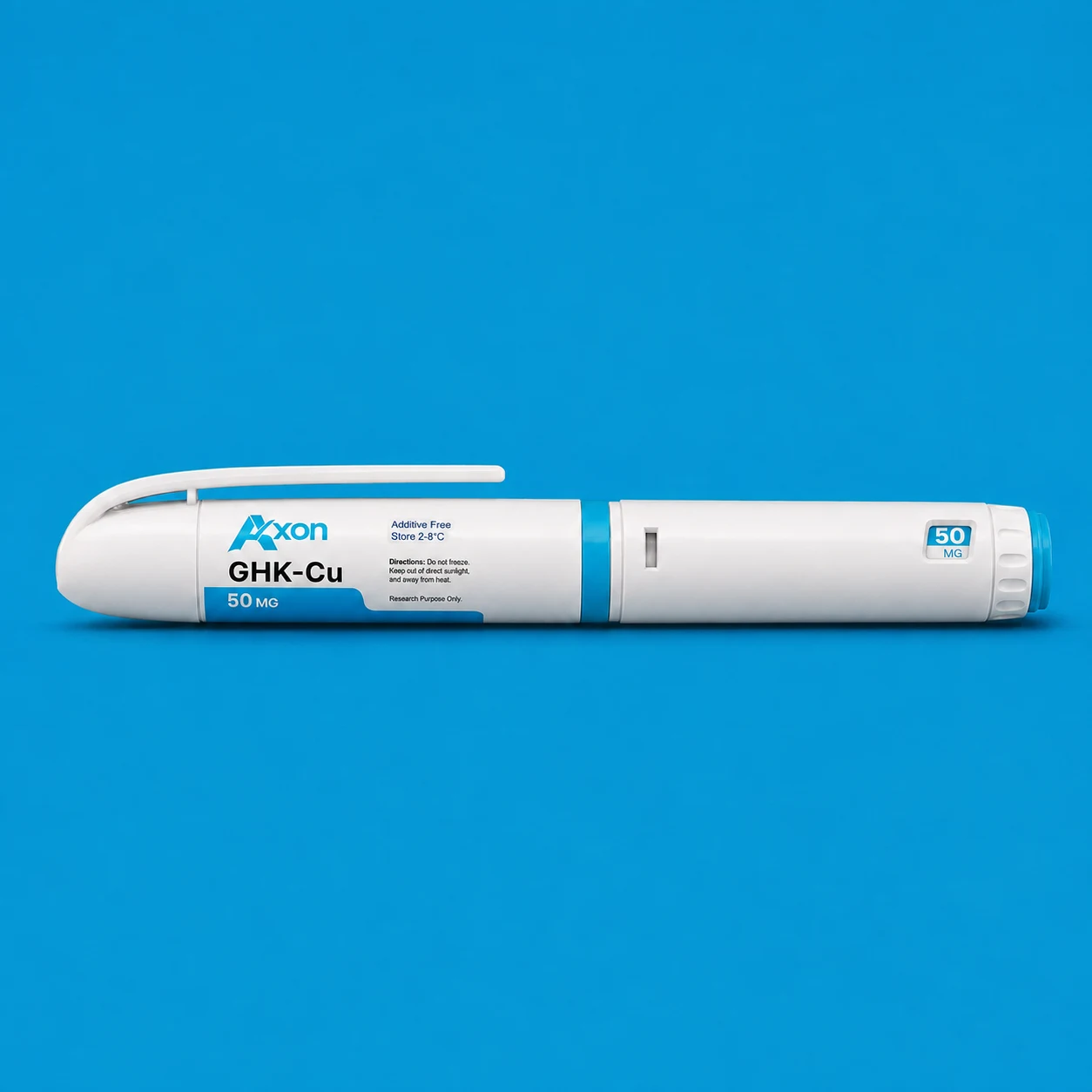
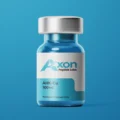
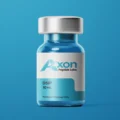
According to the product pages, the tesamorelin 10mg vial is a synthetic GHRH analogue research peptide at 10mg per vial (SKU APL-TESAMORELIN-10MG), not pre-mixed. The tesamorelin 10mg pen states the same compound and the same stated amount in a research pen format. The pen page adds that pens are made to order, ship Monday to Wednesday by 1-2 business day express delivery with an ice pack and insulated packaging, and that continuous refrigeration in transit cannot be guaranteed.
Solid vs solution: why the format matters
The main difference between the two is physical state, and physical state drives stability. Reviews of protein formulation describe liquid formulations as prone to physical and chemical instability, which is why many protein products are kept cold or freeze-dried to reach an acceptable shelf life [2]. Solid formulations are often needed to keep proteins and peptides stable through storage and transport [7].
Freeze-drying is not free of risk either. The process applies freezing and drying stresses, and even a well-made solid may still have limited long-term stability [1]. The point is not that a vial lasts forever; it is that the solid state removes water from most of the reactions that degrade a peptide in solution [8].
What happens to GRF in solution
The clearest data for this peptide family comes from human GRF itself. In aqueous solutions, GRF(1-44)-NH2 degraded at two sites: aspartic acid at position 3 (cleavage or isomerization to beta-Asp) and asparagine at position 8 (deamidation). All the degradation products had much lower in vitro potency than the parent peptide, and GRF was most stable at pH 4-5 [3]. In a related analogue held at pH 7.4 and 37 degrees, deamidation at Asn8 was the main degradation route, and one product was estimated to be 400-500 times less potent in pituitary cell assays [9].
Tesamorelin carries the full 1-44 sequence, so it has the same Asp3 and Asn8 positions. These studies were not run on tesamorelin, but they show which changes a stability-indicating method would look for, and why a solution format is the more time-sensitive one.
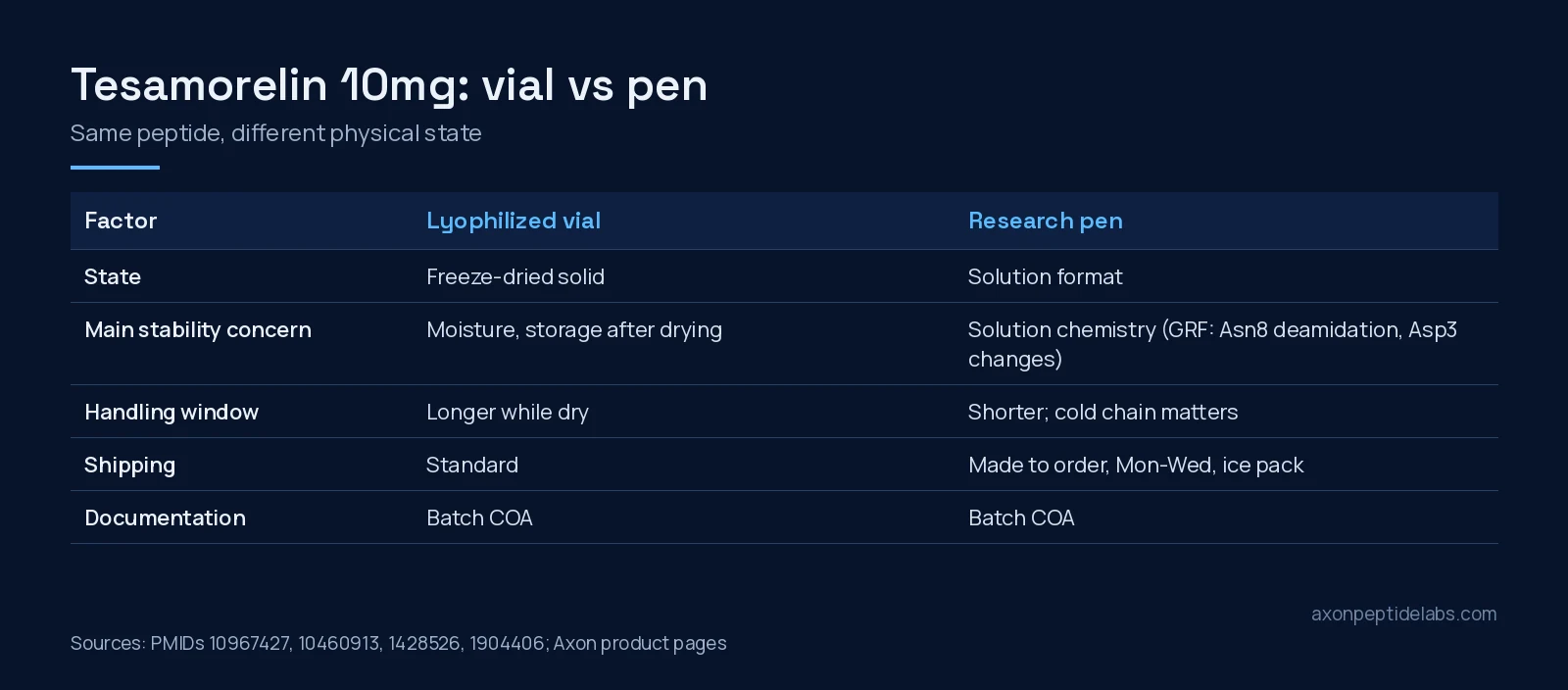
Vial vs pen at a glance
| Factor | 10mg lyophilized vial | 10mg research pen |
|---|---|---|
| Physical state | Freeze-dried solid | Solution format |
| Main stability concern | Moisture and storage after drying [1] | Solution chemistry such as deamidation and Asp3 changes in GRF [3] |
| Handling window | Longer while dry | Shorter; cold chain matters |
| Shipping (per product page) | Standard | Made to order, Mon-Wed, ice pack, refrigeration not guaranteed |
| Preparation in the lab | Reconstitution by the lab | Supplied in pen format |
| Documentation | Batch COA | Batch COA |
Which format fits which study
- The vial suits labs that want to choose their own solvent, concentration and timing, or that need to hold stock before an experiment starts. The product page notes that some peptides can turn cloudy or gel-like depending on the reconstitution solution, so the solvent choice is the lab’s call; bacteriostatic water 10ml is listed as a related supply.
- The pen suits work planned around a ready format, where the material will be used within a short window after it arrives cold.
- Comparisons across formats are cleaner when both share one batch on the COA, since a different lot is a different sample.
The same reasoning applies to other compounds Axon offers in both formats; our retatrutide pen vs vial guide covers it for a GLP-family peptide, and the peptide pens page lists every pen.
What to check on the COA
Identity and purity are separate questions. Methods used for peptide reference standards include NMR, mass spectrometry and chromatography for identity, and HPLC for content and impurities [10]. On a research COA, look for an observed mass that matches tesamorelin, an HPLC purity figure, a lot number that matches your vial or pen, a test date and the testing lab. The COA library lists tesamorelin among the product lots it covers; match the lot before work begins.
Limits of this comparison
- The degradation data are for GRF, not tesamorelin. The Asp3 and Asn8 findings come from GRF(1-44)-NH2, GRF(1-29)-NH2 and a [Leu27] analogue [3][9].
- The pen formulation is not described in the literature cited here. Buffer, pH and excipients affect solution stability [8], and those details are not on the product page.
- The plasma findings describe enzyme resistance, not shelf stability. DPP-IV resistance [4] does not protect a peptide from chemical changes in a vial.
- Research use only. Nothing here concerns human or animal use.
Sourcing for laboratory work
For tesamorelin in Canada, Axon supplies the tesamorelin 10mg research vial and the 10mg pen for in vitro and analytical work only. For background on how tesamorelin compares with related GHRH analogues, see tesamorelin vs sermorelin. To buy lab-tested peptides in Canada, check the matching batch in the COA library first. For a mechanism-level comparison with a secretagogue, see Tesamorelin vs Ipamorelin: GHRH Analogue vs Secretagogue.
Frequently asked questions
Is the tesamorelin pen the same peptide as the vial?
Yes. Both product pages state tesamorelin at a stated amount of 10 mg. The difference is format: the vial is a freeze-dried solid and the pen is a research pen supplied in solution format.
Which tesamorelin format is more stable?
In general, peptides and proteins are more stable as freeze-dried solids than in solution, which is why many are lyophilized for shelf life. GRF studies show deamidation and Asp3 changes in aqueous solution.
Why do tesamorelin pens ship with an ice pack?
The pen page says pens are made to order and shipped Monday to Wednesday by express delivery with an ice pack and insulated packaging, because a solution format is more temperature-sensitive. Continuous refrigeration in transit cannot be guaranteed.
What makes tesamorelin different from native GHRH?
Tesamorelin is hGRF(1-44)NH2 with a trans-3-hexenoyl group on Tyr1. That change made it resistant to DPP-IV deactivation and slowed its breakdown in plasma in vitro.
Where can I buy tesamorelin in Canada for research?
Axon lists a tesamorelin 10mg vial and a 10mg research pen for laboratory research only. Check the batch in the COA library before ordering.
References
- Wang W (2000). Lyophilization and development of solid protein pharmaceuticals. Int J Pharm. PMID: 10967427. doi: 10.1016/s0378-5173(00)00423-3.
- Wang W (1999). Instability, stabilization, and formulation of liquid protein pharmaceuticals. Int J Pharm. PMID: 10460913. doi: 10.1016/s0378-5173(99)00152-0.
- Bongers J, Heimer EP, Lambros T et al. (1992). Degradation of aspartic acid and asparagine residues in human growth hormone-releasing factor. Int J Pept Protein Res. PMID: 1428526. doi: 10.1111/j.1399-3011.1992.tb01596.x.
- Ferdinandi ES, Brazeau P, High K et al. (2007). Non-clinical pharmacology and safety evaluation of TH9507, a human growth hormone-releasing factor analogue. Basic Clin Pharmacol Toxicol. PMID: 17214611. doi: 10.1111/j.1742-7843.2007.00008.x.
- Frohman LA, Downs TR, Heimer EP et al. (1989). Dipeptidylpeptidase IV and trypsin-like enzymatic degradation of human growth hormone-releasing hormone in plasma. J Clin Invest. PMID: 2565342. doi: 10.1172/JCI114049.
- Mayo KE (1992). Molecular cloning and expression of a pituitary-specific receptor for growth hormone-releasing hormone. Mol Endocrinol. PMID: 1333056. doi: 10.1210/mend.6.10.1333056.
- Angkawinitwong U, Sharma G, Khaw PT et al. (2015). Solid-state protein formulations. Ther Deliv. PMID: 25565441. doi: 10.4155/tde.14.98.
- Manning MC, Chou DK, Murphy BM et al. (2010). Stability of protein pharmaceuticals: an update. Pharm Res. PMID: 20143256. doi: 10.1007/s11095-009-0045-6.
- Friedman AR, Ichhpurani AK, Brown DM et al. (1991). Degradation of growth hormone releasing factor analogs in neutral aqueous solution is related to deamidation of asparagine residues. Replacement of asparagine residues by serine stabilizes. Int J Pept Protein Res. PMID: 1904406. doi: 10.1111/j.1399-3011.1991.tb00727.x.
- McCarthy D, Han Y, Carrick K et al. (2023). Reference Standards to Support Quality of Synthetic Peptide Therapeutics. Pharm Res. PMID: 36949371. doi: 10.1007/s11095-023-03493-1.