
Mazdutide Research Overview: The GLP-1/Glucagon Dual Agonist
For laboratory research only. Not for human or animal use. This article gives no dosing, administration or therapeutic advice.
Mazdutide is a dual GLP-1 and glucagon receptor agonist: a single synthetic peptide built on the oxyntomodulin scaffold that activates two metabolic receptors at once. It moved from phase 2 trials to a phase 3 readout in JAMA faster than almost any compound in the metabolic pipeline. Labs looking for mazdutide in Canada usually ask three questions: what it is, what the trial record shows, and how to verify a vial before ordering. This overview answers those three from the peer-reviewed literature.
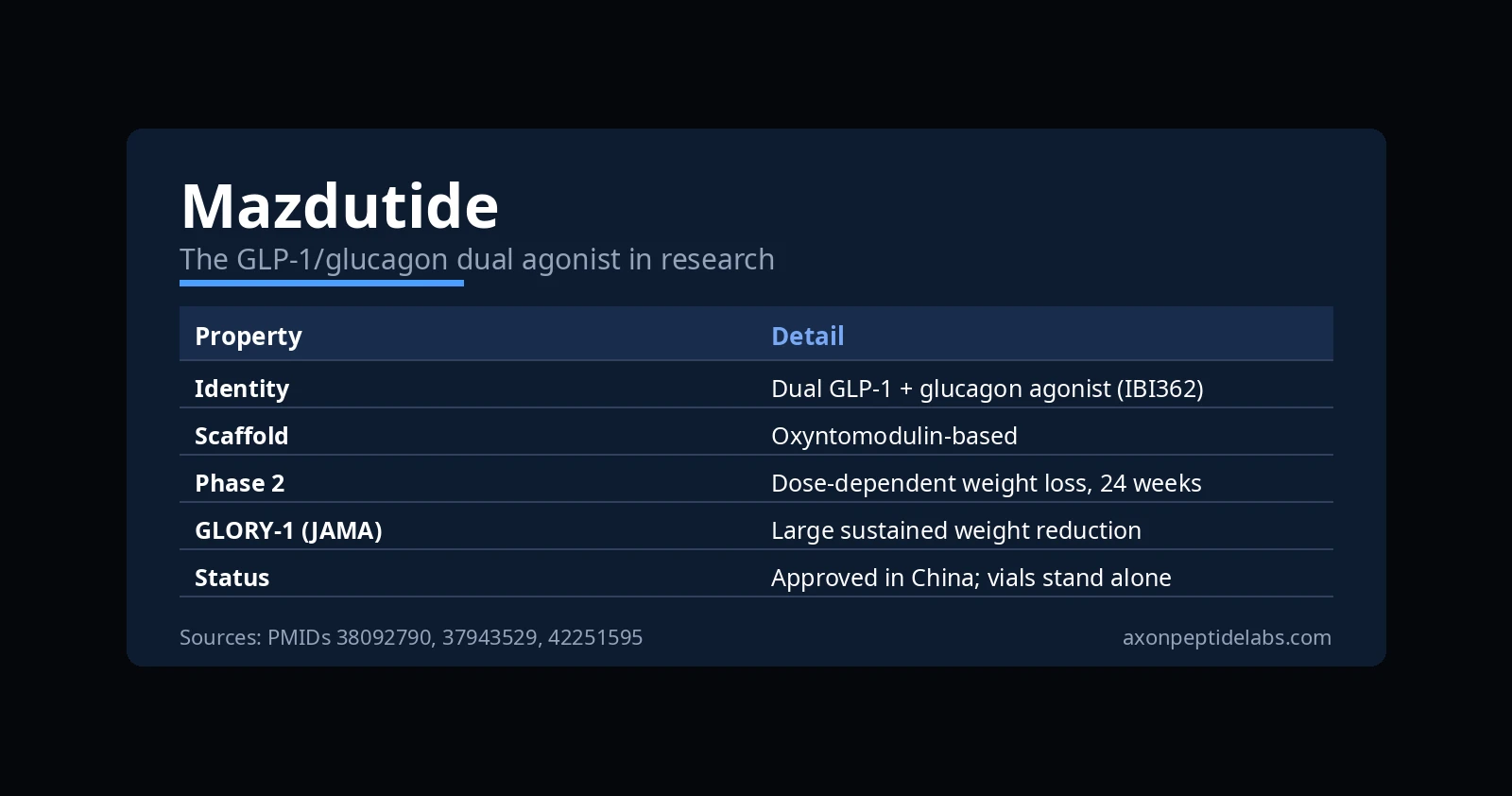
Short answer: Mazdutide (development code IBI362) is a synthetic dual agonist of the GLP-1 and glucagon receptors. In a phase 2 trial in Chinese adults with overweight or obesity it produced dose-dependent weight reductions over 24 weeks [1], and the phase 3 GLORY-1 trial in JAMA confirmed large, sustained weight reductions at higher doses [3]. It has its first regulatory approval in China for weight management, but research-market material is a different supply chain that stands on its own batch testing.
What mazdutide is
Mazdutide is built on oxyntomodulin, a gut peptide that naturally activates both the GLP-1 receptor and the glucagon receptor. The dual activity is the point. GLP-1 receptor agonism reduces appetite and slows gastric emptying; glucagon receptor agonism is associated in the literature with increased energy expenditure and hepatic fat mobilization. The design question was whether pairing those two signals in one engineered molecule could match or exceed what single-target GLP-1 agonists achieve.
The compound carries a fatty acid side chain that extends its half-life and makes once-weekly administration practical, the same structural strategy used in semaglutide and tirzepatide. That side chain is part of the molecule’s identity, and a correct mass-spec trace is the check that it is actually present on a given lot.
As a defined synthetic sequence, research mazdutide is produced by solid-phase peptide synthesis. Identity and purity are confirmed the standard way: mass spectrometry for identity, HPLC for purity, measured on the specific lot and reported on its certificate of analysis. A vial whose mass-spec main peak does not match the expected molecular weight is not the material on the label.
It also helps to place mazdutide on the map of the modern agonist pipeline. Semaglutide is a single-target GLP-1 agonist, tirzepatide adds GIP for dual incretin agonism, retatrutide adds glucagon to that pair for triple agonism, and mazdutide pairs GLP-1 directly with glucagon. Each combination changes the tolerability and efficacy trade-off, which is why the class keeps generating new trials rather than converging on one winner. For researchers, that means the comparator literature around mazdutide is nearly as important as the compound’s own trials, because its place in the pipeline is defined relative to the other agonists.
What the clinical record shows
The first controlled readout was a phase 2 randomized trial published in Nature Communications in 2023. In Chinese adults with overweight or obesity, once-weekly mazdutide produced dose-dependent weight reductions over 24 weeks that clearly separated from placebo across the dose range [1]. Adverse events were predominantly gastrointestinal, consistent with the GLP-1 class, with the transient heart-rate increases also seen with glucagon-pathway agonism.
A phase 2 trial in people with type 2 diabetes, published in Diabetes Care in 2024, extended the record: mazdutide improved glycaemic control and body weight against comparator over the treatment period [2]. That mattered because it showed the dual mechanism holds up in the harder metabolic population, not only in obesity without diabetes.
The headline result is the phase 3 GLORY-1 trial, published in JAMA in 2026. In Chinese adults with obesity, mazdutide at the higher 9 mg dose produced large, statistically significant weight reductions over 48 weeks, the deepest controlled evidence the compound has [3]. On the strength of that program, mazdutide gained its first regulatory approval, in China, for chronic weight management. For a research peptide, that is an unusually mature data set, and it means the remaining open questions are narrower than for most catalogue compounds: mainly long-term outcomes and non-Chinese populations.
| Attribute | Detail |
|---|---|
| Type | Synthetic dual agonist peptide (GLP-1 + glucagon receptors) |
| Development code | IBI362 (oxyntomodulin-based) |
| Clinical status | Phase 3 published in JAMA; approved in China for weight management |
| Headline findings | Dose-dependent weight loss in phase 2 [1]; large sustained reductions in GLORY-1 phase 3 [3] |
| Main adverse events | Gastrointestinal, dose-related; transient heart-rate increase |
| Research format | Lyophilized vial; identity by MS, purity by HPLC per lot |
What the evidence does not show
- Research vials are not the approved product. The Chinese market approval covers pharmaceutical-grade supply in that jurisdiction. A research vial is only as good as its own lot testing.
- The trial populations were predominantly Chinese. GLORY-1 and the phase 2 program enrolled Chinese adults; results in other populations are not yet characterized at the same depth.
- No three-way head-to-head exists. Mazdutide, tirzepatide and retatrutide have not all been compared in one trial; cross-trial comparisons carry the usual caveats.
- The glucagon contribution is still being quantified. How much of the effect comes from glucagon receptor agonism versus the GLP-1 component is an active research question, not settled pharmacology.
Checking a mazdutide batch record
Our Mazdutide 10mg listing is a lyophilized research vial. Before relying on any vial, match three things on the lot certificate: HPLC purity, mass-spec identity against the expected molecular weight, and the lot number on the vial against the lot number on the report. Batch reports are posted per lot in our COA library. For context against the dual GIP/GLP-1 agonist, see our comparison of Tirzepatide vs Mazdutide.
When you are ready to order, the mazdutide research vial ships from the catalogue with each batch tied to its posted record, for labs sourcing mazdutide in Canada.
Formats and handling in the lab
Research mazdutide ships as a lyophilized powder, the standard format for synthetic peptides because the dry cake degrades far more slowly than a solution. General peptide handling applies: keep the vial sealed, cold and dry until use, limit freeze-thaw cycles after reconstitution, and record the lot number in the lab notebook so every result traces back to a specific batch report.
Treat the certificate of analysis as part of the material. A useful COA names the analytical methods, shows measured values for that specific lot, and carries a date and batch identifier. A certificate without a lot number does not document the material in your hands.
Frequently asked questions
What is mazdutide?
A synthetic dual agonist of the GLP-1 and glucagon receptors, built on the oxyntomodulin scaffold and developed as IBI362. It pairs appetite-related GLP-1 signalling with the energy-expenditure effects associated with glucagon receptor activation.
How is mazdutide different from semaglutide and tirzepatide?
Semaglutide targets GLP-1 alone, tirzepatide pairs GLP-1 with GIP, and mazdutide pairs GLP-1 with the glucagon receptor. The glucagon component is the distinction: it is associated with energy expenditure and hepatic fat effects rather than the additional incretin signalling of GIP.
What did the phase 3 GLORY-1 trial find?
In Chinese adults with obesity treated for 48 weeks, mazdutide at the 9 mg dose produced large, statistically significant weight reductions versus placebo, with predominantly gastrointestinal adverse events [3].
Is mazdutide approved anywhere?
Yes, in China for chronic weight management, on the strength of the GLORY program. It is not approved in Canada, the US or Europe. Research-market vials are a separate supply chain from any approved product.
How should a lab verify a mazdutide vial?
Check the lot’s HPLC purity and mass-spec identity on its certificate of analysis and confirm the lot number matches the vial. Reports for our batches are posted per lot in the COA library.
What format does research mazdutide come in?
As a lyophilized powder in a sealed vial, the standard format for synthetic research peptides because it keeps best during storage and transport.
Why does the glucagon receptor matter?
Glucagon receptor activation is associated in the literature with increased energy expenditure and hepatic fat mobilization. Combined with GLP-1 signalling, it is the proposed source of mazdutide’s weight effects [1].
What purity should a mazdutide COA show?
Research-grade synthetic peptides are typically supplied at 98% purity or higher by HPLC, with mass spectrometry confirming the expected molecular weight. The values should be measured on your lot, not copied from a generic specification.
References
- Ji L. et al. (2023), Nature Communications — A phase 2 randomised controlled trial of mazdutide in Chinese overweight adults or adults with obesity. PMID 38092790
- (2024), Diabetes Care — Efficacy and safety of mazdutide in Chinese patients with type 2 diabetes: a randomized controlled trial. PMID 37943529
- (2026), JAMA — Treatment with 9-mg mazdutide for weight reduction in Chinese adults with obesity: the GLORY-1 randomized clinical trial. PMID 42251595