
Thymosin Alpha-1 vs Thymopentin: Two Thymic Peptides
For laboratory research only. Not for human or animal use. This article gives no dosing, administration or therapeutic advice.
Short answer: Thymosin alpha-1 and thymopentin are both thymic peptides, but they come from different parent molecules and are very different in size. Thymosin alpha-1 is a 28-residue, highly acidic peptide first sequenced from calf thymosin fraction 5 [1], carries an N-terminal acetyl group [2], and corresponds to the first 28 residues of prothymosin alpha [3]. Thymopentin (TP-5) is the pentapeptide Arg-Lys-Asp-Val-Tyr, residues 32 to 36 of the thymic hormone thymopoietin [5]. In laboratory work, thymosin alpha-1 has been linked to Toll-like receptor signalling in dendritic cells [9][10], while thymopentin was studied through cyclic GMP responses in T cells and was degraded in human plasma within about 30 seconds [5][13]. Axon supplies thymosin alpha-1; we do not sell thymopentin.
Where each peptide comes from
Thymosin alpha-1: from thymosin fraction 5
Thymosin fraction 5 is a calf thymus preparation. In 1977 Goldstein’s group isolated and sequenced one of its polypeptides, named thymosin alpha-1: a heat-stable, highly acidic molecule of 28 amino acid residues, proposed as one of several fraction 5 peptides that may take part in the regulation, differentiation and function of T cells [1]. Fraction 5 is a mixture; a 2018 high-resolution mass spectrometry study of a 37-year-old lyophilized sample found more than 100 monoisotopic masses, including thymosin beta-4 and truncated forms of prothymosin alpha [4].
Thymosin alpha-1 matches the first 28 residues of prothymosin alpha, a protein involved in chromatin remodelling. For years it was thought to be an extraction artefact, but a 2003 study showed that the lysosomal protease legumain cleaves prothymosin alpha at Asn28-Gly29 to release thymosin alpha-1, and that thymosin alpha-1 is naturally present in diverse mammalian tissues [3]. The peptide is N-alpha-acetylated, which is one reason it was long made only by chemical synthesis; a recombinant route needed a co-expressed acetyltransferase to reproduce that modification [2].
Thymopentin: the active site of thymopoietin
Thymopoietin is a thymic polypeptide hormone of 49 amino acids (bovine), secreted by thymic epithelial cells. Thymopentin is the synthetic pentapeptide Arg-Lys-Asp-Val-Tyr, corresponding to residues 32 to 36, and was described as carrying the biological activities of the native hormone [5]. When human thymopoietin was sequenced it proved to be 48 residues, and the pentapeptide active site was the same in human and bovine thymopoietin [6].
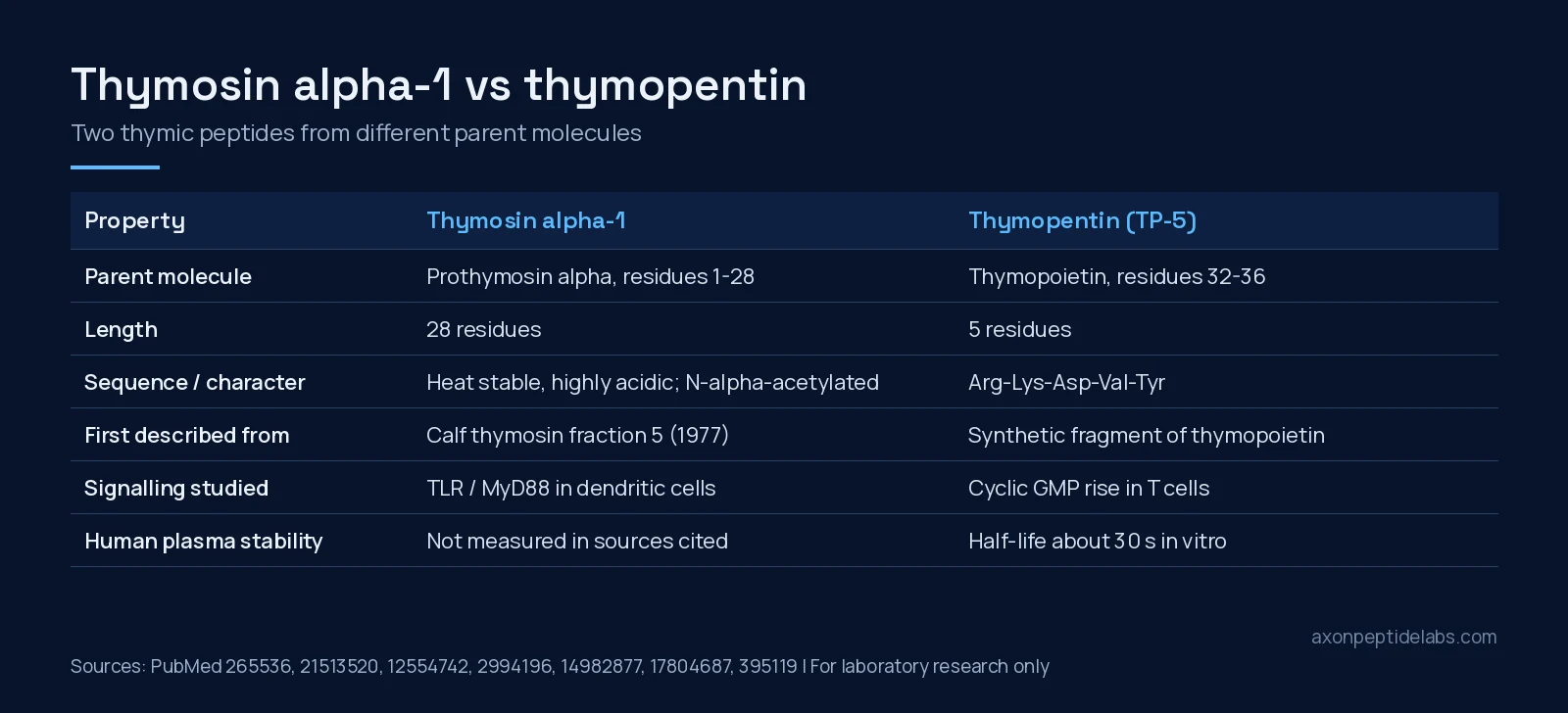
Structure at a glance
| Property | Thymosin alpha-1 | Thymopentin (TP-5) |
|---|---|---|
| Parent molecule | Prothymosin alpha, residues 1 to 28 [3] | Thymopoietin, residues 32 to 36 [5] |
| Length | 28 residues [1] | 5 residues [5] |
| Sequence or character | Heat stable, highly acidic [1] | Arg-Lys-Asp-Val-Tyr [5] |
| Terminal modification | N-alpha-acetylated [2] | Described as the free pentapeptide; no modification reported in the sources here |
| First described from | Calf thymosin fraction 5 [1] | Synthetic fragment of a purified hormone [5] |
| Signalling studied | TLR / MyD88 pathways in dendritic cells [9][10] | Cyclic GMP rise in T cells; cyclic AMP in precursors [5] |
| Stability in human plasma | Not reported in the sources cited here | Half-life about 30 s in vitro [13][14] |
Mechanisms studied
Thymosin alpha-1 and Toll-like receptors
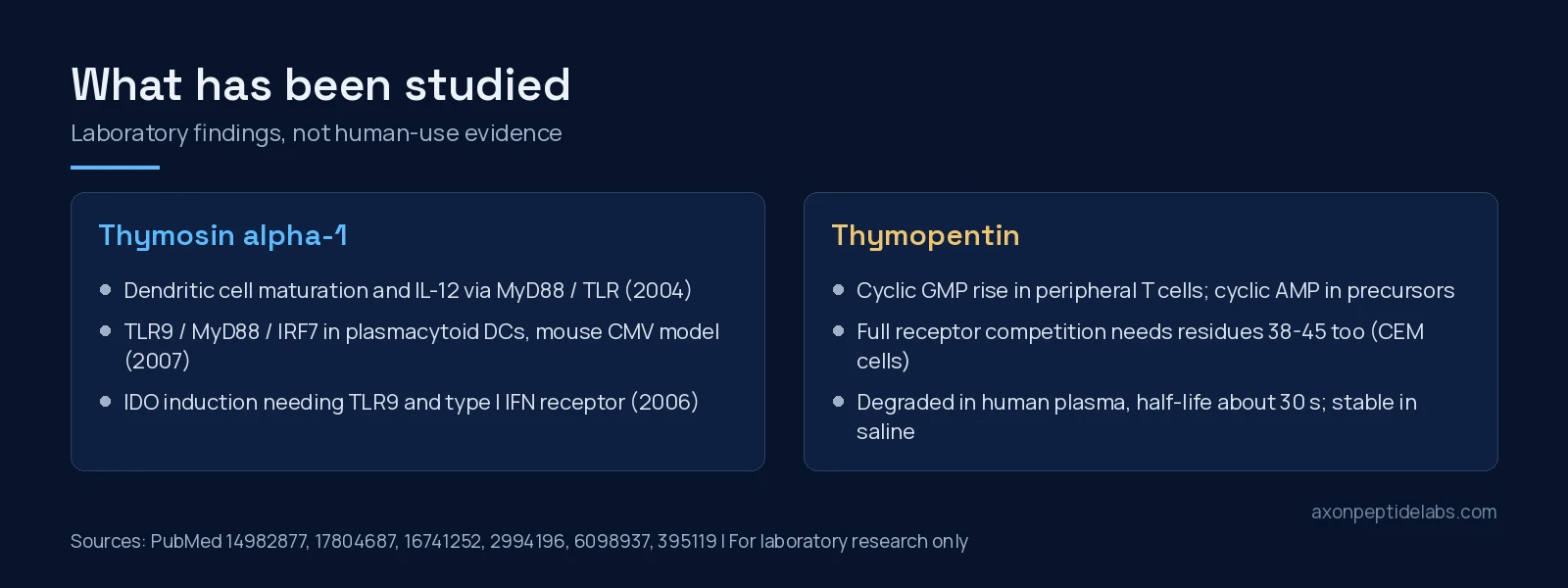
In a 2004 study, thymosin alpha-1 induced functional maturation and interleukin-12 production in fungus-pulsed dendritic cells through a p38 MAPK and NF-kappaB dependent pathway, signalling through MyD88 and distinct Toll-like receptors; in mice that had received hematopoietic transplants, the synthetic peptide protected against aspergillosis [9]. A 2007 mouse study of cytomegalovirus infection found that the effect ran through plasmacytoid dendritic cells via TLR9 and MyD88, leading to activation of interferon regulatory factor 7 [10]. Thymosin alpha-1 also induced indoleamine 2,3-dioxygenase in dendritic cells, which required TLR9 and type I interferon receptor signalling and was linked to interleukin-10 production and regulatory T cells [11]. A 2016 review summarises this as action through Toll-like receptors in both myeloid and plasmacytoid dendritic cells [12].
Thymopentin and T-cell signalling
Thymopentin’s immunoregulatory actions on peripheral T cells were reported to work through intracellular cyclic GMP, while in precursor T cells the hormone raised cyclic AMP and triggered differentiation. In animal models of immune imbalance, thymopoietin and thymopentin were described as “immunonormalizing” [5]. Receptor work on the human T-cell line CEM showed that thymopentin alone induces cyclic GMP, but full competition with thymopoietin for binding required a second fragment, residues 38 to 45, so the hormone appears to bind through two regions [7]. Among 29 single-substitution analogues, activity needed L- or D-arginine at position 1 and L- or D-aspartate at position 3, while positions 2, 4 and 5 tolerated changes [8].
Stability: the short peptide is short-lived
Tritiated thymopentin was degraded in human plasma with an apparent half-life of about 30 seconds, but not in saline, with breakdown products Lys-Asp-Val-Tyr, Asp-Val-Tyr, Val-Tyr and tyrosine [13]. A follow-up attributed the loss to plasma proteolytic enzymes [14]. For in vitro planning, that means a thymopentin result in a serum-containing system may reflect how quickly the peptide was cleaved as much as its activity. The original thymosin alpha-1 paper describes the peptide as heat stable [1], but none of the sources here measured its plasma half-life.
What the evidence does not show
- They are not interchangeable. Different parent molecules, different lengths and different signalling read-outs [3][5].
- Mechanism data are mostly from mice and cell lines. The TLR findings come from murine infection models and dendritic cells [9][10]; the cyclic GMP data from T-cell lines such as CEM [7].
- No head-to-head study is cited. The comparison here is assembled from separate papers.
- Fraction 5 is not thymosin alpha-1. The crude extract contains many polypeptides [4].
Sourcing for laboratory work
Axon carries thymosin alpha-1 10mg for in vitro research; we do not sell thymopentin. Our thymosin alpha-1 Canada page collects related reading, and you can also compare LL-37 vs thymosin alpha-1 and thymosin alpha-1 vs TB-500. To buy lab-tested peptides in Canada, check the relevant batch in our COA library first.
Frequently asked questions
What is the difference between thymosin alpha-1 and thymopentin?
Thymosin alpha-1 is a 28-residue, N-acetylated peptide matching the start of prothymosin alpha, first sequenced from thymosin fraction 5. Thymopentin is the five-residue fragment Arg-Lys-Asp-Val-Tyr from thymopoietin, residues 32 to 36.
How does thymosin alpha-1 act in laboratory studies?
In dendritic cell and mouse studies it signalled through MyD88 and Toll-like receptors, including TLR9 in plasmacytoid dendritic cells, and induced IDO activity in dendritic cells.
How does thymopentin act in laboratory studies?
It raised cyclic GMP in peripheral T cells and the CEM T-cell line, and activity required arginine at position 1 and aspartate at position 3.
Is thymopentin stable in plasma?
No. In human plasma in vitro it was degraded with an apparent half-life of about 30 seconds, an effect attributed to plasma proteases. It was stable in saline.
Can I buy thymosin alpha 1 in Canada from Axon?
Yes. Axon lists thymosin alpha-1 10mg for laboratory research only. Axon does not sell thymopentin. Check the lot against the COA library before use.
References
- Goldstein AL, Low TL, McAdoo M et al. (1977). Thymosin alpha1: isolation and sequence analysis of an immunologically active thymic polypeptide. Proc Natl Acad Sci U S A. PMID: 265536. doi: 10.1073/pnas.74.2.725.
- Ren Y, Yao X, Dai H et al. (2011). Production of Nα-acetylated thymosin α1 in Escherichia coli. Microb Cell Fact. PMID: 21513520. doi: 10.1186/1475-2859-10-26.
- Sarandeses CS, Covelo G, Díaz-Jullien C et al. (2003). Prothymosin alpha is processed to thymosin alpha 1 and thymosin alpha 11 by a lysosomal asparaginyl endopeptidase. J Biol Chem. PMID: 12554742. doi: 10.1074/jbc.M213005200.
- Hannappel E, Iavarone F, Castagnola M (2018). Thymosin fraction 5 re-evaluated after 35 years by high-resolution mass spectrometry. Expert Opin Biol Ther. PMID: 30063862. doi: 10.1080/14712598.2018.1474196.
- Goldstein G, Audhya TK (1985). Thymopoietin to thymopentin: experimental studies. Surv Immunol Res. PMID: 2994196. doi: 10.1007/BF02919050.
- Audhya T, Schlesinger DH, Goldstein G (1987). Isolation and complete amino acid sequence of human thymopoietin and splenin. Proc Natl Acad Sci U S A. PMID: 3473468. doi: 10.1073/pnas.84.11.3545.
- Audhya T, Heavner GA, Kroon DJ et al. (1984). Cooperativity of thymopoietin 32-36 (the active site) and thymopoietin 38-45 in receptor binding. Regul Pept. PMID: 6098937. doi: 10.1016/0167-0115(84)90068-5.
- Heavner GA, Audhya T, Kroon D et al. (1985). Structural requirements for the biological activity of thymopentin analogs. Arch Biochem Biophys. PMID: 2996431. doi: 10.1016/0003-9861(85)90499-0.
- Romani L, Bistoni F, Gaziano R et al. (2004). Thymosin alpha 1 activates dendritic cells for antifungal Th1 resistance through toll-like receptor signaling. Blood. PMID: 14982877. doi: 10.1182/blood-2003-11-4036.
- Bozza S, Gaziano R, Bonifazi P et al. (2007). Thymosin alpha1 activates the TLR9/MyD88/IRF7-dependent murine cytomegalovirus sensing for induction of anti-viral responses in vivo. Int Immunol. PMID: 17804687. doi: 10.1093/intimm/dxm097.
- Romani L, Bistoni F, Perruccio K et al. (2006). Thymosin alpha1 activates dendritic cell tryptophan catabolism and establishes a regulatory environment for balance of inflammation and tolerance. Blood. PMID: 16741252. doi: 10.1182/blood-2006-02-004762.
- King R, Tuthill C (2016). Immune Modulation with Thymosin Alpha 1 Treatment. Vitam Horm. PMID: 27450734. doi: 10.1016/bs.vh.2016.04.003.
- Tischio JP, Patrick JE, Weintraub HS et al. (1979). Short in vitro half-life of thymopoietin32–36 pentapeptide in human plasma. Int J Pept Protein Res. PMID: 395119. doi: 10.1111/j.1399-3011.1979.tb01959.x.
- Audhya TK, Goldstein G (1985). Thymopentin: stability considerations and potency by various routes of administration. Surv Immunol Res. PMID: 3898289. doi: 10.1007/BF02919052.