
hCG Research Overview: Structure and the LH Receptor
For laboratory research only. Not for human or animal use. This article gives no dosing, administration or therapeutic advice.
Short answer: Human chorionic gonadotropin (hCG) is a disulfide-rich glycoprotein heterodimer. It shares a common alpha chain with LH, FSH and TSH and carries its own beta chain [1], and a beta-subunit “seat belt” wrapped around the alpha subunit holds the pair together [2]. Its beta subunit ends in a carboxyl-terminal peptide (CTP) bearing four O-linked sugar chains, tied to in vivo half-life rather than receptor binding [3]. hCG acts on the LH/CG receptor (LHCGR), a G protein-coupled receptor with a large extracellular domain, and in engineered cells it raises cyclic AMP [4]. Cryo-electron microscopy has now shown the receptor bound to hCG and the stimulatory G protein [5].
A heterodimer built on two cystine knots
hCG belongs to the glycoprotein hormone family, whose members are heterodimers sharing a common alpha chain and distinct beta chains specific to their own G protein-linked receptors [1]. The biological specificity of hCG is set mainly by its beta subunit, while the alpha subunit is shared across the gonadotropin family [6].
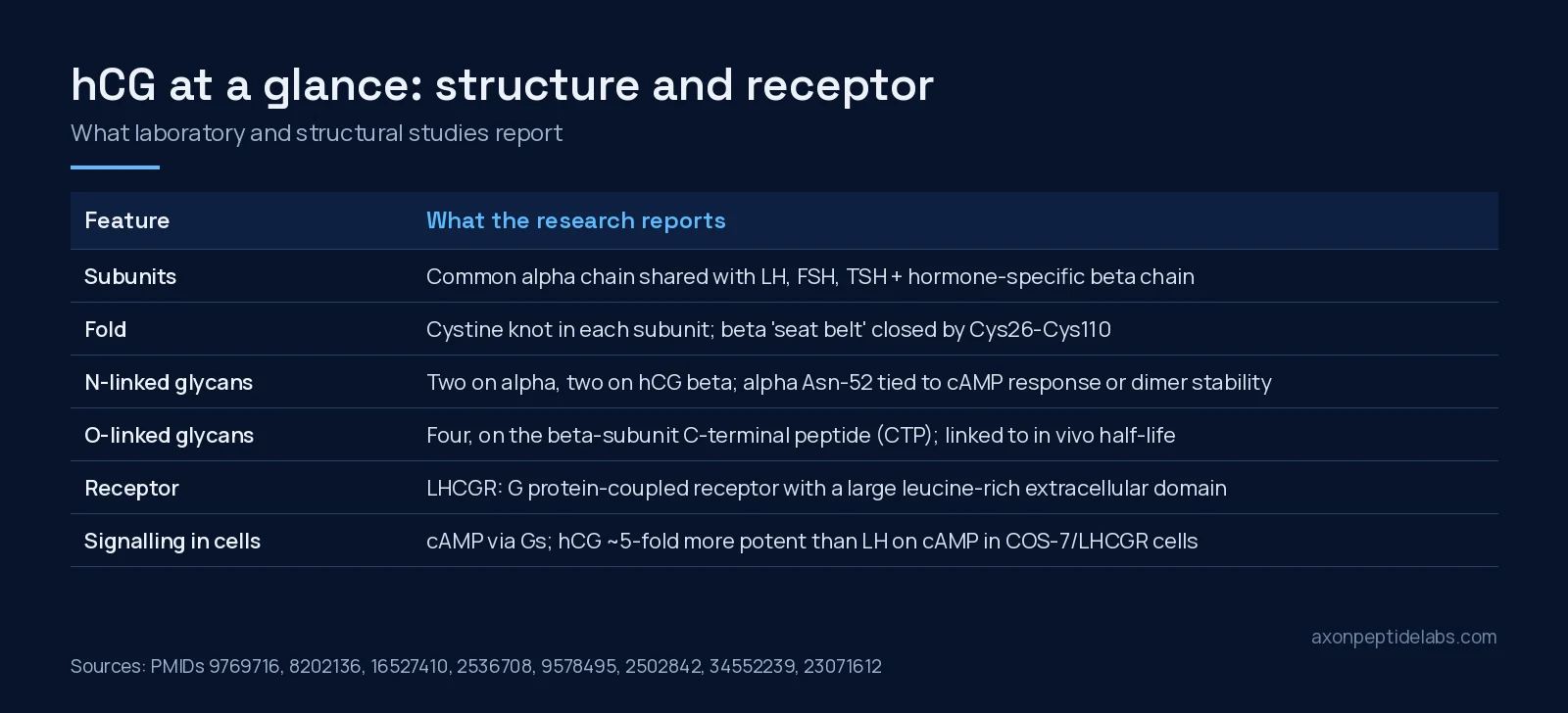
The 1994 crystal structure showed that both subunits have a similar topology, each with three disulphide bonds forming a cystine knot, a fold also seen in some protein growth factors. The dimer is stabilised by a segment of the beta subunit that wraps around the alpha subunit and is closed by the Cys26-Cys110 disulphide, which the authors described as essential for subunit association and for receptor binding [2]. A structure of partially deglycosylated hCG at 2.6 Å resolution found that the two subunits keep strikingly similar folds despite only about 10% sequence identity, with cystine knots at the cores of extended hairpin loops [1].
Sugar chains: N-linked and O-linked
The glycoprotein hormone subunits carry one or two asparagine-linked (N-linked) oligosaccharides; the alpha subunit and hCG beta carry two each [3]. hCG beta is the odd one out among beta subunits because of its CTP, which has four O-linked oligosaccharide chains [3]. A mutagenesis study placed the four serine acceptors of this region within the last 25 amino acids of the beta subunit and noted that the carboxyl-terminal region helps maintain the hormone’s biological half-life [7].
The CTP has also been used as a tool. When the CTP sequence was fused to the FSH beta subunit, receptor binding and steroidogenic activity in vitro were the same as wild-type FSH, while in vivo potency and circulating half-life went up [8]. A review of this work concluded that O-linked chains matter little for in vitro activity or receptor binding but matter for in vivo bioactivity and half-life [3].
The N-linked chains behave differently. In transfected Chinese hamster ovary cell experiments, removing any or all hCG N-linked oligosaccharides had only a minor effect on receptor affinity, but losing the sugar at Asn-52 of the alpha subunit reduced both cAMP and steroid responses, and some deglycosylated derivatives bound the receptor yet acted as competitive antagonists [9]. Deglycosylated gonadotropins lose much of their hormonal bioactivity without losing receptor binding [10]. A later study offered a different reading: hCG mutants lacking the alpha-52 sugar but held together by engineered intersubunit disulfide bonds showed wild-type binding and bioactivity, which pointed to that sugar stabilising the heterodimer rather than driving signal transduction [11]. Glycosylation also shows up as a quality variable: in one recombinant hCG, a beta-subunit variant lacking the Asn-13 glycan reduced biological activity in an in vivo assay [6].
| Feature | What the research reports |
|---|---|
| Subunits | Common alpha chain plus hormone-specific beta chain [1] |
| Fold | Cystine knot in each subunit; beta “seat belt” closed by Cys26-Cys110 [2] |
| N-linked glycans | Two on alpha, two on hCG beta [3]; alpha Asn-52 linked to cAMP response [9] or dimer stability [11] |
| O-linked glycans | Four, on the beta-subunit CTP [3][7] |
| Receptor | LHCGR, a G protein-coupled receptor shared with LH [4][5] |
| Main read-out in cells | Cyclic AMP; LH more potent on ERK1/2 and AKT [12] |
The LH/CG receptor
The rat luteal LH/CG receptor was cloned in 1989. Its cDNA predicted a 26-residue signal peptide, a 341-residue extracellular domain with the internal repeats of the leucine-rich glycoprotein family, and a 333-residue region with seven transmembrane segments similar to other G protein-coupled receptors. Cells engineered to express it bound hCG with high affinity and increased cyclic AMP when exposed to the hormone [4]. A 2002 review describes the receptor as essential for ovulation in females and for normal Leydig cell development in males [13].
In 2021, four cryo-electron microscopy structures of LHCGR were reported, including active-state structures bound to chorionic gonadotropin and the stimulatory G protein Gs. They show a “push-and-pull” activation mechanism: the bound hormone pushes the extracellular domain, while an extended hinge loop pulls it. A conserved 10-residue fragment called P10, at the junction of the extracellular and transmembrane domains, acts as a tethered agonist that drives G-protein coupling [5].
cAMP signalling in lab models: hCG is not just “long LH”
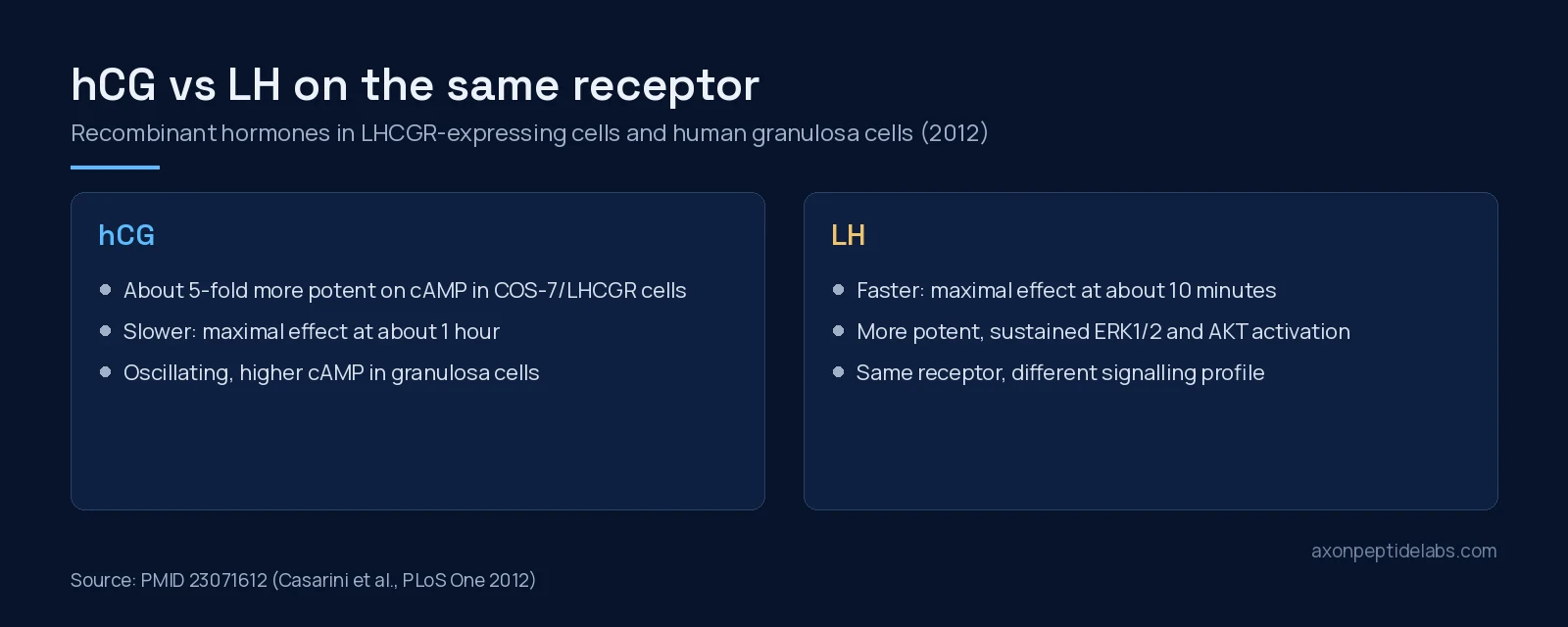
LH and hCG share the receptor, but a 2012 study showed they do not produce identical signals. In COS-7 cells stably expressing LHCGR, recombinant hCG was about 5-fold more potent than LH on cAMP production (half-maximal concentrations of 107.1 and 530.0 pM), while LH reached its peak faster, in about 10 minutes against about 1 hour for hCG. In primary human granulosa-lutein cells, cAMP was oscillating and higher with hCG, while phospho-ERK1/2 and AKT activation was stronger and more sustained with LH. The authors concluded that the receptor can tell the two ligands apart [12].
The name hCG also covers more than one molecule. One review separates hCG made by syncytiotrophoblast cells, hyperglycosylated hCG, free beta subunit and pituitary hCG, each from different cells [14]. Those forms matter when reading older papers that do not say which one was measured.
What the evidence does not show
- Binding is not activity. Several deglycosylated forms bound LHCGR yet signalled poorly or acted as antagonists [9][10].
- Studies disagree on the Asn-52 sugar. One line of work ties it to signalling [9], another to dimer stability [11].
- Cell models differ. Potency and timing results come from transfected COS-7 and hGL5 cells and primary granulosa cells [12]; numbers from one system may not carry over to another.
- Structures are snapshots. The cryo-EM models show defined inactive and active states, not every intermediate [5].
Sourcing for laboratory work
Axon lists HCG 5000iu in its hormone peptides for research range; related products on its page include HMG 75iu and kisspeptin-10. For related reading, compare hCG vs hMG and kisspeptin-10 vs hCG, and see how we work on our lab standards page. To buy lab-tested peptides in Canada, match the batch to the record in our COA library first.
Frequently asked questions
What is hCG made of?
hCG is a glycoprotein heterodimer: an alpha subunit shared with LH, FSH and TSH, and a hormone-specific beta subunit. Each subunit has a cystine-knot fold, and a beta-subunit segment wraps around the alpha subunit like a seat belt.
What makes the hCG beta subunit different from LH beta?
The hCG beta subunit carries a carboxyl-terminal peptide (CTP) with four O-linked oligosaccharide sites clustered in its last 25 residues. Studies link this region to the long in vivo half-life of hCG rather than to receptor binding.
Which receptor does hCG bind?
hCG binds the LH/CG receptor (LHCGR), a G protein-coupled receptor with a large leucine-rich extracellular domain that it shares with LH. Cells expressing the cloned receptor bound hCG with high affinity and raised cyclic AMP.
Do hCG and LH signal the same way in lab models?
Not exactly. In COS-7 cells expressing LHCGR, recombinant hCG was about 5-fold more potent than LH on cAMP, while LH acted faster and was more potent on ERK1/2 and AKT activation in human granulosa cells.
Can I buy hCG in Canada from Axon?
Yes. Axon lists HCG 5000iu in its hormone peptides category for laboratory research only, not for human or animal use. Match the COA to the exact product and batch before relying on it.
References
- Lustbader JW, Lobel L, Wu H et al. (1998). Structural and molecular studies of human chorionic gonadotropin and its receptor. Recent Prog Horm Res. PMID: 9769716.
- Lapthorn AJ, Harris DC, Littlejohn A et al. (1994). Crystal structure of human chorionic gonadotropin. Nature. PMID: 8202136. doi: 10.1038/369455a0.
- Fares F (2006). The role of O-linked and N-linked oligosaccharides on the structure-function of glycoprotein hormones: development of agonists and antagonists. Biochim Biophys Acta. PMID: 16527410. doi: 10.1016/j.bbagen.2005.12.022.
- McFarland KC, Sprengel R, Phillips HS et al. (1989). Lutropin-choriogonadotropin receptor: an unusual member of the G protein-coupled receptor family. Science. PMID: 2502842. doi: 10.1126/science.2502842.
- Duan J, Xu P, Cheng X et al. (2021). Structures of full-length glycoprotein hormone receptor signalling complexes. Nature. PMID: 34552239. doi: 10.1038/s41586-021-03924-2.
- Deng Q, He L, Xu F et al. (2023). Characterization of beta subunit variants of recombinant human chorionic gonadotrophin. Anal Biochem. PMID: 36858250. doi: 10.1016/j.ab.2023.115089.
- Sugahara T, Pixley MR, Fares F et al. (1996). Characterization of the O-glycosylation sites in the chorionic gonadotropin beta subunit in vivo using site-directed mutagenesis and gene transfer. J Biol Chem. PMID: 8702834. doi: 10.1074/jbc.271.34.20797.
- Fares FA, Suganuma N, Nishimori K et al. (1992). Design of a long-acting follitropin agonist by fusing the C-terminal sequence of the chorionic gonadotropin beta subunit to the follitropin beta subunit. Proc Natl Acad Sci U S A. PMID: 1374895. doi: 10.1073/pnas.89.10.4304.
- Matzuk MM, Keene JL, Boime I (1989). Site specificity of the chorionic gonadotropin N-linked oligosaccharides in signal transduction. J Biol Chem. PMID: 2536708.
- Thotakura NR, Weintraub BD, Bahl OP (1990). The role of carbohydrate in human choriogonadotropin (hCG) action. Effects of N-linked carbohydrate chains from hCG and other glycoproteins on hormonal activity. Mol Cell Endocrinol. PMID: 1694506. doi: 10.1016/0303-7207(90)90217-v.
- Heikoop JC, van den Boogaart P, de Leeuw R et al. (1998). Partially deglycosylated human choriogonadotropin, stabilized by intersubunit disulfide bonds, shows full bioactivity. Eur J Biochem. PMID: 9578495. doi: 10.1046/j.1432-1327.1998.2530354.x.
- Casarini L, Lispi M, Longobardi S et al. (2012). LH and hCG action on the same receptor results in quantitatively and qualitatively different intracellular signalling. PLoS One. PMID: 23071612. doi: 10.1371/journal.pone.0046682.
- Ascoli M, Fanelli F, Segaloff DL (2002). The lutropin/choriogonadotropin receptor, a 2002 perspective. Endocr Rev. PMID: 11943741. doi: 10.1210/edrv.23.2.0462.
- Cole LA (2010). Biological functions of hCG and hCG-related molecules. Reprod Biol Endocrinol. PMID: 20735820. doi: 10.1186/1477-7827-8-102.