
GLP-3 (Retatrutide) Pen vs Vial for Research
For laboratory research only. Not for human or animal use. This article gives no dosing, administration or therapeutic advice.
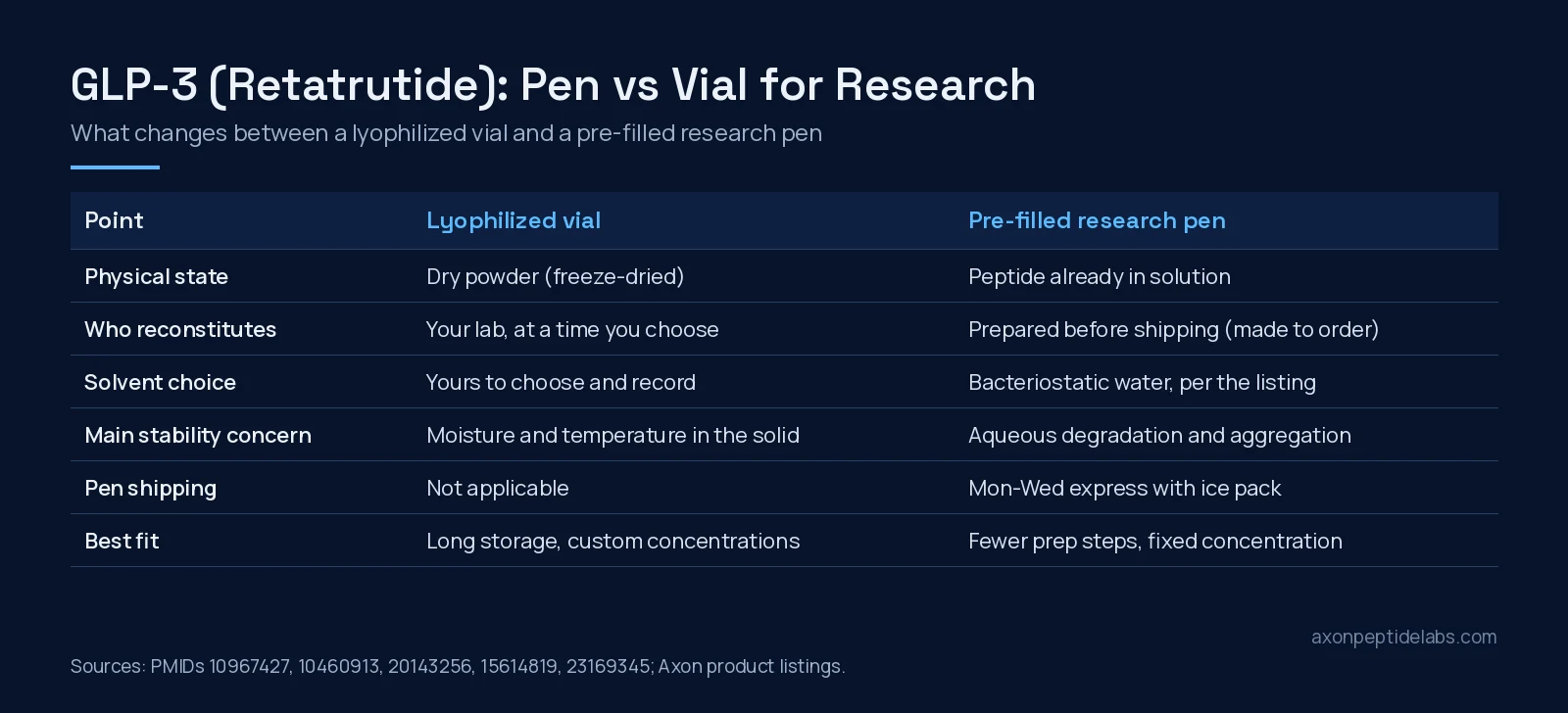
Short answer: the compound is the same; the physical state is not. A GLP-3 (retatrutide) vial holds a freeze-dried solid that your lab reconstitutes when the study starts. A research pen arrives with the peptide already in solution, so the reconstitution step happened before it reached you. Solid forms are what formulation scientists reach for when they need shelf life [1], while peptides in water are exposed to more chemical and physical degradation routes [2][3]. Antimicrobial preservatives such as benzyl alcohol, used in bacteriostatic water, have been shown to promote aggregation of a model protein during reconstitution [4]. So the choice is mostly about where in your workflow the clock starts, and who controls that step.
What GLP-3 (retatrutide) is, briefly
Retatrutide, coded LY3437943 in the literature, is a single peptide with agonist activity at three receptors: the glucagon receptor (GCGR), the GIP receptor (GIPR) and the GLP-1 receptor (GLP-1R). In vitro it showed balanced GCGR and GLP-1R activity and more GIPR activity; in obese mice, the GCGR component added increased energy expenditure on top of the intake effects attributed to GIPR and GLP-1R [5]. It has since been evaluated in a 48-week, placebo-controlled phase 2 trial published in the New England Journal of Medicine [6]. None of that clinical work involved research pens or research vials, and nothing in this article is guidance for people. For mechanism comparisons, see retatrutide vs mazdutide and semaglutide vs tirzepatide vs retatrutide.
The vial: a freeze-dried solid you reconstitute
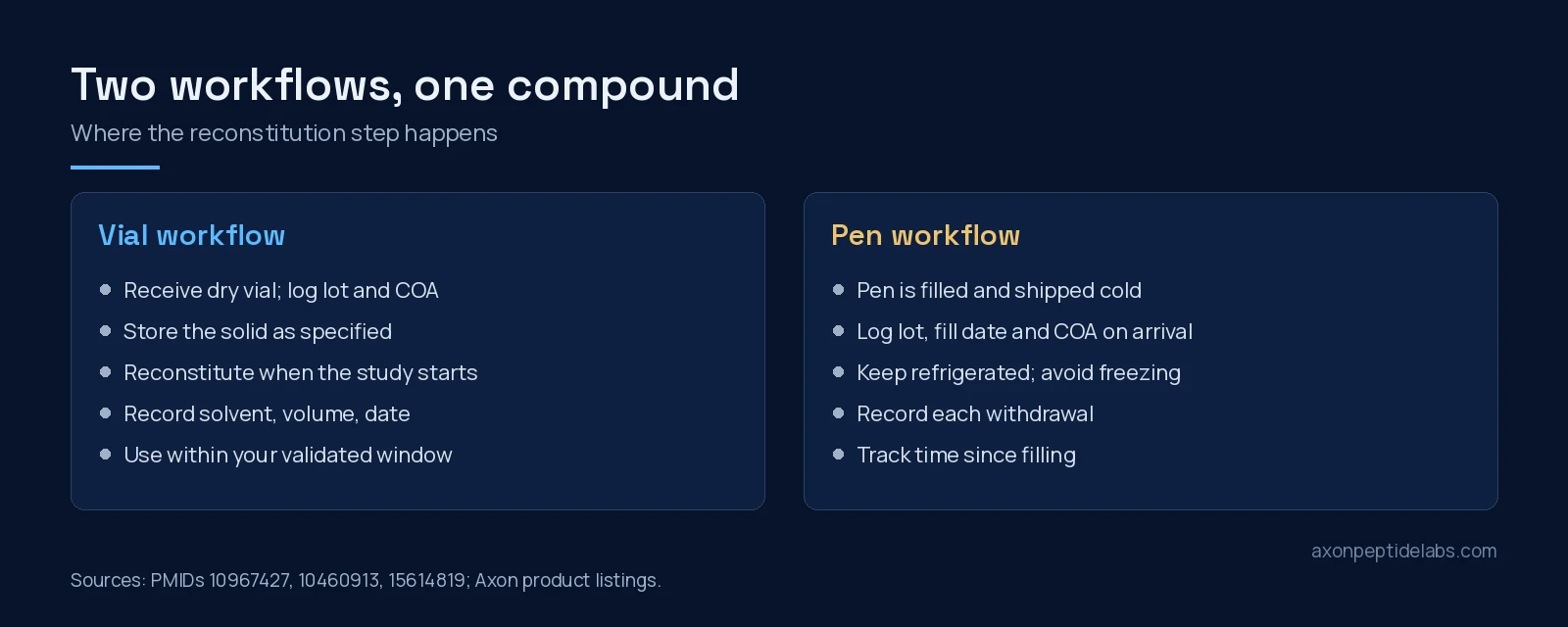
Most research peptides, including our GLP-3 (retatrutide) vial in 10mg and 20mg options, ship as a lyophilized powder. Freeze-drying is the most common way to make a solid protein product, and proteins are often put into solid form specifically to reach an acceptable shelf life [1]. The same review is clear that drying is not free: freezing and drying stresses can denature proteins to various degrees, and even a well-made lyophilized solid can still have limited long-term stability [1].
For a lab, the practical advantage of the vial is control. You decide the solvent, the volume and therefore the concentration, and the date the solution is made. That date goes in your notebook, and every later observation can be tied back to it. The trade-off is an extra handling step, and the results depend on that step being done the same way every time.
The pen: the peptide is already in solution
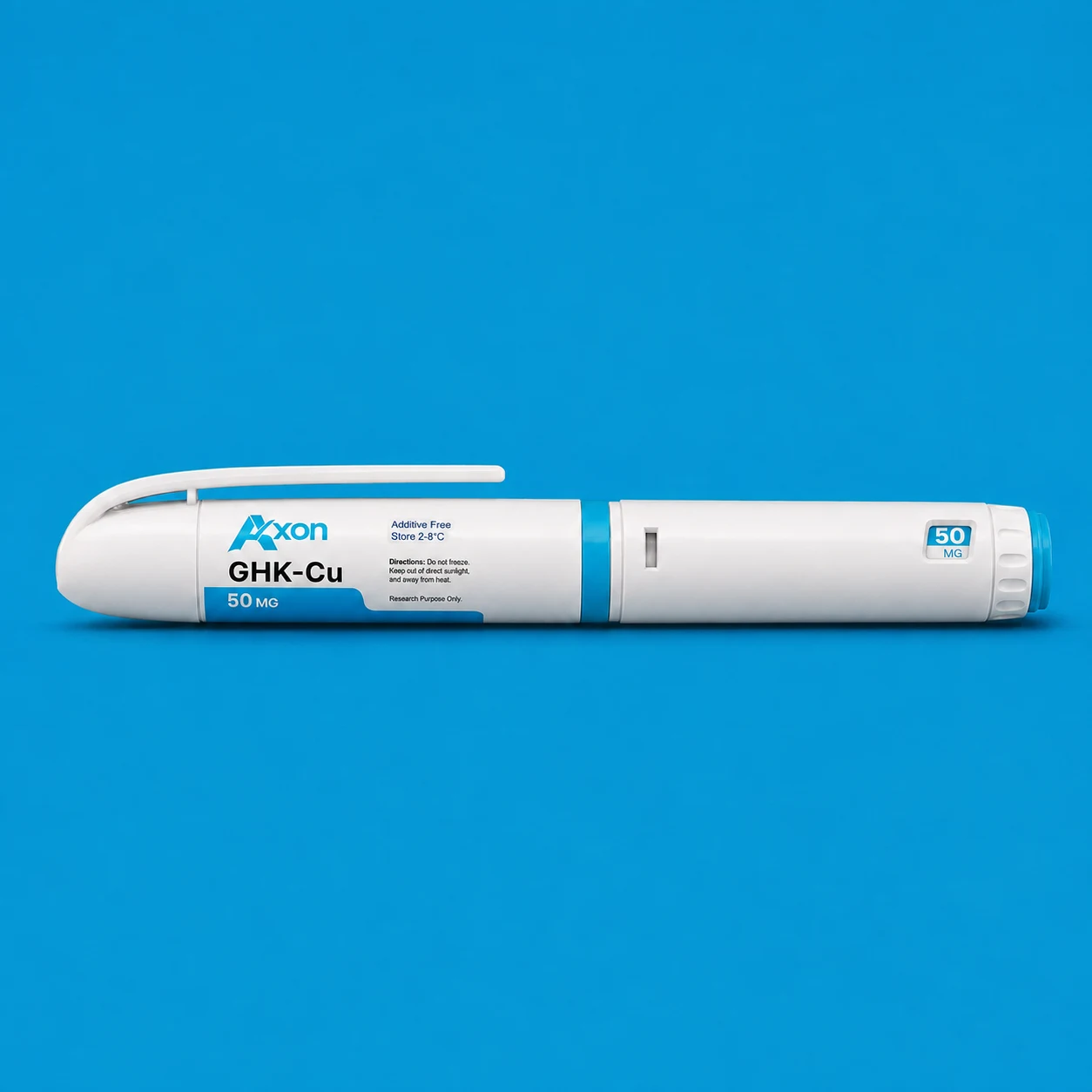
Our GLP-3 research pen is listed as a pre-filled research pen with 10 mg and 20 mg strength options, prepared with 1 mL of bacteriostatic water per 10 mg. Pens are made to order, ship Monday to Wednesday by express delivery with an ice pack and insulated packaging, and the listing notes that continuous refrigeration in transit cannot be guaranteed. All pen formats on the site are collected on the peptide pens page.
The appeal is fewer preparation steps and a fixed, stated concentration from the start. The cost is that the peptide has been in water since it was filled. Reviews of liquid protein formulations describe why proteins are usually stored cold or freeze-dried to reach an acceptable shelf life, and catalogue the chemical and physical instabilities that operate in solution [2][3].
Why the preservative matters
Bacteriostatic water contains benzyl alcohol, which is there to limit microbial growth in a multi-use container. In a study on recombinant interleukin-1 receptor antagonist, reconstituting the lyophilized solid with 0.9% benzyl alcohol caused more aggregation than reconstituting with plain water, and formulations that better preserved the protein’s structure in the dried state aggregated less [4]. A separate comparison of five common antimicrobial preservatives on a model protein found that all of them induced aggregation, ranked m-cresol, phenol, benzyl alcohol, phenoxyethanol, then chlorobutanol [7].
Those studies used model proteins, not retatrutide, so they do not tell you how fast GLP-3 changes in a pen. What they do show is that the solvent is part of the experiment. With a vial, you can choose and document it. With a pen, it was chosen for you, and the listing tells you what it is.
Side by side
| Point | GLP-3 vial | GLP-3 research pen |
|---|---|---|
| Physical state | Lyophilized solid | Solution in a cartridge |
| Reconstitution | Done by your lab | Done before shipping |
| Solvent | Your choice, recorded by you | Bacteriostatic water, per the listing |
| Concentration | Set by the volume you add | Fixed and stated on the listing |
| Main stability risk | Moisture and heat in the solid [1] | Degradation and aggregation in water [2][4] |
| Timing | Clock starts when you reconstitute | Clock starts when the pen is filled |
| Shipping | Dry vial | Made to order, Mon-Wed express, ice pack |
| Strengths at Axon | 10mg and 20mg | 10 mg and 20 mg |
A third route: fill your own pen
Some labs want the vial’s control and a pen’s handling. The peptide pen kit contains a disposable pen, an empty 3 mL cartridge, 10 mL of bacteriostatic water and pen needles, with no peptide included. Its listing makes one point worth repeating: the pen dial shows volume dispensed, not an amount of peptide, so the peptide per unit depends entirely on the concentration of the solution you prepared. If you take this route, the concentration calculation and the fill date belong in your records.
Documentation to check for either format
- Lot number and COA. Match the lot on the vial or pen to a certificate in our COA library. Our guide to reading a peptide COA covers HPLC purity and mass spec identity.
- What the COA describes. A purity result is one measurement of the material tested. For a pen, ask whether the certificate covers the peptide lot before filling, and record the fill date separately.
- Arrival condition. Note whether a pen arrived cold. The listing states that refrigeration in transit cannot be guaranteed.
- Your own dates. Reconstitution date for a vial, fill date for a pen, and every withdrawal after that.
Which format fits which study
Choose the vial when you need to hold material for a while before starting, want to set your own concentration or solvent, or need the reconstitution step under your own procedures. Choose the pen when a fixed, stated concentration and fewer preparation steps matter more, and you can start work soon after it arrives. For a broader view of our retatrutide listings, the retatrutide Canada page lists vials, pens and batch documentation together.
Limits of this comparison
- No retatrutide-specific stability data here. The stability and preservative findings cited come from proteins such as interleukin-1 receptor antagonist and cytochrome c [4][7], not from GLP-3.
- Formulation reviews describe trends. Solid-state and liquid-state reviews explain mechanisms [1][2][3]; they do not give a shelf life for any one peptide.
- Clinical trials are a different context. The phase 2 trial [6] studied a pharmaceutical product in people and says nothing about research formats.
Sourcing for laboratory work
Compare the GLP-3 vial and the retatrutide pen in Canada against your protocol, and add bacteriostatic water only if your method calls for it. To buy lab-tested peptides in Canada, check the relevant batch in our COA library first.
Frequently asked questions
Frequently asked questions
What is the difference between a retatrutide pen and a vial?
A vial holds freeze-dried GLP-3 (retatrutide) that your lab reconstitutes. A research pen arrives with the peptide already in solution, prepared with bacteriostatic water before shipping, so the reconstitution step and its timing are fixed for you.
Is a lyophilized vial more stable than a pen?
Formulation reviews describe solid, freeze-dried forms as the usual route to longer shelf life, and solutions as exposed to more degradation pathways. No retatrutide-specific comparison is cited here, so treat this as a general principle rather than a measured shelf life.
Why does bacteriostatic water matter for stability?
It contains benzyl alcohol. In model-protein studies, benzyl alcohol and other antimicrobial preservatives promoted aggregation, including during reconstitution of a lyophilized protein.
Can I fill my own research pen?
The Axon peptide pen kit includes an empty 3 mL cartridge, a disposable pen, bacteriostatic water and needles, with no peptide. The pen dial measures volume, so peptide per unit depends on the concentration you prepare.
Where can I buy a retatrutide pen in Canada?
Axon lists a GLP-3 research pen in 10 mg and 20 mg options and GLP-3 vials in 10mg and 20mg, for laboratory research only. Check the lot against the COA library before ordering.
References
- Wang W (2000). Lyophilization and development of solid protein pharmaceuticals. Int J Pharm. PMID: 10967427. doi: 10.1016/s0378-5173(00)00423-3.
- Wang W (1999). Instability, stabilization, and formulation of liquid protein pharmaceuticals. Int J Pharm. PMID: 10460913. doi: 10.1016/s0378-5173(99)00152-0.
- Manning MC, Chou DK, Murphy BM et al. (2010). Stability of protein pharmaceuticals: an update. Pharm Res. PMID: 20143256. doi: 10.1007/s11095-009-0045-6.
- Roy S, Jung R, Kerwin BA et al. (2005). Effects of benzyl alcohol on aggregation of recombinant human interleukin-1-receptor antagonist in reconstituted lyophilized formulations. J Pharm Sci. PMID: 15614819. doi: 10.1002/jps.20258.
- Coskun T, Urva S, Roell WC et al. (2022). LY3437943, a novel triple glucagon, GIP, and GLP-1 receptor agonist for glycemic control and weight loss: From discovery to clinical proof of concept. Cell Metab. PMID: 35985340. doi: 10.1016/j.cmet.2022.07.013.
- Jastreboff AM, Kaplan LM, Frías JP et al. (2023). Triple-Hormone-Receptor Agonist Retatrutide for Obesity – A Phase 2 Trial. N Engl J Med. PMID: 37366315. doi: 10.1056/NEJMoa2301972.
- Hutchings RL, Singh SM, Cabello-Villegas J et al. (2013). Effect of antimicrobial preservatives on partial protein unfolding and aggregation. J Pharm Sci. PMID: 23169345. doi: 10.1002/jps.23362.