
Tesamorelin vs Sermorelin: Two GHRH Analogues Compared
For laboratory research only. Not for human or animal use. This article gives no dosing, administration or therapeutic advice.
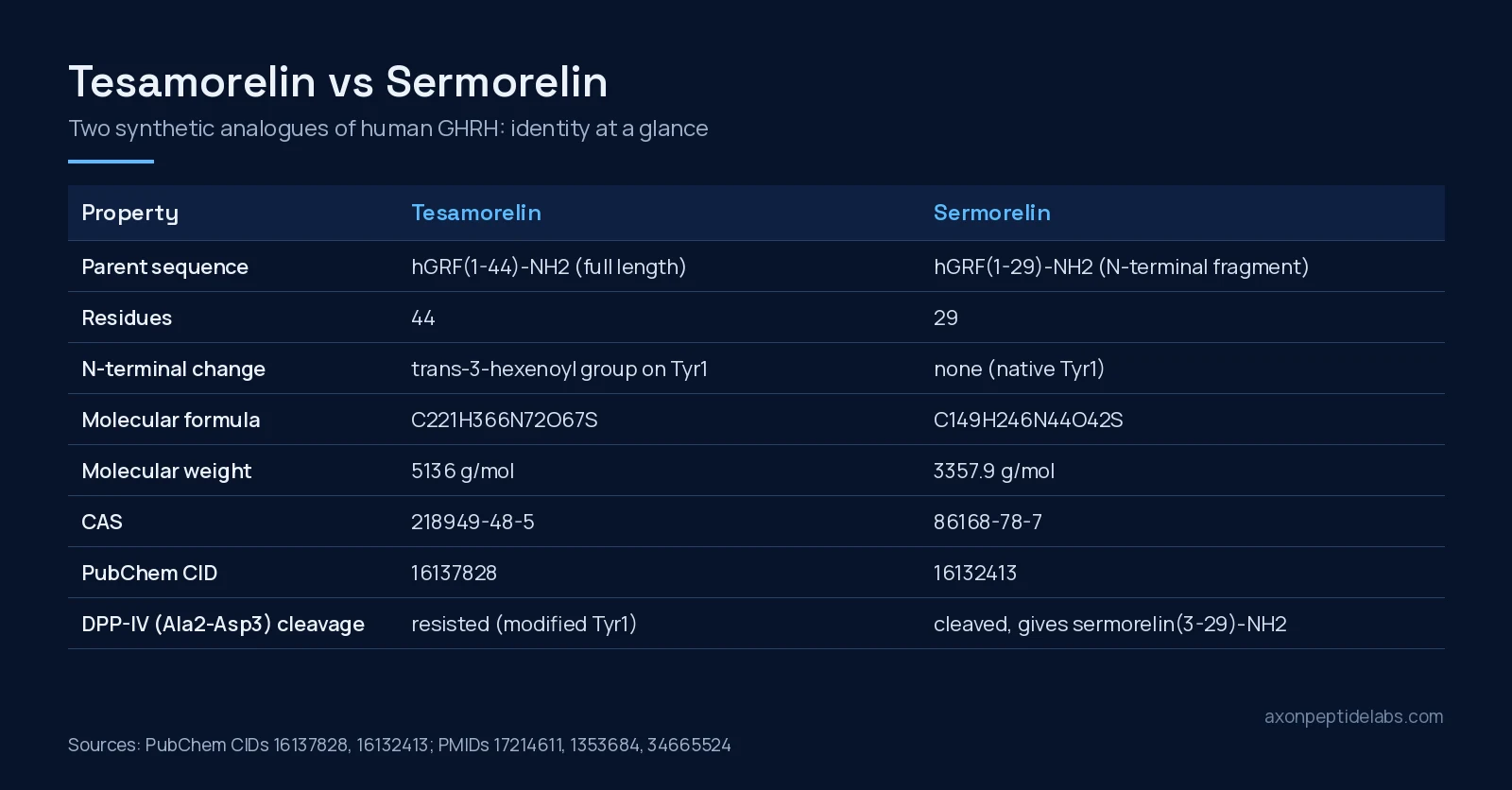
Short answer: tesamorelin and sermorelin are both synthetic copies of human growth hormone-releasing hormone (GHRH), but they are not the same molecule. Sermorelin is the 29-amino-acid N-terminal fragment of GHRH, GHRH(1-29)-NH2[4][2]. Tesamorelin is the full 44-residue hormone with a trans-3-hexenoyl group fixed to its first tyrosine, a change made to block enzymatic cleavage[5][1]. That one modification and the extra 15 residues explain most of the practical differences researchers see: molecular weight, stability against dipeptidyl peptidase IV (DPP-IV) and how each one shows up on a mass spectrum[6][10].
Where both peptides come from
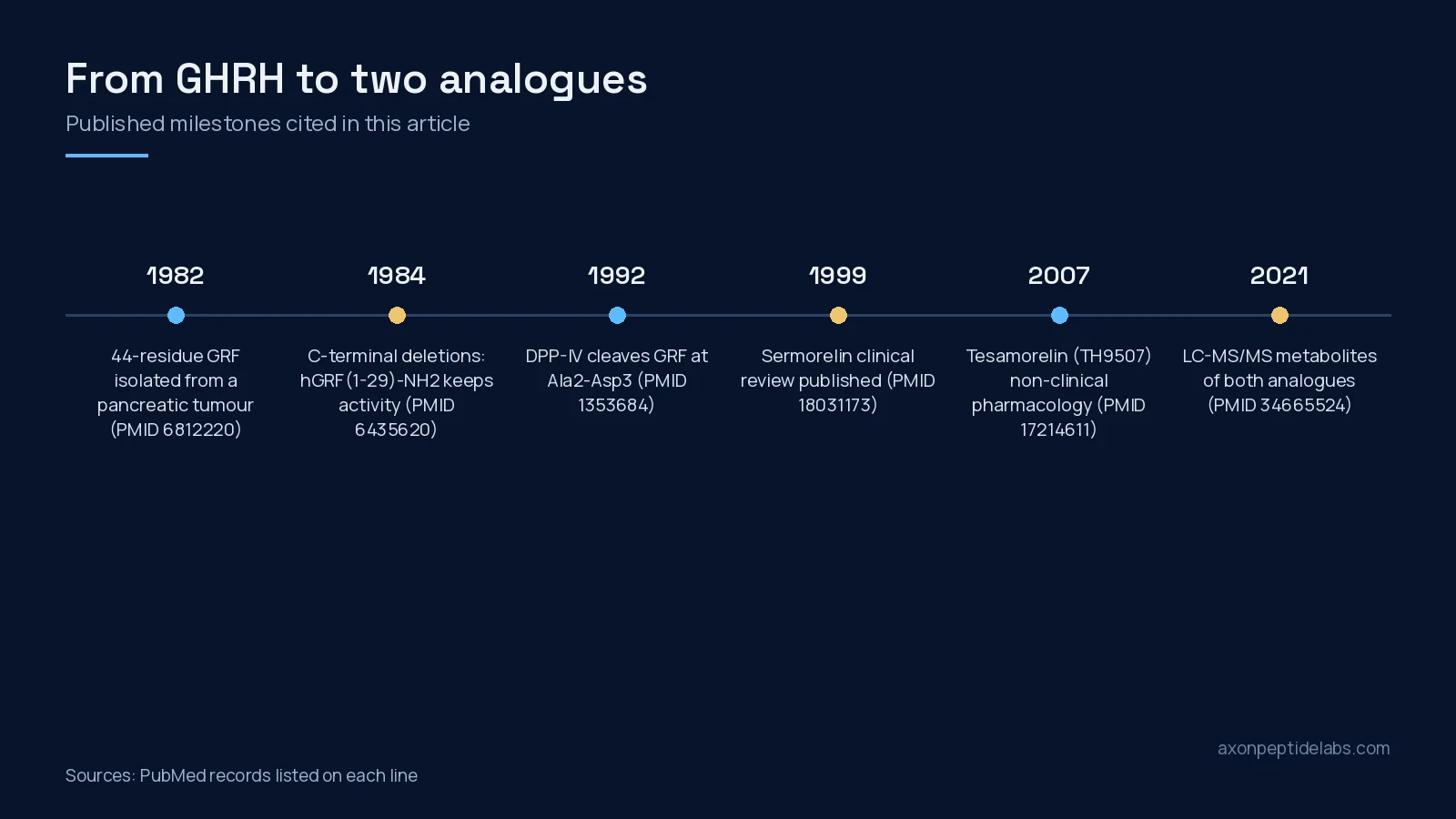
The GHRH story starts with a tumour. In 1982 a group isolated a 44-amino-acid peptide with growth hormone-releasing activity from a human pancreatic tumour that had caused acromegaly. A synthetic copy of that sequence had full biological activity in vitro and in vivo[1]. That 44-residue amide, GRF(1-44)-NH2, is the template for tesamorelin.
Two years later, chemists trimmed residues off the C-terminal end and tested each shortened version on rat anterior pituitary cells in culture. Potency fell as the first few residues came off, then levelled out: the 1-31, 1-30 and 1-29 amides all kept about half the potency of the full hormone. Activity only disappeared completely when the chain was cut down to residues 1-19[2]. The 1-29 amide became sermorelin, described in a later review as the shortest synthetic peptide with the full biological activity of GHRH[4].
Later structure-activity work used that same 1-29 fragment as its scaffold. An alanine scan found that swapping residues such as 1, 3, 5, 6, 10, 11, 13, 14 and 23 almost abolished potency in vitro, while other positions tolerated substitution[3]. In other words, the N-terminal region carries much of the receptor-relevant information, which is why both analogues keep it unchanged apart from tesamorelin’s cap on Tyr1.
Identity table
Values below come from PubChem records, not from certificates of analysis.
| Field | Tesamorelin | Sermorelin |
|---|---|---|
| PubChem CID | 16137828 | 16132413 |
| CAS | 218949-48-5 | 86168-78-7 |
| Synonyms | TH9507, TH-9507 | hGHRH(1-29)NH2, GRF(1-29)-NH2 |
| Molecular formula | C221H366N72O67S | C149H246N44O42S |
| Molecular weight | 5136 g/mol | 3357.9 g/mol |
| Length | 44 residues, C-terminal amide | 29 residues, C-terminal amide |
| N-terminus | trans-3-hexenoyl-Tyr1 | free Tyr1 |
| Sequence (one-letter) | (hexenoyl)-YADAIFTNSYRKVLGQLSARKLLQDIMSRQQGESNQERGARARL-NH2 | YADAIFTNSYRKVLGQLSARKLLQDIMSR-NH2 |
The sequences line up exactly for the first 29 residues. Tesamorelin simply continues with the remaining 15 residues of the native hormone (QQGESNQERGARARL), as published for the tumour-derived peptide[1], and adds the hexenoyl cap at the start[5].
The DPP-IV question: why tesamorelin carries a cap
Native GHRH has a weak point at its N-terminus. Purified human DPP-IV cuts the Ala2-Asp3 bond, and in a 1992 kinetic study it did so at about the same initial rate for GRF(1-44)-NH2, GRF(1-29)-NH2 and GRF(1-20)-NH2. Analogues with a modified first residue, such as desNH2Tyr1 or N-MeTyr1, were not cleaved at all[6]. Losing the first two residues matters because, as the alanine scan showed, positions 1 and 3 are among those whose replacement nearly eliminates activity in vitro[3].
Tesamorelin applies that principle. Its developers attached a trans-3-hexenoyl group to Tyr1 of hGRF(1-44)-NH2 and reported that the analogue was resistant to DPP-IV deactivation. Compared with the unmodified hormone, it degraded more slowly in rat, dog and human plasma in vitro, and immunoreactive peptide stayed in circulation longer in animal studies[5]. Sermorelin carries no such protection; its DPP-IV product, sermorelin(3-29)-NH2, is common enough that anti-doping laboratories use it as a reference metabolite[10][11].
Side-by-side comparison
| Aspect | Tesamorelin | Sermorelin | Sources |
|---|---|---|---|
| Relation to native GHRH | Full-length 1-44 amide plus N-terminal cap | N-terminal 1-29 amide fragment | [5][4] |
| In vitro activity of the backbone | Full-length hormone is the reference | About half the potency of the full hormone in rat pituitary cell culture | [2] |
| DPP-IV cleavage at Ala2-Asp3 | Resisted (modified Tyr1) | Cleaved at a rate similar to native GHRH | [6][5] |
| Main research literature | Non-clinical pharmacology; phase 3 trials in HIV-associated abdominal fat accumulation | Structure-activity work; paediatric diagnostic and growth studies reviewed in 1999 | [5][8][4] |
| Known in vitro metabolites | Characterised as reference materials for LC-MS/MS | Includes sermorelin(3-29)-NH2 | [10][11] |
What the human research looked at
The two compounds were studied clinically in very different settings, which is one reason direct comparisons are hard.
Sermorelin. A 1999 review summarised its use as a provocative test of pituitary growth hormone secretion and in prepubertal children with idiopathic growth hormone deficiency. The same review noted an important limit: a normal response to sermorelin cannot rule out deficiency caused by a hypothalamic problem, so other tests were still needed[4].
Tesamorelin. Under the code TH9507, tesamorelin went through a 412-participant randomized trial and a pooled analysis of two multicentre phase 3 trials (806 randomized participants) in people with HIV and excess abdominal fat[7][8]. The primary endpoint was the change in visceral adipose tissue measured by computed tomography. A 2011 review summarised that trial programme and its tolerability data[9].
The trials also recorded findings that did not move. The 2007 trial found no significant differences in glycemic measures between groups, and more participants in the tesamorelin arm withdrew because of an adverse event[7]. The pooled analysis found no significant change in abdominal subcutaneous fat versus placebo[8], and the 2011 review reported that the visceral fat change reversed when the compound was stopped[9].
How a lab confirms which one is in the vial
Because the two share their first 29 residues, the cleanest way to tell them apart is by mass. Their PubChem molecular weights differ by roughly 1,780 g/mol, so the parent ions sit far apart. Anti-doping chemists have taken this further: one group generated 19 major in vitro metabolites of sermorelin, tesamorelin, CJC-1295 and CJC-1295 with DAC, synthesised them as reference standards and built an LC-MS/MS method with detection limits of about 1 ng/mL or lower[10]. A second laboratory validated a triple-quadrupole UHPLC-MS/MS method covering tesamorelin, sermorelin, sermorelin(3-29)-NH2, CJC-1295 and somatorelin, with a detection limit of 0.2 ng/mL[11].
For anyone sourcing either peptide, the practical point is that identity and purity are separate questions. HPLC purity shows how much of the sample is one main peak. Mass confirmation shows that the main peak has the expected mass, which is how a lab separates a 44-residue capped analogue from a 29-residue fragment, or spots a truncated product such as a 3-29 species.
What the evidence does not show
- No published randomized study compares tesamorelin with sermorelin head to head, so claims that one is “stronger” or “better” have no direct trial behind them.
- The potency figures for the 1-29 fragment come from rat pituitary cells in culture[2]; they are not a measure of activity in any living system.
- DPP-IV resistance for tesamorelin was shown in plasma in vitro and in animal pharmacology[5]; it does not by itself predict what happens in a particular experimental model.
- The sermorelin clinical literature is older and mostly paediatric[4], while the tesamorelin trials studied one specific population[8]. Neither set of results transfers to the other compound or to other settings.
Documentation on our side
Our COA library lists Tesamorelin 10mg under batch MP-TESA-10-041626, 99.68% purity, tested 28 April 2026 by testides.com. No certificate is posted for Sermorelin 10mg on our COA page at the time of writing. For the background on each compound, see our Tesamorelin Canada and Sermorelin Canada pages, and our lab standards page for how we read reports. When you are ready to buy lab-tested peptides in Canada, check the batch number on the label against the report before any work begins.
Frequently asked questions
What is the main structural difference between tesamorelin and sermorelin?
Sermorelin is the 29-residue N-terminal fragment of human GHRH with a C-terminal amide, GHRH(1-29)-NH2. Tesamorelin is the full 44-residue GHRH(1-44)-NH2 with a trans-3-hexenoyl group attached to the first tyrosine. The first 29 residues of both sequences are identical.
Why does the trans-3-hexenoyl group on tesamorelin matter in research?
Native GHRH and its 1-29 fragment are cut by dipeptidyl peptidase IV between Ala2 and Asp3. In non-clinical studies, the N-terminal hexenoyl group made tesamorelin (TH9507) resistant to that cleavage and slowed its breakdown in rat, dog and human plasma in vitro.
Can a mass spectrometer tell tesamorelin and sermorelin apart?
Yes. Their molecular weights differ by roughly 1,780 g/mol (about 5136 versus 3357.9 in PubChem), and published LC-MS/MS methods detect each parent peptide separately, along with metabolites such as sermorelin(3-29)-NH2.
Has tesamorelin been compared with sermorelin head to head?
We found no published randomized study that compares the two peptides directly. Their research literatures were built in different eras, models and settings, so side-by-side conclusions about potency or outcomes are not supported.
Does Axon Peptide Labs post a COA for these products?
Our COA page lists Tesamorelin 10mg, batch MP-TESA-10-041626, 99.68% purity, tested 28 April 2026 by testides.com. No certificate is posted for Sermorelin 10mg on our COA page at the time of writing.
References
- Guillemin R, Brazeau P, Böhlen P et al. (1982). Growth hormone-releasing factor from a human pancreatic tumor that caused acromegaly. Science. PMID: 6812220. doi: 10.1126/science.6812220.
- Ling N, Baird A, Wehrenberg WB et al. (1984). Synthesis and in vitro bioactivity of C-terminal deleted analogs of human growth hormone-releasing factor. Biochem Biophys Res Commun. PMID: 6435620. doi: 10.1016/0006-291x(84)90309-7.
- Cervini LA, Donaldson CJ, Koerber SC et al. (1998). Human growth hormone-releasing hormone hGHRH(1-29)-NH2: systematic structure-activity relationship studies. J Med Chem. PMID: 9513600. doi: 10.1021/jm970618s.
- Prakash A, Goa KL (1999). Sermorelin: a review of its use in the diagnosis and treatment of children with idiopathic growth hormone deficiency. BioDrugs. PMID: 18031173. doi: 10.2165/00063030-199912020-00007.
- Ferdinandi ES, Brazeau P, High K et al. (2007). Non-clinical pharmacology and safety evaluation of TH9507, a human growth hormone-releasing factor analogue. Basic Clin Pharmacol Toxicol. PMID: 17214611. doi: 10.1111/j.1742-7843.2007.00008.x.
- Bongers J, Lambros T, Ahmad M et al. (1992). Kinetics of dipeptidyl peptidase IV proteolysis of growth hormone-releasing factor and analogs. Biochim Biophys Acta. PMID: 1353684. doi: 10.1016/0167-4838(92)90317-7.
- Falutz J, Allas S, Blot K et al. (2007). Metabolic effects of a growth hormone-releasing factor in patients with HIV. N Engl J Med. PMID: 18057338. doi: 10.1056/NEJMoa072375.
- Falutz J, Mamputu JC, Potvin D et al. (2010). Effects of tesamorelin (TH9507), a growth hormone-releasing factor analog, in human immunodeficiency virus-infected patients with excess abdominal fat: a pooled analysis of two multicenter, double-blind placebo-controlled phase 3 trials with safety extension data. J Clin Endocrinol Metab. PMID: 20554713. doi: 10.1210/jc.2010-0490.
- Dhillon S (2011). Tesamorelin: a review of its use in the management of HIV-associated lipodystrophy. Drugs. PMID: 21668043. doi: 10.2165/11202240-000000000-00000.
- Memdouh S, Gavrilović I, Ng K et al. (2021). Advances in the detection of growth hormone releasing hormone synthetic analogs. Drug Test Anal. PMID: 34665524. doi: 10.1002/dta.3183.
- Cristea CD, Radu M, Toboc A et al. (2023). Cationic exchange SPE combined with triple quadrupole UHPLC-MS/MS for detection of GHRHs in urine samples. Anal Biochem. PMID: 37806509. doi: 10.1016/j.ab.2023.115336.