
VIP vs PACAP: Shared VPAC Receptors, Selective PAC1
For laboratory research only. Not for human or animal use. This article gives no dosing, administration or therapeutic advice.
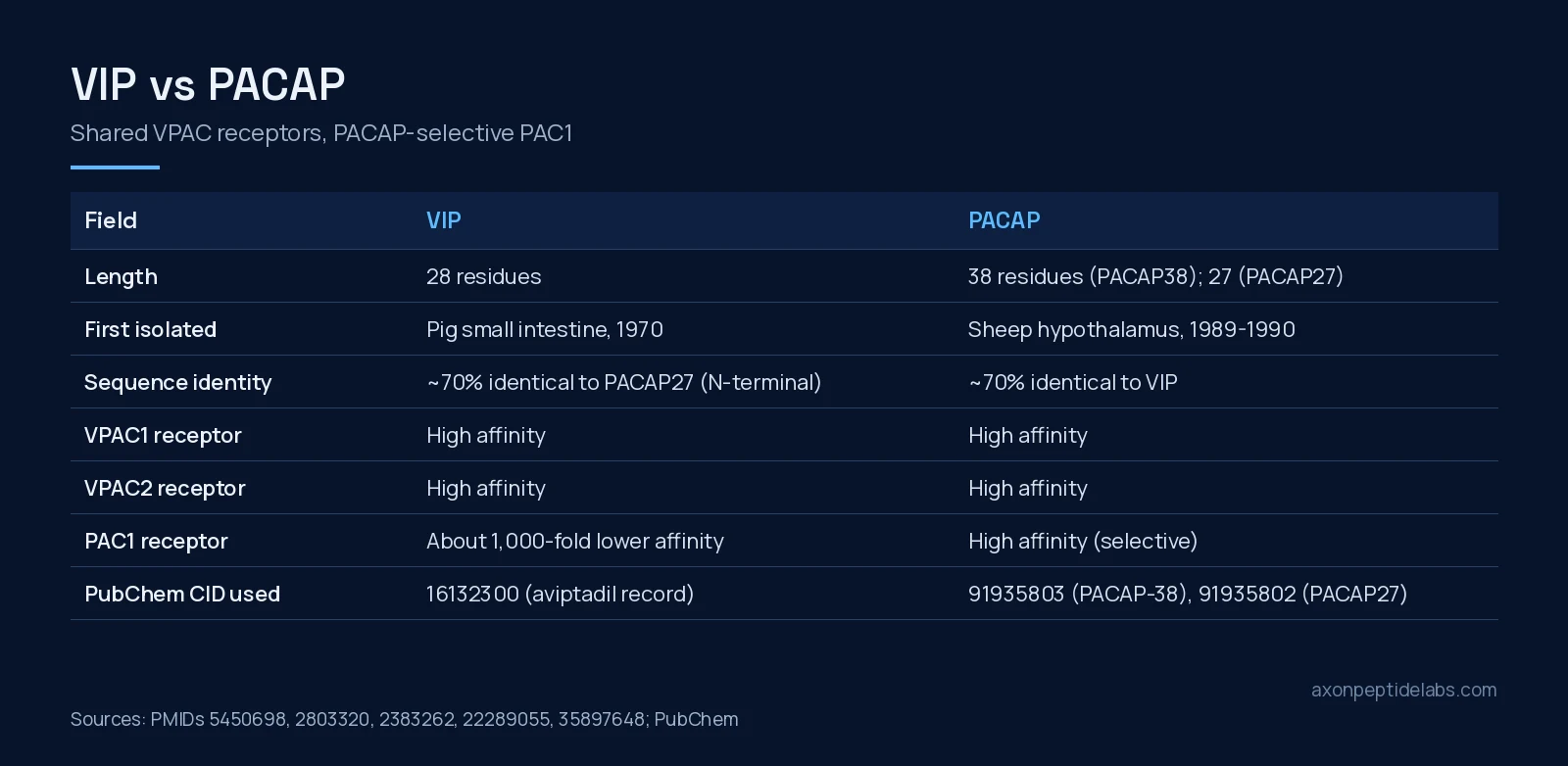
Short answer: VIP (vasoactive intestinal peptide) and PACAP (pituitary adenylate cyclase-activating polypeptide) are close relatives that share two receptors but not the third. Both activate VPAC1 and VPAC2 with high affinity. Only PACAP binds the PAC1 receptor strongly; VIP’s affinity there is about a thousand-fold lower[6][7]. Their N-terminal sequences are roughly 70% identical[3][7], which is why they are so often studied together and why receptor selectivity, not the peptides themselves, is usually the real experimental question.
Most search results for this comparison are either long academic reviews or short vendor summaries without sources. This page sits between the two: the identity data from PubChem, the receptor pharmacology in one table, the knockout-mouse evidence, and what the literature does not yet support, each tied to a PubMed record. Axon supplies VIP 10mg for laboratory research; PACAP is not sold here.
Two peptides, discovered 19 years apart
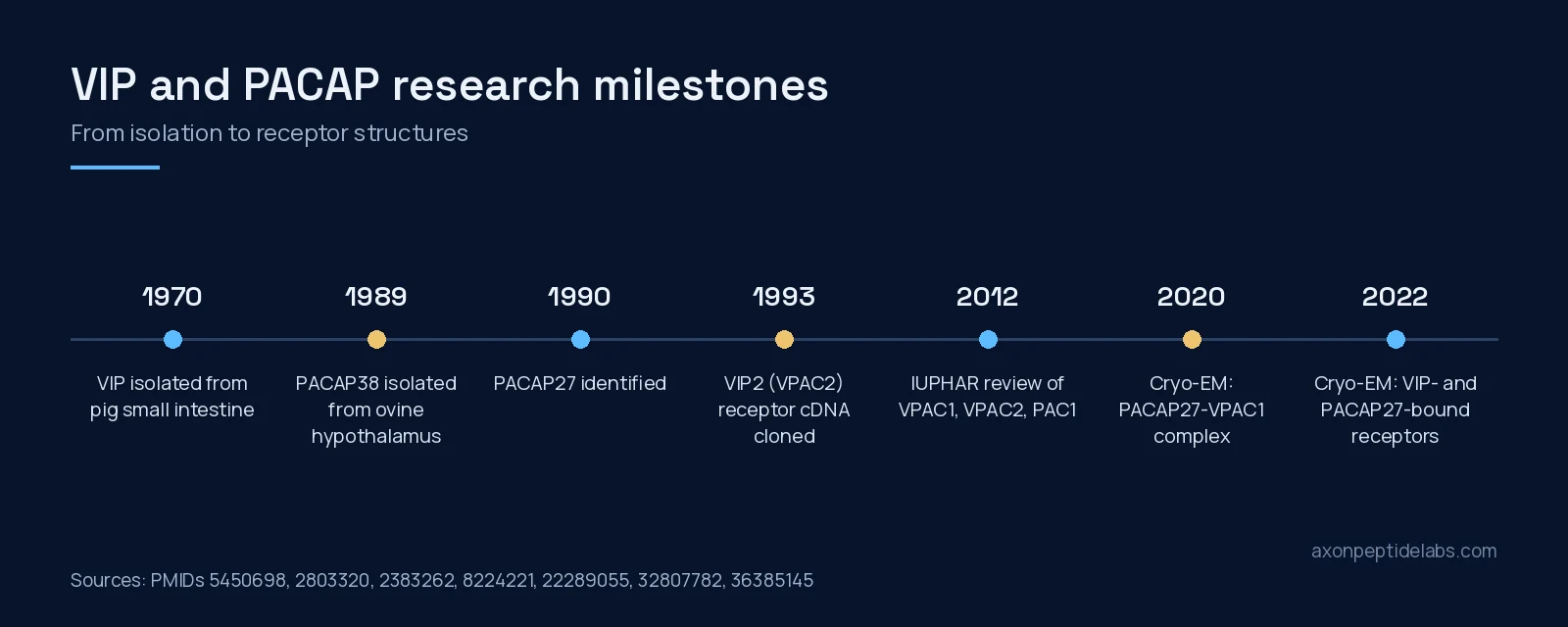
VIP came first. In 1970 a 28-residue peptide with broad vascular, respiratory and metabolic activity was isolated from hog small intestine and shown to be chemically distinct from secretin and glucagon[1]. Later cDNA cloning showed that human VIP is cut from a larger precursor, prepro-VIP, which also carries a second related 27-residue peptide, PHM-27[2].
PACAP was found in 1989 while researchers screened ovine hypothalamic extracts for anything that switched on adenylate cyclase in rat pituitary cells. The new peptide had 38 residues. Its N-terminal region showed 68% homology with VIP, yet its ability to stimulate adenylate cyclase in that assay was at least 1,000 times greater than VIP’s[3]. A year later the same group isolated a shorter, C-terminally amidated form corresponding to the first 27 residues. That form, PACAP27, matched PACAP38 for adenylate cyclase activity and resembled VIP in its vasodepressor activity, while still being about 1,000 times more active than VIP on cyclase[4].
Both belong to a larger structural family. A 2000 review groups nine human hormones, among them glucagon, GLP-1, GLP-2, GIP, GHRH, PHM, PACAP, secretin and VIP, into one superfamily, and describes PACAP as the most tightly conserved member, at 96% over roughly 700 million years[5].
Identity table
Values are copied from PubChem records. PubChem has no record titled simply “vasoactive intestinal peptide”, so the VIP column uses the aviptadil record, which PubChem lists with synonyms including “Vip human vip” and “Vasoactive intestinal octacosapeptide”. The terminal form a given lot carries should be confirmed by mass spectrometry rather than assumed from this table.
| Field | VIP | PACAP38 | PACAP27 |
|---|---|---|---|
| PubChem CID | 16132300 (aviptadil) | 91935803 | 91935802 |
| Molecular formula | C147H237N43O43S | C203H331N63O53S | C142H224N40O39S |
| Molecular weight | 3326.8 g/mol | 4534 g/mol | 3147.6 g/mol |
| Length | 28 residues | 38 residues, C-terminal amide | 27 residues, C-terminal amide |
| Sequence (one-letter) | HSDAVFTDNYTRLRKQMAVKKYLNSILN | HSDGIFTDSYSRYRKQMAVKKYLAAVLGKRYKQRVKNK-NH2 | HSDGIFTDSYSRYRKQMAVKKYLAAVL-NH2 |
| CAS (PubChem synonyms) | 40077-57-4 | not listed | not listed |
The VIP sequence is read from the residue-by-residue name in that PubChem record; the PACAP38 sequence is the one published at its isolation, and PACAP27 is its first 27 residues[3][4]. Lined up against PACAP27, VIP matches at 19 of 27 positions. The shared stretch is longest in the middle (RKQMAVKKYL), while positions 4 and 5 differ (AV in VIP, GI in PACAP). That matters for PAC1, as the next section shows.
The receptors: what is shared and what is not
VIP and PACAP act through three class B G protein-coupled receptors: PAC1, VPAC1 and VPAC2. The IUPHAR nomenclature committee summarises the pattern simply. PAC1 is selective for PACAP, while VPAC1 and VPAC2 respond to both peptides with high affinity[6]. A 2022 review adds two figures: the three receptors share about 60% homology in their transmembrane regions, and VIP’s affinity for PAC1 is roughly a thousand-fold lower than PACAP’s[7].
Cloning work from the 1990s laid this out. A rat cDNA expressed in COS-7 cells produced a receptor that responded to VIP, PACAP38, PACAP27 and helodermin with equal potency; it was named the VIP2 receptor and its mRNA was found mainly in the thalamus, hippocampus and suprachiasmatic nucleus[8]. A follow-up comparison found that VIP, PHI, PACAP38 and PACAP27 had similar potency at both VIP1 and VIP2 receptors, that only VIP1 responded to secretin, and that the two receptors’ mRNAs had largely complementary distributions in rat tissue[9]. VIP1 and VIP2 are the older names for VPAC1 and VPAC2.
| Receptor | VIP | PACAP | Notes from the literature | Sources |
|---|---|---|---|---|
| VPAC1 (VIP1) | High affinity | High affinity | Also responds to secretin; rat mRNA mainly in lung, small intestine, thymus, cortex and hippocampus | [6][9] |
| VPAC2 (VIP2) | High affinity | High affinity | Rat mRNA in hypothalamic nuclei, suprachiasmatic nucleus, pituitary and pancreatic islets | [8][9] |
| PAC1 | About 1,000-fold lower | High affinity | PACAP-selective; positions 4, 5 and 13 of PACAP implicated in selectivity | [7][10] |
Why PAC1 tells the two apart
Substitution studies have tried to pin down which PACAP residues VIP lacks. In binding assays on AR4-2J cells, PACAP(1-27) was much more sensitive to swaps toward the VIP sequence than PACAP(1-38). Positions 4 and 5 were the most important for PACAP27 binding, position 13 was crucial for full PACAP38 affinity, and the PACAP 29-38 extension appeared to stabilise the peptide’s conformation[10].
Structural biology has since added a picture. A 2020 cryo-EM structure of human VPAC1 bound to PACAP27 and the Gs protein showed the peptide’s N-terminus inserting into the binding pocket within the transmembrane bundle[11]. In 2022, structures of VIP-VPAC1, PACAP27-VPAC1 and PACAP27-PAC1 complexes, backed by molecular dynamics, showed fewer stable contacts between VIP and VPAC1 than between PACAP27 and VPAC1. Modelling VIP into PAC1 predicted even more transient contacts in the receptor core, which the authors propose may explain VIP’s preference for VPAC1 over PAC1[12].
For experimental design, this means a PAC1-mediated effect can sometimes be separated from a VPAC effect by comparing the two peptides, or by using a PAC1-selective tool. In a mouse ear model of neurogenic inflammation, the PAC1 agonist maxadilan reduced oedema, plasma leakage and vasodilation, while VIP attenuated only the early vasodilation, without affecting plasma leakage or substance P release[13]. That is a single mouse study, but it shows how the receptor split can produce different readouts.
What knockout mice show
Gene-deletion models exist for both peptides and all three receptors (Vip, Adcyap1, Vipr1, Vipr2, Adcyap1r1). A 2018 review of these mice concluded that the immune roles of endogenous VIP and PACAP are more complex than studies with added peptide had suggested[14]. A few phenotypes show how differently the two systems can matter:
- VPAC2-deficient mice: circadian rhythms in suprachiasmatic clock gene expression and wheel-running behaviour are abolished, and day-night variation in markers of light input to the pacemaker was lost[15].
- VIP-deficient mice: the small bowel was heavier and shorter, with thicker smooth muscle layers, longer villi and more goblet cells that were deficient in mucus secretion[16].
- PACAP-null mice: they were temperature-sensitive. Raised at 21 °C, only 11% survived past two weeks after birth, compared with most of those raised at 24 °C; brown adipocytes still differentiated normally, so the defect did not lie in brown-fat formation itself[17].
These are mouse phenotypes. They point to where each peptide and receptor operates in that species, not to any effect of adding either peptide in another setting.
Research themes for each peptide
The two literatures overlap heavily but lean in different directions. A 2013 review describes VIP and PACAP as neuroprotective peptides that are up-regulated after injury or inflammation and that, in experimental models, inhibit release of inflammatory mediators such as TNF-alpha from macrophages and microglia and shift T-cell responses away from Th1 and Th17[18]. The IUPHAR review lists central roles in circadian rhythm, learning, stress and brain injury, and peripheral roles in immunity, insulin secretion, adrenal catecholamine release and autonomic neurotransmission[6]. A 2021 review notes that PACAP research has concentrated on headache, post-traumatic stress and addiction, while VIP work has leaned toward autoimmune and inflammatory models[19].
Synthetic VIP has also been developed as a drug candidate under the name aviptadil, including in a combination product[20]. We do not state its regulatory status here because we could not confirm it from a regulator’s own record.
Documentation for VIP at Axon
No certificate is posted for VIP 10mg on our COA page at the time of writing, so treat a lot’s identity and purity as unverified until a batch report exists. Our guide on how to check a peptide COA before ordering explains what to look for, and VIP sits in our immune peptides category. Researchers who want to buy lab-tested peptides in Canada can compare the documentation on each listing before ordering. PACAP38 and PACAP27 are not offered by Axon.
What the evidence does not show
- It does not show that VIP can stand in for PACAP. With roughly thousand-fold lower PAC1 affinity[7], VIP would not be expected to reproduce PAC1-mediated effects at comparable concentrations.
- It does not show a fixed potency ratio across systems. The 1,000-fold cyclase difference was measured in rat pituitary cells[3][4], and early receptor work used rat cDNAs expressed in cell lines[8][9].
- It does not translate knockout phenotypes into effects of added peptide. Losing a gene from birth is a different experiment from exposing tissue to the peptide[14].
- It does not settle which receptor carries a given effect when both peptides are active. Most tissues express more than one of the three receptors, and selective tools are still limited[7].
- It does not support any human health or therapeutic claim for either peptide. Reviews describe research directions, not established outcomes[19].
Frequently asked questions
What is the main difference between VIP and PACAP?
Both activate the VPAC1 and VPAC2 receptors with high affinity. PACAP also binds the PAC1 receptor strongly, while VIP’s affinity for PAC1 is about a thousand-fold lower. That PAC1 selectivity is the clearest pharmacological difference between them.
How similar are the VIP and PACAP sequences?
Their N-terminal regions are roughly 70% identical. VIP has 28 residues; PACAP exists as a 38-residue form and a 27-residue form, and VIP matches PACAP27 at 19 of 27 positions.
What is the difference between PACAP38 and PACAP27?
PACAP27 is the first 27 residues of PACAP38 with an amidated C-terminus. Both were isolated from ovine hypothalamus and had comparable adenylate cyclase activity in rat pituitary cells; the 29-38 extension is thought to stabilise PACAP38’s conformation at PAC1.
Which receptor did knockout mice link to circadian rhythm?
Mice lacking the VPAC2 receptor lost circadian rhythms in suprachiasmatic clock gene expression and wheel-running behaviour. VPAC2 responds to both VIP and PACAP.
Does Axon sell PACAP or post a COA for VIP?
Axon offers VIP 10mg but not PACAP38 or PACAP27. No certificate is posted for VIP 10mg on our COA page at the time of writing.
References
- Said SI, Mutt V (1970). Polypeptide with broad biological activity: isolation from small intestine. Science. PMID: 5450698. doi: 10.1126/science.169.3951.1217.
- Itoh N, Obata K, Yanaihara N et al. (1983). Human preprovasoactive intestinal polypeptide contains a novel PHI-27-like peptide, PHM-27. Nature. PMID: 6571696. doi: 10.1038/304547a0.
- Miyata A, Arimura A, Dahl RR et al. (1989). Isolation of a novel 38 residue-hypothalamic polypeptide which stimulates adenylate cyclase in pituitary cells. Biochem Biophys Res Commun. PMID: 2803320. doi: 10.1016/0006-291x(89)91757-9.
- Miyata A, Jiang L, Dahl RD et al. (1990). Isolation of a neuropeptide corresponding to the N-terminal 27 residues of the pituitary adenylate cyclase activating polypeptide with 38 residues (PACAP38). Biochem Biophys Res Commun. PMID: 2383262. doi: 10.1016/0006-291x(90)92140-u.
- Sherwood NM, Krueckl SL, McRory JE (2000). The origin and function of the pituitary adenylate cyclase-activating polypeptide (PACAP)/glucagon superfamily. Endocr Rev. PMID: 11133067. doi: 10.1210/edrv.21.6.0414.
- Harmar AJ, Fahrenkrug J, Gozes I et al. (2012). Pharmacology and functions of receptors for vasoactive intestinal peptide and pituitary adenylate cyclase-activating polypeptide: IUPHAR review 1. Br J Pharmacol. PMID: 22289055. doi: 10.1111/j.1476-5381.2012.01871.x.
- Lu J, Piper SJ, Zhao P et al. (2022). Targeting VIP and PACAP Receptor Signaling: New Insights into Designing Drugs for the PACAP Subfamily of Receptors. Int J Mol Sci. PMID: 35897648. doi: 10.3390/ijms23158069.
- Lutz EM, Sheward WJ, West KM et al. (1993). The VIP2 receptor: molecular characterisation of a cDNA encoding a novel receptor for vasoactive intestinal peptide. FEBS Lett. PMID: 8224221. doi: 10.1016/0014-5793(93)81668-p.
- Usdin TB, Bonner TI, Mezey E (1994). Two receptors for vasoactive intestinal polypeptide with similar specificity and complementary distributions. Endocrinology. PMID: 7988457. doi: 10.1210/endo.135.6.7988457.
- Schäfer H, Zheng J, Morys-Wortmann C et al. (1999). Structural motifs of pituitary adenylate cyclase-activating polypeptide (PACAP) defining PAC1-receptor selectivity. Regul Pept. PMID: 10100920. doi: 10.1016/s0167-0115(98)00147-5.
- Duan J, Shen DD, Zhou XE et al. (2020). Cryo-EM structure of an activated VIP1 receptor-G protein complex revealed by a NanoBiT tethering strategy. Nat Commun. PMID: 32807782. doi: 10.1038/s41467-020-17933-8.
- Piper SJ, Deganutti G, Lu J et al. (2022). Understanding VPAC receptor family peptide binding and selectivity. Nat Commun. PMID: 36385145. doi: 10.1038/s41467-022-34629-3.
- Banki E, Hajna Z, Kemeny A et al. (2014). The selective PAC1 receptor agonist maxadilan inhibits neurogenic vasodilation and edema formation in the mouse skin. Neuropharmacology. PMID: 24973707. doi: 10.1016/j.neuropharm.2014.06.019.
- Abad C, Tan YV (2018). Immunomodulatory Roles of PACAP and VIP: Lessons from Knockout Mice. J Mol Neurosci. PMID: 30105629. doi: 10.1007/s12031-018-1150-y.
- Hughes AT, Fahey B, Cutler DJ et al. (2004). Aberrant gating of photic input to the suprachiasmatic circadian pacemaker of mice lacking the VPAC2 receptor. J Neurosci. PMID: 15071099. doi: 10.1523/JNEUROSCI.5345-03.2004.
- Lelievre V, Favrais G, Abad C et al. (2007). Gastrointestinal dysfunction in mice with a targeted mutation in the gene encoding vasoactive intestinal polypeptide: a model for the study of intestinal ileus and Hirschsprung’s disease. Peptides. PMID: 17606312. doi: 10.1016/j.peptides.2007.05.006.
- Gray SL, Yamaguchi N, Vencová P et al. (2002). Temperature-sensitive phenotype in mice lacking pituitary adenylate cyclase-activating polypeptide. Endocrinology. PMID: 12239106. doi: 10.1210/en.2002-220401.
- Waschek JA (2013). VIP and PACAP: neuropeptide modulators of CNS inflammation, injury, and repair. Br J Pharmacol. PMID: 23517078. doi: 10.1111/bph.12181.
- Moody TW, Jensen RT (2021). Pituitary adenylate cyclase-activating polypeptide/vasoactive intestinal peptide (Part 2): biology and clinical importance in central nervous system and inflammatory disorders. Curr Opin Endocrinol Diabetes Obes. PMID: 33481421. doi: 10.1097/MED.0000000000000621.
- Keijzers GB (2001). Aviptadil (Senatek). Curr Opin Investig Drugs. PMID: 11566015.