
AOD-9604 vs HGH Fragment 176-191: One Residue Apart
For laboratory research only. Not for human or animal use. This article gives no dosing, administration or therapeutic advice.
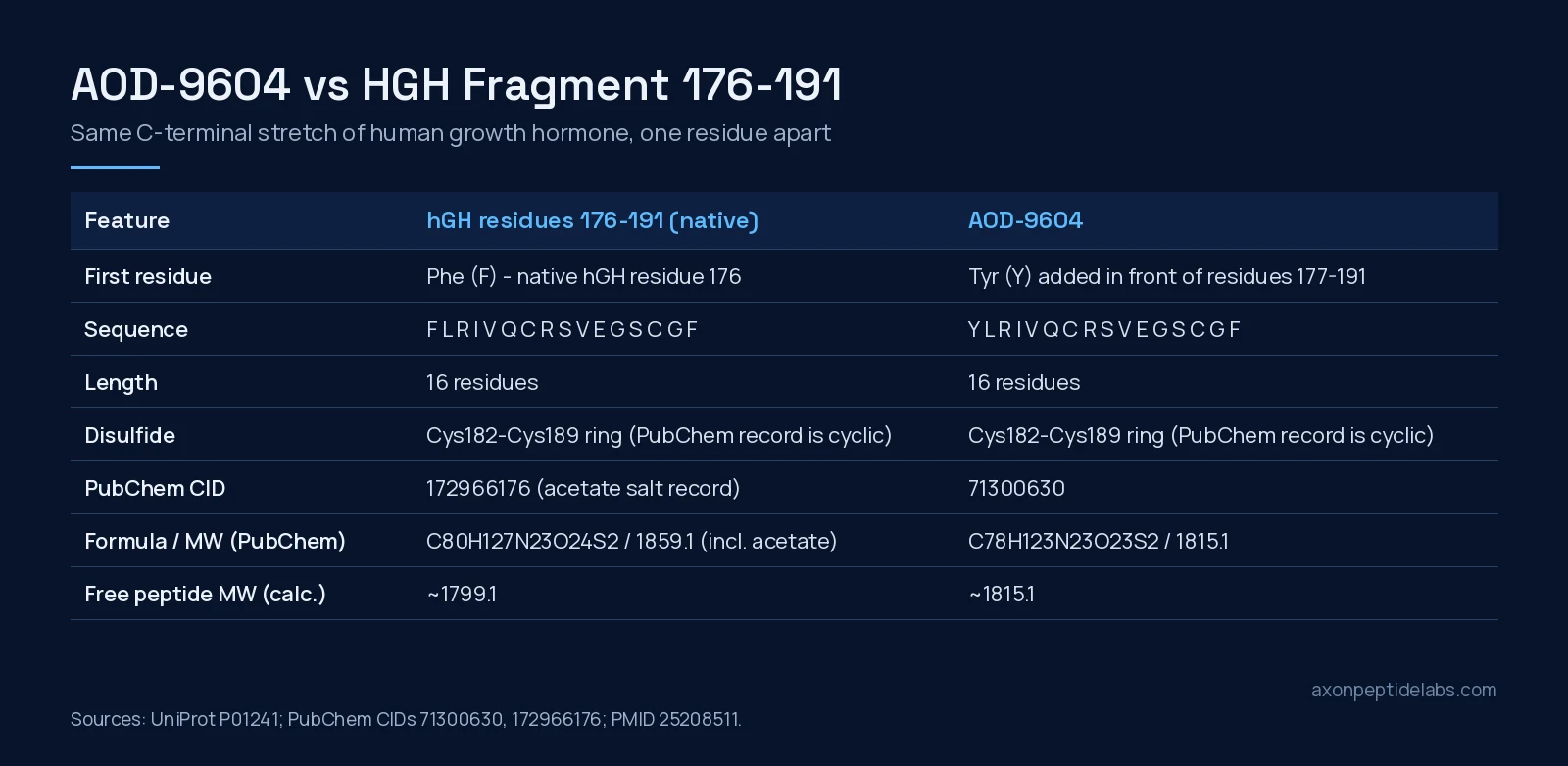
Short answer: AOD-9604 and “HGH Fragment 176-191” come from the same 16-residue stretch at the C-terminal end of human growth hormone (hGH), and the names are often used as if they meant the same peptide[15]. Strictly, they differ by one residue. In native hGH, residue 176 is phenylalanine (UniProt P01241). AOD-9604 is hGH residues 177-191 with a tyrosine added at the N-terminus[10]. So the native 176-191 fragment starts with Phe, AOD-9604 starts with Tyr, and the other 15 residues, including the cysteine pair that closes a disulfide ring, are identical. PubChem keeps separate records for the two (CID 71300630 and CID 172966176). Most of the published biology was done on hGH 177-191, on AOD-9401 or on AOD-9604, in rodents and isolated fat tissue[2][6][7].
What we sell: Axon lists AOD-9604 5mg for laboratory research. We do not sell a separately named “HGH Fragment 176-191” product. This article explains how the two names relate, so a lab can check which sequence it actually has.
Where the fragment came from
Growth hormone has long been known to affect fat and glucose metabolism, and researchers tried to find out which part of the 191-residue hormone carries those effects. A 1982 rat study tested shortened synthetic versions of the reduced, carbamidomethylated hGH 177-191 peptide. Only the longer forms caused high blood glucose and insulin resistance in normal rats. The authors placed this “insulin-antagonistic core” within residues 178-190[1]. Keep that study in mind: it shows that C-terminal hGH peptides were first described for an effect on glucose, not on fat.
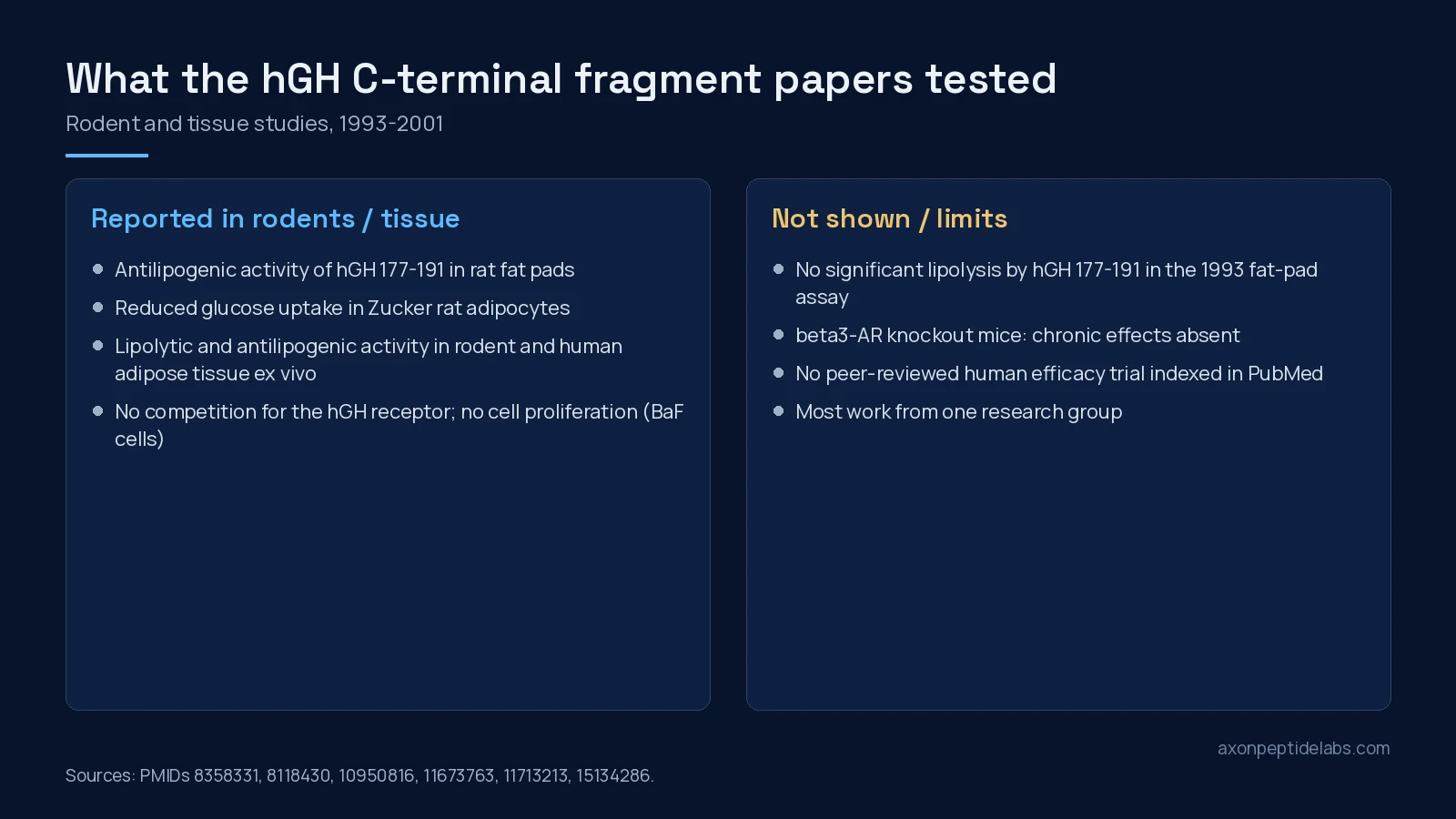
In 1993 Wu and Ng reported that synthetic hGH 177-191 (Leu-Arg-Ile-Val-Gln-Cys-Arg-Val-Ser-Glu-Gly-Ser-Cys-Gly-Phe) had antilipogenic activity identical to intact hGH in rats. In the same study, they found no significant lipolytic effect, measured as glycerol release from epididymal fat pads[2]. A companion paper found that the peptide reduced basal and insulin-stimulated glucose uptake in adipocytes isolated from genetically obese Zucker rats. At equal molar concentrations it was more potent than intact hGH[3]. In ob/ob mice, long-term treatment with hGH 177-191 reduced cumulative body-weight gain and adipose tissue mass and inhibited lipogenesis in fat tissue[4].
From AOD-9401 to AOD-9604
By 2000 the same line of work used the code names AOD9401 and AOD9604. One paper describes AOD9401 as a lipolytic domain containing hGH residues 177-191, made by solid-phase synthesis. In isolated rat adipose tissue it stimulated hormone-sensitive lipase and inhibited acetyl-CoA carboxylase, as intact hGH does. In obese Zucker rats it did not produce the insulin resistance or glucose intolerance seen with hGH[5]. Another 2000 study gave AOD-9401 orally to ob/ob mice and also tested it on isolated adipose tissue from obese rodents and humans. In that tissue, in vitro, it increased lipolytic activity and decreased lipogenic activity[6].
AOD9604 is described in a 2000 Zucker-rat paper as a synthetic analogue of that lipolytic domain[7]. A 2015 anti-doping paper gives its composition: the hGH 177-191 C-terminal fragment with an extra tyrosine at the N-terminus[10]. Why the tyrosine was added is not stated in the abstracts we read, so we do not guess at the reason here.
Identity, side by side
The values below come from PubChem and UniProt, not from any certificate of analysis. PubChem’s “HGH Fragment 176-191” record is an acetate salt, so its listed formula and weight include acetic acid. For a fair comparison we also give our own calculated mass for each free peptide with its disulfide formed.
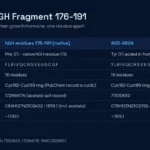
| Field | AOD-9604 | HGH Fragment 176-191 (native sequence) |
|---|---|---|
| PubChem CID | 71300630 | 172966176 |
| Synonyms in PubChem | AOD9604, AOD 9604, CAS 221231-10-3 | HGH Fragment 176-191 |
| Sequence | Tyr-Leu-Arg-Ile-Val-Gln-Cys-Arg-Ser-Val-Glu-Gly-Ser-Cys-Gly-Phe (YLRIVQCRSVEGSCGF) | Phe-Leu-Arg-Ile-Val-Gln-Cys-Arg-Ser-Val-Glu-Gly-Ser-Cys-Gly-Phe (FLRIVQCRSVEGSCGF) |
| Relation to hGH | Tyr + hGH 177-191 | hGH 176-191 exactly (UniProt P01241, mature numbering) |
| Ring | Disulfide between the two Cys (hGH positions 182 and 189); cyclic in the PubChem structure | Same disulfide; cyclic in the PubChem structure |
| Formula (PubChem) | C78H123N23O23S2 | C80H127N23O24S2 (record includes acetic acid) |
| Molecular weight (PubChem) | 1815.1 g/mol | 1859.1 g/mol (acetate salt) |
| Free peptide, calculated | about 1815.1 Da | about 1799.1 Da |
The one-residue difference is small but easy to measure. Tyrosine is phenylalanine with an added hydroxyl group, so the two free peptides differ by about 16 Da, which an LC-MS identity check resolves without difficulty. Some web pages say AOD-9604 is the fragment “with an added disulfide bridge”. The PubChem structures do not support that: both records carry the same Cys-Cys ring.
What the research compared
| Question | What was reported | Peptide tested | Model | Source |
|---|---|---|---|---|
| Antilipogenic activity | Identical to intact hGH; no significant lipolysis by glycerol release | hGH 177-191 | Rat epididymal fat pads | [2] |
| Glucose uptake in fat cells | Basal and insulin-stimulated uptake reduced; more potent than hGH at equal molarity | hGH 177-191 | Zucker rat adipocytes | [3] |
| Lipase / ACC activity | Hormone-sensitive lipase up, acetyl-CoA carboxylase down | AOD9401 | Rat adipose tissue | [5] |
| Human fat tissue in vitro | Lipolytic activity up, lipogenic activity down | AOD-9401 | Isolated human adipose tissue | [6] |
| hGH receptor binding | Did not compete for the hGH receptor; no proliferation | AOD9604 | BaF-BO3 cells with hGH receptor | [8] |
| Glucose and insulin | No hyperglycaemia or reduced insulin secretion, unlike hGH | AOD9604 | Obese and lean mice | [8] |
| Role of beta3-adrenergic receptor | Raised beta3-AR RNA; chronic effects absent in beta3-AR knockout mice | AOD9604 | Mice | [9] |
The “no growth effect” findings
The finding most often repeated about AOD-9604 is that it acts on fat tissue without acting like growth hormone. In the primary data that rests on a 2001 mouse and cell study. AOD9604 did not compete with labelled hGH for the hGH receptor on cells engineered to express it, and, unlike hGH, it did not drive proliferation of those cells. In obese and lean mice it also did not cause the hyperglycaemia or reduced insulin secretion that hGH did[8]. Two earlier rat papers reported no adverse effect on insulin sensitivity after chronic treatment, one of them measured by euglycaemic clamp[5][7].
That differs from the 1982 rat data on carbamidomethylated C-terminal peptides, which did raise glucose and cause insulin resistance[1]. Those were different preparations, chemically modified at the cysteines, so the two sets of results do not directly contradict each other. They do show that the C-terminal region has been linked to more than one metabolic effect depending on how the peptide was made and tested.
The mechanism is still open. In the beta3-adrenergic receptor study, hGH and AOD9604 both raised beta3-AR RNA in obese mice, and their chronic effects disappeared in beta3-AR knockout mice. Yet AOD9604 still raised energy expenditure and fat oxidation acutely in those knockouts. The authors concluded that its lipolytic action is not mediated directly through the beta3 receptor[9].
Human development and detection
A 2004 drug profile reports that the developer was working on AOD-9604 for obesity and that phase IIa trials were under way by February 2002[13]. A 2006 review listed it among anti-obesity drugs in clinical development[14]. Neither is a trial report, and we did not find a peer-reviewed human tolerability or outcome trial of AOD-9604 indexed in PubMed, so we make no statement about human results. A 2026 sports-medicine review groups AOD-9604 with other unapproved peptides for which rigorous human safety data are scarce[16].
In anti-doping science, AOD9604 is on the World Anti-Doping Agency’s banned list. A validated urine method was published in 2015, and serum incubation produced a stable metabolite made of the residues CRSVEGSCG[10]. A 2013 letter, as its title states, reported that AOD-9604 does not affect the WADA hGH isoform immunoassay[11]. Outside fat metabolism, a 2015 rabbit study tested AOD9604 injected into joints with and without hyaluronic acid in a collagenase-induced osteoarthritis model[12].
What the evidence does not show
- No head-to-head study of the Phe and Tyr versions. We found no paper comparing native hGH 176-191 with AOD-9604 directly. Any claim that one is “stronger” is not backed by primary data we could find.
- No human outcome data in the indexed literature. The phase IIa mention is a development note, not a result[13]. Human adipose tissue was only studied in vitro[6].
- Mostly one research lineage. All eight fat-metabolism papers we cite from 1993 to 2001 list F. M. Ng as an author, so independent replication is limited.
- Not every paper tested the same molecule. The 1993-1994 papers used hGH 177-191, the 2000 papers used AOD9401 and AOD9604, and reviews label AOD9604 as “hGH 176-191”[15]. Results from one should not be credited to the other without checking the sequence.
- Nothing here describes a commercial vial. Which sequence a product contains is shown by its own identity test, not by its name.
Documentation for our AOD-9604
We checked our COA page and the product page while writing this. No certificate is posted for this product on our COA page at the time of writing. If one is published, it will appear there with batch, purity and test date. AOD-9604 sits in our metabolic research peptides category. Our AOD-9604 vs 5-Amino-1MQ comparison covers a different mechanism, and labs comparing suppliers can buy lab-tested peptides in Canada through our main catalogue.
Frequently asked questions
Is AOD-9604 the same as HGH Fragment 176-191?
Not exactly. Both are the 16-residue C-terminal stretch of human growth hormone, but native hGH residue 176 is phenylalanine, while AOD-9604 is hGH 177-191 with a tyrosine added at the N-terminus. The remaining 15 residues are identical, and the names are often used interchangeably.
How can a lab tell AOD-9604 from the native 176-191 fragment?
By mass and sequence. The free peptides differ by about 16 Da (Tyr versus Phe), roughly 1815 versus 1799 Da, which LC-MS identity testing resolves. PubChem lists AOD-9604 as CID 71300630 and HGH Fragment 176-191 as CID 172966176 (an acetate-salt record).
Does AOD-9604 bind the growth hormone receptor?
In a 2001 study, AOD9604 did not compete for the hGH receptor on cells engineered to express it and did not drive their proliferation, unlike hGH. In obese and lean mice it also did not cause the hyperglycaemia seen with hGH.
Does AOD-9604 have an extra disulfide bridge compared with Fragment 176-191?
No. Both sequences have the same two cysteines, at hGH positions 182 and 189, and both PubChem structures show the same disulfide ring. The difference between them is the first residue.
Has AOD-9604 been tested in humans?
A 2004 drug profile reports phase IIa trials under way by 2002, and a 2006 review listed it in clinical development. We found no peer-reviewed human trial report indexed in PubMed. Human adipose tissue was studied in vitro only.
Does Axon sell HGH Fragment 176-191?
No. Axon sells AOD-9604 5mg for laboratory research only and does not sell a separately named Fragment 176-191 product. No certificate of analysis is posted for AOD-9604 on our COA page at the time of writing.
- Wade JD, Ng FM, Bornstein J et al. (1982). Effect of C-terminal chain shortening on the insulin-antagonistic activity of human growth hormone 177–191. Acta Endocrinol (Copenh). PMID: 6751009. doi: 10.1530/acta.0.1010010.
- Wu Z, Ng FM (1993). Antilipogenic action of synthetic C-terminal sequence 177-191 of human growth hormone. Biochem Mol Biol Int. PMID: 8358331.
- Wijaya E, Ng FM (1993). Effect of an antilipogenic fragment of human growth hormone on glucose transport in rat adipocytes. Biochem Mol Biol Int. PMID: 8118430.
- Natera SH, Jiang WJ, Ng FM (1994). Reduction of cumulative body weight gain and adipose tissue mass in obese mice: response to chronic treatment with synthetic hGH 177-191 peptide. Biochem Mol Biol Int. PMID: 7987248.
- Ng FM, Jiang WJ, Gianello R et al. (2000). Molecular and cellular actions of a structural domain of human growth hormone (AOD9401) on lipid metabolism in Zucker fatty rats. J Mol Endocrinol. PMID: 11116208. doi: 10.1677/jme.0.0250287.
- Heffernan MA, Jiang WJ, Thorburn AW et al. (2000). Effects of oral administration of a synthetic fragment of human growth hormone on lipid metabolism. Am J Physiol Endocrinol Metab. PMID: 10950816. doi: 10.1152/ajpendo.2000.279.3.E501.
- Ng FM, Sun J, Sharma L et al. (2000). Metabolic studies of a synthetic lipolytic domain (AOD9604) of human growth hormone. Horm Res. PMID: 11146367. doi: 10.1159/000053183.
- Heffernan MA, Thorburn AW, Fam B et al. (2001). Increase of fat oxidation and weight loss in obese mice caused by chronic treatment with human growth hormone or a modified C-terminal fragment. Int J Obes Relat Metab Disord. PMID: 11673763. doi: 10.1038/sj.ijo.0801740.
- Heffernan M, Summers RJ, Thorburn A et al. (2001). The effects of human GH and its lipolytic fragment (AOD9604) on lipid metabolism following chronic treatment in obese mice and beta(3)-AR knock-out mice. Endocrinology. PMID: 11713213. doi: 10.1210/endo.142.12.8522.
- Cox HD, Smeal SJ, Hughes CM et al. (2015). Detection and in vitro metabolism of AOD9604. Drug Test Anal. PMID: 25208511. doi: 10.1002/dta.1715.
- Orlovius AK, Thomas A, Schänzer W et al. (2013). AOD-9604 does not influence the WADA hGH isoform immunoassay. Drug Test Anal. PMID: 24124033. doi: 10.1002/dta.1557.
- Kwon DR, Park GY (2015). Effect of Intra-articular Injection of AOD9604 with or without Hyaluronic Acid in Rabbit Osteoarthritis Model. Ann Clin Lab Sci. PMID: 26275694.
- Wilding J (2004). AOD-9604 Metabolic. Curr Opin Investig Drugs. PMID: 15134286.
- Halford JC (2006). Obesity drugs in clinical development. Curr Opin Investig Drugs. PMID: 16625817.
- Dominikowski A, Rękoś Z, Olejarz M et al. (2026). The emerging landscape of performance-enhancing peptides modulating GH-IGF1 axis: bridging the gap between clinical evidence and patient self-administration. Front Endocrinol (Lausanne). PMID: 42395176. doi: 10.3389/fendo.2026.1822475.
- Mendias CL, Awan TM (2026). Safety and Efficacy of Approved and Unapproved Peptide Therapies for Musculoskeletal Injuries and Athletic Performance. Sports Med. PMID: 41966639. doi: 10.1007/s40279-026-02437-0.