
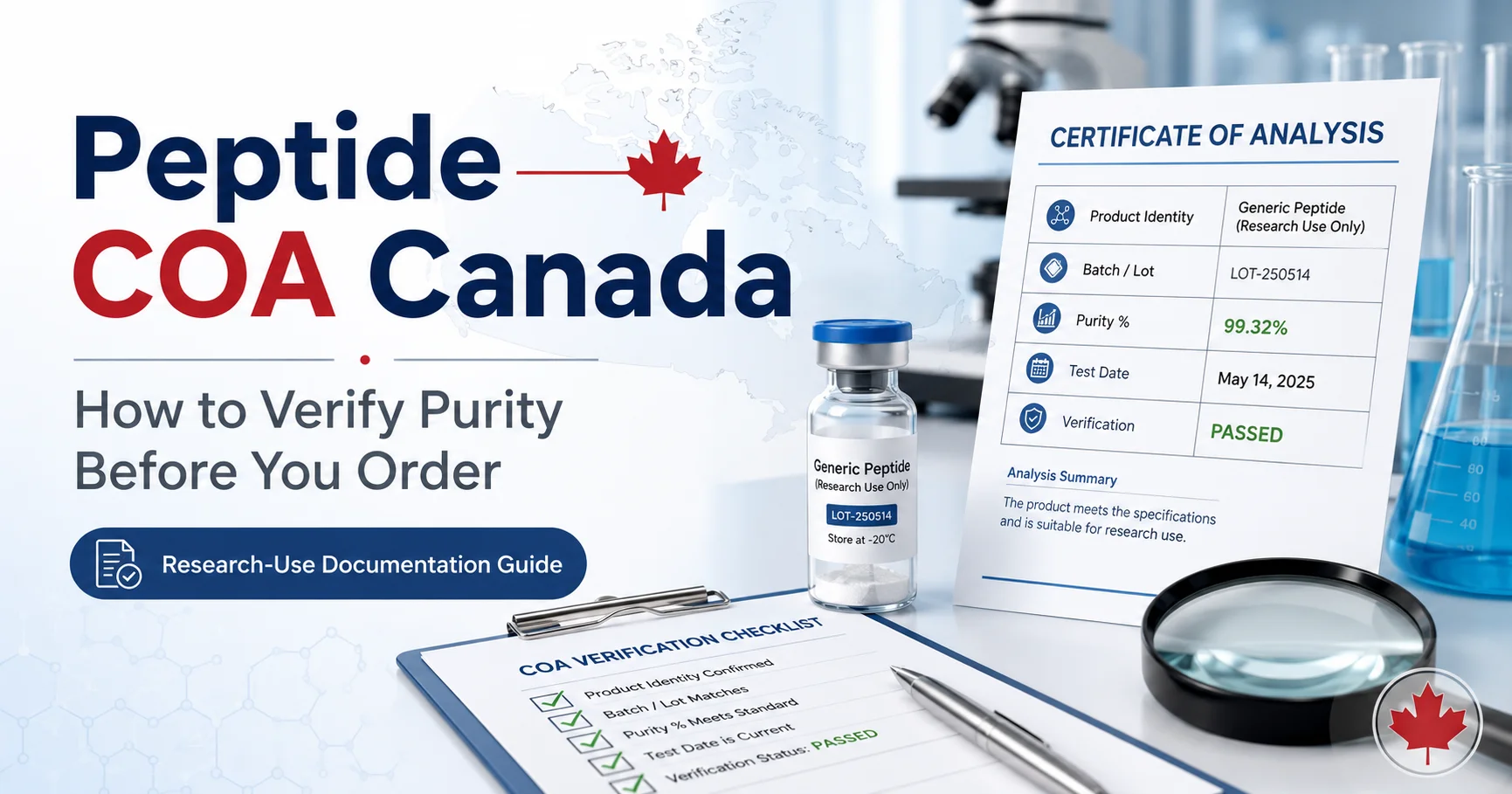
How to Read and Verify a Peptide Certificate of Analysis (COA)
How to Read and Verify a Peptide Certificate of Analysis (COA)
Quick answer: To read a peptides COA in Canada, confirm it’s batch-specific and recent, check the HPLC purity percentage (ideally 98%+), verify the mass spec result matches the expected molecular weight, and confirm it was issued by a named third-party lab. To verify it’s real, match the batch number to your product and cross-reference the lab.
For anyone sourcing research peptides, the Certificate of Analysis is the single most useful document for judging quality — but only if you can read it. When you’re comparing a peptides COA in Canada, impressive-looking numbers mean nothing if the document is generic, outdated, or belongs to a different batch. This guide walks through each part of a COA and how to confirm it’s legitimate.
What a COA is — and isn’t
A COA is a lab document reporting the test results for a specific batch of a specific product. The key phrase is specific batch. A real COA corresponds to the exact lot you’d receive; a generic PDF reused across every product and every order is marketing dressed up as documentation.
If a supplier shows one COA for a product that’s been restocked many times, that’s a flag — each batch should have its own.
Step 1: Check the header details
Start at the top. A legitimate COA identifies:
- Product name and sequence — matching what you ordered
- Batch or lot number — this should match the number on your physical product label
- Test date — recent, and ideally close to the manufacturing date
- The testing lab — named, ideally an independent third party
If the batch number on the COA doesn’t match your vial, the document doesn’t describe your product — no matter how good the numbers look.
Step 2: Read the HPLC purity result
HPLC (high-performance liquid chromatography) measures purity by separating the sample into its components, each appearing as a peak on a chromatogram.
What to look for:
- A purity percentage, ideally 98% or higher
- The actual chromatogram, not just the number — one tall, dominant peak for the target peptide and minimal others
- A clean baseline without a forest of small impurity peaks
The chromatogram is the evidence. A COA that states “99% pure” with no graph is asking you to take its word for it.
Step 3: Verify identity with mass spec
Purity tells you how clean the sample is; it doesn’t tell you whether it’s the right molecule. That’s what mass spectrometry (MS) is for.
The COA should list an observed molecular weight that matches the expected (theoretical) weight for the peptide’s sequence. If they match, the identity is confirmed. If the COA reports purity but no mass spec result, you only have half the picture — a sample can be highly pure and still be the wrong peptide.
Step 4: Confirm it’s third-party
A COA from the vendor’s own bench is better than nothing, but the vendor has an incentive to pass its own product. A COA from a named independent lab carries more weight because the lab has no stake in the result. Look for the lab’s name and, where possible, cross-reference it.
Step 5: Verify the COA is real
This is the step most people skip. A COA can look perfect and still be recycled or fabricated. To verify any peptides COA in Canada:
- Match the batch number on the COA to your physical product
- Check the date is recent and plausible for your order
- Confirm the lab exists — a named lab you can look up, not an unnamed “third-party lab”
- Watch for reuse — if the same COA appears for multiple batches or restocks, it isn’t batch-specific
- Ask — a credible supplier will provide the batch-matched COA for your specific order on request
If a supplier can’t or won’t produce a COA that matches the batch you received, treat the documentation as absent.
Quick COA verification checklist
| Element | What confirms it’s legitimate |
|---|---|
| Batch number | Matches your physical product label |
| Test date | Recent and plausible |
| HPLC purity | 98%+, with a visible chromatogram |
| Mass spec | Observed weight matches expected |
| Lab | Named, independent, verifiable |
| Batch-specific | Not reused across products or restocks |
Frequently asked questions
What should a peptide COA include?
Product name and sequence, a batch/lot number, test date, HPLC purity percentage with chromatogram, mass spec identity confirmation, and the name of the testing lab.
How do I verify a peptides COA in Canada is real?
Match the batch number to your physical product, confirm the date is plausible, check the named lab actually exists, and make sure the same COA isn’t reused across multiple batches.
What purity should a COA show?
For most research applications, 98% or higher — supported by an HPLC chromatogram, not just a stated figure.
Why does the COA need to be batch-specific?
Each production batch can differ in purity and quality. A COA only describes the batch it was run on, so a generic or reused document tells you nothing reliable about the material you received.
Where can I see example COAs?
You can review available COA records here to see what batch-specific documentation looks like, or check the FAQ for how COA access works.
Products referenced in research contexts include Retatrutide, BPC-157, and TB-500, each supplied for research use only.