
Tirzepatide vs Mazdutide: GIP vs Glucagon Co-Agonism
For laboratory research only. Not for human or animal use. This article gives no dosing, administration or therapeutic advice.
Short answer: tirzepatide and mazdutide are both single peptides that activate the GLP-1 receptor plus one other receptor, and the second receptor is the whole story. Tirzepatide (LY3298176) pairs GLP-1 receptor agonism with the receptor for GIP, the other incretin hormone[1][2]. Mazdutide (LY3305677, IBI362) pairs it with the glucagon receptor[20][17]. One design leans on a second gut incretin signal; the other borrows from glucagon, a hormone that acts mainly on the liver[14][9]. They are different research tools for different questions, and no published study compares them head to head.
Most pages that rank for this comparison put headline trial numbers side by side. This article does something else. It looks at receptor pharmacology, molecular identity and the preclinical models behind each co-agonism strategy, with every claim tied to a PubMed record. Axon already covers the glucagon side from a different direction in retatrutide vs mazdutide, where a triple agonist is set against mazdutide. Here the question is narrower: GIP co-agonism versus glucagon co-agonism.
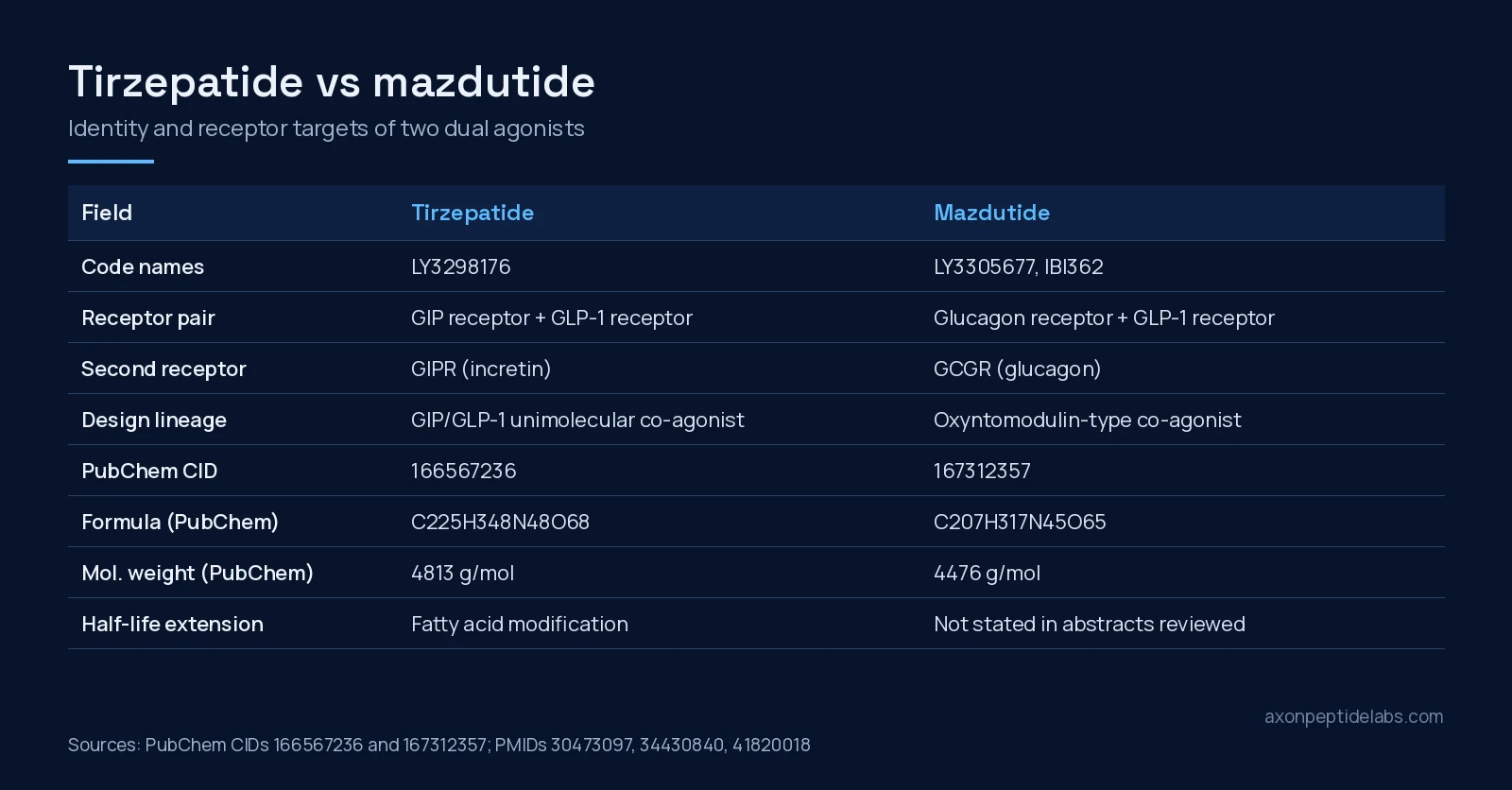
Identity at a glance
Values below are copied from PubChem compound records, not from certificates of analysis. Both are large modified peptides, so the formula and weight describe the whole molecule, not just the amino-acid chain.
| Field | Tirzepatide | Mazdutide |
|---|---|---|
| PubChem CID | 166567236 | 167312357 |
| CAS (PubChem synonyms) | 2023788-19-2 | 2259884-03-0 |
| Development codes | LY3298176 | LY3305677, IBI362 |
| Molecular formula | C225H348N48O68 | C207H317N45O65 |
| Molecular weight | 4813 g/mol | 4476 g/mol |
| Receptors activated | GIP receptor (GIPR) and GLP-1 receptor (GLP-1R) | Glucagon receptor (GCGR) and GLP-1 receptor |
| Developers named in the literature | Eli Lilly | Eli Lilly, then Innovent Biologics |
The developer row comes from the discovery paper for tirzepatide[1] and from a 2025 approval profile and a 2026 patent-landscape review for mazdutide, which trace early peptide design to Eli Lilly and later formulation and clinical work to Innovent Biologics[17][11]. The roughly 340 g/mol difference in molecular weight is large enough for mass spectrometry to tell the two apart without difficulty.
Two ways to build a dual agonist
The GIP route: a “unimolecular dual incretin”
GIP and GLP-1 are the two incretin hormones, which scale insulin responses to nutrient intake[3]. For years GIP drew less interest than GLP-1, partly because loss-of-function studies had suggested that GIP signalling might favour fat storage. A 2021 review notes that this idea came only from loss-of-function work and that both agonism and antagonism of the GIP receptor have since been pursued as research strategies, a paradox that is still unresolved[6].
The co-agonist concept was set out in a 2013 paper describing a single peptide built from an intermixed GLP-1 and GIP sequence. It had balanced activity at both receptors and was tested in db/db mice, ZDF rats, cynomolgus monkeys and humans. In obese rodents the dual agonist reduced fat mass more than a selective GLP-1 agonist, while a selective GIP agonist had negligible effect on body weight. Lipidation or PEGylation was then used to extend its duration of action[5].
Tirzepatide is described in its discovery paper as a fatty-acid-modified peptide with dual GIP and GLP-1 receptor agonist activity. It was characterised in cell lines expressing recombinant or native incretin receptors and in mice, where it acted through both receptors on insulin secretion and glucose tolerance[1].
The glucagon route: oxyntomodulin as the template
Glucagon co-agonism has a different origin. Oxyntomodulin is a 37-residue gut peptide that contains the full glucagon sequence and activates both the glucagon and GLP-1 receptors, though only weakly[9]. Reviews of oxyntomodulin analogues describe how its sequence has been modified to raise potency and extend half-life, producing a family of GLP-1/glucagon dual agonists[10]. The 2026 patent analysis places mazdutide within this family of oxyntomodulin analogues[11].
The early proof of principle came from rodents. In 2009, selective chemical changes to glucagon produced peptides that activated both the glucagon and GLP-1 receptors. Two PEGylated versions, differing only in how strongly they activated the glucagon receptor, were tested in diet-induced obese mice. Lower food intake and higher energy expenditure both contributed to the reduction in body fat seen in those mice[8].
What the GIP arm does at the receptor level
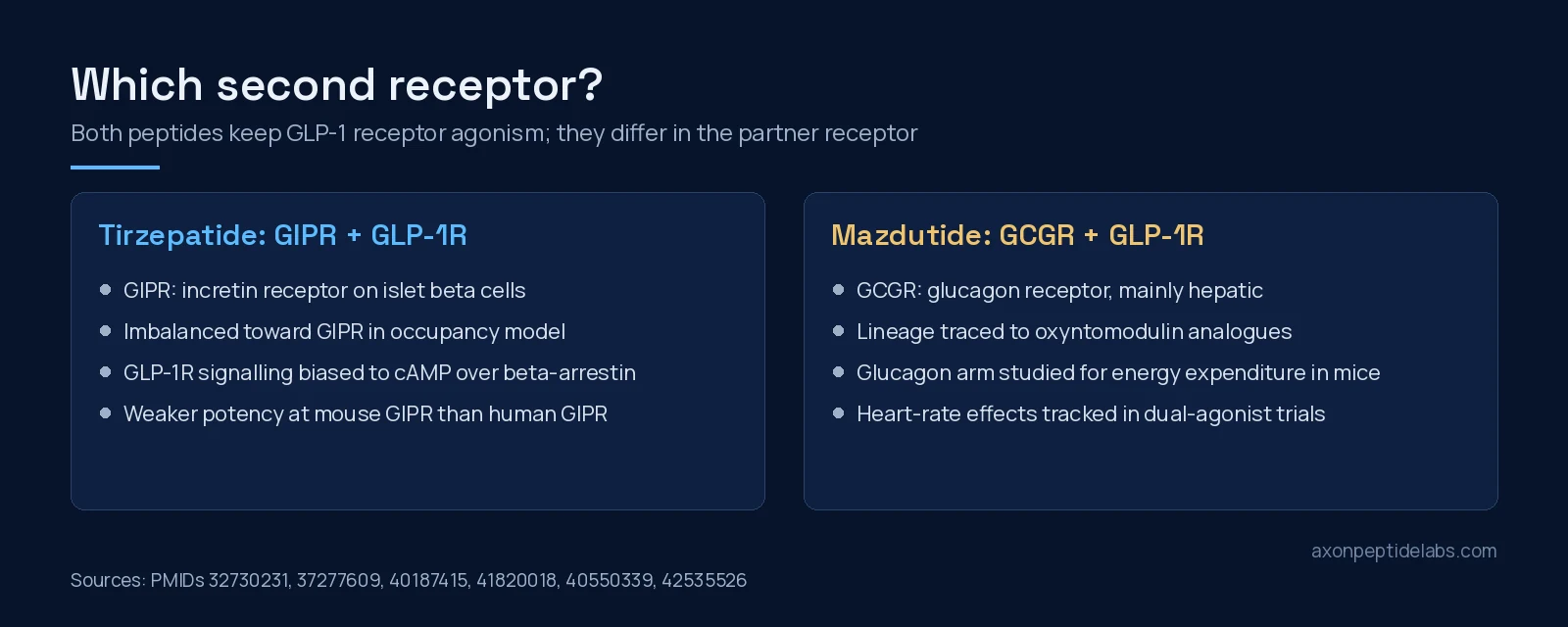
Tirzepatide is not simply “half GLP-1, half GIP.” Using receptor-occupancy calculations, a 2020 study concluded that tirzepatide engages the GIP receptor to a greater degree than the GLP-1 receptor, and called it an imbalanced agonist. At the GIP receptor it behaved like native GIP. At the GLP-1 receptor it was biased toward cAMP generation over beta-arrestin recruitment and drove less receptor internalisation than GLP-1 itself. In primary islets, beta-arrestin 1 limited the insulin response to GLP-1 but not to GIP or tirzepatide[2].
Species matters here. In mouse islets, tirzepatide stimulated insulin secretion mainly through the GLP-1 receptor because it is less potent at the mouse GIP receptor. In human islets, blocking the GIP receptor consistently reduced the insulin response to tirzepatide, and tirzepatide also increased glucagon and somatostatin secretion[3]. A 2023 review went further, proposing that tirzepatide may not act as a classical co-activator in humans, given its biased GLP-1 receptor profile and evidence of GIP receptor downregulation in vitro[4].
Signalling bias is not unique to tirzepatide. A HEK293 cell study comparing mono-, dual- and triple agonists at human GIP and GLP-1 receptors found that different ligands favoured different downstream pathways, such as ERK1/2 phosphorylation versus cAMP[7]. For researchers, the practical point is that “dual agonist” describes which receptors a peptide binds, not how it signals through them.
What the glucagon arm does
The glucagon receptor brings a different set of effects, most of them in the liver. Glucagon raises hepatic glucose output, but reviews also describe roles in fatty acid oxidation, suppression of lipid synthesis, amino acid and ketone metabolism and mitochondrial function[14]. That glucose-raising action is why glucagon agonism is paired with GLP-1 agonism to dampen glucose excursions[14].
Mouse work with a long-acting glucagon analogue found that it raised energy expenditure in diet-induced obese mice, but not in lean mice. Hepatic rather than adipose glucagon receptors were essential for that effect, which tracked with sustained cAMP/PKA signalling[12]. In a separate female-mouse study, chronic glucagon receptor activation increased amino acid catabolism and ureagenesis and caused alpha-cell hypoplasia, while receptor blockade had the opposite effects[13].
Mazdutide itself has been studied in mice. In a high-fat-diet mouse model and hepatocyte cultures, researchers examined liver lipid handling and endoplasmic reticulum stress markers[23]. In male db/db mice, it was compared with dulaglutide in behavioural and brain-pathology tests, and the authors stress that the findings apply to male mice only[22].
Side-by-side comparison
| Aspect | Tirzepatide (GIP + GLP-1) | Mazdutide (glucagon + GLP-1) | Sources |
|---|---|---|---|
| Partner receptor | GIP receptor, an incretin receptor on islet cells | Glucagon receptor, acting mainly in the liver | [3][14] |
| Natural template | Unimolecular dual-incretin concept (GLP-1/GIP) | Oxyntomodulin, which contains the glucagon sequence | [5][9][11] |
| Receptor balance described | Imbalanced toward GIPR; biased at GLP-1R | No receptor ratio found in the abstracts we reviewed | [2] |
| Key species caveat | Lower potency at mouse GIPR than human GIPR | GLP-1:glucagon effects differ between mice and rats in related co-agonists | [3][15] |
| Main preclinical themes | Islet hormone secretion, incretin signalling | Hepatic lipid handling, energy expenditure (glucagon arm) | [1][23][12] |
| Safety signal researchers track | Gastrointestinal events in early trials | Heart rate, as for other GLP-1/glucagon dual agonists | [1][16] |
Why the glucagon balance is hard to predict
Glucagon co-agonism has a translation problem that GIP co-agonism does not share in the same form. A preclinical report on NN1177, a long-acting GLP-1/glucagon co-agonist, together with two sister compounds at different receptor ratios, found that the outcome depended on the species. In diet-induced obese mice, weight loss was mostly fat mass and glucose tolerance improved. In diet-induced obese rats, total weight fell by a similar amount but mostly as lean mass, and glucose tolerance worsened. Glucose control also depended on exposure and study length, with higher glucagon-receptor preference impairing glucose tolerance at lower exposures[15]. The authors concluded that this makes it hard to identify an optimally balanced candidate, which may partly explain why few such co-agonists have succeeded[15].
Cardiovascular questions follow the same receptor. A 2026 narrative review notes that clear evidence for glucagon receptor expression in the human heart is lacking, yet high-dose glucagon has acute effects on heart rate, contractility and blood pressure. Dual agonists such as mazdutide and survodutide have generally raised heart rate to a similar extent as GLP-1 monoagonists, while at least one other dual agonist was discontinued partly because of heart-rate and QT findings. The review attributes those between-compound differences to different potencies at the two receptors[16].
The human programmes, by design only
Both peptides have been studied in humans. To keep this a research comparison, we describe designs and endpoints, not results.
- Tirzepatide, early clinical: a phase 1 randomised, placebo-controlled programme in healthy volunteers and people with type 2 diabetes, with dulaglutide as a positive control and safety and tolerability as the primary objective[1].
- Tirzepatide, SURMOUNT: four global phase 3 trials comparing tirzepatide with placebo, double-blind, with percentage change in body weight as the primary endpoint in every trial[19].
- Mazdutide, phase 1b: a randomised, placebo-controlled, multiple-ascending-dose study in Chinese adults with overweight or obesity, run over 12 weeks with 8 weeks of safety follow-up[20].
- Mazdutide, phase 3 in China: a double-blind trial randomising 610 adults to one of two dose levels or placebo for 48 weeks, with percentage change in body weight and the share of participants reaching at least 5% reduction at week 32 as co-primary endpoints[21].
The populations, comparators and durations differ, so the programmes cannot be ranked against each other. Any page that places their results side by side is comparing different experiments.
Regulatory status, stated neutrally
Tirzepatide: Health Canada’s Drug Product Database lists Mounjaro (DIN 02532891, Eli Lilly Canada) with status “Approved” dated 2022-11-24, and Zepbound (DIN 02557509) with status “Marketed” and a first market date of 2025-07-09 (Mounjaro record, Zepbound record). A 2024 drug review also describes approvals in the USA, EU and Japan for glycaemic control in type 2 diabetes[18].
Mazdutide: according to a 2025 approval profile, it received its first approval in China in June 2025 for long-term body-weight management, followed in September 2025 by a Chinese approval for glycaemic control in type 2 diabetes[17]. We could not retrieve the Chinese regulator’s own record, and a search of Health Canada’s Drug Product Database on October 7, 2026 returned no mazdutide product.
These are prescription-medicine records for finished products. They say nothing about research-grade material, and this article makes no statement about the legal status of either compound in Canada.
Documentation for these listings
Axon lists Tirzepatide 10mg (GLP-1/GIP) and Mazdutide 10mg in its metabolic research category. No certificate is posted for either product on our COA page at the time of writing. Until a batch report exists, treat a lot’s identity and purity as unverified. Researchers who want to buy lab-tested peptides in Canada can compare the documentation each listing carries before ordering.
What the evidence does not show
- It does not show that GIP co-agonism or glucagon co-agonism is the better strategy. No study has tested tirzepatide against mazdutide under one protocol.
- It does not settle how much the GIP arm contributes to tirzepatide’s effects in humans; reviewers still describe that contribution as uncertain[4].
- It does not give a published receptor-potency ratio for mazdutide in the abstracts we reviewed, so claims about its “balance” on other sites are not backed here.
- It does not transfer cleanly from rodents. Tirzepatide is weaker at the mouse GIP receptor[3], and related GLP-1/glucagon co-agonists behave differently in mice and rats[15].
- It does not establish long-term cardiovascular safety for glucagon-based dual agonists; the 2026 review says this should be clarified compound by compound in ongoing trials[16].
- The mazdutide animal studies cited here are single-laboratory mouse studies, and one is limited to male mice[22][23].
Frequently asked questions
What is the main difference between tirzepatide and mazdutide?
Both activate the GLP-1 receptor. Tirzepatide’s second target is the GIP receptor, the receptor for the other incretin hormone. Mazdutide’s second target is the glucagon receptor, which acts mainly in the liver. That partner receptor shapes the questions each peptide is used to study.
Is mazdutide related to oxyntomodulin?
Yes. Oxyntomodulin is a gut peptide that contains the glucagon sequence and weakly activates both the glucagon and GLP-1 receptors. A 2026 patent-landscape review places mazdutide among the oxyntomodulin analogues first designed by Eli Lilly and later developed by Innovent Biologics.
Does tirzepatide activate both receptors equally?
No. A 2020 receptor-occupancy and signalling study described tirzepatide as imbalanced toward the GIP receptor and biased at the GLP-1 receptor toward cAMP over beta-arrestin recruitment. Human islet work showed the GIP receptor contributes to its insulin response.
Why do mouse studies of these peptides need care?
Tirzepatide is less potent at the mouse GIP receptor than the human one, so mouse islets respond mainly through the GLP-1 receptor. For GLP-1/glucagon co-agonists, a preclinical report found different effects on body composition and glucose tolerance in mice and rats.
Has tirzepatide been compared with mazdutide in a trial?
We found no published head-to-head study. The tirzepatide and mazdutide programmes enrolled different populations with different comparators and durations, so their results cannot be ranked against each other.
Does Axon post a COA for tirzepatide or mazdutide?
No certificate is posted for Tirzepatide 10mg or Mazdutide 10mg on our COA page at the time of writing. Treat a lot’s identity and purity as unverified until a batch report is published.
References
- Coskun T, Sloop KW, Loghin C et al. (2018). LY3298176, a novel dual GIP and GLP-1 receptor agonist for the treatment of type 2 diabetes mellitus: From discovery to clinical proof of concept. Mol Metab. PMID: 30473097. doi: 10.1016/j.molmet.2018.09.009.
- Willard FS, Douros JD, Gabe MB et al. (2020). Tirzepatide is an imbalanced and biased dual GIP and GLP-1 receptor agonist. JCI Insight. PMID: 32730231. doi: 10.1172/jci.insight.140532.
- El K, Douros JD, Willard FS et al. (2023). The incretin co-agonist tirzepatide requires GIPR for hormone secretion from human islets. Nat Metab. PMID: 37277609. doi: 10.1038/s42255-023-00811-0.
- Gasbjerg LS, Rosenkilde MM, Meier JJ et al. (2023). The importance of glucose-dependent insulinotropic polypeptide receptor activation for the effects of tirzepatide. Diabetes Obes Metab. PMID: 37551549. doi: 10.1111/dom.15216.
- Finan B, Ma T, Ottaway N et al. (2013). Unimolecular dual incretins maximize metabolic benefits in rodents, monkeys, and humans. Sci Transl Med. PMID: 24174327. doi: 10.1126/scitranslmed.3007218.
- Campbell JE (2021). Targeting the GIPR for obesity: To agonize or antagonize? Potential mechanisms. Mol Metab. PMID: 33290902. doi: 10.1016/j.molmet.2020.101139.
- Yuliantie E, Darbalaei S, Dai A et al. (2020). Pharmacological characterization of mono-, dual- and tri-peptidic agonists at GIP and GLP-1 receptors. Biochem Pharmacol. PMID: 32360365. doi: 10.1016/j.bcp.2020.114001.
- Day JW, Ottaway N, Patterson JT et al. (2009). A new glucagon and GLP-1 co-agonist eliminates obesity in rodents. Nat Chem Biol. PMID: 19597507. doi: 10.1038/nchembio.209.
- Holst JJ, Rosenkilde MM (2025). Oxyntomodulin – past, present and future. Peptides. PMID: 40187415. doi: 10.1016/j.peptides.2025.171393.
- Zhihong Y, Chen W, Qianqian Z et al. (2023). Emerging roles of oxyntomodulin-based glucagon-like peptide-1/glucagon co-agonist analogs in diabetes and obesity. Peptides. PMID: 36669563. doi: 10.1016/j.peptides.2023.170955.
- Abdul Fasi M (2026). Patent landscape and therapeutic evolution of mazdutide: a dual GLP-1/Glucagon receptor agonist for obesity and type 2 diabetes. Expert Opin Ther Pat. PMID: 41820018. doi: 10.1080/13543776.2026.2645812.
- Long F, Challa TD, Ding L et al. (2025). Glucagon controls obesity-specific energy expenditure via persistent cAMP/PKA signaling. J Hepatol. PMID: 40550339. doi: 10.1016/j.jhep.2025.06.011.
- Elmelund E, Galsgaard KD, Johansen CD et al. (2022). Opposing effects of chronic glucagon receptor agonism and antagonism on amino acids, hepatic gene expression, and alpha cells. iScience. PMID: 36325048. doi: 10.1016/j.isci.2022.105296.
- Kajani S, Laker RC, Ratkova E et al. (2024). Hepatic glucagon action: beyond glucose mobilization. Physiol Rev. PMID: 38300523. doi: 10.1152/physrev.00028.2023.
- Simonsen L, Lau J, Kruse T et al. (2022). Preclinical evaluation of a protracted GLP-1/glucagon receptor co-agonist: Translational difficulties and pitfalls. PLoS One. PMID: 35245328. doi: 10.1371/journal.pone.0264974.
- Kushner PR, Michos ED (2026). Cardiovascular Effects of Glucagon Receptor Signaling Alone and Combined With Glucagon-Like Peptide-1 Receptor Signaling in Multiagonists: A Narrative Review With a Translational Focus. J Am Heart Assoc. PMID: 42535526. doi: 10.1161/JAHA.126.049727.
- Shirley M (2025). Mazdutide: First Approval. Drugs. PMID: 41028652. doi: 10.1007/s40265-025-02249-y.
- France NL, Syed YY (2024). Tirzepatide: A Review in Type 2 Diabetes. Drugs. PMID: 38388874. doi: 10.1007/s40265-023-01992-4.
- le Roux CW, Zhang S, Aronne LJ et al. (2023). Tirzepatide for the treatment of obesity: Rationale and design of the SURMOUNT clinical development program. Obesity (Silver Spring). PMID: 36478180. doi: 10.1002/oby.23612.
- Ji L, Jiang H, An P et al. (2021). IBI362 (LY3305677), a weekly-dose GLP-1 and glucagon receptor dual agonist, in Chinese adults with overweight or obesity: A randomised, placebo-controlled, multiple ascending dose phase 1b study. EClinicalMedicine. PMID: 34430840. doi: 10.1016/j.eclinm.2021.101088.
- Ji L, Jiang H, Bi Y et al. (2025). Once-Weekly Mazdutide in Chinese Adults with Obesity or Overweight. N Engl J Med. PMID: 40421736. doi: 10.1056/NEJMoa2411528.
- Dong W, Bai J, Yuan Q et al. (2025). Mazdutide, a dual agonist targeting GLP-1R and GCGR, mitigates diabetes-associated cognitive dysfunction: mechanistic insights from multi-omics analysis. EBioMedicine. PMID: 40479843. doi: 10.1016/j.ebiom.2025.105791.
- Gan L, Duan L, Zheng X (2026). Mazdutide Ameliorates Metabolic Dysfunction-Associated Steatotic Liver Disease by Modulating Endoplasmic Reticulum Stress, Improving Lipid Metabolism and Alleviating Inflammation. Pharmaceuticals (Basel). PMID: 41901218. doi: 10.3390/ph19030371.