
SS-31 vs MOTS-c: Cardiolipin Binder vs Mitochondrial Signal
Short answer: SS-31 and MOTS-c are both called “mitochondrial peptides”, but they reach that label from opposite directions. SS-31 (elamipretide) is a synthetic four-residue peptide designed to accumulate at the inner mitochondrial membrane, where it binds the phospholipid cardiolipin [1][2]. MOTS-c is a 16-residue peptide encoded inside the mitochondrial genome itself; in mouse studies it acts as a signal, inhibiting the folate cycle, activating AMPK in skeletal muscle and, under stress, moving into the nucleus to change gene expression [3][4]. One is a membrane-binding tool compound with a regulatory history; the other is an endogenous signalling molecule whose evidence is mostly cell and animal work.
For laboratory research only. Not for human or animal use. This article gives no dosing, administration or therapeutic advice.
Supplier pages and forums often present the two as a “mitochondrial stack” with performance language attached. This article does something narrower: it sets out what each molecule is, what the primary papers measured and in which model, which trials returned null results, and what our own documentation shows for each listing.
Two different origins
SS-31 belongs to the Szeto-Schiller (SS) peptide series. The series was built around a structural motif of alternating aromatic and basic residues, with 2′,6′-dimethyltyrosine (Dmt) supplying radical-scavenging chemistry. In the founding cell work these peptides were cell-permeable and concentrated roughly 1000-fold in the inner mitochondrial membrane, where they reduced reactive oxygen species and prevented mitochondrial swelling in neuronal cell lines [1]. A 2006 review from the same laboratory framed the SS peptides as a way to deliver antioxidant activity to the site where mitochondrial radicals are generated, rather than relying on antioxidants that never reach it [5].
MOTS-c was found by looking for short open reading frames in mitochondrial DNA. The 2015 discovery paper reported a sequence within the 12S rRNA gene that encodes a 16-amino-acid peptide, named it MOTS-c (mitochondrial open reading frame of the 12S rRNA-c), and identified skeletal muscle as its apparent primary target organ in mice [3]. It was the second mitochondrial-derived signalling peptide described after humanin, and the authors presented it as evidence that mitochondria can signal to the rest of the cell and body through peptides encoded in their own genome [3].
So SS-31 is a designed molecule that goes to the mitochondrion; MOTS-c is a natural product of the mitochondrion that acts mostly outside it.
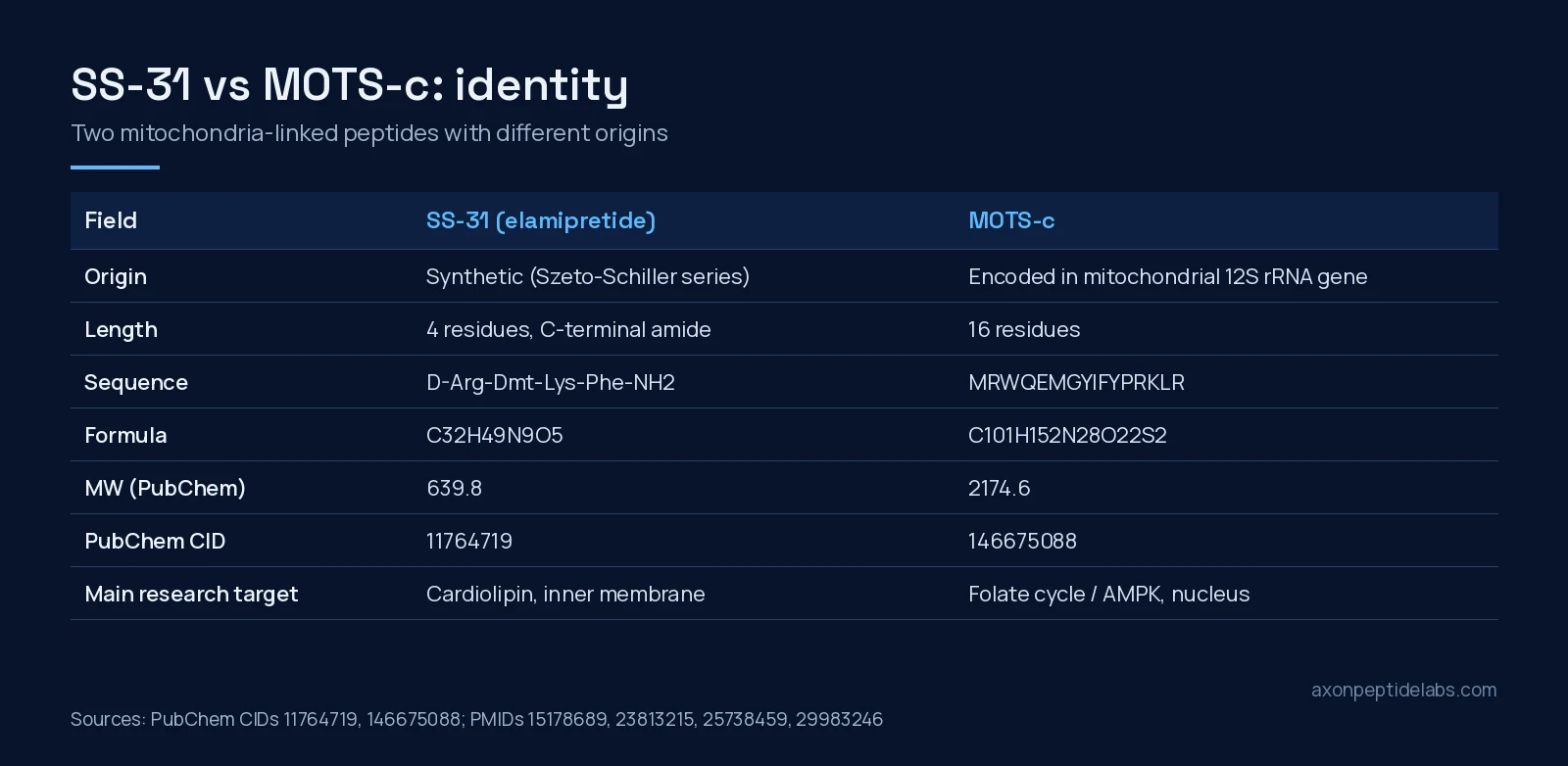
Identity table
Values below were taken from PubChem records on October 12, 2026, not from certificates of analysis or supplier labels.
| Field | SS-31 (elamipretide) | MOTS-c |
|---|---|---|
| Sequence | D-Arg-Dmt-Lys-Phe-NH2 (Dmt = 2′,6′-dimethyltyrosine) | MRWQEMGYIFYPRKLR |
| Length | 4 residues, C-terminal amide | 16 residues |
| Molecular formula | C32H49N9O5 | C101H152N28O22S2 |
| Molecular weight (PubChem) | 639.8 | 2174.6 |
| PubChem CID | 11764719 | 146675088 |
| CAS (PubChem synonyms) | 736992-21-5 | 1627580-64-6 |
| Other names | Elamipretide, MTP-131, Bendavia | Mitochondria-derived peptide MOTS-c |
| Origin | Synthetic | Encoded in the mitochondrial 12S rRNA gene |
The size gap matters in the lab. SS-31 is a small, highly basic tetrapeptide containing a non-natural amino acid and a D-amino acid; MOTS-c is a natural-sequence 16-mer with two methionines, which makes oxidation a practical handling concern for anyone storing or analysing it.
Mechanism: membrane binding vs signalling
SS-31 and cardiolipin
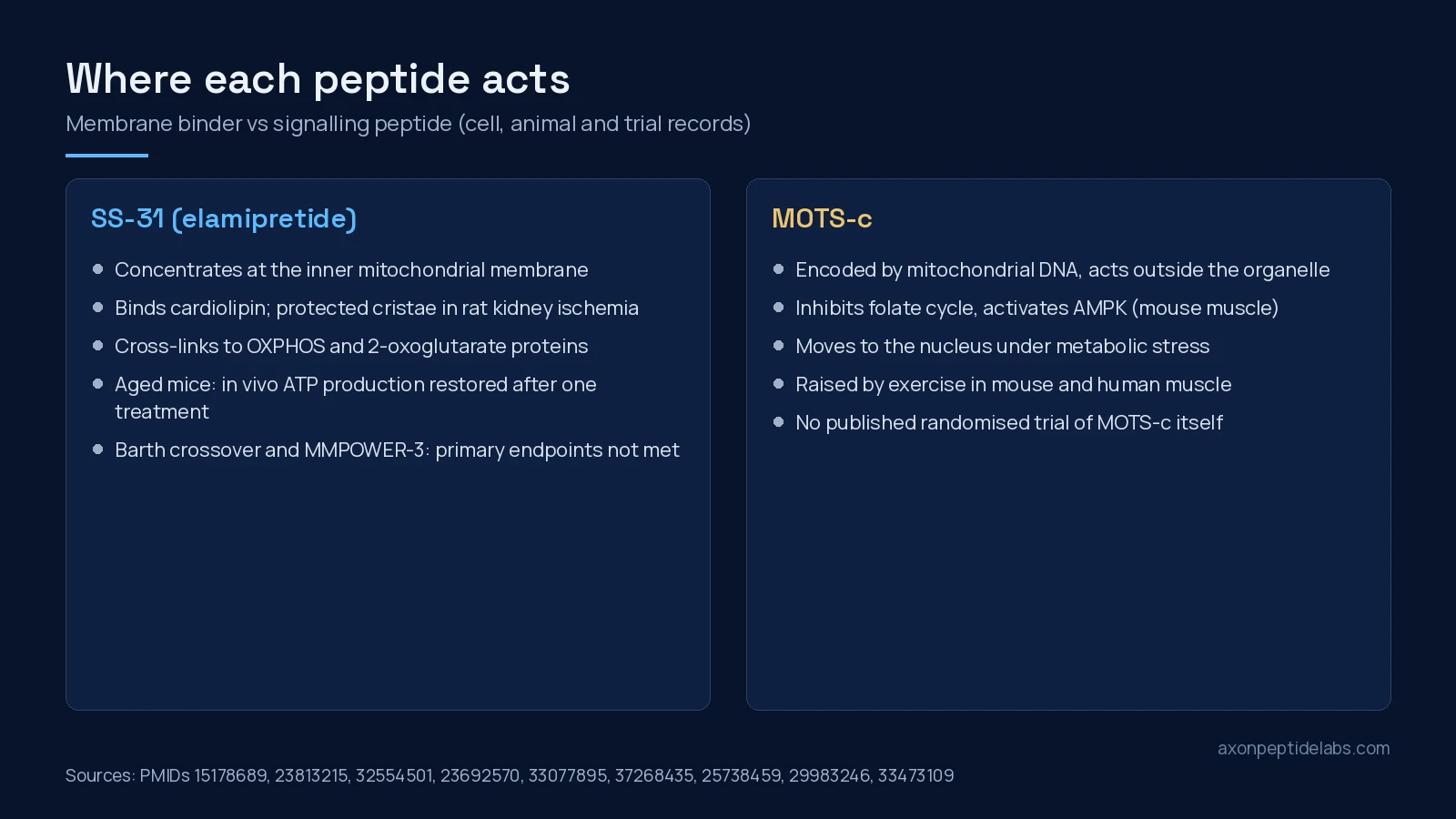
The cardiolipin model of SS-31 comes from a 2013 rat study of kidney ischemia. Using a fluorescent analogue, the authors showed SS-31 binding cardiolipin with high affinity; the SS-31/cardiolipin complex inhibited the peroxidase activity of cytochrome c, and pretreatment protected cristae membranes and prevented mitochondrial swelling during renal ischemia [2]. A review the following year described cardiolipin as the lipid that organises respiratory complexes into supercomplexes and argued that protecting it was the basis of the compound’s activity [6].
Later biophysics refined that picture. A 2020 study using model and mitochondrial membranes reported that SS-31 partitions into the membrane interfacial region and alters surface electrostatics, suggesting part of its effect is on the membrane as a whole rather than on one lipid alone [7]. Cross-linking mass spectrometry in isolated mitochondria the same year found that SS-31’s protein partners were all known cardiolipin binders, clustered in oxidative phosphorylation and 2-oxoglutarate metabolism [8].
MOTS-c, AMPK and the nucleus
In the discovery work, MOTS-c’s cellular actions inhibited the folate cycle and the de novo purine synthesis tied to it, which led to AMPK activation; in mice, treatment prevented diet-induced and age-dependent insulin resistance [3]. A 2018 follow-up reported that under glucose restriction MOTS-c moves into the nucleus in an AMPK-dependent manner, regulates genes carrying antioxidant response elements, and interacts with stress-responsive transcription factors such as NRF2 [4]. In C2C12 myotubes and diet-induced obese mice, MOTS-c reduced myostatin signalling through a CK2-PTEN-mTORC2-AKT-FOXO1 pathway [9].
Put side by side, SS-31 is studied as something that changes the physical environment of the respiratory chain, while MOTS-c is studied as a messenger that changes which genes and pathways are switched on. They are not alternative versions of one mechanism.
What each line of research measured
| Question | SS-31 (elamipretide) | MOTS-c |
|---|---|---|
| Main cell/animal readout | In vivo mitochondrial ATP production and coupling in aged mouse muscle, measured by 31P and optical spectroscopy [10] | Insulin sensitivity and diet-induced weight gain in mice [3]; physical capacity in young, middle-aged and old mice [11] |
| Longer animal study | 8 weeks in aged female mice: ATP production and coupling restored, but mitochondrial protein content and permeabilised-fibre respiration did not differ from untreated aged mice [12] | Late-life intermittent treatment in mice increased physical capacity [11] |
| Human data | Randomised trials in Barth syndrome [13] and primary mitochondrial myopathy [14] | Plasma levels and exercise response only [15][16]; a human mtDNA variant (K14Q) in genetic association data [17] |
| Regulatory status | Elamipretide received FDA accelerated approval for Barth syndrome on September 19, 2025 [18] (FDA announcement) | No approved product located |
SS-31 in animals
The most quoted SS-31 animal result is from aged mice: one hour after a single treatment, resting and maximal mitochondrial ATP production, coupling of oxidative phosphorylation and cell energy state in skeletal muscle were restored toward young levels, while young muscle was unaffected [10]. The 8-week follow-up in aged females found the same functional shift alongside restored redox balance, but no increase in mitochondrial protein, and no difference in respiration of permeabilised muscle fibres [12]. That second point is worth reading carefully: the in vivo change was not matched by an ex vivo one.
MOTS-c in animals and cells
MOTS-c work is concentrated in mouse metabolism and muscle. Beyond the discovery paper, a 2021 study reported improved physical performance in mice of three ages and regulation of nuclear genes related to metabolism and proteostasis [11]. The myostatin work used cultured myotubes and diet-induced obese mice [9]. A genetic study added a useful control: the East Asian mtDNA variant m.1382A>C changes lysine 14 to glutamine (K14Q), and in high-fat-fed male mice the native peptide reduced weight and improved glucose tolerance while K14Q-MOTS-c did not; female mice were unaffected by either [17].
The null results
Both molecules have results that did not go the expected way, and they rarely appear on sales pages.
- SS-31, Barth syndrome: in the randomised, double-blind, placebo-controlled crossover part of the phase 2/3 trial (12 participants), neither primary endpoint (6-minute walk test and a symptom scale) was met; changes were reported only in the open-label extension that followed [13]. The FDA approval in 2025 was an accelerated approval with a confirmatory trial required [18].
- SS-31, primary mitochondrial myopathy: MMPOWER-3, a phase 3 randomised trial with 218 participants, did not meet its primary endpoints of 6-minute walk distance and total fatigue score at 24 weeks [14].
- MOTS-c, human plasma: plasma MOTS-c concentration was similar in lean and obese adults; it correlated with insulin-sensitivity indexes only in lean participants [15].
- MOTS-c, exercise: in a 16-week exercise trial in breast cancer survivors, plasma MOTS-c rose in non-Hispanic White participants but not in Hispanic participants [16].
What the evidence does not show
- No head-to-head study. We found no paper that tested SS-31 and MOTS-c in the same experiment. Claims that one is “better” than the other, or that the two work together, are not backed by a direct comparison.
- No published randomised trial of MOTS-c itself. Human MOTS-c data are measurements of the body’s own peptide, not studies of a supplied peptide.
- Animal results do not transfer automatically. SS-31’s aged-mouse findings were followed by two human trials that missed their primary endpoints [13][14].
- Grey-market framing is not evidence. A 2026 sports-medicine review that covers both peptides notes that many unapproved peptides look favourable in animal models but have scarce rigorous human safety data [19].
- Long-term safety of research material is unstudied. The approval of elamipretide covers a specific medicine for a specific condition, not research-grade peptide.
Documentation for our listings
Axon carries SS-31 10mg, MOTS-C 10mg and a MOTS-C 10mg pen. Our COA page lists MOTS-C 10mg (pen), batch MP-MOTS-10-041626, purity 99.89%, dated 28 APR 2026, lab testides.com. That report names the pen format and the batch shown; match the batch on any item you receive against it. No certificate is posted for SS-31 on our COA page at the time of writing. Identity values in this article come from PubChem, not from batch documents. More background on MOTS-c is on our MOTS-c Canada page, and two related comparisons are Methylene Blue vs SS-31 and SLU-PP-332 vs MOTS-c. When you are ready to order, you can buy lab-tested peptides in Canada with batch documentation on our COA page where it exists.
Frequently asked questions
Is SS-31 the same kind of peptide as MOTS-c?
No. SS-31 (elamipretide) is a synthetic four-residue peptide, D-Arg-Dmt-Lys-Phe-NH2, designed to concentrate at the inner mitochondrial membrane and bind cardiolipin. MOTS-c is a natural 16-residue peptide encoded in the mitochondrial 12S rRNA gene that acts mainly as a signalling molecule in cell and mouse studies.
How do their mechanisms differ?
In rat and cell studies SS-31 binds cardiolipin, protects cristae and changes membrane surface electrostatics. In mouse and cell studies MOTS-c inhibits the folate cycle, activates AMPK and can move into the nucleus to regulate stress-response genes. One acts on the membrane; the other acts as a messenger.
Has SS-31 or MOTS-c been tested in humans?
Elamipretide has randomised trials in Barth syndrome and primary mitochondrial myopathy; the crossover part of the Barth trial and the phase 3 myopathy trial did not meet their primary endpoints. For MOTS-c, human data are measurements of the body’s own plasma levels and exercise responses, not trials of supplied peptide.
Is elamipretide approved anywhere?
The FDA granted elamipretide accelerated approval for Barth syndrome on September 19, 2025, with a confirmatory trial required. That approval covers a specific medicine. Research-grade SS-31 is not covered by it, and no approved MOTS-c product was located.
Has anyone compared SS-31 and MOTS-c directly?
We found no study that tested the two in the same experiment. Statements that one outperforms the other, or that they combine well, are not supported by a direct comparison in the published literature.
Does Axon Peptide Labs post a COA for these products?
Our COA page lists MOTS-C 10mg (pen), batch MP-MOTS-10-041626, 99.89% purity, dated 28 APR 2026, tested by testides.com. No certificate is posted for SS-31 on our COA page at the time of writing.
References
- Zhao K, Zhao GM, Wu D et al. (2004). Cell-permeable peptide antioxidants targeted to inner mitochondrial membrane inhibit mitochondrial swelling, oxidative cell death, and reperfusion injury. J Biol Chem. PMID: 15178689. doi: 10.1074/jbc.M402999200.
- Birk AV, Liu S, Soong Y et al. (2013). The mitochondrial-targeted compound SS-31 re-energizes ischemic mitochondria by interacting with cardiolipin. J Am Soc Nephrol. PMID: 23813215. doi: 10.1681/ASN.2012121216.
- Lee C, Zeng J, Drew BG et al. (2015). The mitochondrial-derived peptide MOTS-c promotes metabolic homeostasis and reduces obesity and insulin resistance. Cell Metab. PMID: 25738459. doi: 10.1016/j.cmet.2015.02.009.
- Kim KH, Son JM, Benayoun BA et al. (2018). The Mitochondrial-Encoded Peptide MOTS-c Translocates to the Nucleus to Regulate Nuclear Gene Expression in Response to Metabolic Stress. Cell Metab. PMID: 29983246. doi: 10.1016/j.cmet.2018.06.008.
- Szeto HH (2006). Cell-permeable, mitochondrial-targeted, peptide antioxidants. AAPS J. PMID: 16796378. doi: 10.1007/BF02854898.
- Szeto HH (2014). First-in-class cardiolipin-protective compound as a therapeutic agent to restore mitochondrial bioenergetics. Br J Pharmacol. PMID: 24117165. doi: 10.1111/bph.12461.
- Mitchell W, Ng EA, Tamucci JD et al. (2020). The mitochondria-targeted peptide SS-31 binds lipid bilayers and modulates surface electrostatics as a key component of its mechanism of action. J Biol Chem. PMID: 32273339. doi: 10.1074/jbc.RA119.012094.
- Chavez JD, Tang X, Campbell MD et al. (2020). Mitochondrial protein interaction landscape of SS-31. Proc Natl Acad Sci U S A. PMID: 32554501. doi: 10.1073/pnas.2002250117.
- Kumagai H, Coelho AR, Wan J et al. (2021). MOTS-c reduces myostatin and muscle atrophy signaling. Am J Physiol Endocrinol Metab. PMID: 33554779. doi: 10.1152/ajpendo.00275.2020.
- Siegel MP, Kruse SE, Percival JM et al. (2013). Mitochondrial-targeted peptide rapidly improves mitochondrial energetics and skeletal muscle performance in aged mice. Aging Cell. PMID: 23692570. doi: 10.1111/acel.12102.
- Reynolds JC, Lai RW, Woodhead JST et al. (2021). MOTS-c is an exercise-induced mitochondrial-encoded regulator of age-dependent physical decline and muscle homeostasis. Nat Commun. PMID: 33473109. doi: 10.1038/s41467-020-20790-0.
- Campbell MD, Duan J, Samuelson AT et al. (2019). Improving mitochondrial function with SS-31 reverses age-related redox stress and improves exercise tolerance in aged mice. Free Radic Biol Med. PMID: 30597195. doi: 10.1016/j.freeradbiomed.2018.12.031.
- Reid Thompson W, Hornby B, Manuel R et al. (2021). A phase 2/3 randomized clinical trial followed by an open-label extension to evaluate the effectiveness of elamipretide in Barth syndrome, a genetic disorder of mitochondrial cardiolipin metabolism. Genet Med. PMID: 33077895. doi: 10.1038/s41436-020-01006-8.
- Karaa A, Bertini E, Carelli V et al. (2023). Efficacy and Safety of Elamipretide in Individuals With Primary Mitochondrial Myopathy: The MMPOWER-3 Randomized Clinical Trial. Neurology. PMID: 37268435. doi: 10.1212/WNL.0000000000207402.
- Cataldo LR, Fernández-Verdejo R, Santos JL et al. (2018). Plasma MOTS-c levels are associated with insulin sensitivity in lean but not in obese individuals. J Investig Med. PMID: 29593067. doi: 10.1136/jim-2017-000681.
- Dieli-Conwright CM, Sami N, Norris MK et al. (2021). Effect of aerobic and resistance exercise on the mitochondrial peptide MOTS-c in Hispanic and Non-Hispanic White breast cancer survivors. Sci Rep. PMID: 34413391. doi: 10.1038/s41598-021-96419-z.
- Zempo H, Kim SJ, Fuku N et al. (2021). A pro-diabetogenic mtDNA polymorphism in the mitochondrial-derived peptide, MOTS-c. Aging (Albany NY). PMID: 33468709. doi: 10.18632/aging.202529.
- Zhao C, Zhuang X, Gao J (2026). Elamipretide: The first cardiolipin-directed mitochondrial therapeutic for Barth syndrome approved under accelerated approval. Drug Discov Ther. PMID: 41260682. doi: 10.5582/ddt.2025.01111.
- Mendias CL, Awan TM (2026). Safety and Efficacy of Approved and Unapproved Peptide Therapies for Musculoskeletal Injuries and Athletic Performance. Sports Med. PMID: 41966639. doi: 10.1007/s40279-026-02437-0.