
Gonadorelin vs hCG: Two Ways to Study the HPG Axis
For laboratory research only. Not for human or animal use. This article gives no dosing, administration or therapeutic advice.
Short answer: Gonadorelin and hCG enter the hypothalamic-pituitary-gonadal (HPG) axis at different levels. Gonadorelin is synthetic GnRH [1], a decapeptide that acts on GnRH receptors on pituitary gonadotrophs [2][3], so its readout runs through LH and FSH release. hCG is a two-subunit glycoprotein [4] that acts directly at the LH/CG receptor (LHCGR) on gonadal cells [5], skipping the pituitary. Use a GnRH-level tool to ask how the pituitary responds; use hCG to ask how the gonad responds to LH-receptor signalling on its own.
Where each one acts
The HPG axis has three tiers: the hypothalamus releases GnRH, the pituitary answers with LH and FSH, and the gonads respond to those gonadotropins. GnRH is the pivotal hypothalamic hormone of that chain, and more than 20 forms of the decapeptide have been identified, all with conserved N- and C-terminal sequences that are essential for receptor binding and activation [2]. In mammals, GnRH I is the form that regulates gonadotropin release [2].
hCG works one tier lower. LH and hCG both act through the LH/CG receptor, a G protein-coupled receptor; binding can engage Gs, Gq/11 and Gi proteins and beta-arrestins, with cAMP-dependent cascades among the outputs [5]. Because hCG binds the gonadal receptor itself, it reproduces the LH signal without needing the pituitary.
Gonadorelin: a pituitary-level tool
The principal physiological site of GnRH action is the pituitary gonadotroph, where it binds high-affinity receptors and triggers an immediate release of LH and FSH within minutes, synthesis of LH and FSH over hours, and longer-term changes over days [3]. Receptor occupation activates phospholipase C, producing inositol trisphosphate and diacylglycerol, which activates protein kinase C [3]. Gonadorelin is also a subject of analytical method development in its own right, as a small peptide hormone measured by chromatography, immunochemistry and affinity sensors [6].
Why the pattern of exposure matters
GnRH regulates its own receptors depending on whether exposure is pulsatile or continuous, increasing or decreasing receptor numbers respectively. Down-regulation contributes to desensitization, together with uncoupling of receptors from signalling and depletion of LH stores [3]. In rhesus monkeys whose own GnRH input had been removed, changing the frequency or the amplitude of GnRH pulses had profound effects on plasma gonadotropins and on the FSH to LH ratio, and raising pulse frequency led to declines caused by reduced pituitary responses [7]. Continuous GnRH is described as desensitizing the pituitary-ovarian axis [8]. For a lab model, the timing of a GnRH-level stimulus is part of the experiment, not a detail.
hCG: a gonad-level tool
The crystal structure of hCG shows two different subunits, each folded around a cystine knot formed by three disulphide bonds. A segment of the beta subunit wraps around the alpha subunit like a seat belt, fastened by the Cys26-Cys110 disulphide, and this feature appears essential both for holding the heterodimer together and for receptor binding [4].
LH and hCG share the receptor but not every downstream effect. In cells expressing LHCGR and in primary human granulosa cells, recombinant hLH and hCG differed in the kinetics of cAMP production and in activation of ERK1/2 and AKT [9]. So hCG is a convenient LH-receptor agonist for gonad-level work, but it is not an exact stand-in for LH. The hCG 5000IU product page describes it as a glycoprotein hormone studied in relation to LH receptor activity, steroidogenesis models and gonadotropin comparison.
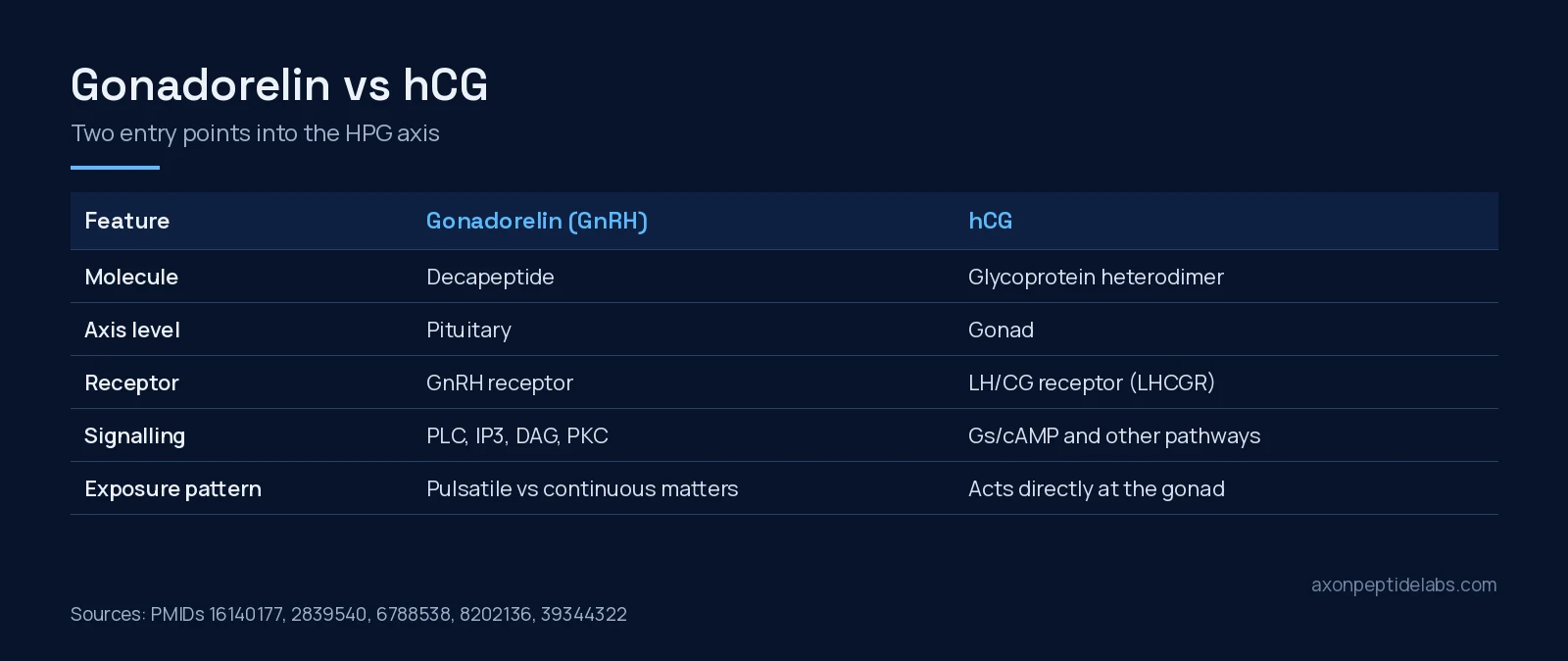
Gonadorelin vs hCG at a glance
| Feature | Gonadorelin (GnRH) | hCG |
|---|---|---|
| Molecule | Decapeptide [2] | Glycoprotein heterodimer, alpha and beta subunits [4] |
| Level of the HPG axis | Pituitary | Gonad |
| Receptor | GnRH receptor on gonadotrophs [3] | LH/CG receptor (LHCGR) [5] |
| Main signalling | Phospholipase C, IP3, DAG, protein kinase C [3] | Gs/cAMP plus Gq/11, Gi and beta-arrestin pathways [5] |
| Readout | LH and FSH release | Gonadal response, such as steroidogenesis |
| Exposure pattern | Pulsatile vs continuous changes the response [3][7] | Acts directly; LH and hCG signal differently at one receptor [9] |
Choosing between them for a study
- Is the pituitary responsive? A GnRH-level stimulus answers that, because its effect passes through gonadotroph LH and FSH release [3].
- Is the gonad responsive on its own? hCG answers that by acting at LHCGR directly [5].
- Studying desensitization: GnRH systems show it clearly with continuous exposure [3][8].
- Studying LH-receptor bias: compare hCG with LH, since they signal differently at one receptor [9].
For other upstream and downstream tools, see kisspeptin-10 vs hCG (kisspeptin acts above GnRH) and hCG vs hMG (LH-like vs combined LH and FSH activity).
Limits of this comparison
- Most GnRH data cited here are for GnRH itself, and the pulse study was in rhesus monkeys [7]; they describe the pathway gonadorelin uses rather than a specific product.
- No head-to-head study is cited. The comparison is built from separate papers on each compound.
- Axon does not list gonadorelin. This article compares mechanisms; Axon’s hormone range includes hCG, hMG and kisspeptin-10.
- Research use only. Nothing here concerns human or animal use.
Sourcing for laboratory work
Axon’s hormone peptides for HPG axis research include hCG 5000IU (5000 IU per vial, not pre-mixed), kisspeptin-10 for upstream work and hMG 75IU, all for laboratory research only. To buy lab-tested peptides in Canada, review the available batch documentation in the COA library first.
Frequently asked questions
What is the difference between gonadorelin and hCG?
Gonadorelin is synthetic GnRH, a decapeptide that acts on pituitary gonadotrophs to release LH and FSH. hCG is a glycoprotein that acts directly at the LH/CG receptor on gonadal cells, bypassing the pituitary.
Why does the timing of GnRH exposure matter in research?
GnRH up-regulates its receptors with pulsatile exposure and down-regulates them with continuous exposure, which contributes to desensitization. In rhesus monkeys, changing pulse frequency or amplitude markedly changed gonadotropin levels.
Do LH and hCG act on the same receptor?
Yes, both act through LHCGR. A study comparing recombinant hLH and hCG found differences in cAMP kinetics and in ERK1/2 and AKT activation, so they are not interchangeable in every readout.
What does hCG’s structure look like?
hCG has an alpha and a beta subunit, each with a cystine knot. A beta-subunit segment wraps around the alpha subunit like a seat belt, held by a disulphide bond that appears essential for the dimer and for receptor binding.
Does Axon sell gonadorelin?
No. Axon’s hormone peptides category lists hCG 5000IU, hMG 75IU and kisspeptin-10 for laboratory research only.
References
- (1983). Gonadorelin–synthetic LH-RH. Med Lett Drugs Ther. PMID: 6358816.
- Millar RP (2005). GnRHs and GnRH receptors. Anim Reprod Sci. PMID: 16140177. doi: 10.1016/j.anireprosci.2005.05.032.
- Clayton RN (1988). Mechanism of GnRH action in gonadotrophs. Hum Reprod. PMID: 2839540. doi: 10.1093/oxfordjournals.humrep.a136732.
- Lapthorn AJ, Harris DC, Littlejohn A et al. (1994). Crystal structure of human chorionic gonadotropin. Nature. PMID: 8202136. doi: 10.1038/369455a0.
- Shpakov AO (2024). Hormonal and Allosteric Regulation of the Luteinizing Hormone/Chorionic Gonadotropin Receptor. Front Biosci (Landmark Ed). PMID: 39344322. doi: 10.31083/j.fbl2909313.
- Torrini F, Scarano S, Palladino P et al. (2023). Advances and perspectives in the analytical technology for small peptide hormones analysis: A glimpse to gonadorelin. J Pharm Biomed Anal. PMID: 36858006. doi: 10.1016/j.jpba.2023.115312.
- Wildt L, Häusler A, Marshall G et al. (1981). Frequency and amplitude of gonadotropin-releasing hormone stimulation and gonadotropin secretion in the rhesus monkey. Endocrinology. PMID: 6788538. doi: 10.1210/endo-109-2-376.
- Schneider F, Tomek W, Gründker C (2006). Gonadotropin-releasing hormone (GnRH) and its natural analogues: a review. Theriogenology. PMID: 16650469. doi: 10.1016/j.theriogenology.2006.03.025.
- Casarini L, Lispi M, Longobardi S et al. (2012). LH and hCG action on the same receptor results in quantitatively and qualitatively different intracellular signalling. PLoS One. PMID: 23071612. doi: 10.1371/journal.pone.0046682.