
hCG vs hMG: Structure, Receptors and What the Research Shows
For laboratory research only. Not for human or animal use. This article gives no dosing, administration or therapeutic advice.
Short answer: hCG and hMG are not two versions of the same thing. hCG (human chorionic gonadotropin) is one glycoprotein hormone that acts at a single receptor, the LH/hCG receptor (LHCGR). hMG (human menopausal gonadotropin, menotropins) is a urinary extract that carries two kinds of activity, FSH-like and LH-like, so it reaches two receptors: FSHR and LHCGR. In the highly purified hMG preparations that have been analysed, most of the “LH activity” turns out to be hCG [1][2]. That single fact explains most of the practical differences researchers care about.
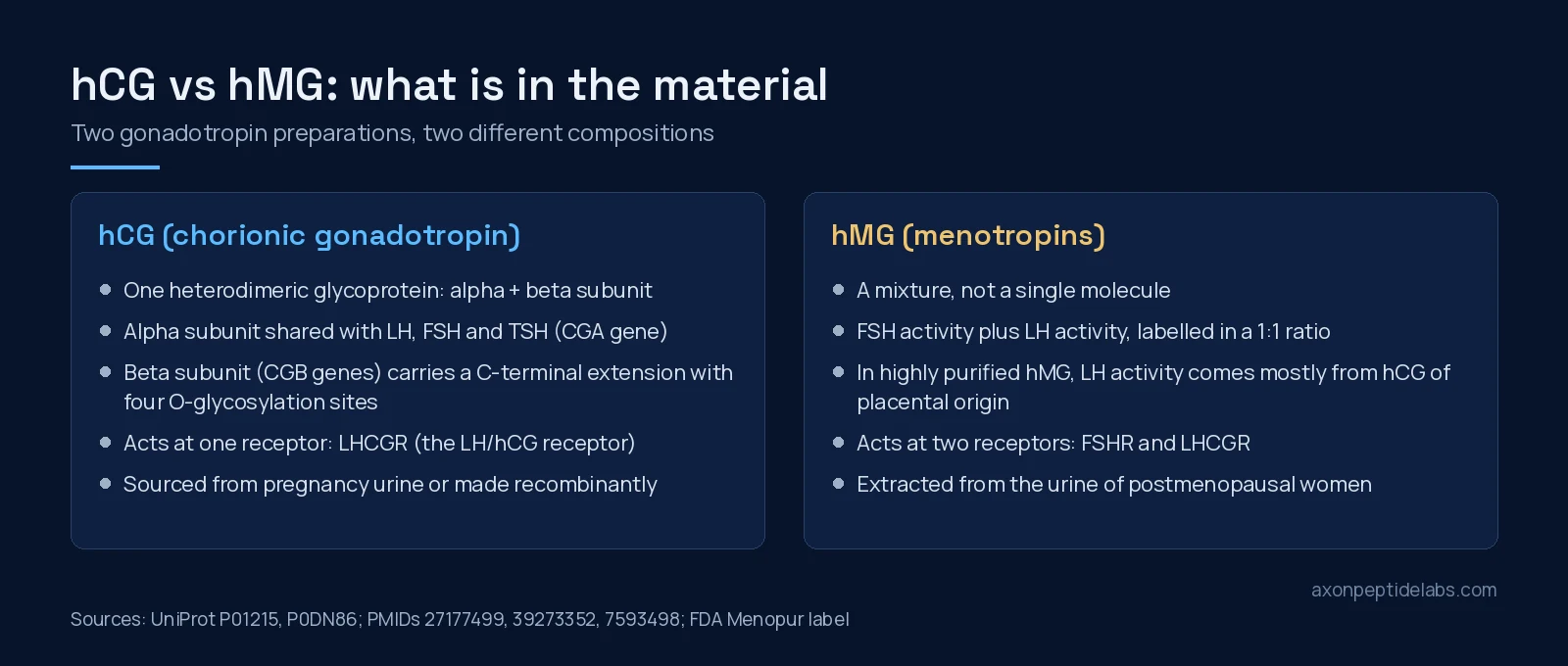
Below we set out what each material is, how the receptor biology differs, which research models use which, what head-to-head clinical comparisons found (including the null results), and what the evidence does not support. Everything here is sourced to PubMed, UniProt or a regulator’s label.
Identity at a glance
Both materials are glycoproteins built from an alpha and a beta subunit, so they have no single small-molecule record. A PubChem name lookup for “chorionic gonadotropin” returns CID 1108, which is a C17H28 steroid ring skeleton that only carries the name as a synonym, and the urofollitropin record (CID 73759969, C42H65N11O12S2) is a small fragment record, not the intact glycoprotein hormone. We use UniProt protein accessions instead, because they describe the actual subunits.
| Item | hCG | hMG (menotropins) |
|---|---|---|
| Also called | Chorionic gonadotropin, choriogonadotropin | Human menopausal gonadotropin, menotropins |
| What it is | A single heterodimeric glycoprotein hormone | A purified urinary mixture with FSH and LH activity |
| Alpha subunit | Glycoprotein hormones alpha chain, gene CGA, UniProt P01215 (116 aa precursor) | Same alpha chain (P01215) in both FSH and hCG/LH |
| Beta subunit | Choriogonadotropin subunit beta 3, genes CGB3/CGB5/CGB8, UniProt P0DN86 (165 aa precursor) | Follitropin beta, FSHB, P01225 (129 aa); lutropin beta, LHB, P01229 (141 aa), found only in traces in analysed HP-hMG; plus hCG beta |
| Receptor | LHCGR | FSHR and LHCGR |
| Source | Pregnancy urine, or recombinant | Urine of postmenopausal women |
| Single PubChem CID | None (the name lookup maps to an unrelated steroid skeleton) | None |
What hCG is
hCG is the first hormonal signal from the placenta. It is a heavily glycosylated heterodimer: its alpha subunit is identical to the alpha subunit of LH, FSH and TSH, while the beta subunit is specific and carries two N-glycosylation sites and four O-glycosylation sites [3]. The beta subunit is what gives hCG its receptor specificity, and hCG shares that receptor with LH. A 2016 review describes hCG as behaving like a “super LH agonist” on the corpus luteum [3].
“hCG” is also not one molecule in biology. A review by Cole lists four distinct forms made by different cells: classic hCG from syncytiotrophoblast, hyperglycosylated hCG from cytotrophoblast, a free beta subunit made by some non-trophoblastic tumours, and a sulfated pituitary hCG produced at low levels during the menstrual cycle [4]. Which glycoform a preparation contains depends on where it came from [3].
The older assumption was that LH and hCG are interchangeable because they bind the same receptor. Work since the 2010s says otherwise, at least in cells. In LHCGR-expressing cell lines and human primary granulosa cells, recombinant hCG was about five-fold more potent than LH for cAMP production, while LH produced stronger and more sustained ERK1/2 and AKT activation, and some target genes were regulated through different pathways depending on the ligand [5]. A review by Choi and Smitz makes the same point: the two hormones share a receptor but differ downstream [6].
The picture changes with the model. In primary mouse Leydig cells, hCG was about ten-fold more potent than LH for cAMP, but downstream CREB phosphorylation, Stard1 expression and testosterone output did not differ [7]. So the “hCG signals differently from LH” finding comes from human granulosa cells and did not carry over to mouse testis cells. That matters if you are choosing a model.
What hMG is
hMG is defined by its activity, not by a single structure. The FDA label for Menopur describes it as gonadotropins with FSH and LH activity, extracted from the urine of postmenopausal women and further purified, with FSH and LH activity in a 1:1 ratio, and with that activity assigned by rat bioassays (ovarian weight gain for FSH, seminal vesicle weight gain for LH) (FDA prescribing label, NLM label database).
Where does the LH activity come from? A 1995 crossover pharmacokinetic study in nine women with suppressed endogenous gonadotropins found that the LH activity measured after two hMG preparations was a composite of specific LH and hCG [2]. A 2024 mass-spectrometry study of highly purified hMG samples went further: LH beta subunit was detected only in traces, about 0.9 to 1.2% of gonadotropin content, while beta-hCG made up roughly 18 to 47%. The hCG lacked the sulfated glycans typical of pituitary hCG and matched placental hCG, which points to a placental (pregnancy-urine) source [1]. The same study estimated that non-gonadotropin proteins made up about 20 to 30% of total protein, with more than 200 identified, and found the alpha subunit strongly oxidised [1].
Different hMG products are also not identical. Two commercial preparations (Menopur and Meriofert) differed in FSH-to-hCG ratio, only one contained detectable LH, and they produced different cAMP, beta-arrestin 2 and steroid responses in HEK293 and human granulosa lutein cells [8]. A wider comparison of four urinary hCG/hMG products and one recombinant product found heterogeneous molecular weights, isoelectric points and glycan profiles, with cAMP potencies spread across a wide range, even though progesterone reached similar plateaus after 24 hours [9]. On the other hand, a 2005 study found good batch-to-batch consistency for urinary preparations, similar to a recombinant FSH product [10]. Composition varies between products more than between batches of one product.
hCG vs hMG side by side
| Feature | hCG | hMG | Sources |
|---|---|---|---|
| Composition | One hormone (alpha + hCG beta), several possible glycoforms | FSH + LH-type activity; LH-type activity mostly hCG in analysed HP-hMG; non-gonadotropin proteins present | [3][4][1] |
| Receptors reached | LHCGR | FSHR and LHCGR | [3][8] |
| Signalling notes | Stronger cAMP than LH; weaker ERK/AKT than LH in human granulosa cells | Preparation-specific cAMP, beta-arrestin and steroid responses | [5][8][9] |
| Testis targets | Leydig cells (testosterone) | Leydig cells (via hCG/LH) and Sertoli cells (via FSH) | [11] |
| Standard rodent use | Ovulation trigger in eCG-primed superovulation | Not part of the standard eCG-hCG protocol | [12][13] |
| Usual trial comparator | LH, recombinant hCG | Recombinant FSH | [14][15] |
| US regulatory status | FDA-labelled products exist (e.g. Novarel) | FDA-labelled product exists (Menopur) | FDA labels (NLM) |
| Axon COA status | No certificate is posted for HCG 5000iu or HMG 75iu on our COA page at the time of writing | COA page | |
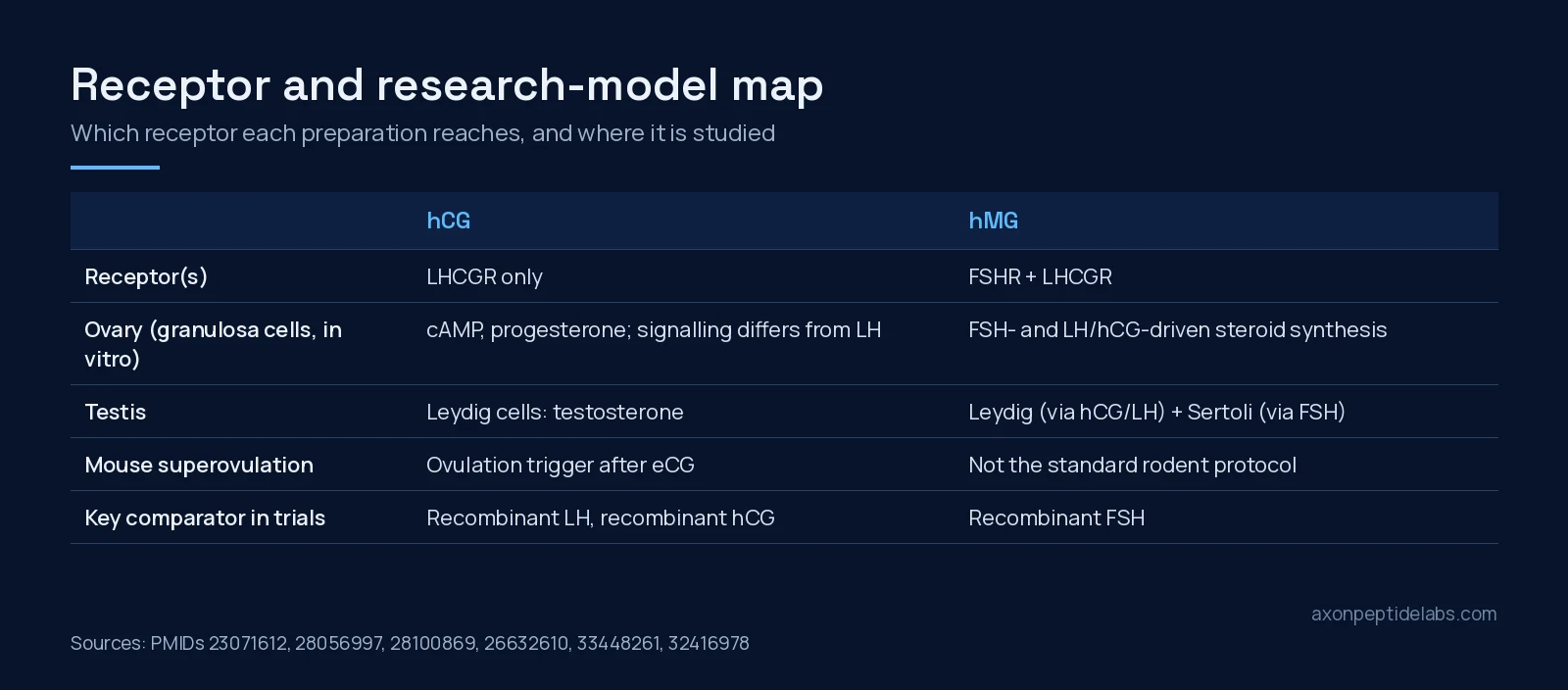
Where each one shows up in research
Ovary and granulosa cells
Human primary granulosa (lutein) cells are the main in vitro model for comparing the two. They are where the LH-versus-hCG signalling differences were described [5] and where hMG products were shown to differ from each other [8][9]. These are cell-culture findings with concentration ranges set by the investigators; they show mechanism, not outcomes in an animal.
Testis: Leydig versus Sertoli cells
The male axis is where the FSH content of hMG matters most. LH (or hCG) drives Leydig cells to make testosterone, and intratesticular testosterone runs roughly 100- to 1,000-fold higher than in circulation; Sertoli cells are the FSH target and also carry androgen receptors [11]. Knockout mice show the balance: loss of the LH receptor causes infertility while loss of the FSH receptor does not [11].
Human studies in men with hypogonadotropic hypogonadism (low or absent gonadotropins) fit this. In a retrospective series of 13 men whose spermatogenesis had first been induced with GnRH or hCG/hMG, hCG alone kept sperm production going qualitatively in most of them, but sperm counts fell over time and one man became azoospermic, which the authors read as FSH still being needed for full maintenance [16]. In a 10-man study, combined hMG and hCG induced spermatogenesis in all participants, while pure FSH plus exogenous testosterone did not, which the authors attribute to the need for intratesticular rather than circulating testosterone [17]. Response is not uniform. Pooled data from four open-label, non-comparative trials of hCG followed by recombinant FSH found that larger baseline testicular volume, lower body mass index and more advanced sexual maturity predicted a better response [18], and a 51-patient review found that the cause and timing of the deficiency mattered, with Kallmann syndrome responding least [19]. All of these are small, retrospective or uncontrolled designs.
Mouse superovulation
In mice, an injection of equine chorionic gonadotropin (eCG, also called PMSG) followed by hCG has long been the standard way to collect oocytes, with hCG acting as the ovulation trigger [12]. Oocyte yield under this regimen varies with strain, body weight, age, oestrous stage and even the time of day of injection [20][13][12], and anti-inhibin serum protocols have produced higher yields than eCG-hCG in adult C57BL/6 mice [12].
What head-to-head clinical comparisons found
The clinical literature compares hMG mainly with recombinant FSH in assisted reproduction, and compares urinary with recombinant hCG in gonadotropin-deficient men. We summarise direction and certainty only; these are approved medicines in some countries, and nothing here is advice about their use.
- 2003 meta-analysis, 6 RCTs, 2,030 women: higher clinical pregnancy with hMG in long-agonist protocols, but no evidence of a difference in ongoing pregnancy or live birth per woman [21].
- 2008 meta-analysis: reported a modestly higher live-birth rate with hMG and no difference in ovarian hyperstimulation syndrome (OHSS) [22]. This is the one pooled analysis here that favoured hMG.
- 2010 meta-analysis, 5 RCTs (HP-hMG vs one recombinant FSH product): ongoing pregnancy and live birth were similar; no superiority either way [23].
- Embryo-quality analysis of a 731-woman RCT: the primary endpoint was not significantly different, and a small difference in top-quality embryos seen by local embryologists was not confirmed by the blinded central panel [24].
- 2020 assessor-blinded RCT in 620 predicted high responders: HP-hMG was noninferior on ongoing pregnancy, cumulative live birth was similar, and OHSS and early pregnancy loss were lower with HP-hMG [15].
- 2025 Cochrane review (PCOS ovulation induction, 15 RCTs): little or no difference in live birth between recombinant FSH and urinary gonadotropins (low-certainty evidence), and very low certainty for hMG versus urinary FSH [25].
- Urinary vs recombinant hCG in men (2024): the two were not formally bioequivalent in pharmacokinetics, but serum testosterone responses were similar [14].
The honest summary: across pooled trials, the LH-type activity in hMG has not produced a consistent outcome advantage over FSH alone, and the most recent Cochrane evidence rates the certainty as low to very low.
A documented null result: hCG and fat loss
One popular claim deserves its own line because the evidence against it is clear. In a double-blind, placebo-controlled trial, 40 women on the same restricted diet received hCG or saline injections; the hCG group showed no advantage on any measured variable [26]. A criteria-based meta-analysis of 8 controlled and 16 uncontrolled trials found most were of poor quality and concluded there was no scientific basis for hCG as an adjunct in obesity [27]. The FDA label for chorionic gonadotropin states that hCG has not been demonstrated to be effective adjunctive therapy for obesity and has no known effect on fat mobilisation, appetite or fat distribution (FDA prescribing label, NLM label database).
What the evidence does not show
- That hMG is “hCG plus FSH” in a fixed recipe. The hCG share varied widely between analysed samples, LH itself was barely present, and products differ in composition [1][8].
- That hCG and LH are interchangeable. In human granulosa cells they are not [5]; in mouse Leydig cells the end result looked the same [7]. Neither finding generalises to every tissue.
- That hMG beats FSH alone. Pooled trials disagree, and the newest review rates the evidence as low or very low certainty [21][22][23][25].
- That a purity percentage tells you biological activity. Gonadotropin potency is expressed in International Units assigned by bioassay (see the Menopur label above). An HPLC purity figure on a certificate, where one exists, measures something different.
- Anything about body composition. See the null results above [26][27].
Documentation for Axon’s hCG and hMG listings
Axon lists HCG 5000iu and HMG 75iu under hormone peptides, alongside Kisspeptin-10. No certificate of analysis is posted for either HCG 5000iu or HMG 75iu on our COA page at the time of writing, so we make no purity or identity claim for them here. If a report is added later, match its product name, IU amount and batch to the vial in front of you; our guide to checking a peptide COA walks through that. For glycoproteins specifically, ask what was measured: chromatographic purity, identity by mass, or activity by bioassay. They answer different questions.
If you are comparing suppliers, you can buy lab-tested peptides in Canada from Axon and review the posted reports for each listing first.
Frequently asked questions
What is the main difference between hCG and hMG?
hCG is a single glycoprotein hormone that acts at the LH/hCG receptor (LHCGR). hMG (menotropins) is a urinary extract with both FSH and LH-type activity, so it reaches FSHR as well as LHCGR. In analysed highly purified hMG, most of the LH-type activity came from hCG rather than LH.
Does hMG contain hCG?
In the samples that have been analysed, yes. A 2024 mass-spectrometry study found beta-hCG at roughly 18 to 47% of gonadotropin content in highly purified hMG, with LH beta only in traces, and the hCG glycan pattern matched placental hCG. A 1995 study likewise found that hMG’s LH activity in serum was a composite of LH and hCG.
Are hCG and LH the same thing in research?
They share a receptor but are not identical. In human granulosa cells hCG was more potent for cAMP while LH was more potent for ERK and AKT signalling. In mouse Leydig cells, testosterone output was the same for both. The answer depends on the model.
Is there a PubChem CID for hCG or hMG?
No single PubChem compound record represents either glycoprotein. A name lookup for chorionic gonadotropin returns an unrelated steroid ring skeleton (CID 1108). UniProt accessions for the subunits (P01215, P0DN86, P01225, P01229) are the more useful identifiers.
Does hCG help with weight loss?
The controlled evidence says no. A double-blind placebo-controlled trial found no advantage over saline, a meta-analysis of 24 trials found no scientific basis for it, and the FDA label for chorionic gonadotropin states it has not been shown to be effective adjunctive therapy for obesity.
Does Axon post a COA for its hCG or hMG?
Not at the time of writing. No certificate is posted for HCG 5000iu or HMG 75iu on the Axon COA page, so this article makes no purity or identity claim for either listing.
References
- Capolupo A, Petrocchi S, Melchiorre M et al. (2024). Analytical Investigation of the Profile of Human Chorionic Gonadotropin in Highly Purified Human Menopausal Gonadotrophin Preparations. Int J Mol Sci. PMID: 39273352. doi: 10.3390/ijms25179405.
- Duijkers IJ, Beerens MC, Coelingh Bennink HJ et al. (1995). Pharmacokinetics of two human menopausal gonadotrophin preparations after single intravenous administration during pituitary suppression. Hum Reprod. PMID: 7593498. doi: 10.1093/humrep/10.6.1367.
- Fournier T (2016). Human chorionic gonadotropin: Different glycoforms and biological activity depending on its source of production. Ann Endocrinol (Paris). PMID: 27177499. doi: 10.1016/j.ando.2016.04.012.
- Cole LA (2010). Biological functions of hCG and hCG-related molecules. Reprod Biol Endocrinol. PMID: 20735820. doi: 10.1186/1477-7827-8-102.
- Casarini L, Lispi M, Longobardi S et al. (2012). LH and hCG action on the same receptor results in quantitatively and qualitatively different intracellular signalling. PLoS One. PMID: 23071612. doi: 10.1371/journal.pone.0046682.
- Choi J, Smitz J (2014). Luteinizing hormone and human chorionic gonadotropin: origins of difference. Mol Cell Endocrinol. PMID: 24365330. doi: 10.1016/j.mce.2013.12.009.
- Riccetti L, De Pascali F, Gilioli L et al. (2017). Human LH and hCG stimulate differently the early signalling pathways but result in equal testosterone synthesis in mouse Leydig cells in vitro. Reprod Biol Endocrinol. PMID: 28056997. doi: 10.1186/s12958-016-0224-3.
- Casarini L, Riccetti L, Paradiso E et al. (2020). Two human menopausal gonadotrophin (hMG) preparations display different early signaling in vitro. Mol Hum Reprod. PMID: 33084890. doi: 10.1093/molehr/gaaa070.
- Riccetti L, Klett D, Ayoub MA et al. (2017). Heterogeneous hCG and hMG commercial preparations result in different intracellular signalling but induce a similar long-term progesterone response in vitro. Mol Hum Reprod. PMID: 29044421. doi: 10.1093/molehr/gax047.
- Wolfenson C, Groisman J, Couto AS et al. (2005). Batch-to-batch consistency of human-derived gonadotrophin preparations compared with recombinant preparations. Reprod Biomed Online. PMID: 15901450. doi: 10.1016/s1472-6483(10)60819-x.
- Shiraishi K, Matsuyama H (2017). Gonadotoropin actions on spermatogenesis and hormonal therapies for spermatogenic disorders [Review]. Endocr J. PMID: 28100869. doi: 10.1507/endocrj.EJ17-0001.
- Hasegawa A, Mochida K, Inoue H et al. (2016). High-Yield Superovulation in Adult Mice by Anti-Inhibin Serum Treatment Combined with Estrous Cycle Synchronization. Biol Reprod. PMID: 26632610. doi: 10.1095/biolreprod.115.134023.
- Lamas S, Carvalheira J, Gartner F et al. (2021). C57BL/6J mouse superovulation: schedule and age optimization to increase oocyte yield and reduce animal use. Zygote. PMID: 33448261. doi: 10.1017/S0967199420000714.
- Handelsman DJ, Idan A, Desai R et al. (2024). Single and multi-dose pharmacology of recombinant and urinary human chorionic gonadotrophin in men. Clin Endocrinol (Oxf). PMID: 38446525. doi: 10.1111/cen.15040.
- Witz CA, Daftary GS, Doody KJ et al. (2020). Randomized, assessor-blinded trial comparing highly purified human menotropin and recombinant follicle-stimulating hormone in high responders undergoing intracytoplasmic sperm injection. Fertil Steril. PMID: 32416978. doi: 10.1016/j.fertnstert.2020.03.029.
- Depenbusch M, von Eckardstein S, Simoni M et al. (2002). Maintenance of spermatogenesis in hypogonadotropic hypogonadal men with human chorionic gonadotropin alone. Eur J Endocrinol. PMID: 12444893. doi: 10.1530/eje.0.1470617.
- Schaison G, Young J, Pholsena M et al. (1993). Failure of combined follicle-stimulating hormone-testosterone administration to initiate and/or maintain spermatogenesis in men with hypogonadotropic hypogonadism. J Clin Endocrinol Metab. PMID: 8263139. doi: 10.1210/jcem.77.6.8263139.
- Warne DW, Decosterd G, Okada H et al. (2009). A combined analysis of data to identify predictive factors for spermatogenesis in men with hypogonadotropic hypogonadism treated with recombinant human follicle-stimulating hormone and human chorionic gonadotropin. Fertil Steril. PMID: 18930225. doi: 10.1016/j.fertnstert.2008.07.1720.
- Rohayem J, Sinthofen N, Nieschlag E et al. (2016). Causes of hypogonadotropic hypogonadism predict response to gonadotropin substitution in adults. Andrology. PMID: 26779870. doi: 10.1111/andr.12128.
- Luo C, Zuñiga J, Edison E et al. (2011). Superovulation strategies for 6 commonly used mouse strains. J Am Assoc Lab Anim Sci. PMID: 21838974.
- van Wely M, Westergaard LG, Bossuyt PM et al. (2003). Effectiveness of human menopausal gonadotropin versus recombinant follicle-stimulating hormone for controlled ovarian hyperstimulation in assisted reproductive cycles: a meta-analysis. Fertil Steril. PMID: 14607553. doi: 10.1016/s0015-0282(03)02187-3.
- Al-Inany HG, Abou-Setta AM, Aboulghar MA et al. (2008). Efficacy and safety of human menopausal gonadotrophins versus recombinant FSH: a meta-analysis. Reprod Biomed Online. PMID: 18252052. doi: 10.1016/s1472-6483(10)60559-7.
- Jee BC, Suh CS, Kim YB et al. (2010). Clinical efficacy of highly purified hMG versus recombinant FSH in IVF/ICSI cycles: a meta-analysis. Gynecol Obstet Invest. PMID: 20389096. doi: 10.1159/000308458.
- Ziebe S, Lundin K, Janssens R et al. (2007). Influence of ovarian stimulation with HP-hMG or recombinant FSH on embryo quality parameters in patients undergoing IVF. Hum Reprod. PMID: 17640944. doi: 10.1093/humrep/dem221.
- Weiss NS, Kostova EB, Mol BWJ et al. (2025). Gonadotropins for ovulation induction in women with polycystic ovary syndrome. Cochrane Database Syst Rev. PMID: 40193219. doi: 10.1002/14651858.CD010290.pub4.
- Bosch B, Venter I, Stewart RI et al. (1990). Human chorionic gonadotrophin and weight loss. A double-blind, placebo-controlled trial. S Afr Med J. PMID: 2405506.
- Lijesen GK, Theeuwen I, Assendelft WJ et al. (1995). The effect of human chorionic gonadotropin (HCG) in the treatment of obesity by means of the Simeons therapy: a criteria-based meta-analysis. Br J Clin Pharmacol. PMID: 8527285. doi: 10.1111/j.1365-2125.1995.tb05779.x.