
Tesamorelin Storage and COA Checklist
For laboratory research only. Not for human or animal use. This article gives no dosing, administration or therapeutic advice.
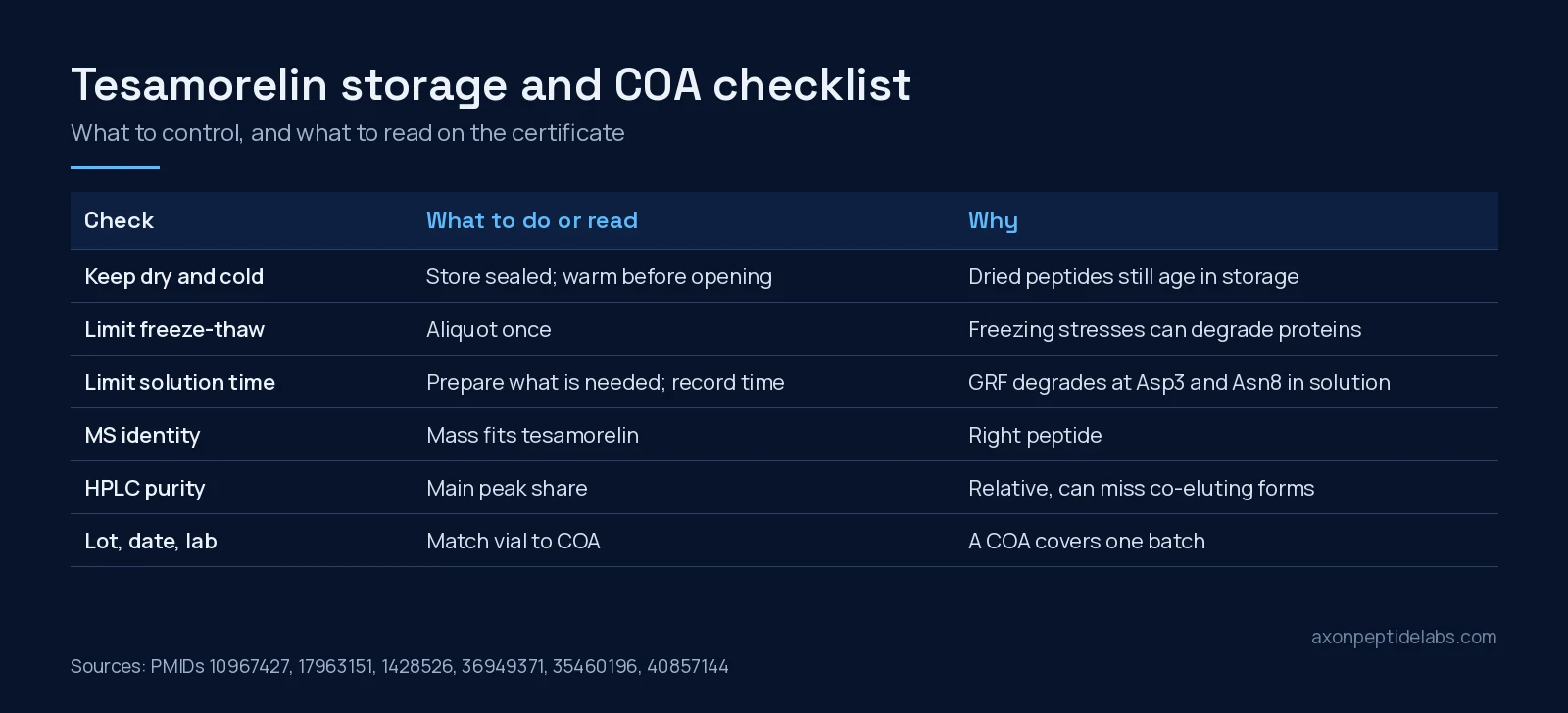
Short answer: Keep tesamorelin dry and cold until the lab needs it, limit freeze-thaw and time in solution, and check four things on the certificate of analysis (COA) before any experiment: identity by mass spectrometry, HPLC purity, a lot number that matches the vial, and a test date and lab. Freeze-dried peptides are more stable than solutions but not immune to storage stress [1], and studies on human growth hormone-releasing factor (GRF) show that in solution it degrades at Asp3 and Asn8 into much less potent products [2]. The checklist below turns those findings into routine lab steps.
Why storage matters for a GRF analogue
Tesamorelin is hGRF(1-44)NH2 with a trans-3-hexenoyl group on Tyr1, a change that made it resistant to dipeptidyl aminopeptidase-IV deactivation in plasma [3]. That modification addresses enzymes, not chemistry in a vial. The rest of the sequence is the native GRF chain, so the degradation routes measured for GRF are the ones to watch.
In aqueous GRF(1-44)-NH2 and GRF(1-29)-NH2, degradation happened at aspartic acid 3 (cleavage at Asp3-Ala4 below about pH 4, isomerization to beta-Asp3 above it) and at asparagine 8 (deamidation). Every product tested had much lower in vitro potency than the parent, and GRF was most stable at pH 4-5 [2]. In a [Leu27] GRF analogue held at pH 7.4 and 37 degrees, Asn8 deamidation was the main route, and samples lost GH-releasing potency over 14 days, while analogues with serine in place of Asn8 kept full potency [4].
Storage checklist for the lyophilized vial
- On arrival: record the date, the lot number on the vial and whether the seal is intact. Note it beside the COA lot.
- Keep it dry: the value of freeze-drying is that water is removed. Reviews of solid protein formulations note that even dried material can have limited long-term stability, so moisture and temperature still count [1][5].
- Keep it cold as the product documentation and your lab’s standard operating procedure specify, and log the storage temperature.
- Let a cold vial reach room temperature before opening, so condensation does not land on the powder.
- Avoid repeated freeze-thaw. Freezing brings low temperature, ice formation and freeze-concentration, and those stresses can degrade proteins [6]. Aliquoting once is gentler than thawing the same stock repeatedly.
- Treat solution time as a clock. The GRF data show solution-phase changes that depend on pH and temperature [2]. Prepare what the experiment needs and record when it was prepared.
The product page adds one practical warning: some peptides can become cloudy, thick or gel-like depending on the reconstitution solution, so the solvent choice should be tested and recorded. Bacteriostatic water 10ml is listed as a related supply. If you are choosing between formats, our tesamorelin vial vs pen comparison explains why the solid is the longer-lived one.
COA checklist
| COA line | What it tells you | What it does not |
|---|---|---|
| Mass spec identity | Whether the observed mass fits tesamorelin [7] | How pure the batch is |
| HPLC purity | Main peak share of detected material [8] | Co-eluting impurities [9]; absolute content |
| Lot number | Which batch was tested | Anything about another lot |
| Test date and lab | How recent the result is and who tested it | Stability after the test date |
| Counter-ion or net peptide content | How much of the powder is peptide vs TFA or other salts [10] | Often not reported on research COAs |
Identity
Reference-standard work uses NMR, mass spectrometry and chromatography to confirm identity, and HPLC to assess content and impurities [7]. For a research COA, the practical check is an observed mass consistent with the tesamorelin sequence plus its hexenoyl group.
Purity, and what it can miss
Reversed-phase HPLC with UV detection is a standard way to characterise synthetic peptides, their impurities and their degradation products [8]. It is a relative figure, and closely related impurities can co-elute with the main peak; in synthetic glucagon, two deletion impurities needed high-resolution mass spectrometry to be quantified [9]. For a GRF analogue, the deamidated and beta-Asp forms are exactly the close relatives a method has to separate [2].
Salt content
Peptides made by solid-phase synthesis are usually obtained as trifluoroacetate salts [10], so powder weight and peptide weight can differ. If the COA reports net peptide content, use it; if not, note that the label amount is the supplier’s stated fill.
What Axon’s documentation shows
The tesamorelin 10mg product page lists the material as a synthetic GHRH analogue research peptide, 10mg per vial, SKU APL-TESAMORELIN-10MG, not pre-mixed, and points buyers to available COA and purity information. The COA library lists tesamorelin among the product lots it documents. Match the lot on your vial to the report before work starts, and file both together. Our older tesamorelin COA and purity guide covers the GH-axis background.
Limits of this checklist
- The degradation data are for GRF, not tesamorelin. They come from GRF(1-44)-NH2, GRF(1-29)-NH2 and a [Leu27] analogue [2][4].
- No storage temperature or shelf life is given here. Those belong to the product documentation and your lab’s own validation.
- A COA is a snapshot of one batch on one date; it does not describe material after shipping or storage.
- Research use only. Nothing here concerns human or animal use.
Sourcing for laboratory work
For tesamorelin peptide in Canada, Axon supplies the tesamorelin 10mg research vial for in vitro and analytical work, with the tesamorelin Canada page grouping formats and documentation. Our guide to verifying a peptide COA in Canada goes through red flags in more detail. To buy lab-tested peptides in Canada, check the matching batch in the COA library first. For a mechanism-level comparison, see Tesamorelin vs Ipamorelin: GHRH Analogue vs Secretagogue.
Frequently asked questions
How should a lyophilized tesamorelin vial be stored?
Keep it sealed, dry and cold as the product documentation and your lab’s procedure specify, let it reach room temperature before opening, and avoid repeated freeze-thaw. Freeze-dried peptides are more stable than solutions but can still change in storage.
Why does tesamorelin degrade in solution?
Studies on human GRF, which shares tesamorelin’s sequence, found degradation at Asp3 (cleavage or isomerization) and Asn8 (deamidation) in aqueous solution, with products of much lower potency. GRF was most stable at pH 4-5.
What should a tesamorelin COA include?
An observed mass that matches tesamorelin, an HPLC purity figure, a lot number that matches the vial, a test date and the testing lab. Net peptide or counter-ion content is useful when reported.
Does HPLC purity prove a tesamorelin batch is intact?
It shows the main peak’s share of what the method detected. Closely related impurities, such as deamidated forms, can co-elute unless the method separates them.
Where can I check Axon’s tesamorelin COA?
The COA library lists tesamorelin among the product lots it documents. Match the lot on your vial to the report there.
References
- Wang W (2000). Lyophilization and development of solid protein pharmaceuticals. Int J Pharm. PMID: 10967427. doi: 10.1016/s0378-5173(00)00423-3.
- Bongers J, Heimer EP, Lambros T et al. (1992). Degradation of aspartic acid and asparagine residues in human growth hormone-releasing factor. Int J Pept Protein Res. PMID: 1428526. doi: 10.1111/j.1399-3011.1992.tb01596.x.
- Ferdinandi ES, Brazeau P, High K et al. (2007). Non-clinical pharmacology and safety evaluation of TH9507, a human growth hormone-releasing factor analogue. Basic Clin Pharmacol Toxicol. PMID: 17214611. doi: 10.1111/j.1742-7843.2007.00008.x.
- Friedman AR, Ichhpurani AK, Brown DM et al. (1991). Degradation of growth hormone releasing factor analogs in neutral aqueous solution is related to deamidation of asparagine residues. Replacement of asparagine residues by serine stabilizes. Int J Pept Protein Res. PMID: 1904406. doi: 10.1111/j.1399-3011.1991.tb00727.x.
- Manning MC, Chou DK, Murphy BM et al. (2010). Stability of protein pharmaceuticals: an update. Pharm Res. PMID: 20143256. doi: 10.1007/s11095-009-0045-6.
- Bhatnagar BS, Bogner RH, Pikal MJ (2007). Protein stability during freezing: separation of stresses and mechanisms of protein stabilization. Pharm Dev Technol. PMID: 17963151. doi: 10.1080/10837450701481157.
- McCarthy D, Han Y, Carrick K et al. (2023). Reference Standards to Support Quality of Synthetic Peptide Therapeutics. Pharm Res. PMID: 36949371. doi: 10.1007/s11095-023-03493-1.
- Sharma N, Kukreja D, Giri T et al. (2022). Synthetic pharmaceutical peptides characterization by chromatography principles and method development. J Sep Sci. PMID: 35460196. doi: 10.1002/jssc.202101034.
- Kodidasu A, Acharyya K, Ramu VG (2025). Absolute Quantitation of Coeluting Impurities in Peptide Drugs Using High Resolution Mass Spectrometry: Glucagon a Case Study in Pharmaceutical Development. J Am Soc Mass Spectrom. PMID: 40857144. doi: 10.1021/jasms.5c00105.
- Erckes V, Streuli A, Chamera Rendueles L et al. (2025). Towards a Consensus for the Analysis and Exchange of TFA as a Counterion in Synthetic Peptides and Its Influence on Membrane Permeation. Pharmaceuticals (Basel). PMID: 40872554. doi: 10.3390/ph18081163.