
Kisspeptin-10 vs hCG: Upstream Signal vs Direct LH Agonist
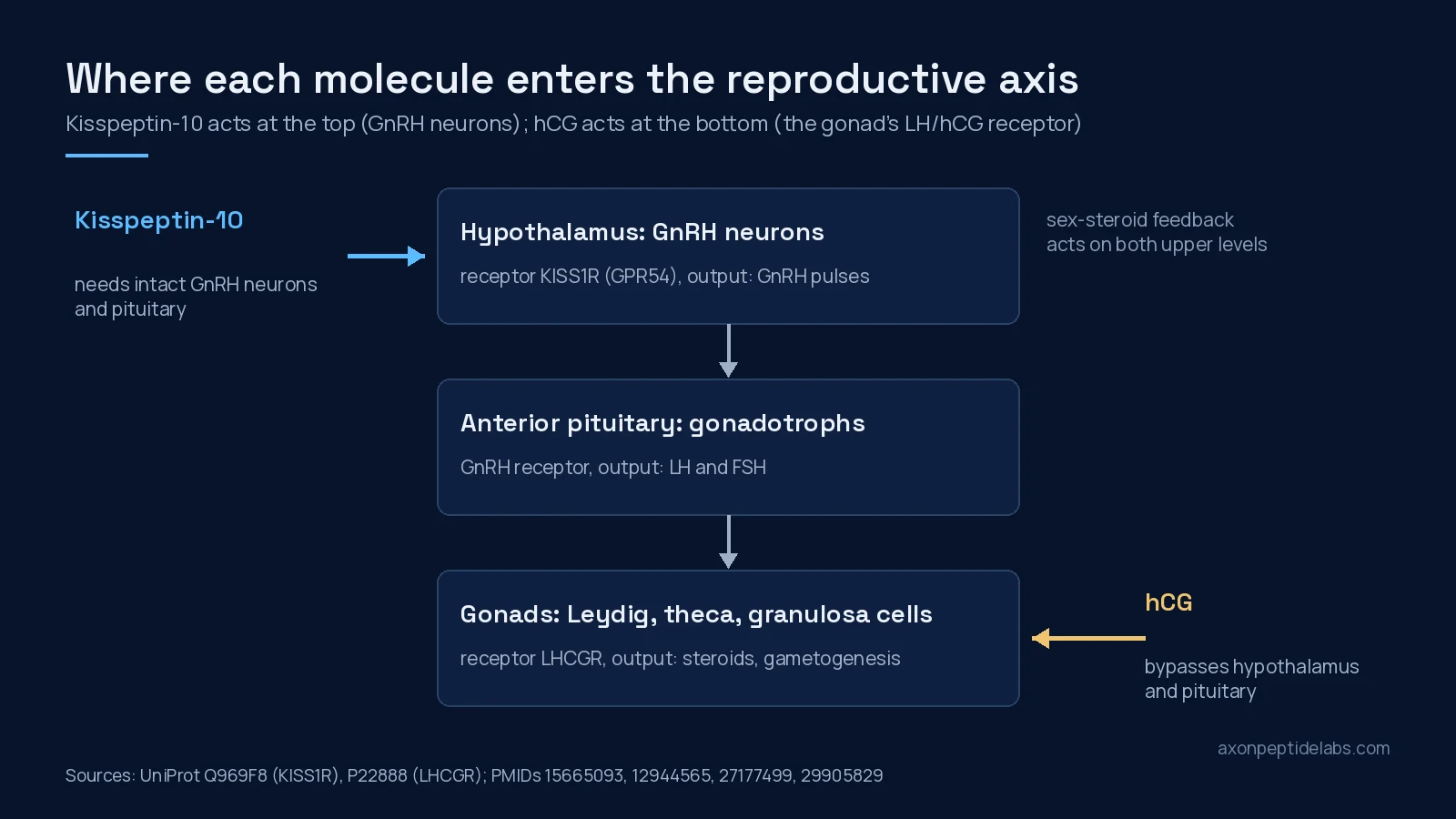
Short answer: kisspeptin-10 and hCG both raise sex-steroid output in research models, but they enter the reproductive axis at opposite ends. Kisspeptin-10 is a 10-residue peptide that activates the kisspeptin receptor (KISS1R, formerly GPR54) on hypothalamic GnRH neurons, so its effect depends on an intact hypothalamus and pituitary producing the body’s own LH and FSH [1][2]. Human chorionic gonadotropin (hCG) is a large glycoprotein hormone that binds the LH/hCG receptor (LHCGR) on the gonad directly, skipping both upper levels [3][4]. One is a signal to the system’s controller; the other is a substitute for one of its outputs.
For laboratory research only. Not for human or animal use. This article gives no dosing, administration or therapeutic advice.
That single difference explains most of what the literature shows: kisspeptin’s effect is shaped by sex, cycle phase and receptor desensitisation, while hCG’s effect is shaped by its long half-life and its potency at the LH receptor. Below we compare identity, mechanism, study models and the null and negative findings, using primary papers rather than forum summaries.
Identity: a decapeptide vs a glycoprotein heterodimer
Kisspeptin-10 is the C-terminal decapeptide of the KISS1 gene product (YNWNSFGLRF-NH2, residues 112–121 of the 138-residue human precursor, UniProt Q15726). Kisspeptins were first isolated from human placenta as 54-, 14- and 13-residue peptides sharing an RF-amide C-terminus that activate GPR54 at low nanomolar affinity [5][6]. hCG has no small-molecule record: it is two glycosylated subunits, an alpha chain identical to that of LH, FSH and TSH (gene CGA) and a hormone-specific beta chain from the CGB gene cluster that gives receptor specificity [3]. Its glycosylation varies with source and stage of pregnancy, so its mass is not a single fixed number [3].
| Item | Kisspeptin-10 | hCG (human chorionic gonadotropin) |
|---|---|---|
| Class | Linear amidated peptide, 10 residues | Glycoprotein hormone, alpha/beta heterodimer |
| Sequence / subunits | YNWNSFGLRF-NH2 (KISS1 residues 112–121) | Alpha: CGA, UniProt P01215 (116-residue precursor); beta: CGB3, UniProt P0DN86 (165-residue precursor) |
| Molecular formula | C63H83N17O14 | Not applicable (glycoprotein; glycan content varies) |
| Molecular weight | 1302.4 (PubChem) | Varies with glycosylation; no single PubChem value |
| PubChem CID | 25240297 (CAS 374675-21-5) | No single CID for the intact hormone |
| Receptor | KISS1R / GPR54 (UniProt Q969F8), on GnRH neurons | LHCGR (UniProt P22888), on gonadal cells; shared with LH |
| Other names | KP-10, metastin 45-54 | Chorionic gonadotropin, choriogonadotropin |
Mechanism: upstream signalling vs direct receptor agonism
Kisspeptin-10 works through the body’s own GnRH
The case that kisspeptin acts at the top of the axis rests on genetics and physiology. Loss-of-function mutations in GPR54 caused isolated hypogonadotropic hypogonadism in human families, and Gpr54-deficient mice reproduced the phenotype [7][8]; an inactivating KISS1 mutation later did the same in a human family [9]. In mice, GPR54 transcripts colocalised with GnRH neurons, injected kisspeptin raised LH and FSH in wild-type but not Gpr54-knockout animals, and in sheep central kisspeptin produced a measurable release of GnRH into cerebrospinal fluid [1].
In healthy men, intravenous kisspeptin-10 produced a rapid, dose-dependent rise in LH and, with infusion, higher LH pulse frequency and testosterone; the highest bolus tested gave a smaller response than the one below it [2]. A head-to-head physiology study in healthy men found kisspeptin-10 and kisspeptin-54 produced similar gonadotropin responses at the doses tested, both less potent than GnRH itself [10].
hCG acts on the gonad’s LH receptor
hCG binds the same receptor as pituitary LH. A 2016 review describes it as behaving like a “super LH agonist” on the corpus luteum [3]. The two hormones are not identical at that receptor, though: in cells expressing LHCGR, recombinant hCG was about five times more potent than LH for cAMP, while LH acted faster and favoured ERK1/2 and AKT signalling [11]; a second group, using live-cell BRET and FRET, also found hCG more potent and the two hormones biased toward different pathways [12]. A 2018 review puts the difference in context: pulsatile pituitary LH has a half-life of about 90 minutes, while placental hCG isoforms last hours [4]. In gonadotropin-deficient men, a population analysis of urinary and recombinant hCG reported a pooled half-life of several days [13].
Side-by-side comparison
| Question | Kisspeptin-10 | hCG |
|---|---|---|
| Level of the axis | Hypothalamus (GnRH neurons) [1] | Gonad (LHCGR) [3] |
| Needs a working pituitary? | Yes: output is the body’s own LH and FSH [2] | No: acts directly on the gonadal receptor [4] |
| Raises FSH as well as LH? | Yes, through GnRH [14][15] | No FSH activity; LH-type receptor only [3] |
| Duration of action | Plasma half-life about 4 minutes in mice; kisspeptin-54 lasts longer [16] | Hours to days [4][13] |
| Sex and cycle effects | Strong: no gonadotropin response in follicular-phase women, response in the preovulatory phase [15] | Acts wherever LHCGR is expressed [4] |
| Loss of response with continuous exposure | Yes: receptor desensitisation in monkeys; blunted response after repeated dosing in women [17][18] | Not the main issue; prolonged luteotrophic action is [19] |
| Regulatory status | Investigational; human data are research studies | Prescription biologic in the US (FDA-approved label for chorionic gonadotropin (Novarel)) |
Probe vs substitute: what each is used to ask
Because kisspeptin’s effect has to pass through the GnRH neuron, researchers use it as a probe of the top of the axis. A 2026 review sets out the reasoning: GnRH cannot be measured directly in human portal blood, so pituitary (secondary) and hypothalamic (tertiary) causes of low gonadotropins are often lumped together, and the LH response to kisspeptin offers a way to test the hypothalamic step on its own [20]. The logic is visible in the desensitisation studies described below: a lost response to kisspeptin with a preserved response to GnRH places the block at GPR54, not at the pituitary [17][18].
hCG answers the opposite question: can the gonad respond to LH-type stimulation, whatever is happening above it? In cell work it is one of the two standard LHCGR agonists, studied side by side with recombinant LH [11][12]. Put simply, a study design that wants to know whether the hypothalamus is working reaches for a kisspeptin; one that wants to drive the gonad regardless of upstream signals reaches for hCG. Using one in place of the other changes the question being asked.
The IVF trigger question, by design only
The most-cited clinical contrast between the two comes from assisted reproduction. hCG has long been used as the trigger for final oocyte maturation; a review notes its long luteotrophic effect raises the risk of ovarian hyperstimulation syndrome (OHSS) [19]. Because kisspeptin releases a time-limited endogenous LH surge, a London group tested it as an alternative trigger: first in 53 women in an IVF programme [21], then in a phase 2 randomised trial of 60 women at high risk of OHSS [22], and then a placebo-controlled trial of a second dose in 62 high-risk women [23]. A synthetic kisspeptin receptor agonist, MVT-602, has since been studied in phase 1 and 2a trials in healthy women [24].
Two points matter for anyone reading these as evidence about kisspeptin-10. Every one of those IVF trials used kisspeptin-54 or an analogue, not kisspeptin-10. And none was a randomised comparison against hCG; the comparator was a different kisspeptin dose or placebo. The only direct three-way comparison of kisspeptin-10, LH and hCG we found is in male horses, donkeys and mules, where all three raised serum testosterone over four hours in groups of three animals [25].
Null and negative findings
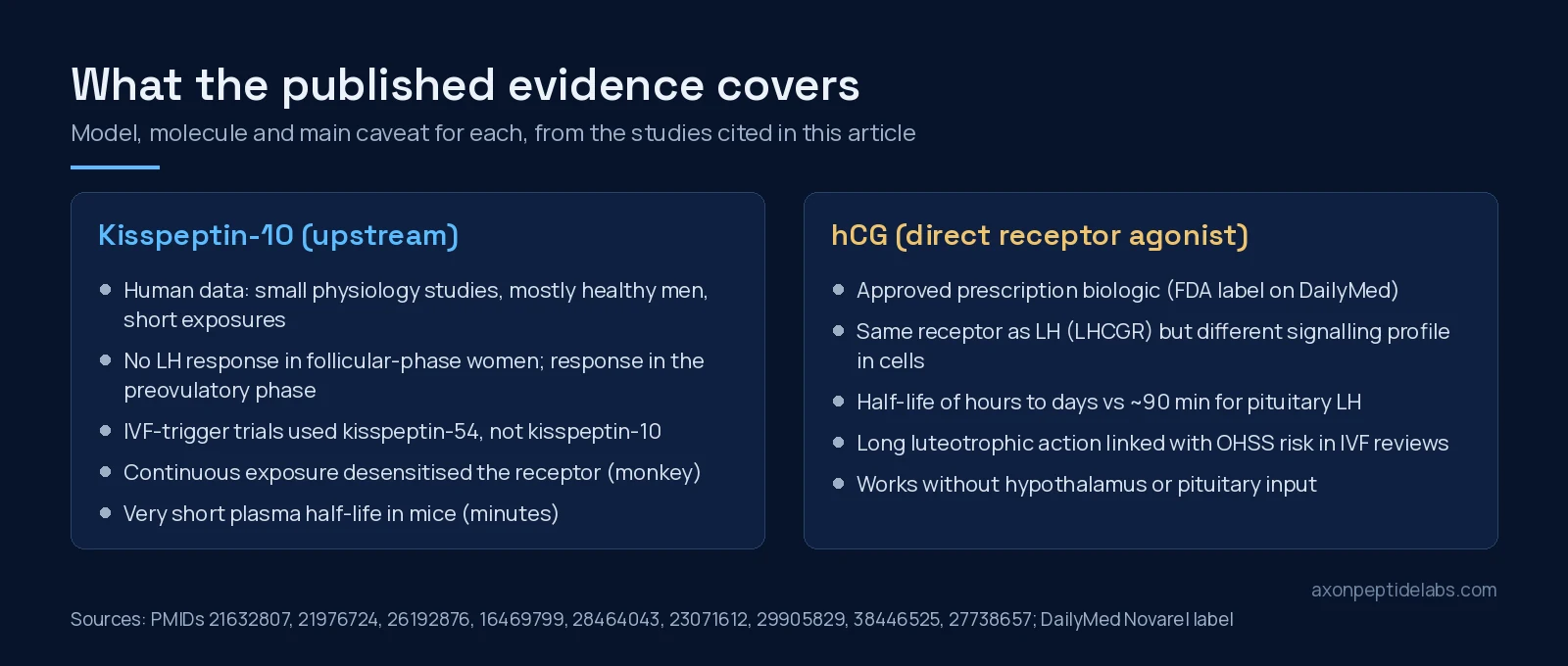
- Cycle phase: kisspeptin-10 did not change gonadotropins in healthy women in the follicular phase across bolus and infusion routes, even at the highest amounts tested [15].
- Tachyphylaxis: in women with hypothalamic amenorrhea, frequent repeated kisspeptin-54 dosing led to desensitisation: the LH response faded gradually and the FSH response was nearly gone by the second day, while a less frequent schedule gave only partial desensitisation [18]. In juvenile monkeys, continuous metastin 45-54 (the same sequence as kisspeptin-10) gave a brief LH response, then GPR54 desensitised while GnRH responses stayed intact [17].
- Testis histology in rats: repeated intraperitoneal kisspeptin-10 in prepubertal male rats lowered LH and testosterone at the higher doses and produced degenerative changes in seminiferous tubules [26].
- Bypass: in a woman with a fully inactivating KISS1R mutation, pulsatile GnRH still produced an LH surge and ovulation, which shows that the kisspeptin step can be skipped from below as well as above [27].
What the evidence does not show
- No randomised human trial compares kisspeptin-10 with hCG. Online claims that one “replaces” the other are inferences from mechanism, not results.
- Kisspeptin-54 results are not kisspeptin-10 results. The two differ in half-life and in how long they sustain LH release in mice [16], and the IVF work used kisspeptin-54 [21][22].
- Short studies say little about long exposure. Most kisspeptin-10 human data cover hours, and the repeated-dosing data that exist show a fading response [18][17].
- Cell-signalling differences between hCG and LH are in vitro findings. They come from transfected cell lines, granulosa cells and mouse Leydig tumour cells [11][12].
- Nothing here describes the safety or effects of research materials. Human studies used pharmaceutical-grade material under trial conditions.
Documentation at Axon
Axon lists Kisspeptin-10 10mg and HCG 5000iu in its hormone research range. No certificate is posted for either product on our COA library at the time of writing, so we quote no purity or batch figures here. For hCG compared with the LH- and FSH-containing menotropin, see our post on hCG vs hMG. Researchers comparing suppliers can buy lab-tested peptides in Canada; check what documentation each listing actually has before ordering.
Frequently asked questions
What is the main difference between kisspeptin-10 and hCG?
Where they act. Kisspeptin-10 activates KISS1R on hypothalamic GnRH neurons, so its effect runs through the body’s own GnRH, LH and FSH. hCG binds the LH/hCG receptor on the gonad directly and needs no hypothalamic or pituitary input.
Does kisspeptin-10 raise FSH as well as LH?
In healthy men, yes: kisspeptin raised both LH and FSH because it acts through GnRH. hCG acts only on the LH-type receptor and has no FSH activity.
Has kisspeptin-10 been compared with hCG in a human trial?
Not in any randomised human trial we found in PubMed. The IVF trigger trials used kisspeptin-54 and compared kisspeptin doses or placebo. The only direct kisspeptin-10, LH and hCG comparison we found was in male horses, donkeys and mules.
Why does the kisspeptin response fade with repeated exposure?
Continuous exposure desensitised the kisspeptin receptor in juvenile monkeys while responses to GnRH itself were preserved, and frequent repeated kisspeptin-54 dosing in women with hypothalamic amenorrhea led to a fading LH response and a nearly abolished FSH response.
Does Axon post a COA for Kisspeptin-10 or hCG?
No certificate is posted for Kisspeptin-10 10mg or HCG 5000iu on the Axon COA library at the time of writing, so this article quotes no purity or batch data for either.
References
- Messager S, Chatzidaki EE, Ma D et al. (2005). Kisspeptin directly stimulates gonadotropin-releasing hormone release via G protein-coupled receptor 54. Proc Natl Acad Sci U S A. PMID: 15665093. doi: 10.1073/pnas.0409330102.
- George JT, Veldhuis JD, Roseweir AK et al. (2011). Kisspeptin-10 is a potent stimulator of LH and increases pulse frequency in men. J Clin Endocrinol Metab. PMID: 21632807. doi: 10.1210/jc.2011-0089.
- Fournier T (2016). Human chorionic gonadotropin: Different glycoforms and biological activity depending on its source of production. Ann Endocrinol (Paris). PMID: 27177499. doi: 10.1016/j.ando.2016.04.012.
- Casarini L, Santi D, Brigante G et al. (2018). Two Hormones for One Receptor: Evolution, Biochemistry, Actions, and Pathophysiology of LH and hCG. Endocr Rev. PMID: 29905829. doi: 10.1210/er.2018-00065.
- Kotani M, Detheux M, Vandenbogaerde A et al. (2001). The metastasis suppressor gene KiSS-1 encodes kisspeptins, the natural ligands of the orphan G protein-coupled receptor GPR54. J Biol Chem. PMID: 11457843. doi: 10.1074/jbc.M104847200.
- Ohtaki T, Shintani Y, Honda S et al. (2001). Metastasis suppressor gene KiSS-1 encodes peptide ligand of a G-protein-coupled receptor. Nature. PMID: 11385580. doi: 10.1038/35079135.
- de Roux N, Genin E, Carel JC et al. (2003). Hypogonadotropic hypogonadism due to loss of function of the KiSS1-derived peptide receptor GPR54. Proc Natl Acad Sci U S A. PMID: 12944565. doi: 10.1073/pnas.1834399100.
- Seminara SB, Messager S, Chatzidaki EE et al. (2003). The GPR54 gene as a regulator of puberty. N Engl J Med. PMID: 14573733. doi: 10.1056/NEJMoa035322.
- Topaloglu AK, Tello JA, Kotan LD et al. (2012). Inactivating KISS1 mutation and hypogonadotropic hypogonadism. N Engl J Med. PMID: 22335740. doi: 10.1056/NEJMoa1111184.
- Jayasena CN, Abbara A, Narayanaswamy S et al. (2015). Direct comparison of the effects of intravenous kisspeptin-10, kisspeptin-54 and GnRH on gonadotrophin secretion in healthy men. Hum Reprod. PMID: 26089302. doi: 10.1093/humrep/dev143.
- Casarini L, Lispi M, Longobardi S et al. (2012). LH and hCG action on the same receptor results in quantitatively and qualitatively different intracellular signalling. PLoS One. PMID: 23071612. doi: 10.1371/journal.pone.0046682.
- Riccetti L, Yvinec R, Klett D et al. (2017). Human Luteinizing Hormone and Chorionic Gonadotropin Display Biased Agonism at the LH and LH/CG Receptors. Sci Rep. PMID: 28424471. doi: 10.1038/s41598-017-01078-8.
- Handelsman DJ, Idan A, Desai R et al. (2024). Single and multi-dose pharmacology of recombinant and urinary human chorionic gonadotrophin in men. Clin Endocrinol (Oxf). PMID: 38446525. doi: 10.1111/cen.15040.
- Dhillo WS, Chaudhri OB, Patterson M et al. (2005). Kisspeptin-54 stimulates the hypothalamic-pituitary gonadal axis in human males. J Clin Endocrinol Metab. PMID: 16174713. doi: 10.1210/jc.2005-1468.
- Jayasena CN, Nijher GM, Comninos AN et al. (2011). The effects of kisspeptin-10 on reproductive hormone release show sexual dimorphism in humans. J Clin Endocrinol Metab. PMID: 21976724. doi: 10.1210/jc.2011-1408.
- d’Anglemont de Tassigny X, Jayasena CN, Murphy KG et al. (2017). Mechanistic insights into the more potent effect of KP-54 compared to KP-10 in vivo. PLoS One. PMID: 28464043. doi: 10.1371/journal.pone.0176821.
- Seminara SB, Dipietro MJ, Ramaswamy S et al. (2006). Continuous human metastin 45-54 infusion desensitizes G protein-coupled receptor 54-induced gonadotropin-releasing hormone release monitored indirectly in the juvenile male Rhesus monkey (Macaca mulatta): a finding with therapeutic implications. Endocrinology. PMID: 16469799. doi: 10.1210/en.2005-1550.
- Jayasena CN, Nijher GM, Abbara A et al. (2010). Twice-weekly administration of kisspeptin-54 for 8 weeks stimulates release of reproductive hormones in women with hypothalamic amenorrhea. Clin Pharmacol Ther. PMID: 20980998. doi: 10.1038/clpt.2010.204.
- Alyasin A, Mehdinejadiani S, Ghasemi M (2016). GnRH agonist trigger versus hCG trigger in GnRH antagonist in IVF/ICSI cycles: A review article. Int J Reprod Biomed. PMID: 27738657.
- Pierret ACS, Patel AH, Daniels E et al. (2026). Kisspeptin as a test of hypothalamic dysfunction in pubertal and reproductive disorders. Andrology. PMID: 39834030. doi: 10.1111/andr.13843.
- Jayasena CN, Abbara A, Comninos AN et al. (2014). Kisspeptin-54 triggers egg maturation in women undergoing in vitro fertilization. J Clin Invest. PMID: 25036713. doi: 10.1172/JCI75730.
- Abbara A, Jayasena CN, Christopoulos G et al. (2015). Efficacy of Kisspeptin-54 to Trigger Oocyte Maturation in Women at High Risk of Ovarian Hyperstimulation Syndrome (OHSS) During In Vitro Fertilization (IVF) Therapy. J Clin Endocrinol Metab. PMID: 26192876. doi: 10.1210/jc.2015-2332.
- Abbara A, Clarke S, Islam R et al. (2017). A second dose of kisspeptin-54 improves oocyte maturation in women at high risk of ovarian hyperstimulation syndrome: a Phase 2 randomized controlled trial. Hum Reprod. PMID: 28854728. doi: 10.1093/humrep/dex253.
- Abbara A, Ufer M, Voors-Pette C et al. (2024). Endocrine profile of the kisspeptin receptor agonist MVT-602 in healthy premenopausal women with and without ovarian stimulation: results from 2 randomized, placebo-controlled clinical tricals. Fertil Steril. PMID: 37925096. doi: 10.1016/j.fertnstert.2023.10.031.
- Akhtar RW, Shah SAH, Qureshi IZ (2017). Effect of kisspeptin-10, LH and hCG on serum testosterone concentrations in stallions, donkeys and mules. Theriogenology. PMID: 28753433. doi: 10.1016/j.theriogenology.2017.07.027.
- Ramzan F, Qureshi IZ (2011). Intraperitoneal kisspeptin-10 administration induces dose-dependent degenerative changes in maturing rat testes. Life Sci. PMID: 21112339. doi: 10.1016/j.lfs.2010.11.019.
- Hugon-Rodin J, Yoshii K, Lahlou N et al. (2018). Complete Kisspeptin Receptor Inactivation Does Not Impede Exogenous GnRH-Induced LH Surge in Humans. J Clin Endocrinol Metab. PMID: 30124894. doi: 10.1210/jc.2018-00410.