
hCG 5000IU Research Vial: Format, Storage and COA
For laboratory research only. Not for human or animal use. This article gives no dosing, administration or therapeutic advice.
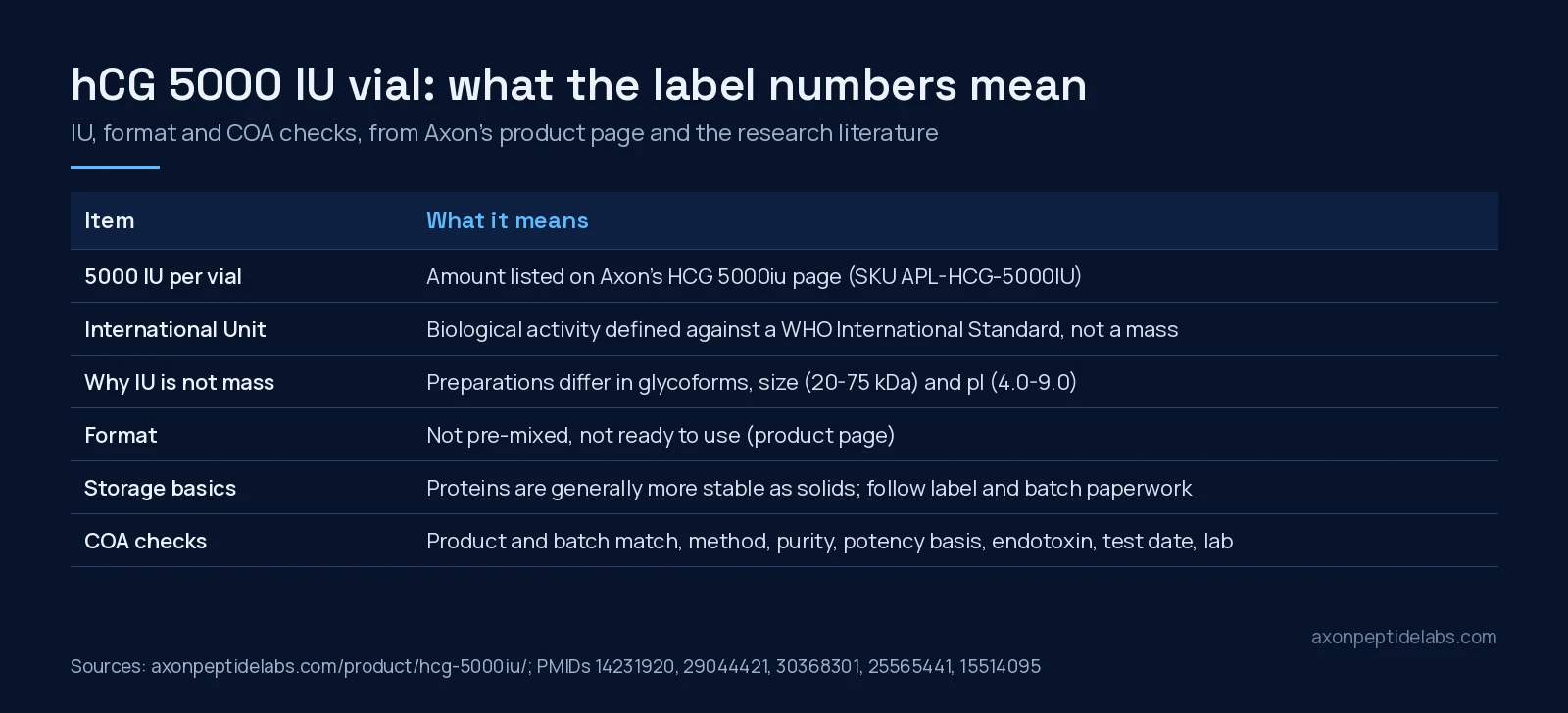
Short answer: Axon’s HCG 5000iu is listed as 5000 IU per vial, not pre-mixed and not ready to use, for laboratory research only. The “IU” is a unit of biological activity: for chorionic gonadotropin it was defined against a WHO International Standard [1], and commercial IU values come from in vivo bioassay calibrated against such a standard [2]. Because hCG preparations vary in glycoforms and isoforms [2][3], an IU figure is not a fixed mass. For storage, proteins are generally more stable as solids than in solution [4]. On a COA, check identity, the purity method, potency and endotoxin, and that the report matches the exact batch.
What the vial format means
IU is activity, not weight
The International Unit for chorionic gonadotropin is tied to reference material held for the WHO. When the first International Standard ran low, a replacement was assayed by nine laboratories in six countries and established in 1964 as the second International Standard, with a defined potency of 5300 International Units per ampoule. The paper defines the International Unit as the activity contained in 0.001279 mg of that second standard [1].
That definition is historical; later preparations were calibrated against newer standards. A 2017 comparison of commercial hCG and hMG preparations quantified them by immunoassay against the Fifth International Standard (NIBSC 07/364). Its authors note that the biological activity of commercial hCG is given in IU by in vivo bioassay and calibration against an International Standard, and call that an unsuitable unit for in vitro studies [2]. Clinical chemistry took a different route: an IFCC working group purified six hCG-related molecules and assigned them values in substance concentration (mol/L), and these were adopted by the WHO as International Reference Reagents [5].
Why one IU number can hide different molecules
The same 2017 study found heterogeneous profiles across preparations, with molecular weights in a 20 to 75 kDa range and isoelectric points from 4.0 to 9.0, and different potencies on cAMP production (EC50 1.0 to 400.0 ng/ml) in human granulosa-lutein and HEK293 cells [2]. Capillary electrophoresis of a recombinant and a urinary hCG product showed that each contained isoforms differing in nature and proportion, with pI ranges of 3.4 to 4.7 and 4.5 to 5.2; the authors note that hCG has 8 potential glycosylation sites [3]. Liquid chromatography with high-resolution mass spectrometry found more than 30 isoforms of the alpha subunit alone [6]. Glycosylation also showed up as a quality variable in one recombinant product, where a beta-subunit variant missing the Asn-13 glycan reduced biological activity in vivo [7].
What Axon’s product page states
| Item | As listed on the HCG 5000iu page |
|---|---|
| Product | HCG 5000iu (human chorionic gonadotropin) |
| Also known as | hCG, HCG 5000 IU, chorionic gonadotropin |
| Amount | 5000 IU per vial |
| SKU | APL-HCG-5000IU |
| Category | Hormone Peptides |
| Format | Not pre-mixed, not ready to use; a reconstitution disclaimer applies |
| Documentation | Review available COA and purity information before ordering, where published |
| Related supply | Bacteriostatic Water 10ml |
| Intended use | Laboratory research only; not for human or animal use |
The page does not state a purity percentage, so we do not quote one here. Its reconstitution note says some peptides can turn cloudy, thick or gel-like depending on the reconstitution solution.
Storage basics for a dry glycoprotein
A 2015 review of solid-state protein formulations notes that proteins and peptides in liquid form often show instability from chemical degradation, and that solid formulations are frequently needed to keep them stable during storage and transport; freeze-drying is one of the main techniques [4]. How well a freeze-dried cake holds up depends on how it was made: a practical review of freeze-drying design stresses control of freezing and the product’s collapse temperature and Tg’ [8]. For hCG specifically, the WHO reference reagents were ampouled and lyophilized, and accelerated degradation studies showed them to be highly stable [5]. Structure matters too: in one mutagenesis study, removing the alpha-52 glycan made the hCG heterodimer unstable [9].
For a research vial, follow the storage conditions on the label and the batch paperwork, and record when a vial is reconstituted. We will cover hCG stability in more depth in a separate article.
What to look for on an hCG COA
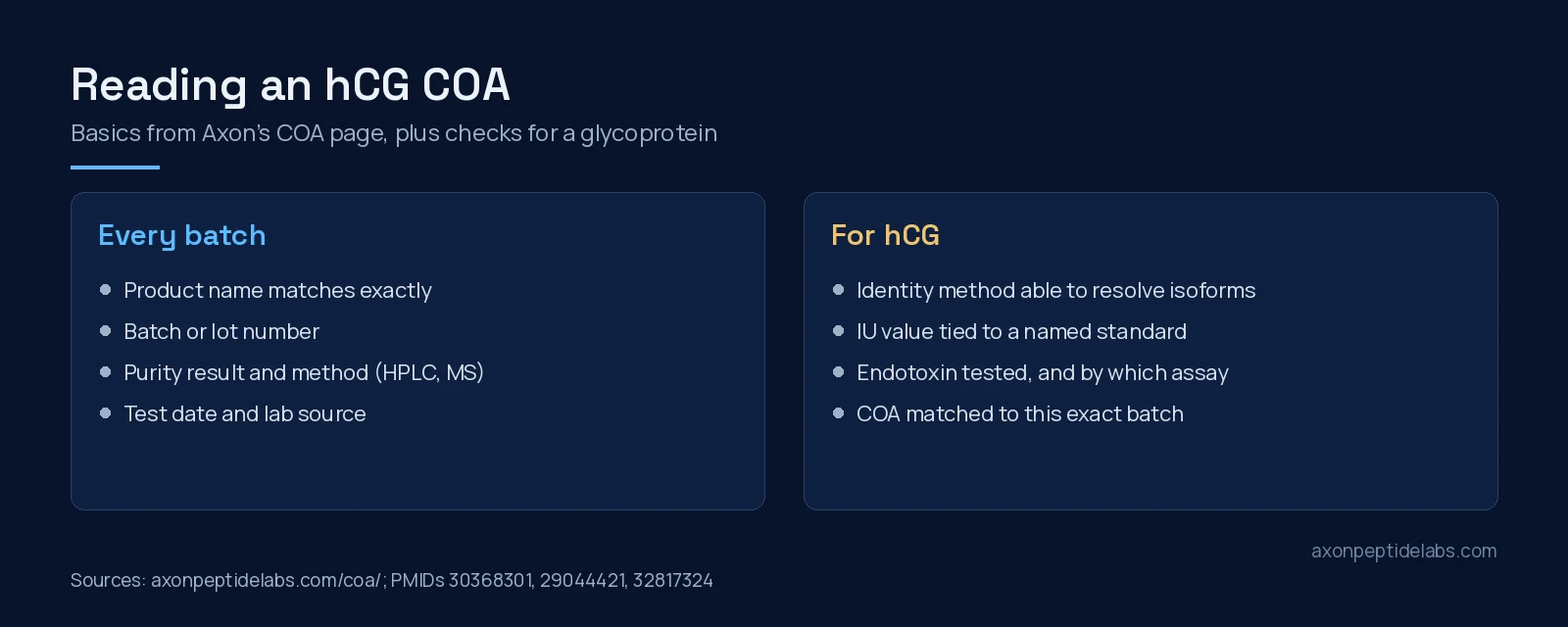
Our COA library lists what to check on any batch: product match, batch or lot number, purity result, testing method (HPLC and mass spectrometry are common), test date and lab source. For a glycoprotein like hCG, a few more questions are worth asking.
- Identity. Is the method able to tell hCG from related molecules? Researchers have used capillary electrophoresis and LC-MS to fingerprint hCG isoforms [3][6].
- Purity method. Which method produced the purity figure, and was it run on this batch?
- Potency. Is the IU value tied to a named standard and assay? Bioassay IU and immunoassay mass can disagree [2].
- Endotoxin. Was it tested, and by which assay? Recombinant factor C tests are designed as substitutes for the traditional Limulus amebocyte lysate test, and comparative testing has shown a high degree of correlation between them [10].
- Batch match. The product page asks you to match the COA to the exact product and batch before relying on it.
What the evidence does not show
- IU values are not interchangeable across sources. Preparations calibrated in IU can differ in composition and in vitro potency [2].
- Isoform data come from specific products. The electrophoresis and MS studies compared named recombinant and urinary products [3][6]; they say nothing direct about any other vial.
- Stability of reference ampoules is not a shelf life for every vial. The WHO stability data apply to those reference reagents [5].
Sourcing for laboratory work
To order hCG in Canada for research, start at the HCG 5000iu product page and the wider hormone peptides Canada category; the product page also lists HMG 75iu as a related product. The page lists bacteriostatic water 10ml as a related supply. For background, read our hCG structure and LH receptor overview, hCG vs hMG and hMG vs FSH, and see our lab standards. To buy lab-tested peptides in Canada, check the batch in the COA library first.
Frequently asked questions
What does 5000 IU mean on an hCG vial?
IU is a unit of biological activity, not mass. For hCG it was historically defined against a WHO International Standard; the second standard defined one IU as the activity in 0.001279 mg of that reference material.
Is 5000 IU the same as a fixed number of micrograms?
Not reliably. Commercial hCG preparations differ in size, charge and glycosylation, and a 2017 study argued that IU from in vivo bioassay is an unsuitable unit for in vitro work.
Why are protein standards like hCG often lyophilized?
Proteins in liquid form are prone to chemical degradation, and solid formulations such as freeze-dried material are frequently used to keep them stable in storage and transport. WHO hCG reference reagents were lyophilized in ampoules and proved highly stable in accelerated degradation studies.
What should an hCG COA show?
The exact product and batch number, the test date and lab source, the testing method used for identity and purity, and the result. Ask whether potency and endotoxin were tested, and match the COA to the exact product and batch.
Can I order hCG in Canada from Axon?
Yes. Axon lists HCG 5000iu, 5000 IU per vial (SKU APL-HCG-5000IU), in its hormone peptides category for laboratory research only. It is not pre-mixed and is not for human or animal use.
References
- BANGHAM DR, GRAB B (1964). THE SECOND INTERNATIONAL STANDARD FOR CHORIONIC GONADOTROPHIN. Bull World Health Organ. PMID: 14231920.
- Riccetti L, Klett D, Ayoub MA et al. (2017). Heterogeneous hCG and hMG commercial preparations result in different intracellular signalling but induce a similar long-term progesterone response in vitro. Mol Hum Reprod. PMID: 29044421. doi: 10.1093/molehr/gax047.
- Camperi J, De Cock B, Pichon V et al. (2019). First characterizations by capillary electrophoresis of human Chorionic Gonadotropin at the intact level. Talanta. PMID: 30368301. doi: 10.1016/j.talanta.2018.09.095.
- Angkawinitwong U, Sharma G, Khaw PT et al. (2015). Solid-state protein formulations. Ther Deliv. PMID: 25565441. doi: 10.4155/tde.14.98.
- Bristow A, Berger P, Bidart JM et al. (2005). Establishment, value assignment, and characterization of new WHO reference reagents for six molecular forms of human chorionic gonadotropin. Clin Chem. PMID: 15514095. doi: 10.1373/clinchem.2004.038679.
- Camperi J, Combes A, Guibourdenche J et al. (2018). An attempt to characterize the human Chorionic Gonadotropin protein by reversed phase liquid chromatography coupled with high-resolution mass spectrometry at the intact level. J Pharm Biomed Anal. PMID: 30144627. doi: 10.1016/j.jpba.2018.07.056.
- Deng Q, He L, Xu F et al. (2023). Characterization of beta subunit variants of recombinant human chorionic gonadotrophin. Anal Biochem. PMID: 36858250. doi: 10.1016/j.ab.2023.115089.
- Tang X, Pikal MJ (2004). Design of freeze-drying processes for pharmaceuticals: practical advice. Pharm Res. PMID: 15032301. doi: 10.1023/b:pham.0000016234.73023.75.
- Heikoop JC, van den Boogaart P, de Leeuw R et al. (1998). Partially deglycosylated human choriogonadotropin, stabilized by intersubunit disulfide bonds, shows full bioactivity. Eur J Biochem. PMID: 9578495. doi: 10.1046/j.1432-1327.1998.2530354.x.
- Bolden J, Knutsen C, Levin J et al. (2020). Currently Available Recombinant Alternatives to Horseshoe Crab Blood Lysates: Are They Comparable for the Detection of Environmental Bacterial Endotoxins? A Review. PDA J Pharm Sci Technol. PMID: 32817324. doi: 10.5731/pdajpst.2020.012187.