
CJC-1295 With DAC vs Without DAC (Mod GRF 1-29): The Science
For laboratory research only. Not for human or animal use. This article gives no dosing, administration or therapeutic advice.
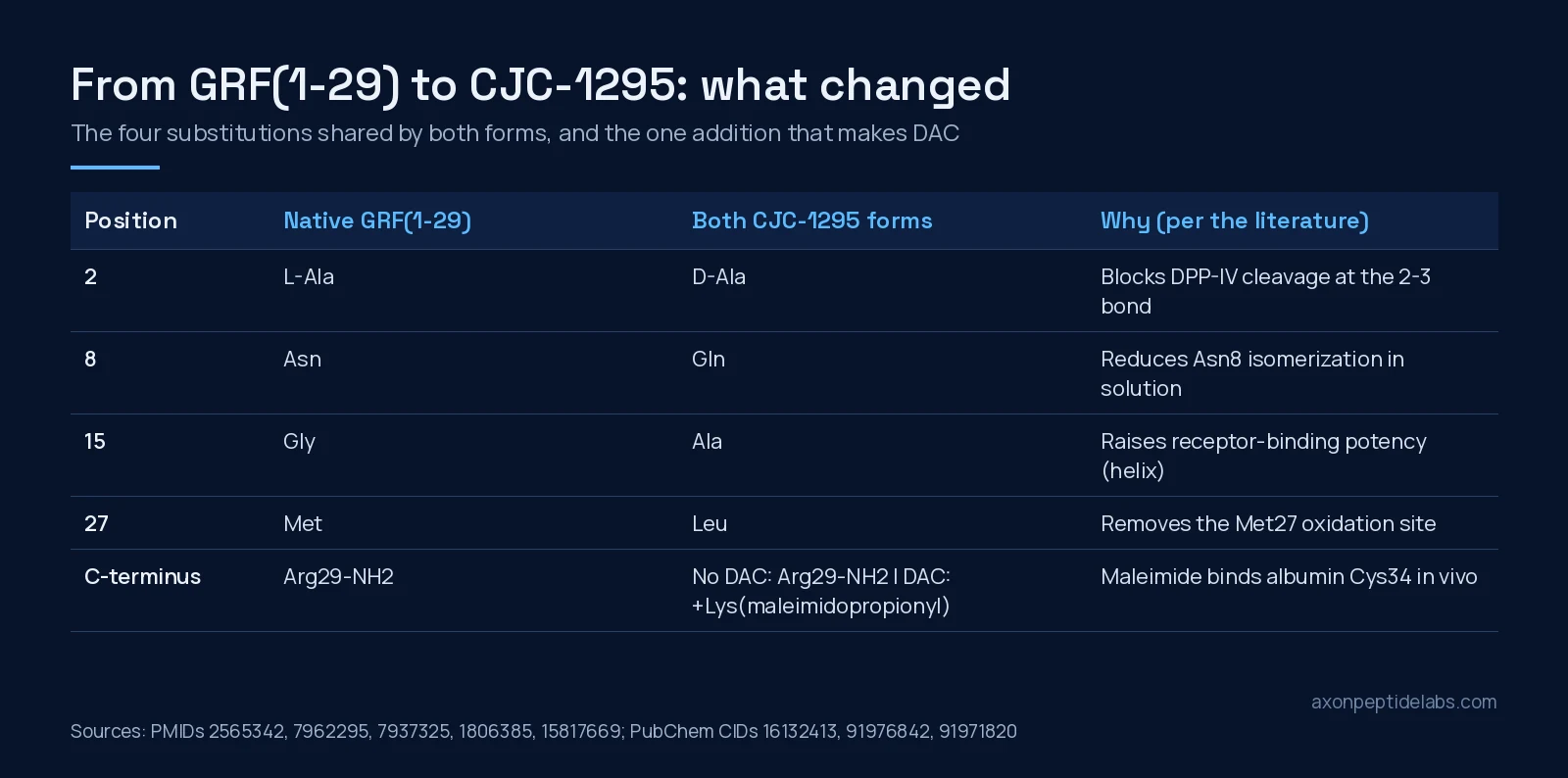
Short answer: both products sold as “CJC-1295” start from the same 29-residue core, a growth hormone-releasing hormone fragment, GRF(1-29), with four amino-acid substitutions. The difference is one extra piece. “With DAC” adds a lysine carrying a maleimide group at the C-terminus, which bonds to circulating albumin and stretches the time course from minutes into days [1][2]. “Without DAC” (often sold as Mod GRF 1-29) lacks that anchor. Almost all of the published human data are for the DAC form; we found no published human pharmacokinetic study of the no-DAC peptide.
Identity: three related molecules
Identity is where most confusion starts, so we checked each record directly in PubChem. One caution before the table: a PubChem name search for “CJC-1295” resolves to the DAC structure, not the no-DAC peptide, and the no-DAC record’s own synonym list also carries a “CJC1295 With DAC” label. Formula and molecular weight are the reliable way to tell them apart.
| Item | Sermorelin (GRF 1-29, reference) | CJC-1295 without DAC | CJC-1295 with DAC |
|---|---|---|---|
| Common names | Sermorelin, GHRH(1-29)-NH2 | Mod GRF 1-29, tetrasubstituted GRF(1-29) | CJC-1295, CJC-1295 DAC |
| PubChem CID | 16132413 | 91976842 | 91971820 |
| Molecular formula | C149H246N44O42S | C152H252N44O42 | C165H269N47O46 |
| Molecular weight (PubChem) | 3357.9 | 3367.9 | 3647.2 |
| CAS (PubChem synonyms) | 86168-78-7 | None listed | 446262-90-4 |
| Positions 2 / 8 / 15 / 27 | Ala / Asn / Gly / Met | D-Ala / Gln / Ala / Leu | D-Ala / Gln / Ala / Leu |
| C-terminus | Arg29-NH2 | Arg29-NH2 | Arg29-Lys(3-maleimidopropionyl)-NH2 |
The formulas line up with the chemistry: the four substitutions add three CH2 units and remove sulfur (Met to Leu), which takes sermorelin’s C149H246N44O42S to C152H252N44O42, and the added lysine plus maleimidopropionyl group accounts for the rest of the DAC formula.
Why the four substitutions exist
Native GHRH is cleared quickly. In human plasma, the main first cut is made by dipeptidyl peptidase IV (DPP-IV) between residues 2 and 3, with trypsin-like enzymes cutting later in the chain, and a D-amino acid at position 1 or 2 prevents the DPP-IV cleavage [3]. The same enzyme dominates GRF(1-29) breakdown in rat intestinal brush-border preparations, and a D-Ala2-containing analog was far more stable there [4]. In ten healthy men given constant infusions, D-Ala2-GHRH(1-29) had a lower metabolic clearance rate than GHRH(1-29), although the disappearance half-time of both was still measured in minutes [5].
The other three changes target chemistry and binding. Asn8 rearranges in water (via aminosuccinimide formation) and Met27 oxidises; replacing residue 8 and residue 27 was proposed to block both, and analogs carrying Gln8 or Thr8 showed lower isomerization in vitro [6]. Ala15 in place of Gly15 strengthens the helix and raised potency several-fold in rat pituitary cell cultures [7][6]. Those are the four positions that differ between sermorelin and both CJC-1295 forms in the PubChem records above.
A useful null result sits beside this: blocking DPP-IV on its own did not raise IGF-1. In growing pigs, a DPP-IV inhibitor that cut circulating DPP-IV activity by about 90% did not increase IGF-1, while a GHRH infusion did [8]. In 60 adults with type 2 diabetes, IGF-I did not differ between people on DPP-4 inhibitors, GLP-1 agonists or metformin alone [9]. Protecting a peptide from DPP-IV helps that peptide survive; it does not by itself change the axis.
What DAC adds
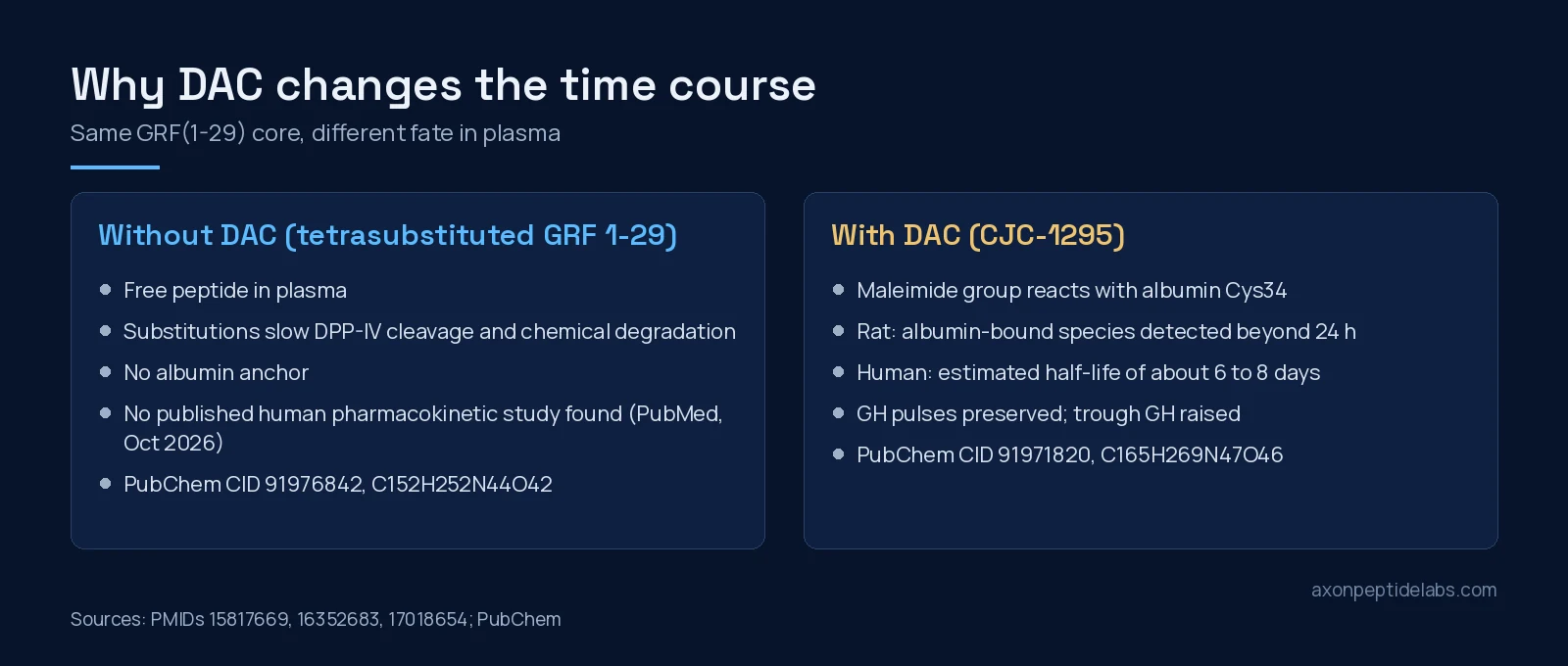
DAC stands for “drug affinity complex”. Jetté and colleagues attached maleimide groups to GRF(1-29) analogs so they would react with the free thiol on cysteine 34 of serum albumin. The albumin conjugates resisted DPP-IV in vitro and still released GH from cultured rat pituitary cells. Given to rats, the best compound, CJC-1295, produced about four times the GH area under the curve of GRF(1-29) over two hours, was still present in plasma beyond 72 hours, and an albumin-bound form was visible on Western blot from 15 minutes to beyond 24 hours [1].
In humans, two randomised, placebo-controlled, double-blind ascending-dose trials in healthy adults found dose-dependent rises in GH for six days or more and in IGF-I for 9 to 11 days after a single injection, with an estimated half-life of 5.8 to 8.1 days; no serious adverse reactions were reported [2]. A follow-up in healthy men found that GH pulse frequency and size were unchanged one week after CJC-1295, while trough (between-pulse) GH rose sharply and mean GH and IGF-I increased; the responses did not differ between the two dose levels tested [10]. Sera from 11 healthy young men taken before and one week after CJC-1295 showed shifts in a handful of serum proteins, proposed as possible biomarkers of GH action rather than as effects in their own right [11].
The receptor both forms act on
Whatever the time course, both forms are ligands for the same target: the GHRH receptor, a class B G protein-coupled receptor expressed mainly in the pituitary and on somatotroph cells, whose gene promoter is driven by the pituitary transcription factor Pit-1 [12]. In rodents, GHRH signalling controls not only GH release but somatotroph proliferation. The “little” mouse, which carries a GHRH-receptor mutation that abolishes binding, has severe somatotroph hypoplasia, while mice overexpressing GHRH show hyperplasia [12]. That is the biological reason continuous versus intermittent receptor exposure is an interesting variable, and it is the variable that separates the two CJC-1295 forms.
One detail is often missed. The four substitutions address the DPP-IV cut, Asn8 rearrangement and Met27 oxidation, but native GRH is also cut by trypsin-like enzymes at the 11-12 and 12-13 bonds [3], and the Arg11-Lys12 pair is still present in both PubChem sequences. “Stabilised” therefore means protected at specific sites, not protected everywhere. In the DAC form, albumin binding adds a second layer of protection that the free peptide does not have [1].
DAC vs no DAC side by side
| Feature | Without DAC | With DAC | Sources |
|---|---|---|---|
| Core sequence | Tetrasubstituted GRF(1-29)-NH2 | Same core plus Lys(maleimidopropionyl) | PubChem; [1] |
| Fate in plasma | Free peptide; protected from DPP-IV at position 2 | Binds albumin Cys34; albumin-bound species detected for over 24 h in rats | [3][1] |
| Receptor | GHRH receptor on pituitary somatotrophs | Same receptor | [12][1] |
| Human pharmacokinetics | No published human study found | Estimated half-life 5.8 to 8.1 days | [2] |
| GH pattern in humans | Not studied | Pulses preserved, trough GH raised | [10] |
| Typical research question | Short, pulse-like receptor stimulation; comparison with sermorelin | Sustained GHRH-receptor exposure; albumin-conjugation pharmacology | [5][1] |
| Anti-doping status | GHRH and its analogs are prohibited by WADA; detection methods cover both forms | [13][14] | |
| Axon COA status | No certificate is posted for either CJC-1295 listing on our COA page at the time of writing | COA page | |
How the literature handles the two forms
The research record is lopsided. The DAC form has a rat discovery paper and human trials [1][2][10]. The no-DAC peptide shows up mostly in analytical chemistry: anti-doping laboratories have characterised its in vitro metabolites and built mass-spectrometry methods that detect sermorelin, tesamorelin and both CJC-1295 forms in urine and plasma [13][14]. One seizure study found “modified GRF 1-29” powders carrying an extra glycine at the N-terminus, an unexpected variant that only high-resolution mass spectrometry caught [15]. A 2026 clinical review lists CJC-1295 with and without DAC among unregulated GH-axis peptides and sorts such compounds into evidence tiers running down to a complete absence of human studies [16].
For context on the wider GHRH-analog family, tesamorelin is a different, approved GHRH analog with its own record; our tesamorelin guide covers it, and the GHRH receptor biology that all of these share is reviewed in [12].
What the evidence does not show
- A measured half-life for the no-DAC peptide in people. Figures quoted online are extrapolations. The closest measured data are for D-Ala2-GHRH(1-29), whose clearance half-time was minutes [5], and that is a different (monosubstituted) analog.
- That the two forms are interchangeable. One circulates bound to albumin for days, the other does not [1][2]. Results from DAC studies do not transfer to the no-DAC peptide.
- Any outcome beyond GH and IGF-I levels. The human trials measured hormones, pharmacokinetics and safety in healthy volunteers [2][10]; they did not test body composition or any clinical endpoint.
- That stabilising GHRH against DPP-IV changes IGF-1 on its own. DPP-IV inhibition did not, in pigs or in people [8][9].
- Identity from a name. PubChem name lookups, synonym lists and seized-product analyses all show how easily the forms are mixed up [15]. Check formula and mass on the vial’s own report.
Documentation for Axon’s CJC-1295 listings
Axon lists CJC-1295 10mg and CJC-1295 with DAC 2mg as separate products in growth hormone peptides, along with a CJC-1295 + Ipamorelin blend and Sermorelin 10mg. No certificate of analysis is posted for either CJC-1295 listing on our COA page at the time of writing, so we make no purity or identity claim for them here. When a report is available, the quickest check is the mass: a result near 3,368 Da points to the no-DAC peptide, and one near 3,647 Da points to the DAC form. Our COA checklist covers the rest.
When you are ready to buy lab-tested peptides in Canada, compare the posted reports for each listing first.
Frequently asked questions
What is the difference between CJC-1295 with DAC and without DAC?
Both share a GRF(1-29) core with four substitutions (D-Ala2, Gln8, Ala15, Leu27). The DAC form adds a lysine carrying a maleimidopropionyl group that bonds to albumin, which extended its measured half-life in healthy adults to about 6 to 8 days. The no-DAC form has no albumin anchor.
Is Mod GRF 1-29 the same as CJC-1295 without DAC?
Yes, the names describe the same tetrasubstituted GRF(1-29) peptide. Its PubChem record is CID 91976842 (C152H252N44O42, molecular weight 3367.9). The DAC form is CID 91971820 (C165H269N47O46, 3647.2).
Is there human research on CJC-1295 without DAC?
We found no published human pharmacokinetic or clinical study of the no-DAC peptide. The human trials, including the half-life and GH-pulsatility studies, used the DAC form, and their results do not transfer.
Does CJC-1295 with DAC flatten natural GH pulses?
In healthy men studied one week after a single injection, the frequency and size of GH pulses were unchanged; trough GH between pulses rose markedly, which accounted for most of the increase in mean GH and IGF-I.
How can a lab tell the two forms apart?
By mass. The no-DAC peptide is about 3,368 Da and the DAC form about 3,647 Da. Names alone are unreliable: a PubChem search for CJC-1295 resolves to the DAC record, and seized products have carried unexpected modifications.
Does Axon post a COA for its CJC-1295 products?
Not at the time of writing. No certificate is posted for CJC-1295 10mg or CJC-1295 with DAC 2mg on the Axon COA page, so this article makes no purity or identity claim for either.
References
- Jetté L, Léger R, Thibaudeau K et al. (2005). Human growth hormone-releasing factor (hGRF)1-29-albumin bioconjugates activate the GRF receptor on the anterior pituitary in rats: identification of CJC-1295 as a long-lasting GRF analog. Endocrinology. PMID: 15817669. doi: 10.1210/en.2004-1286.
- Teichman SL, Neale A, Lawrence B et al. (2006). Prolonged stimulation of growth hormone (GH) and insulin-like growth factor I secretion by CJC-1295, a long-acting analog of GH-releasing hormone, in healthy adults. J Clin Endocrinol Metab. PMID: 16352683. doi: 10.1210/jc.2005-1536.
- Frohman LA, Downs TR, Heimer EP et al. (1989). Dipeptidylpeptidase IV and trypsin-like enzymatic degradation of human growth hormone-releasing hormone in plasma. J Clin Invest. PMID: 2565342. doi: 10.1172/JCI114049.
- Bai JP, Chang LL (1995). The involvement of dipeptidyl peptidase IV in brush-border degradation of GRF(1-29)NH2 by intestinal mucosal cells. J Pharm Pharmacol. PMID: 8583376. doi: 10.1111/j.2042-7158.1995.tb05863.x.
- Soule S, King JA, Millar RP (1994). Incorporation of D-Ala2 in growth hormone-releasing hormone-(1-29)-NH2 increases the half-life and decreases metabolic clearance in normal men. J Clin Endocrinol Metab. PMID: 7962295. doi: 10.1210/jcem.79.4.7962295.
- Campbell RM, Stricker P, Miller R et al. (1994). Enhanced stability and potency of novel growth hormone-releasing factor (GRF) analogues derived from rodent and human GRF sequences. Peptides. PMID: 7937325. doi: 10.1016/0196-9781(94)90211-9.
- Coy DH, Hocart SJ, Murphy WA (1991). Human growth hormone-releasing hormone analogues with much improved in vitro growth hormone-releasing potencies in rat pituitary cells. Eur J Pharmacol. PMID: 1806385. doi: 10.1016/0014-2999(91)90703-s.
- Faidley TD, Leiting B, Pryor KD et al. (2006). Inhibition of dipeptidyl-peptidase IV does not increase circulating IGF-1 concentrations in growing pigs. Exp Biol Med (Maywood). PMID: 16946406. doi: 10.1177/153537020623100811.
- Teti C, Talco M, Albertelli M et al. (2020). Dipeptidyl peptidase-4 inhibitors do not alter GH/IGF-I axis in adult diabetic patients. J Endocrinol Invest. PMID: 31473983. doi: 10.1007/s40618-019-01106-6.
- Ionescu M, Frohman LA (2006). Pulsatile secretion of growth hormone (GH) persists during continuous stimulation by CJC-1295, a long-acting GH-releasing hormone analog. J Clin Endocrinol Metab. PMID: 17018654. doi: 10.1210/jc.2006-1702.
- Sackmann-Sala L, Ding J, Frohman LA et al. (2009). Activation of the GH/IGF-1 axis by CJC-1295, a long-acting GHRH analog, results in serum protein profile changes in normal adult subjects. Growth Horm IGF Res. PMID: 19386527. doi: 10.1016/j.ghir.2009.03.001.
- Mayo KE, Miller T, DeAlmeida V et al. (2000). Regulation of the pituitary somatotroph cell by GHRH and its receptor. Recent Prog Horm Res. PMID: 11036940.
- Memdouh S, Gavrilović I, Ng K et al. (2021). Advances in the detection of growth hormone releasing hormone synthetic analogs. Drug Test Anal. PMID: 34665524. doi: 10.1002/dta.3183.
- Knoop A, Thomas A, Fichant E et al. (2016). Qualitative identification of growth hormone-releasing hormones in human plasma by means of immunoaffinity purification and LC-HRMS/MS. Anal Bioanal Chem. PMID: 26879649. doi: 10.1007/s00216-016-9377-3.
- Gajda PM, Holm NB, Hoej LJ et al. (2019). Glycine-modified growth hormone secretagogues identified in seized doping material. Drug Test Anal. PMID: 30136411. doi: 10.1002/dta.2489.
- Dominikowski A, Rękoś Z, Olejarz M et al. (2026). The emerging landscape of performance-enhancing peptides modulating GH-IGF1 axis: bridging the gap between clinical evidence and patient self-administration. Front Endocrinol (Lausanne). PMID: 42395176. doi: 10.3389/fendo.2026.1822475.