
Thymosin Alpha-1 vs TB-500: Two Unrelated Peptides
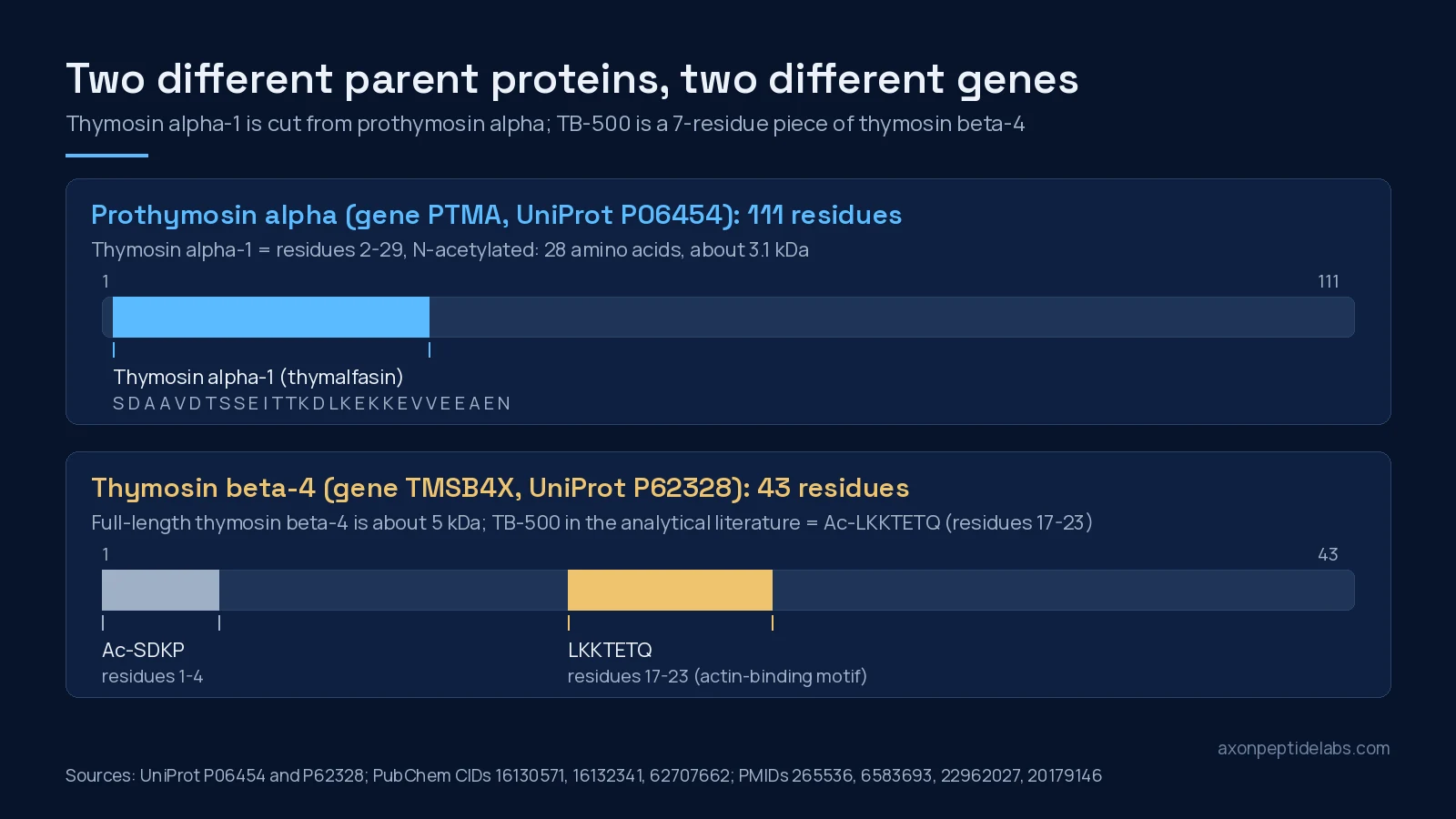
Short answer: they are not related. Thymosin alpha-1 (Tα1, thymalfasin) is a 28-residue, N-acetylated peptide cut from the N-terminus of a nuclear protein called prothymosin alpha, and its best-described research activity is immune signalling through dendritic cells [1][2][3]. TB-500 is a name used for thymosin beta-4 (Tβ4), a 43-residue actin-binding protein made by most vertebrate cells, and, in the analytical literature, for a 7-residue synthetic fragment of it, Ac-LKKTETQ [4][5][6]. The two share the word “thymosin” because both were first pulled out of the same calf-thymus extract in the 1970s and 1980s, not because they share a gene, a sequence or a mechanism [1][7].
For laboratory research only. Not for human or animal use. This article gives no dosing, administration or therapeutic advice.
This matters for anyone ordering or reading papers. A search for “thymosin” returns both families mixed together, supplier pages often blur “thymosin beta-4” and “TB-500”, and the evidence behind each name comes from different models. Below we separate the two by identity, mechanism, study model and documentation, and we list the trials that found nothing.
Why two unrelated peptides share one name
In 1977 Goldstein’s group sequenced a heat-stable, highly acidic 28-residue polypeptide from calf thymus, named it thymosin alpha-1, and proposed a naming system for the many peptides in “thymosin fraction 5”, a crude thymus extract [1]. Peptides were named alpha, beta or gamma by where they ran on isoelectric focusing, not by function. Thymosin beta-4 was sequenced from the same fraction in 1981: 43 residues, an acetylated N-terminus and an isoelectric point of 5.1 [7].
Later work showed that neither molecule is a thymus-specific hormone. A 2005 review of the field states plainly that none of the main peptides isolated from fraction 5 “were really thymic hormones” and that Tβ4 is found in large amounts in many cells [8]. Tβ4 turned out to be the main G-actin-sequestering peptide of most vertebrate cells [4][9]. Tα1, for its part, is the N-terminal piece of prothymosin alpha, a roughly 112-residue protein isolated from rat thymus with the Tα1 sequence at its N-terminus [2]. Whether Tα1 exists naturally or is only an artefact of extraction was debated; a 1992 study reported it as a native peptide in calf thymus and in several lymphoid and non-lymphoid rat tissues [10].
So the shared name is historical. In sequence terms the two have nothing in common: Tα1 begins SDAAVDT… while Tβ4 begins SDKPDMA…, and they are encoded by different genes (PTMA and TMSB4X, UniProt P06454 and P62328).
Identity: what each name actually refers to
Identifiers below were checked against PubChem and UniProt on October 1, 2026, not copied from supplier labels or certificates.
| Item | Thymosin alpha-1 (thymalfasin) | Thymosin beta-4 (timbetasin) | TB-500 fragment (Ac-LKKTETQ) |
|---|---|---|---|
| Length | 28 residues, N-acetylated | 43 residues, N-acetylated | 7 residues, N-acetylated |
| Sequence | Ac-SDAAVDTSSEITTKDLKEKKEVVEEAEN | Ac-SDKPDMAEIEKFDKSKLKKTETQEKNPLPSKETIEQEKQAGES | Ac-LKKTETQ (Tβ4 residues 17–23) |
| Parent protein / gene | Prothymosin alpha, residues 2–29 (PTMA, UniProt P06454) | Thymosin beta-4 (TMSB4X, UniProt P62328) | Synthetic fragment of thymosin beta-4 |
| Molecular formula | C129H215N33O55 | C212H350N56O78S | C38H68N10O14 |
| Molecular weight (PubChem) | 3108.3 | 4963 | 889.0 |
| PubChem CID | 16130571 | 16132341 | 62707662 |
| CAS (PubChem synonyms) | 62304-98-7 | 77591-33-4 | 885340-08-9 |
| Other names | Tα1, thymalfasin, Zadaxin | Tβ4, timbetasin | TB500, TB-500 |
The third column is the one that causes trouble. Two doping-control papers identify the ingredient of products sold as “TB-500” as the N-acetylated 17–23 fragment of Tβ4, not the full protein [5][6]. Yet many papers and catalogues still use “TB-500” as shorthand for full-length Tβ4. A 2023 analysis of internet products sold as TB500 and TB1000 reported that their content was not consistently what the labels described [11]. When you read a study, check which molecule was actually used; when you buy, check what the certificate says was measured.
Mechanism: immune signalling vs actin binding
Thymosin alpha-1
The most cited mechanistic work on Tα1 comes from mouse and cell studies of dendritic cells. In a 2004 study, Tα1 induced maturation and interleukin-12 production in fungus-pulsed mouse dendritic cells through MyD88-dependent Toll-like receptor signalling, and this translated into resistance to Aspergillus in mice [3]. A 2007 review by the same group adds activation of plasmacytoid dendritic cells via TLR9 and induction of indoleamine 2,3-dioxygenase, which it links to tolerance in mouse models [12]. A 2016 review summarises the same picture: Tα1 acts through Toll-like receptors in myeloid and plasmacytoid dendritic cells and affects several immune-cell subsets [13]. These are reviews by groups that work on the peptide, and the core mechanistic data are from mice and cultured cells.
Thymosin beta-4 and the LKKTETQ fragment
Tβ4 is unstructured in solution and folds on binding G-actin; it is the main actin-sequestering molecule in most vertebrate cells [4]. In cell and chick-embryo assays, a seven-residue actin-binding motif was essential for Tβ4’s effects on endothelial cell migration and vessel sprouting, and the motif alone showed near-identical activity to the full protein in those assays [9]. A 2010 review maps several active sites onto the molecule: Ac-SDKP at the N-terminus (residues 1–4), linked to reduced inflammation and fibrosis, and the LKKTETQ region (17–23), linked to cell migration and angiogenesis [14].
In vivo, full-length Tβ4 increased re-epithelialisation in a rat full-thickness wound model [15], and in mice after coronary ligation it activated integrin-linked kinase and Akt in the heart [16]. In diabetic and aged mice, the 7-residue LKKTETQ peptide promoted wound repair in aged animals comparably to the full molecule [17]. Note what was tested: mostly the full protein, in rodents.
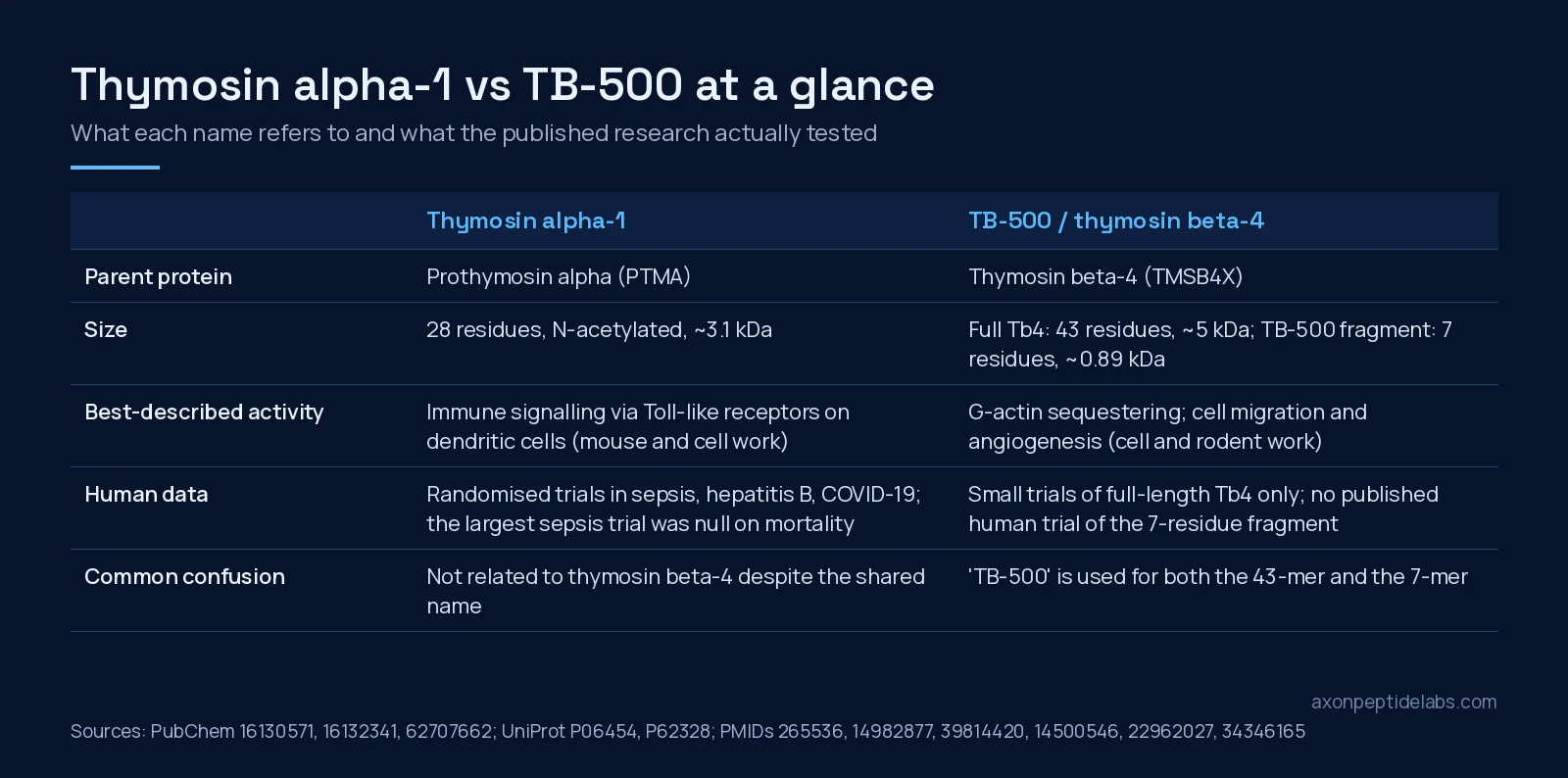
Side-by-side comparison
| Question | Thymosin alpha-1 | TB-500 / thymosin beta-4 |
|---|---|---|
| Main research theme | Immune regulation via dendritic cells and Toll-like receptors [3][13] | Actin sequestering, cell migration, angiogenesis [9][14] |
| Strongest models | Mouse infection models, cultured dendritic cells [3][12] | Rat and mouse wound and cardiac models, endothelial cell assays [15][16] |
| Human studies | Randomised trials in sepsis, chronic hepatitis B and COVID-19 [18][19][20] | Phase 1 safety and pharmacokinetics of recombinant full-length Tβ4 [21]; none found in PubMed for the 7-residue fragment |
| Notable null or negative results | Phase 3 sepsis trial: no clear reduction in 28-day mortality [18] | No improvement in heart function or fibrosis in dystrophic mice, though more regenerating skeletal-muscle fibres were seen [22]; the TB-500 parent peptide showed no significant wound-healing activity in fibroblasts, only one metabolite did [23] |
| Identity pitfalls | Few: one 28-residue sequence, one CID | “TB-500” can mean the 43-mer or the 7-mer; product content has been inconsistent [5][11] |
What the human studies tested (design only)
Tα1 has a larger clinical literature than either form of Tβ4. The largest trial, TESTS, randomised 1,106 adults with sepsis across 22 Chinese centres to thymalfasin or placebo, with 28-day all-cause mortality as the primary outcome; it found no clear evidence that Tα1 lowered that outcome, and no secondary or safety outcome differed significantly [18]. An earlier, smaller single-blind trial (ETASS, 361 patients) reported a result of marginal statistical significance [24]. A 2025 meta-analysis of 11 randomised trials found that the apparent benefit was not significant when only high-quality or multicentre trials were analysed, and its trial sequential analysis judged the total sample size inadequate [25].
In chronic hepatitis B, a Cochrane review published in September 2026 pooled 10 randomised trials (1,349 participants, published 1991–2018) and rated the certainty of evidence as very low for every outcome except serious adverse events (low), concluding that it is not sure whether Tα1 changes mortality or other outcomes [19]. In COVID-19, an open-label pilot trial of 49 hospitalised patients found no significant difference in clinical recovery, while reporting faster CD4+ T-cell recovery in one subgroup [20].
For Tβ4, the human record is thinner. A first-in-human phase 1 study of recombinant Tβ4 in 84 healthy volunteers reported mild-to-moderate adverse events and no dose-limiting toxicity [21]. We found no published human trial of the 7-residue TB-500 fragment in PubMed; the fragment appears there mainly in doping-control, metabolism and rodent papers [5][6][23]. A 2026 rat Achilles-tendon study compared BPC-157, “synthetic thymosin beta-4 (TB-500)” and the combination, and reported better tendon histology scores in the TB-500 group at four weeks; the abstract does not say whether the 43-mer or the 7-mer was used [26].
Thymalfasin has been developed as a drug, and its regulatory status differs between countries; this article makes no statement about its status anywhere, including Canada.
What the evidence does not show
- It does not show that the two peptides act together. We found no study that tested Tα1 and Tβ4 (or the fragment) in combination. Combination protocols seen online are not based on any published study we could find.
- It does not show that TB-500 the fragment equals thymosin beta-4 the protein. Most of the wound and cardiac work used the full protein [15][16]; the fragment matched it only in specific assays [9][17], and one metabolism study found no significant wound-healing activity for the acetylated parent fragment itself in fibroblasts [23].
- It does not show consistent clinical effects for Tα1. The biggest and best-controlled trial was null on its primary outcome [18], and the hepatitis B evidence is rated very low certainty [19].
- Mouse dendritic-cell data do not transfer automatically to other species or settings. The TLR mechanism is well described in mice and cells [3][12]; it is a model result, not a property of any vial.
- Nothing here establishes safety or effects for research products. The human studies used pharmaceutical-grade material under trial conditions.
Documentation at Axon
Axon lists Thymosin Alpha-1 10mg in its immune research range and TB-500 in its recovery range. On our COA library, TB-500 10mg has a posted report from testides.com: batch MP-TB50-10-041626, purity 99.69%, dated 29 APR 2026. That report covers the 10mg listing only. No certificate is posted for Thymosin Alpha-1 on our COA page at the time of writing. The TB-500 product page describes the material as a thymosin beta-4 fragment; given the naming problem above, compare the identity and mass reported on any certificate with the table in this article before relying on it.
For more on the thymic peptide itself, see our Thymosin Alpha-1 Canada page; for TB-500 alongside BPC-157, see BPC-157 and TB-500 in Canada. If you are comparing suppliers, you can buy lab-tested peptides in Canada with batch documentation listed where it exists.
Frequently asked questions
Is TB-500 the same as thymosin alpha-1?
No. Thymosin alpha-1 is a 28-residue peptide from the N-terminus of prothymosin alpha (gene PTMA). TB-500 refers to thymosin beta-4 (gene TMSB4X), a 43-residue actin-binding protein, or to its synthetic 7-residue fragment Ac-LKKTETQ. They differ in sequence, size, gene and studied mechanism.
Why do both peptides have “thymosin” in their names?
Both were first isolated from thymosin fraction 5, a calf-thymus extract, and were named by where they ran on isoelectric focusing (alpha, beta). Later work showed neither is a thymus-specific hormone; the shared name is historical, not structural.
Is TB-500 the full thymosin beta-4 protein?
Not always. Doping-control papers identify products sold as TB-500 as the N-acetylated 17–23 fragment (Ac-LKKTETQ, about 889 Da), while many papers and catalogues use TB-500 for full-length thymosin beta-4 (about 4,963 Da). Check which molecule a study used and what a certificate measured.
Which of the two has more human research?
Thymosin alpha-1. It has randomised trials in sepsis, chronic hepatitis B and COVID-19, though the largest sepsis trial found no clear effect on 28-day mortality and the hepatitis B evidence is rated very low certainty. Full-length thymosin beta-4 has small early trials; we found no published human trial of the 7-residue fragment.
Does Axon post a COA for Thymosin Alpha-1 and TB-500?
TB-500 10mg has a posted testides.com report on the Axon COA library (batch MP-TB50-10-041626, purity 99.69%, 29 APR 2026). No certificate is posted for Thymosin Alpha-1 on the COA page at the time of writing.
References
- Goldstein AL, Low TL, McAdoo M et al. (1977). Thymosin alpha1: isolation and sequence analysis of an immunologically active thymic polypeptide. Proc Natl Acad Sci U S A. PMID: 265536. doi: 10.1073/pnas.74.2.725.
- Haritos AA, Goodall GJ, Horecker BL (1984). Prothymosin alpha: isolation and properties of the major immunoreactive form of thymosin alpha 1 in rat thymus. Proc Natl Acad Sci U S A. PMID: 6583693. doi: 10.1073/pnas.81.4.1008.
- Romani L, Bistoni F, Gaziano R et al. (2004). Thymosin alpha 1 activates dendritic cells for antifungal Th1 resistance through toll-like receptor signaling. Blood. PMID: 14982877. doi: 10.1182/blood-2003-11-4036.
- Hannappel E (2007). beta-Thymosins. Ann N Y Acad Sci. PMID: 17468232. doi: 10.1196/annals.1415.018.
- Esposito S, Deventer K, Goeman J et al. (2012). Synthesis and characterization of the N-terminal acetylated 17-23 fragment of thymosin beta 4 identified in TB-500, a product suspected to possess doping potential. Drug Test Anal. PMID: 22962027. doi: 10.1002/dta.1402.
- Ho EN, Kwok WH, Lau MY et al. (2012). Doping control analysis of TB-500, a synthetic version of an active region of thymosin β₄, in equine urine and plasma by liquid chromatography-mass spectrometry. J Chromatogr A. PMID: 23084823. doi: 10.1016/j.chroma.2012.09.043.
- Low TL, Hu SK, Goldstein AL (1981). Complete amino acid sequence of bovine thymosin beta 4: a thymic hormone that induces terminal deoxynucleotidyl transferase activity in thymocyte populations. Proc Natl Acad Sci U S A. PMID: 6940133. doi: 10.1073/pnas.78.2.1162.
- Goldstein AL, Hannappel E, Kleinman HK (2005). Thymosin beta4: actin-sequestering protein moonlights to repair injured tissues. Trends Mol Med. PMID: 16099219. doi: 10.1016/j.molmed.2005.07.004.
- Philp D, Huff T, Gho YS et al. (2003). The actin binding site on thymosin beta4 promotes angiogenesis. FASEB J. PMID: 14500546. doi: 10.1096/fj.03-0121fje.
- Franco FJ, Diaz C, Barcia M et al. (1992). Thymosin alpha 1 is a native peptide in several tissues. Biochim Biophys Acta. PMID: 1554740. doi: 10.1016/0167-4838(92)90422-a.
- Delcourt V, Garcia P, Chabot B et al. (2023). TB500/TB1000 and SGF1000: A scientific approach for a better understanding of misbranded and adulterated drugs. Drug Test Anal. PMID: 36482504. doi: 10.1002/dta.3421.
- Romani L, Bistoni F, Montagnoli C et al. (2007). Thymosin alpha1: an endogenous regulator of inflammation, immunity, and tolerance. Ann N Y Acad Sci. PMID: 17495242. doi: 10.1196/annals.1415.002.
- King R, Tuthill C (2016). Immune Modulation with Thymosin Alpha 1 Treatment. Vitam Horm. PMID: 27450734. doi: 10.1016/bs.vh.2016.04.003.
- Sosne G, Qiu P, Goldstein AL et al. (2010). Biological activities of thymosin beta4 defined by active sites in short peptide sequences. FASEB J. PMID: 20179146. doi: 10.1096/fj.09-142307.
- Malinda KM, Sidhu GS, Mani H et al. (1999). Thymosin beta4 accelerates wound healing. J Invest Dermatol. PMID: 10469335. doi: 10.1046/j.1523-1747.1999.00708.x.
- Bock-Marquette I, Saxena A, White MD et al. (2004). Thymosin beta4 activates integrin-linked kinase and promotes cardiac cell migration, survival and cardiac repair. Nature. PMID: 15565145. doi: 10.1038/nature03000.
- Philp D, Badamchian M, Scheremeta B et al. (2003). Thymosin beta 4 and a synthetic peptide containing its actin-binding domain promote dermal wound repair in db/db diabetic mice and in aged mice. Wound Repair Regen. PMID: 12581423. doi: 10.1046/j.1524-475x.2003.11105.x.
- Wu J, Pei F, Zhou L et al. (2025). The efficacy and safety of thymosin α1 for sepsis (TESTS): multicentre, double blinded, randomised, placebo controlled, phase 3 trial. BMJ. PMID: 39814420. doi: 10.1136/bmj-2024-082583.
- Naing C, Ni H, Aung HH et al. (2026). Thymosin-ɑ1 for people with chronic hepatitis B. Cochrane Database Syst Rev. PMID: 42713852. doi: 10.1002/14651858.CD014610.pub2.
- Shehadeh F, Benitez G, Mylona EK et al. (2023). A Pilot Trial of Thymalfasin (Thymosin-α-1) to Treat Hospitalized Patients With Hypoxemia and Lymphocytopenia Due to Coronavirus Disease 2019 Infection. J Infect Dis. PMID: 36056913. doi: 10.1093/infdis/jiac362.
- Wang X, Liu L, Qi L et al. (2021). A first-in-human, randomized, double-blind, single- and multiple-dose, phase I study of recombinant human thymosin β4 in healthy Chinese volunteers. J Cell Mol Med. PMID: 34346165. doi: 10.1111/jcmm.16693.
- Spurney CF, Cha HJ, Sali A et al. (2010). Evaluation of skeletal and cardiac muscle function after chronic administration of thymosin beta-4 in the dystrophin deficient mouse. PLoS One. PMID: 20126456. doi: 10.1371/journal.pone.0008976.
- Rahaman KA, Muresan AR, Min H et al. (2024). Simultaneous quantification of TB-500 and its metabolites in in-vitro experiments and rats by UHPLC-Q-Exactive orbitrap MS/MS and their screening by wound healing activities in-vitro. J Chromatogr B Analyt Technol Biomed Life Sci. PMID: 38382158. doi: 10.1016/j.jchromb.2024.124033.
- Wu J, Zhou L, Liu J et al. (2013). The efficacy of thymosin alpha 1 for severe sepsis (ETASS): a multicenter, single-blind, randomized and controlled trial. Crit Care. PMID: 23327199. doi: 10.1186/cc11932.
- Gu B, Zhou Y, Nie Y et al. (2025). Efficacy of thymosin α1 for sepsis: a systematic review and meta-analysis of randomized controlled trials. Front Cell Infect Microbiol. PMID: 40969554. doi: 10.3389/fcimb.2025.1673959.
- Biçer O, Adanir O, Güleryüz Y et al. (2026). Effects of BPC-157 and TB-500 on Achilles tendon healing in rats: A histopathological and biomechanical study. Jt Dis Relat Surg. PMID: 42542926. doi: 10.52312/jdrs.2026.2951.