
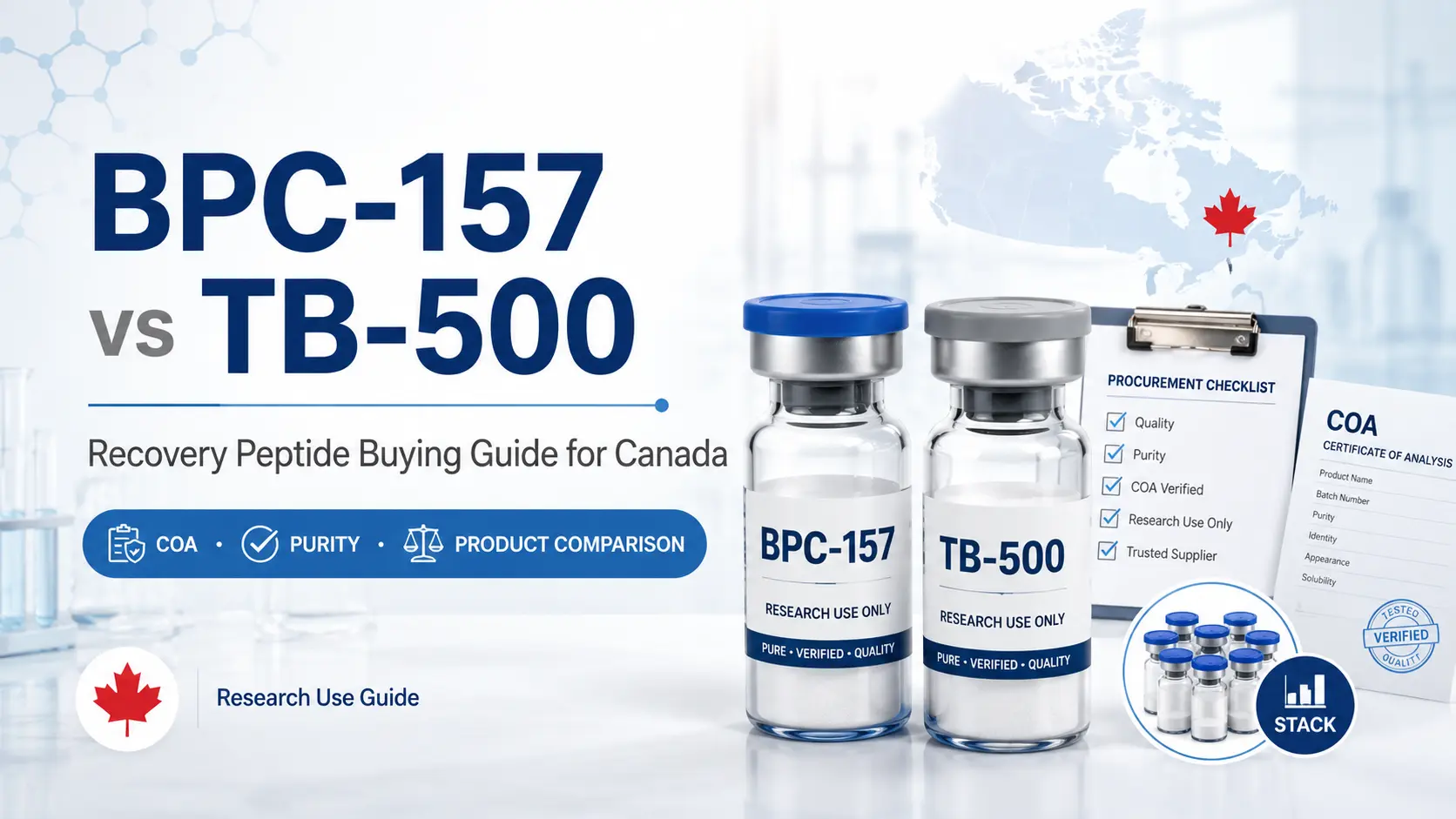
BPC-157 vs TB-500: Recovery Peptide Buying Guide for Canada
BPC-157 and TB-500 are two of the most searched recovery research peptides in Canada. They are often compared because both appear in research discussions related to tissue repair, recovery pathways, inflammation response, connective tissue research, and regenerative peptide studies.
For Canadian buyers comparing research-use products, the main goal is not to decide which peptide to use personally. The goal is to understand how BPC-157 and TB-500 are positioned in research, how they differ, what documentation to review, and what to check before ordering from a research-use peptide supplier.
Ready to compare products? Buy BPC-157 Canada research vials (5mg and 10mg), or see the BPC-157 + TB-500 stack. Research use only.
Quick Comparison
| Product | Research Profile | Common Research Context |
|---|---|---|
| BPC-157 | Synthetic pentadecapeptide research compound | Tissue repair, connective tissue, gastrointestinal, tendon, and recovery research |
| TB-500 | Thymosin beta-4 related research peptide | Cell migration, tissue repair, wound healing, and recovery pathway research |
| BPC-157 + TB-500 | Combined research category | Recovery peptide comparison, tissue repair research, and regenerative research models |
BPC-157 and TB-500 are often discussed together because both are connected to recovery-focused research. However, they are not the same compound, and they should not be described as interchangeable.
Why BPC-157 and TB-500 Are Compared
BPC-157 and TB-500 are commonly compared because buyers often search for recovery peptides in Canada and want to understand how these two products fit into the same research category.
BPC-157 is usually discussed in relation to tissue repair, tendon research, connective tissue models, gastrointestinal research, and inflammation-related pathways. TB-500 is commonly discussed in relation to thymosin beta-4 research, cell migration, wound healing models, tissue remodeling, and recovery pathway studies.
BPC-157 Research Overview
BPC-157 is commonly described in research literature as a synthetic peptide compound associated with tissue repair and protective pathway studies. It is often discussed in preclinical research involving connective tissue, tendon, ligament, muscle, gastrointestinal tissue, angiogenesis, and collagen-related pathways.
For Canadian buyers reviewing a BPC-157 product page, the most important step is to check whether the listing clearly presents the product as research-use only. A strong product page should include the product name, amount, SKU, category, COA availability, purity details where published, and batch information where available.
Important BPC-157 page details to review include:
| Buyer Check | What to Review |
|---|---|
| Product identity | Confirm the listing is for BPC-157 |
| Amount options | Review available size or product variation |
| SKU | Check product tracking information where listed |
| COA availability | Look for Certificate of Analysis access where available |
| Purity details | Review published purity values where provided |
| Research-use language | Confirm no personal-use or therapeutic claims are made |
BPC-157 may be relevant to buyers comparing recovery research peptides, but the product page should avoid claims related to human use, injury healing, pain relief, diagnosis, treatment, or disease prevention.
TB-500 Research Overview
TB-500 is commonly discussed as a thymosin beta-4 related research peptide. It is often reviewed in connection with cell migration, tissue repair, wound healing models, inflammation response, and regenerative research pathways.
Because TB-500 is often searched with recovery and repair language, product content should be written carefully. A research-use article can describe TB-500 as part of tissue repair research and recovery pathway research. It should not claim that TB-500 repairs injuries, improves performance, reduces pain, or provides human health benefits.
Important TB-500 page details to review include:
| Buyer Check | What to Review |
|---|---|
| Product identity | Confirm the listing is for TB-500 |
| Research context | Review thymosin beta-4 related research positioning |
| COA access | Look for available COA or batch-level documentation |
| Purity information | Check purity details where published |
| Category placement | Compare with recovery and repair research products |
| Compliance | Confirm research-use only language is clear |
BPC-157 vs TB-500: Main Differences
The main difference between BPC-157 and TB-500 is how they are discussed in research.
BPC-157 is usually associated with tissue protection, connective tissue repair models, gastrointestinal research, tendon and ligament research, collagen-related pathways, and angiogenesis-related studies. TB-500 is more commonly connected with thymosin beta-4 related research, cell migration, wound healing models, tissue remodeling, and regenerative pathway studies.
| Comparison Point | BPC-157 | TB-500 |
|---|---|---|
| Common research category | Tissue repair and recovery research | Recovery and regenerative research |
| Research association | Connective tissue, tendon, ligament, GI, collagen pathways | Cell migration, wound healing, thymosin beta-4 related pathways |
| Product review focus | COA, purity, product identity, batch details | COA, purity, product identity, batch details |
| Buyer search intent | Recovery peptide Canada, BPC-157 COA, BPC-157 Canada | TB-500 Canada, TB-500 COA, recovery peptide research |
| Compliance note | Research-use only | Research-use only |
This comparison helps buyers understand the category difference between the two products. It should not be used as medical guidance or personal-use advice.
Are BPC-157 and TB-500 Used Together in Research?
BPC-157 and TB-500 are sometimes searched together because both are connected to recovery and tissue repair research categories. Some buyers compare them side by side, while others look for blend-style research products or related recovery peptide categories.
What Buyers Should Check Before Ordering
Before ordering BPC-157 or TB-500 for research procurement in Canada, buyers should review the product page carefully.
Important checks include:
| Buyer Check | Why It Matters |
|---|---|
| Product name | Confirms the exact compound being reviewed |
| Amount options | Helps compare product variations |
| SKU | Supports product tracking and procurement review |
| COA availability | Helps verify available documentation |
| Purity value | Provides a quality-review point where published |
| Batch or lot details | Supports batch-level review where available |
| Research-use labeling | Confirms the product is not positioned for personal use |
| Related products | Helps compare recovery research categories |
A transparent product page should make it easy to understand what the product is, what documentation is available, and whether the listing avoids unsupported personal-use claims.
How to Review COA and Purity Details
A COA, or Certificate of Analysis, is one of the most important documents to review when comparing BPC-157, TB-500, or any research-use peptide.
Where available, a COA may include product identity, batch or lot number, purity value, test date, testing method, lab or source information, and other quality-related details. Buyers should compare the COA details with the product page to make sure the documentation matches the listed compound.
Useful COA fields may include:
- Product name
- Batch or lot number
- Purity percentage
- Test date
- Testing method where listed
- Lab or source information
- Matching product details
Buyers should look beyond general marketing phrases such as “high quality,” “premium grade,” or “verified purity.” The strongest product pages support those claims with clear documentation, COA access where available, and transparent product information.
If COA details are missing, unclear, or difficult to match with the product page, buyers should contact support before ordering.
Why Research-Use Language Matters
BPC-157 and TB-500 are often searched with recovery, injury, repair, and performance-related wording. Because of that, research-use websites need to be careful with how product pages and blog articles are written.
A compliant research-use article can discuss:
- Recovery research
- Tissue repair research
- Connective tissue research
- Wound healing models
- Cell migration research
- Regenerative pathway research
- COA review
- Purity documentation
- Research-use procurement
BPC-157 vs TB-500: Which One Should Buyers Review First?
The best product to review first depends on the research topic.
Buyers interested in connective tissue, tendon, ligament, collagen-related pathways, gastrointestinal research, and tissue protection models may start by reviewing BPC-157. Buyers interested in thymosin beta-4 related pathways, cell migration, wound healing models, and tissue remodeling research may start by reviewing TB-500.
Related Products to Compare
Canadian buyers comparing BPC-157 and TB-500 may also review related recovery and repair research products.
Recommended related pages include:
FAQ
What is the difference between BPC-157 and TB-500?
BPC-157 is commonly discussed in tissue repair, connective tissue, tendon, ligament, gastrointestinal, and collagen-related research. TB-500 is commonly discussed in thymosin beta-4 related research, cell migration, wound healing models, and regenerative pathway studies.
Are BPC-157 and TB-500 the same product?
No. BPC-157 and TB-500 are different research compounds. They may appear in the same recovery peptide category, but they should not be described as identical or interchangeable.
Why are BPC-157 and TB-500 compared?
They are compared because both are commonly searched in relation to recovery research, tissue repair research, and regenerative peptide studies. Buyers often review them side by side before deciding which product page is most relevant to their research topic.
What should buyers check before ordering BPC-157 or TB-500?
Buyers should check product identity, amount options, SKU, COA availability, purity details, batch or lot information where available, category placement, and research-use only labeling.
Should buyers review the COA before ordering?
Yes. Where available, the COA should be reviewed before ordering. Buyers should compare the COA details with the product page, including product name, batch or lot number, purity value, test date, and testing method where listed.