
NAD+ vs NMN: The Coenzyme and Its Precursor Compared
For laboratory research only. Not for human or animal use. This article gives no dosing, administration or therapeutic advice.
Short answer: NAD+ (nicotinamide adenine dinucleotide) is the coenzyme itself, a 663 g/mol dinucleotide that carries electrons in redox reactions and is consumed as a substrate by sirtuins, PARPs and CD38[1][2]. NMN (nicotinamide mononucleotide) is one step upstream: in the salvage pathway, NAMPT makes NMN from nicotinamide and an NMNAT enzyme joins NMN to ATP to make NAD+[3][4]. The practical difference for researchers is what happens outside the cell. In human cell studies neither NAD+ nor NMN readily crossed the plasma membrane intact; both were broken down outside the cell first, and the permeable product, chiefly nicotinamide riboside (NR), then entered[5][6]. A proposed dedicated NMN transporter, Slc12a8, was reported in mouse intestine and then disputed[7][8].
Identity: two different molecules, not two grades of one
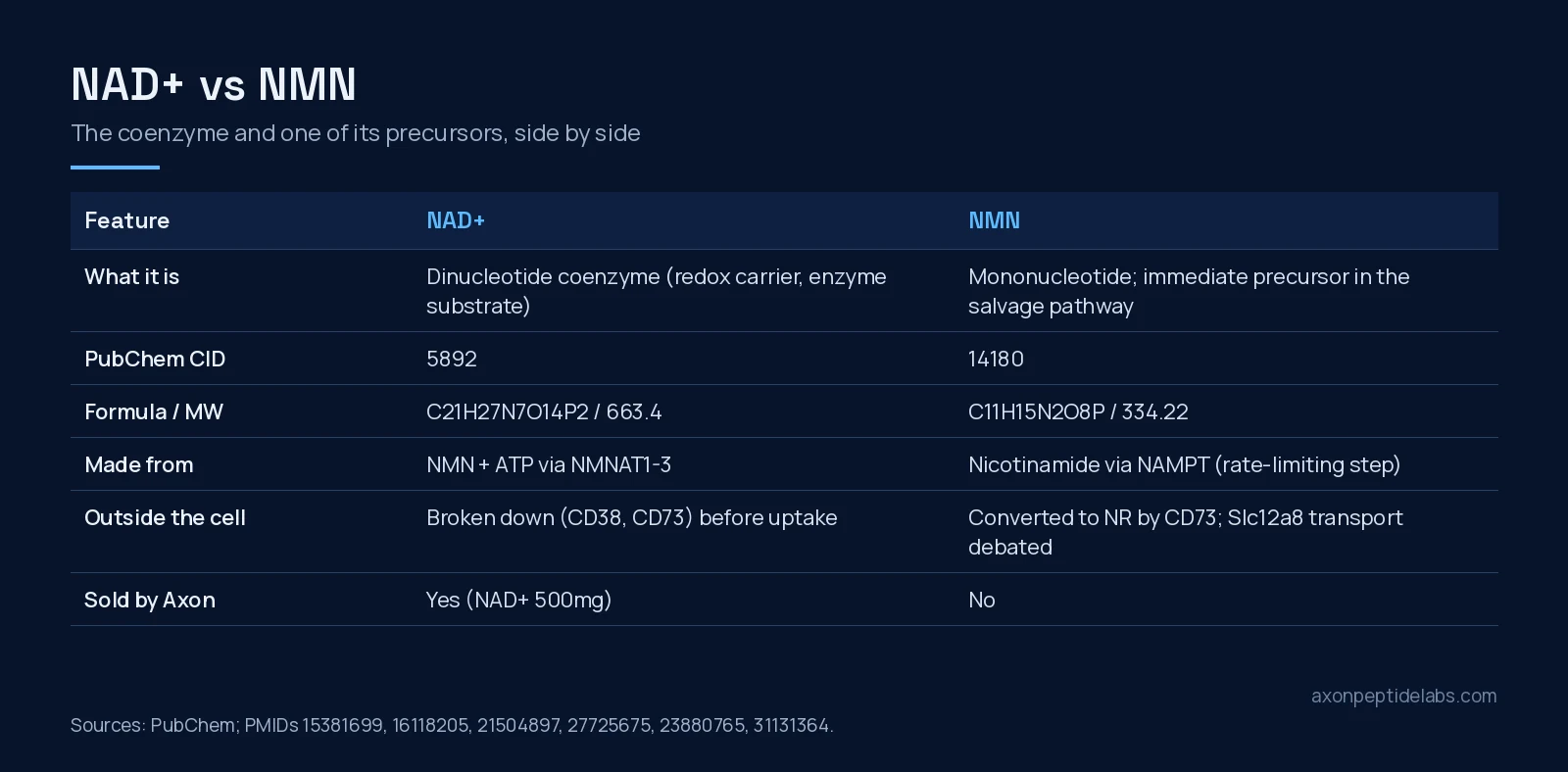
The names sound close, but these are separate compounds with different formulas. The values below come from PubChem records, not from certificates of analysis. NR is included because it keeps turning up in the same pathway.
| Field | NAD+ | NMN | NR (for reference) |
|---|---|---|---|
| PubChem CID | 5892 (nadide) | 14180 | 439924 |
| CAS | 53-84-9 | 1094-61-7 | 1341-23-7 |
| Molecular formula | C21H27N7O14P2 | C11H15N2O8P | C11H15N2O5+ |
| Molecular weight | 663.4 g/mol | 334.22 g/mol | 255.25 g/mol |
| Structure | Dinucleotide: a nicotinamide nucleotide and an adenine nucleotide joined through a pyrophosphate | Mononucleotide: nicotinamide, ribose and one phosphate | Nucleoside: nicotinamide and ribose, no phosphate |
| Peptide? | No | No | No |
None of the three is a peptide. They are nucleotides or a nucleoside, so identity and purity work looks more like small-molecule analysis than peptide mass mapping. NMN is roughly half the mass of NAD+, and NR is NMN without its phosphate group.
The salvage pathway: where NMN sits
Mammalian cells recycle the nicotinamide released whenever NAD+ is consumed. In mouse fibroblasts, Revollo and colleagues measured the kinetics of the two steps: NAMPT converts nicotinamide to NMN, and NMNAT converts NMN to NAD+. NAMPT was the rate-limiting component. Raising NAMPT, but not NMNAT, increased total cellular NAD in that cell model[3].
The second step is split across cell compartments. Of the three human NMNAT isoforms, NMNAT1 is nuclear, NMNAT2 localizes to the Golgi complex and NMNAT3 to mitochondria, and the isoforms differ in their catalytic properties[4]. A later study in human cells used a mitochondria-targeted PARP as a detector of organelle NAD. It found that precursors are converted to NMN in the cytosol, and that NMN taken into mitochondria is turned into NAD by NMNAT3 in the matrix[5]. So inside the cell, NMN is the last intermediate before NAD+ in each compartment.
The pool also turns over quickly. Isotope-tracer work found NAD fluxes that varied widely between tissues, high in small intestine and spleen and low in skeletal muscle, with PARPs and sirtuins as the main consumers in cell lines[9]. A 2021 perspective noted NAD half-lives on the order of minutes in some tissues[2]. That speed is one reason a single concentration measurement can mislead.
Outside the cell: degradation comes first
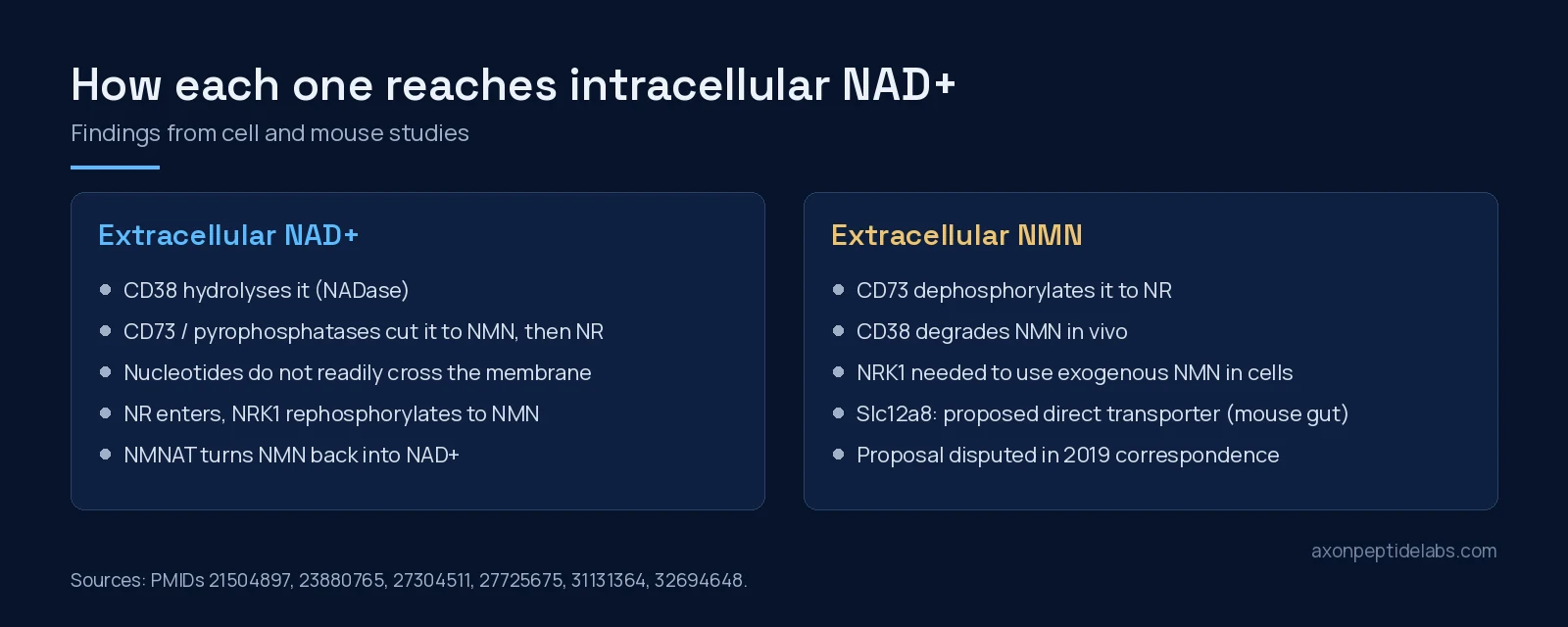
This is where NAD+ and NMN stop behaving like interchangeable inputs. In the human cell study above, besides nicotinamide and nicotinic acid, only the corresponding nucleosides readily entered cells; nucleotides such as NAD and NMN were degraded outside the cell into permeable precursors first[5].
Two cell-surface enzymes dominate that step. CD73 converts NMN to NR, and CD38 converts NMN to nicotinamide. In human cell lines, silencing and overexpression experiments showed that CD73 enables, and CD38 impairs, the use of extracellular NMN as an NR source for intracellular NAD+[10]. Ratajczak and colleagues used stable-isotope-labelled compounds to confirm that NMN is metabolized outside mammalian cells to NR, which is taken up and converted into NAD+. NR kinase 1 (NRK1) was necessary and rate-limiting for using either exogenous NR or NMN[6]. In human aortic endothelial cells, a CD73 inhibitor cancelled the effects of added NMN but not of added NR, again pointing to conversion of NMN to NR outside the cell[11].
CD38 matters in animals too. In mice, CD38 expression and activity rose with age, CD38 was required for the age-related fall in NAD, and it was identified as the main enzyme degrading NMN in vivo[12]. A 2020 mouse study traced the rise of CD38 in white fat and liver to accumulating CD38-positive immune cells, and found that blocking CD38’s ectoenzyme activity raised NAD+ through an NMN-dependent process[13].
The Slc12a8 debate
In 2019, Grozio and colleagues reported that the mouse gene Slc12a8 encodes a sodium-dependent transporter specific for NMN, not NR. It was highly expressed in mouse small intestine, its knockdown reduced NMN uptake in vitro and in vivo, and its loss lowered NAD+ in jejunum and ileum[7]. If correct, this would give NMN a direct entry route that NAD+ lacks, at least in the mouse gut.
The finding was challenged within months. Schmidt and Brenner published a correspondence titled “Absence of evidence that Slc12a8 encodes a nicotinamide mononucleotide transporter”[8], and the original authors published a reply[14]. The question remains open: the transporter claim rests on mouse data, and it sits beside cell work with labelled NMN showing extracellular conversion to NR before uptake[6].
What pharmacokinetic studies measured
Route matters a great deal in the tracer data. In mice, intravenous NR or NMN delivered intact molecules to multiple tissues, but the same compounds given orally were metabolized to nicotinamide in the liver[9]. Mills and colleagues gave NMN orally to wild-type mice for 12 months and reported that it was quickly used to synthesize NAD+ in tissues, without obvious toxicity in that model[15].
Human data are smaller and mostly about safety and blood metabolites. The studies differ in what they measured:
| Study | Compound and design | What was measured | Limit |
|---|---|---|---|
| Irie et al. 2020[16] | NMN, single oral administrations, 10 healthy men, single-arm, non-randomized | Clinical parameters, laboratory values and NMN metabolites over 5 hours | No control group; very small; short window |
| Yamaguchi et al. 2024[17] | NMN, 8 weeks, 11 healthy middle-aged men, open-label, single-arm | Tolerability; NAD+ in peripheral blood mononuclear cells over time | No placebo; one centre; 11 people |
| Grant et al. 2019[18] | NAD+, 6-hour intravenous infusion, pilot cohort | Plasma and urine NAD+ metabolome | Pilot; no change in plasma NAD+ for the first 2 hours |
| Trammell et al. 2016[19] | NR, single administrations; first human NR pharmacokinetic trial plus mouse liver work | Blood NAD+ metabolome; NAAD as a marker | About NR, not NMN; small |
The intravenous NAD+ pilot is the most direct human look at the coenzyme itself. Plasma NAD+ and its metabolites, including NMN, did not change until after 2 hours, which the authors read as rapid and complete removal from plasma, and the metabolite profile was consistent with NAD+ glycohydrolase and pyrophosphatase activity[18]. That matches the cell data: extracellular NAD+ is processed quickly.
Where nicotinamide riboside fits
NR is the other well-studied precursor, and the cell data put it at the centre of both stories. Extracellular NMN becomes NR before uptake, and NRK1 phosphorylates NR back to NMN inside the cell[6]. In the first human NR pharmacokinetic trial, NR produced dose-dependent increases in the blood NAD+ metabolome, and nicotinic acid adenine dinucleotide (NAAD) rose as a sensitive marker[19]. Axon does not sell NR or NMN; the only compound of the three in our catalogue is NAD+.
What the evidence does not show
- No head-to-head human comparison of NAD+ and NMN. We found no randomized study comparing the two directly. The human studies above used different compounds, routes, populations and endpoints.
- No settled answer on NMN transport. Slc12a8 was reported in mouse intestine and disputed in published correspondence[7][8][14]. Cell studies with labelled NMN point to conversion to NR first[6].
- No human outcome claims. The human NMN studies cited here are small, uncontrolled or open-label safety and metabolite studies[16][17]. Mouse findings[15] do not transfer to people.
- Blood levels are not tissue levels. Tracer work shows large tissue-to-tissue differences in NAD flux and in what oral precursors become[9].
- Reviews frame open questions. A 2021 review notes that how to restore NAD+ effectively, whether doing so is safe and whether it helps ageing humans are still open questions[1].
Sourcing NAD+ for research
For in-vitro and analytical work, the identity questions are the same as for any reagent: confirm the compound (NAD+ is CID 5892, not a precursor), the amount and the batch documentation. Our NAD+ 500mg has a certificate on our COA page: batch MP-NAD-500-041626, 97.56% purity, tested 28 April 2026 by testides.com. We do not sell NMN. Handling and storage notes are in our NAD+ purity and storage checklist, and the NAD+ Canada page collects related material. For a redox-focused comparison, see glutathione vs NAD+. If you are comparing suppliers more broadly, you can buy lab-tested peptides in Canada with batch documentation where it is posted.
Frequently asked questions
Is NMN the same thing as NAD+?
No. NAD+ (PubChem CID 5892, 663.4 g/mol) is the coenzyme. NMN (CID 14180, 334.22 g/mol) is a mononucleotide precursor that NMNAT enzymes combine with ATP to form NAD+ inside cells.
Can NAD+ or NMN enter cells intact?
In human cell studies, both were mostly degraded outside the cell first. CD73 converts NMN to nicotinamide riboside, which enters and is phosphorylated back to NMN by NRK1. A dedicated NMN transporter, Slc12a8, was reported in mouse intestine, but that claim has been disputed.
What do CD38 and CD73 do to NAD+ and NMN?
They are cell-surface enzymes. CD73 converts NMN to nicotinamide riboside, an uptake-ready precursor. CD38 degrades NAD+ and NMN; in mice it rose with age and was identified as the main enzyme breaking down NMN in vivo.
Have NAD+ and NMN been compared head to head in humans?
We found no randomized head-to-head study. The published human work consists of small safety and pharmacokinetic studies of NMN, a pilot intravenous NAD+ study and NR pharmacokinetic trials, each measuring different things.
Does Axon Peptide Labs sell NMN or post a COA for NAD+?
Axon does not sell NMN. Our COA page lists NAD+ 500mg, batch MP-NAD-500-041626, 97.56% purity, tested 28 April 2026 by testides.com.
References
- Covarrubias AJ, Perrone R, Grozio A et al. (2021). NAD(+) metabolism and its roles in cellular processes during ageing. Nat Rev Mol Cell Biol. PMID: 33353981. doi: 10.1038/s41580-020-00313-x.
- Chini CCS, Zeidler JD, Kashyap S et al. (2021). Evolving concepts in NAD(+) metabolism. Cell Metab. PMID: 33930322. doi: 10.1016/j.cmet.2021.04.003.
- Revollo JR, Grimm AA, Imai S (2004). The NAD biosynthesis pathway mediated by nicotinamide phosphoribosyltransferase regulates Sir2 activity in mammalian cells. J Biol Chem. PMID: 15381699. doi: 10.1074/jbc.M408388200.
- Berger F, Lau C, Dahlmann M et al. (2005). Subcellular compartmentation and differential catalytic properties of the three human nicotinamide mononucleotide adenylyltransferase isoforms. J Biol Chem. PMID: 16118205. doi: 10.1074/jbc.M508660200.
- Nikiforov A, Dölle C, Niere M et al. (2011). Pathways and subcellular compartmentation of NAD biosynthesis in human cells: from entry of extracellular precursors to mitochondrial NAD generation. J Biol Chem. PMID: 21504897. doi: 10.1074/jbc.M110.213298.
- Ratajczak J, Joffraud M, Trammell SA et al. (2016). NRK1 controls nicotinamide mononucleotide and nicotinamide riboside metabolism in mammalian cells. Nat Commun. PMID: 27725675. doi: 10.1038/ncomms13103.
- Grozio A, Mills KF, Yoshino J et al. (2019). Slc12a8 is a nicotinamide mononucleotide transporter. Nat Metab. PMID: 31131364. doi: 10.1038/s42255-018-0009-4.
- Schmidt MS, Brenner C (2019). Absence of evidence that Slc12a8 encodes a nicotinamide mononucleotide transporter. Nat Metab. PMID: 32694648. doi: 10.1038/s42255-019-0085-0.
- Liu L, Su X, Quinn WJ 3rd et al. (2018). Quantitative Analysis of NAD Synthesis-Breakdown Fluxes. Cell Metab. PMID: 29685734. doi: 10.1016/j.cmet.2018.03.018.
- Grozio A, Sociali G, Sturla L et al. (2013). CD73 protein as a source of extracellular precursors for sustained NAD+ biosynthesis in FK866-treated tumor cells. J Biol Chem. PMID: 23880765. doi: 10.1074/jbc.M113.470435.
- Mateuszuk Ł, Campagna R, Kutryb-Zając B et al. (2020). Reversal of endothelial dysfunction by nicotinamide mononucleotide via extracellular conversion to nicotinamide riboside. Biochem Pharmacol. PMID: 32389638. doi: 10.1016/j.bcp.2020.114019.
- Camacho-Pereira J, Tarragó MG, Chini CCS et al. (2016). CD38 Dictates Age-Related NAD Decline and Mitochondrial Dysfunction through an SIRT3-Dependent Mechanism. Cell Metab. PMID: 27304511. doi: 10.1016/j.cmet.2016.05.006.
- Chini CCS, Peclat TR, Warner GM et al. (2020). CD38 ecto-enzyme in immune cells is induced during aging and regulates NAD(+) and NMN levels. Nat Metab. PMID: 33199925. doi: 10.1038/s42255-020-00298-z.
- Grozio A, Mills K, Yoshino J et al. (2019). Reply to: Absence of evidence that Slc12a8 encodes a nicotinamide mononucleotide transporter. Nat Metab. PMID: 32694650. doi: 10.1038/s42255-019-0086-z.
- Mills KF, Yoshida S, Stein LR et al. (2016). Long-Term Administration of Nicotinamide Mononucleotide Mitigates Age-Associated Physiological Decline in Mice. Cell Metab. PMID: 28068222. doi: 10.1016/j.cmet.2016.09.013.
- Irie J, Inagaki E, Fujita M et al. (2020). Effect of oral administration of nicotinamide mononucleotide on clinical parameters and nicotinamide metabolite levels in healthy Japanese men. Endocr J. PMID: 31685720. doi: 10.1507/endocrj.EJ19-0313.
- Yamaguchi S, Irie J, Mitsuishi M et al. (2024). Safety and efficacy of long-term nicotinamide mononucleotide supplementation on metabolism, sleep, and nicotinamide adenine dinucleotide biosynthesis in healthy, middle-aged Japanese men. Endocr J. PMID: 38191197. doi: 10.1507/endocrj.EJ23-0431.
- Grant R, Berg J, Mestayer R et al. (2019). A Pilot Study Investigating Changes in the Human Plasma and Urine NAD+ Metabolome During a 6 Hour Intravenous Infusion of NAD. Front Aging Neurosci. PMID: 31572171. doi: 10.3389/fnagi.2019.00257.
- Trammell SA, Schmidt MS, Weidemann BJ et al. (2016). Nicotinamide riboside is uniquely and orally bioavailable in mice and humans. Nat Commun. PMID: 27721479. doi: 10.1038/ncomms12948.