
KPV vs BPC-157: Two Unrelated Peptides in Gut Research
For laboratory research only. Not for human or animal use. This article gives no dosing, administration or therapeutic advice.
Short answer: KPV and BPC-157 are often mentioned together, but they have nothing in common chemically. KPV is a three-residue fragment of alpha-MSH that enters gut and immune cells through the PepT1 transporter and damps inflammatory signalling in mouse colitis models[1][2]. BPC-157 is a 15-residue peptide described as coming from gastric juice, studied mostly in rat injury and gut models, with proposed links to the nitric oxide system and VEGFR2 signalling[9][13][14]. Neither has a completed, published human efficacy trial, and most indexed BPC-157 papers list the same author.
Below: identity, mechanism, the main animal and cell findings for each (including a knockout-mouse result that shows where KPV stops working), how the two literatures differ in size and source, and what Axon’s COA library says. Products discussed: KPV 10mg and BPC-157.
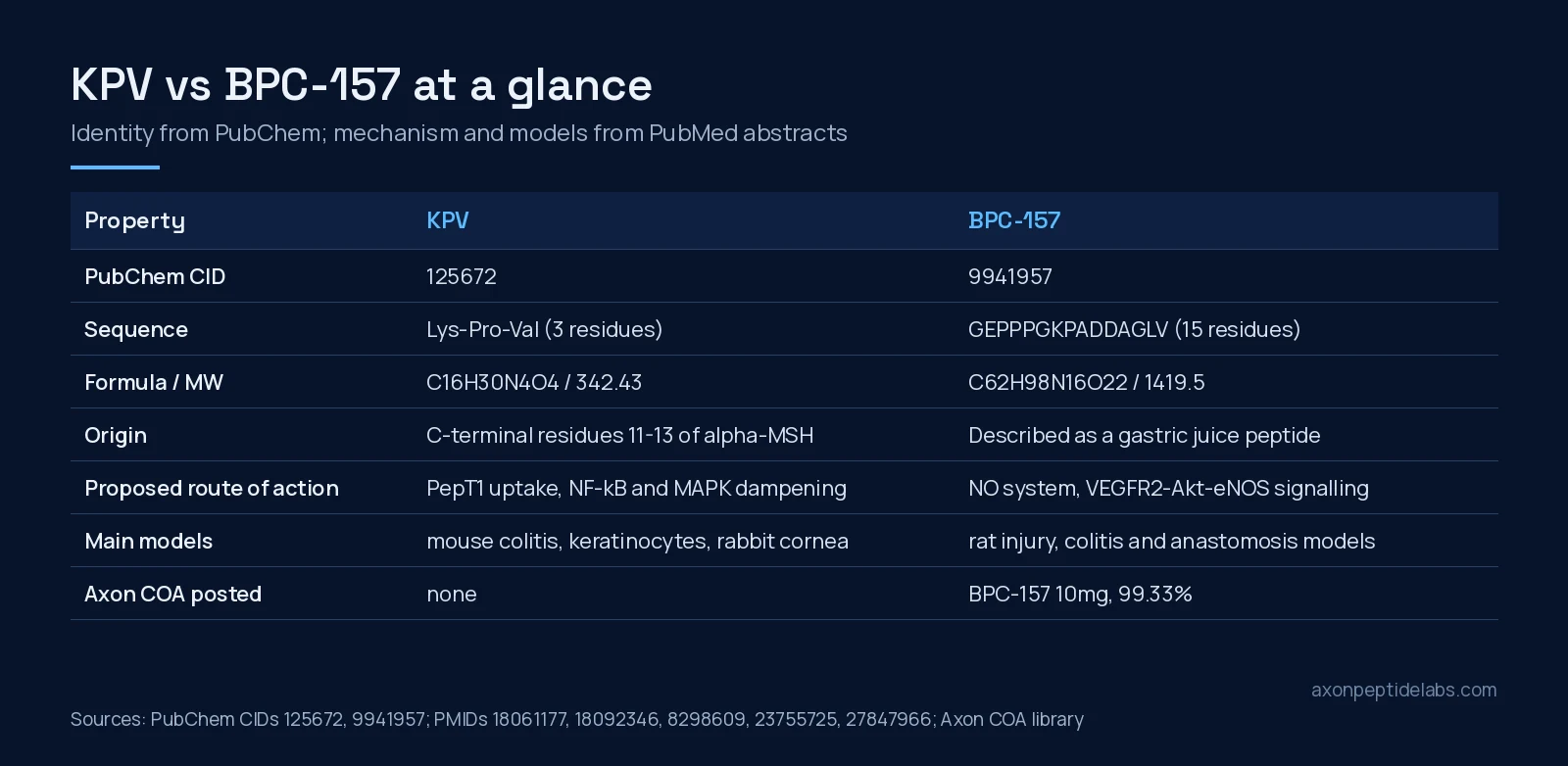
Identity
| Property | KPV | BPC-157 |
|---|---|---|
| PubChem CID | 125672 (“MSH (11-13)”) | 9941957 |
| Synonyms (PubChem) | Lys-Pro-Val, alpha-MSH (11-13), ACTH-(11-13) | Bepecin, PL-10, PLD-116, PL-14736 |
| Sequence | Lys-Pro-Val | GEPPPGKPADDAGLV[10] |
| Formula | C16H30N4O4 | C62H98N16O22 |
| Molecular weight | 342.43 | 1419.5 |
| CAS (PubChem synonyms) | 67727-97-3 | 137525-51-0 |
| Origin | C-terminal tripeptide of alpha-MSH[7][4] | Described as a new gastric juice peptide in 1993[9] |
At 342 Da versus 1,419 Da, the two sit in very different chemical territory. KPV is small enough to be a substrate for peptide transporters; BPC-157 is a typical linear pentadecapeptide.
KPV: what the research shows
Where it comes from and what it does in cells
Alpha-MSH, the 13-residue hormone cut from proopiomelanocortin, has anti-inflammatory and protective effects through melanocortin receptors on brain, immune and other cells; its C-terminal tripeptide KPV was singled out as an alternative anti-inflammatory candidate[4]. Early work found that both alpha-MSH and KPV inhibited colony formation by Staphylococcus aureus and Candida albicans in vitro, and did not reduce killing of those microbes by human neutrophils[7].
How KPV signals is not fully settled. In human keratinocytes and in Chinese hamster ovary cells transfected with MC1R, KPV raised intracellular calcium, as alpha-MSH did, suggesting some MC1R interaction[3]. Yet in mouse colitis, KPV still rescued MC1R-deficient mice from death during DSS colitis, so its gut effects appear at least partly independent of MC1R[2].
The PepT1 route
The clearest mechanism comes from a 2008 study in intestinal epithelial and immune cells. KPV was transported by PepT1, a di- and tripeptide transporter; at nanomolar concentrations it inhibited NF-kB and MAP kinase activation and reduced pro-inflammatory cytokine secretion, and KPV given in drinking water reduced DSS- and TNBS-induced colitis in mice[1]. A second 2008 group found reduced inflammation in DSS colitis and recovery in T-cell transfer colitis[2].
The strongest test of that mechanism is a negative one. In a colitis-associated cancer model, KPV prevented tumour formation in wild-type mice but had none of that inhibitory effect in PepT1-knockout mice[5]. Without the transporter, KPV did nothing measurable in that model.
Delivery and other tissues
Because a free tripeptide is vulnerable in the gut, later work focused on delivery: hyaluronic-acid-coated KPV nanoparticles in a chitosan/alginate hydrogel reduced mucosal damage and TNF-alpha in a mouse ulcerative colitis model more than nanoparticles without the coating[6]. Outside the gut, KPV increased corneal epithelial cell viability in culture and was studied for corneal wound healing in rabbits, with the authors noting that the mechanism was unclear[8].
BPC-157: what the research shows
Origin and proposed mechanisms
BPC-157 was introduced in 1993 as part of a “stomach-stress-organoprotection” hypothesis; the authors reported protective effects across noxious-agent models and no toxicity in their tests[9]. Proposed mechanisms centre on the nitric oxide system: a 2014 review links BPC-157 to NO-system modulation across many rat models while noting that the clinical translation “remains to be determined”[13]. A separate group showed BPC-157 up-regulated VEGFR2 and activated VEGFR2-Akt-eNOS signalling in endothelial cells, and sped blood-flow recovery in a rat hind-limb ischaemia model[14].
Gut and tissue models
In rats, BPC-157 was reported to heal cysteamine-induced colitis and colon-colon anastomoses[11], and in an ischaemic colitis model it was reported to restore blood supply to the injured segment through collateral vessels, an effect tied to the NO system[12]. In tendon work it accelerated healing of transected rat Achilles tendons and stimulated cultured tendocyte growth[15].
A null result on combinations
A 2026 rat Achilles study compared BPC-157, TB-500 and the two together over four weeks. TB-500 reached statistical significance on load to failure and histology scores; BPC-157 alone showed numerically better scores that did not reach significance, and the combination conferred no additional benefit over either peptide alone. The authors called the study exploratory and preliminary[16]. That matters for blends such as KLOW, which contain both BPC-157 and KPV among other peptides: there is no published evidence on how KPV and BPC-157 behave together.
Two very different literatures
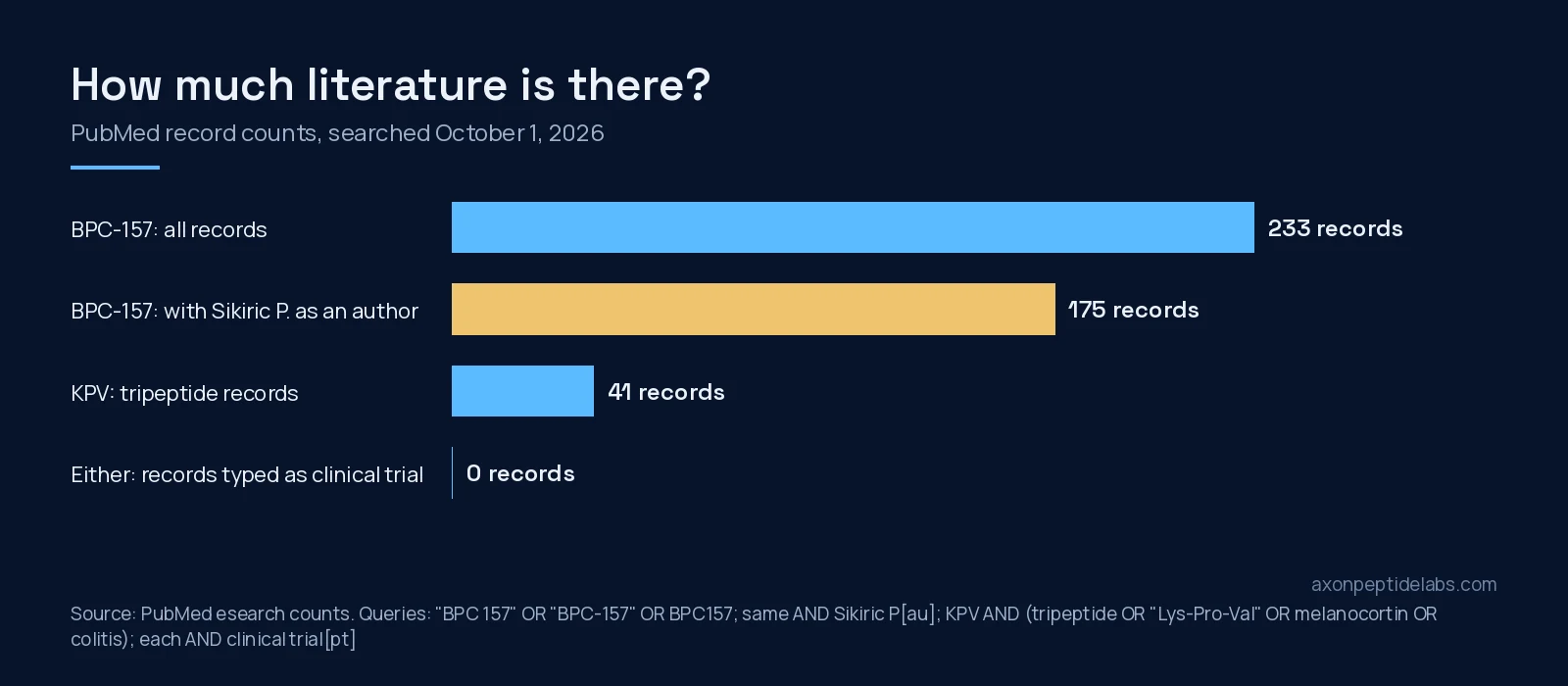
We counted PubMed records on October 1, 2026. A search for BPC-157 returned 233 records, and 175 of them list Sikiric P. as an author. A KPV tripeptide search returned 41. Neither search returned a single record indexed as a clinical trial. Concentration in one group does not make findings wrong, but independent replication is thin.
Reviews agree on the gap. A 2025 systematic review covering 36 BPC-157 studies from 1993 to 2024 found improved outcomes in animal muscle, tendon, ligament and bone models and no harmful effects in animals, but no clinical safety data in humans; it also noted that BPC-157 lacks FDA approval and is banned in professional sport[17]. A 2025 scoping review called it investigational, with minimal human data[18]. The only dedicated human safety report is an intravenous pilot in two healthy adults with no measured changes in heart, liver, kidney, thyroid or glucose markers[19]. A 2006 review by BPC-157’s developers described it as safe in clinical trials for inflammatory bowel disease under the codes PL 10, PLD 116 and PL 14736[10]; we found no peer-reviewed report of those trials’ results in PubMed. For KPV, we found no human study at all.
Side-by-side comparison
| Question | KPV | BPC-157 |
|---|---|---|
| Proposed mechanism | PepT1 uptake; NF-kB and MAPK inhibition[1] | NO system; VEGFR2-Akt-eNOS[13][14] |
| Melanocortin link | Yes, alpha-MSH fragment; partly MC1R-independent in colitis[3][2] | None reported |
| Main gut models | Mouse DSS, TNBS and transfer colitis[1][2] | Rat cysteamine and ischaemic colitis, anastomosis[11][12] |
| Key negative or limiting result | No anti-tumour effect without PepT1[5] | Alone, not significant in a 2026 rat tendon study; no added benefit with TB-500[16] |
| Human data | None found | Two-person IV safety pilot[19]; no clinical safety data per 2025 review[17] |
| Independent replication | Papers from several different author groups[1][2][6] | 175 of 233 PubMed records list the same author (our count) |
| Regulatory status | Not an approved drug | Not FDA-approved; banned in professional sport[17] |
| Axon COA | None posted | BPC-157 10mg, 99.33% |
What the evidence does not show
- No human efficacy data for either. No PubMed record for KPV or BPC-157 is indexed as a clinical trial, and the human BPC-157 data are a two-person safety pilot[19].
- No head-to-head study. No paper compares KPV with BPC-157 in the same model, and none tests them together.
- No transfer from mice and rats. KPV’s gut work is in mice with chemically induced colitis; BPC-157’s is mostly in rats. Different species, different injury models and different routes make cross-study comparison unreliable.
- No identified BPC-157 receptor. The NO and VEGFR2 findings describe downstream signalling, not a binding site.
- No settled KPV receptor story. Calcium signalling in MC1R-transfected cells[3] sits beside MC1R-independent effects in colitis[2].
- No evidence for blends. The one combination study (BPC-157 with TB-500) found no added benefit, and BPC-157 alone did not reach significance there[16], and KPV has never been tested in a blend.
COA status at Axon
Our COA library lists one report relevant here: BPC-157 10mg, batch MP-BPC1-10-041626, purity 99.33%, test date April 29, 2026, lab testides.com. It covers that 10mg listing and batch only. No certificate of analysis for KPV 10mg is posted at the time of writing, and none is posted for the KLOW80 blend that contains both peptides. Related listings are grouped under recovery peptides, and our BPC-157 and TB-500 guide covers the other common pairing. Before you buy lab-tested peptides in Canada, check the COA page for the exact listing and batch.
Frequently asked questions
Are KPV and BPC-157 related?
No. KPV is the three-residue C-terminal end of alpha-MSH (Lys-Pro-Val, PubChem CID 125672). BPC-157 is an unrelated 15-residue peptide described as a gastric juice peptide (PubChem CID 9941957). They share an interest in gut inflammation models, not a structure or a receptor.
How does KPV get into cells?
In the 2008 Gastroenterology study, KPV was taken up by PepT1, a di- and tripeptide transporter, in intestinal epithelial and immune cells, where it dampened NF-kB and MAP kinase signalling. In PepT1-knockout mice, KPV lost its effect on colitis-associated tumours.
What mechanism is proposed for BPC-157?
Studies point to the nitric oxide system and to VEGFR2-Akt-eNOS signalling in endothelial cells and rat ischaemia models. No single receptor for BPC-157 has been identified in the papers cited here.
Has either peptide been tested in human clinical trials?
No PubMed record for either is indexed as a clinical trial. BPC-157 has a two-person intravenous safety pilot and developer statements about earlier IBD trials whose results we could not find in PubMed; KPV has no human study we could find.
Does Axon post a COA for KPV or BPC-157?
For BPC-157, yes: the COA library lists BPC-157 10mg, batch MP-BPC1-10-041626, 99.33% purity, tested April 29, 2026 by testides.com. For KPV 10mg, no certificate is posted at the time of writing.
References
- Dalmasso G, Charrier-Hisamuddin L, Nguyen HT et al. (2008). PepT1-mediated tripeptide KPV uptake reduces intestinal inflammation. Gastroenterology. PMID: 18061177. doi: 10.1053/j.gastro.2007.10.026.
- Kannengiesser K, Maaser C, Heidemann J et al. (2008). Melanocortin-derived tripeptide KPV has anti-inflammatory potential in murine models of inflammatory bowel disease. Inflamm Bowel Dis. PMID: 18092346. doi: 10.1002/ibd.20334.
- Elliott RJ, Szabo M, Wagner MJ et al. (2004). alpha-Melanocyte-stimulating hormone, MSH 11-13 KPV and adrenocorticotropic hormone signalling in human keratinocyte cells. J Invest Dermatol. PMID: 15102092. doi: 10.1111/j.0022-202X.2004.22404.x.
- Brzoska T, Luger TA, Maaser C et al. (2008). Alpha-melanocyte-stimulating hormone and related tripeptides: biochemistry, antiinflammatory and protective effects in vitro and in vivo, and future perspectives for the treatment of immune-mediated inflammatory diseases. Endocr Rev. PMID: 18612139. doi: 10.1210/er.2007-0027.
- Viennois E, Ingersoll SA, Ayyadurai S et al. (2016). Critical role of PepT1 in promoting colitis-associated cancer and therapeutic benefits of the anti-inflammatory PepT1-mediated tripeptide KPV in a murine model. Cell Mol Gastroenterol Hepatol. PMID: 27458604. doi: 10.1016/j.jcmgh.2016.01.006.
- Xiao B, Xu Z, Viennois E et al. (2017). Orally Targeted Delivery of Tripeptide KPV via Hyaluronic Acid-Functionalized Nanoparticles Efficiently Alleviates Ulcerative Colitis. Mol Ther. PMID: 28143741. doi: 10.1016/j.ymthe.2016.11.020.
- Cutuli M, Cristiani S, Lipton JM et al. (2000). Antimicrobial effects of alpha-MSH peptides. J Leukoc Biol. PMID: 10670585. doi: 10.1002/jlb.67.2.233.
- Bonfiglio V, Camillieri G, Avitabile T et al. (2006). Effects of the COOH-terminal tripeptide alpha-MSH(11-13) on corneal epithelial wound healing: role of nitric oxide. Exp Eye Res. PMID: 16965771. doi: 10.1016/j.exer.2006.07.014.
- Sikirić P, Petek M, Rucman R et al. (1993). A new gastric juice peptide, BPC. An overview of the stomach-stress-organoprotection hypothesis and beneficial effects of BPC. J Physiol Paris. PMID: 8298609. doi: 10.1016/0928-4257(93)90038-u.
- Sikiric P, Seiwerth S, Brcic L et al. (2006). Stable gastric pentadecapeptide BPC 157 in trials for inflammatory bowel disease (PL-10, PLD-116, PL 14736, Pliva, Croatia). Full and distended stomach, and vascular response. Inflammopharmacology. PMID: 17186181. doi: 10.1007/s10787-006-1531-7.
- Klicek R, Kolenc D, Suran J et al. (2013). Stable gastric pentadecapeptide BPC 157 heals cysteamine-colitis and colon-colon-anastomosis and counteracts cuprizone brain injuries and motor disability. J Physiol Pharmacol. PMID: 24304574.
- Duzel A, Vlainic J, Antunovic M et al. (2017). Stable gastric pentadecapeptide BPC 157 in the treatment of colitis and ischemia and reperfusion in rats: New insights. World J Gastroenterol. PMID: 29358856. doi: 10.3748/wjg.v23.i48.8465.
- Sikiric P, Seiwerth S, Rucman R et al. (2014). Stable gastric pentadecapeptide BPC 157-NO-system relation. Curr Pharm Des. PMID: 23755725. doi: 10.2174/13816128113190990411.
- Hsieh MJ, Liu HT, Wang CN et al. (2017). Therapeutic potential of pro-angiogenic BPC157 is associated with VEGFR2 activation and up-regulation. J Mol Med (Berl). PMID: 27847966. doi: 10.1007/s00109-016-1488-y.
- Staresinic M, Sebecic B, Patrlj L et al. (2003). Gastric pentadecapeptide BPC 157 accelerates healing of transected rat Achilles tendon and in vitro stimulates tendocytes growth. J Orthop Res. PMID: 14554208. doi: 10.1016/S0736-0266(03)00110-4.
- Biçer O, Adanir O, Güleryüz Y et al. (2026). Effects of BPC-157 and TB-500 on Achilles tendon healing in rats: A histopathological and biomechanical study. Jt Dis Relat Surg. PMID: 42542926. doi: 10.52312/jdrs.2026.2951.
- Vasireddi N, Hahamyan H, Salata MJ et al. (2025). Emerging Use of BPC-157 in Orthopaedic Sports Medicine: A Systematic Review. HSS J. PMID: 40756949. doi: 10.1177/15563316251355551.
- McGuire FP, Martinez R, Lenz A et al. (2025). Regeneration or Risk? A Narrative Review of BPC-157 for Musculoskeletal Healing. Curr Rev Musculoskelet Med. PMID: 40789979. doi: 10.1007/s12178-025-09990-7.
- Lee E, Burgess K (2025). Safety of Intravenous Infusion of BPC157 in Humans: A Pilot Study. Altern Ther Health Med. PMID: 40131143.