
Cerebrolysin vs Semax: Peptide Mixture vs Single Peptide
For laboratory research only. Not for human or animal use. This article gives no dosing, administration or therapeutic advice.
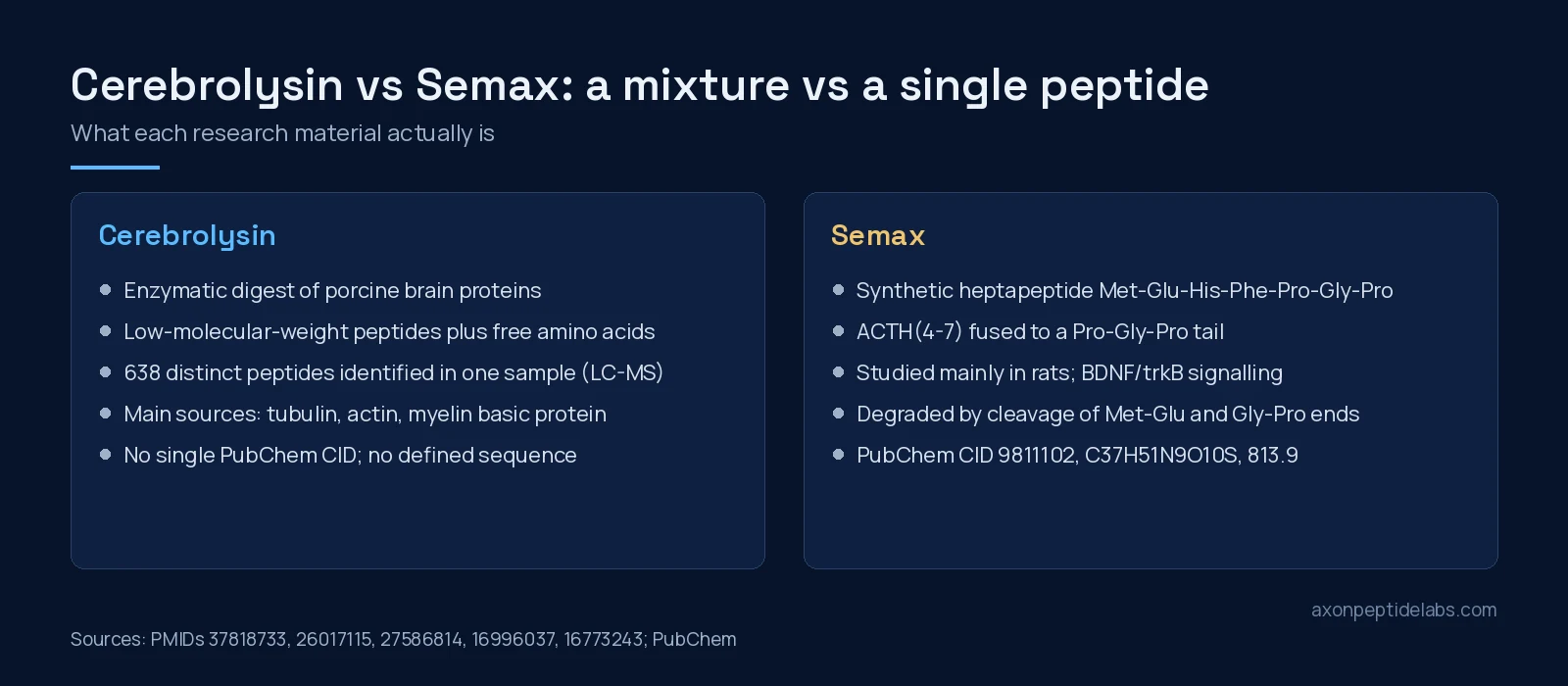
Short answer: Cerebrolysin and Semax are both called “nootropic peptides”, but they are different kinds of material. Cerebrolysin is a mixture of low-molecular-weight peptides and amino acids from porcine brain [1][2]. Semax is one synthetic seven-residue peptide, Met-Glu-His-Phe-Pro-Gly-Pro, built from a fragment of ACTH [3][4]. When the two were tested side by side in the same cell assay, Cerebrolysin had a trophic effect and Semax did not [5]. Cerebrolysin has large randomised trials and Cochrane reviews behind it, mostly with neutral main results. Semax’s human data are small and mostly open-label.
Identity at a glance
| Item | Cerebrolysin | Semax |
|---|---|---|
| What it is | Peptide preparation made by controlled enzymatic digestion of porcine brain proteins | Synthetic heptapeptide: ACTH(4-7) plus a Pro-Gly-Pro tail |
| Sequence | None defined; 638 distinct peptides identified in one sample | Met-Glu-His-Phe-Pro-Gly-Pro (MEHFPGP) |
| PubChem CID | None (a mixture has no single compound record) | 9811102 |
| Formula / MW (PubChem) | Not applicable | C37H51N9O10S / 813.9 |
| CAS (PubChem synonyms) | Not applicable | 80714-61-0 |
| Main components | Fragments of tubulin alpha and beta chains, actin and myelin basic protein | One peptide |
| FDA label | Neither has a label in the NLM drug-label database (checked October 1, 2026) | |
Sources: [2][1][3]; Semax identifiers from PubChem.
Cerebrolysin: what is in the mixture
Cerebrolysin is described in the Cochrane review as a mixture of low-molecular-weight peptides and amino acids derived from porcine brain, widely used for acute ischaemic stroke in Russia, Eastern Europe, China and other Asian and post-Soviet countries [1]. For a long time its exact composition was not published. In 2015 a mass-spectrometry study of an Internet-obtained sample identified 638 unique peptides, mostly fragments of tubulin, actin and myelin basic protein, and found no fragments of known neurotrophic factors (GDNF, NGF, BDNF or CNTF) [2]. The authors suggested that any activity comes from as-yet unknown “cryptic” peptides, not from neurotrophins themselves [2].
Composition is also product-specific. A 2024 study compared Cerebrolysin with several peptide preparations sold as similar and approved in some countries; the comparators differed significantly in peptide composition and lacked relevant neurotrophic activity in the assays used [6]. A name on a label is therefore not proof of what is inside.
In rats with embolic stroke, Cerebrolysin started 24 or 48 hours after the stroke increased markers of subventricular-zone neurogenesis and improved functional scores, with the PI3K/Akt pathway implicated in progenitor proliferation [7]. A follow-up linked the effect to Sonic hedgehog signalling, which was blocked by cyclopamine [8]. These are rodent findings at doses set per kilogram for rats.
Semax: a short ACTH-derived peptide
Semax keeps residues 4 to 7 of adrenocorticotropic hormone and adds Pro-Gly-Pro at the C-terminus [3]. It is classed as an ACTH(4-10) analogue but described as non-corticotropic, meaning it lacks ACTH’s steroid-stimulating action [9]. In rat basal forebrain cell cultures and membranes, it was broken down mainly by removal of the Met-Glu and Gly-Pro ends, leaving pentapeptides [10].
Most of its mechanistic literature concerns neurotrophin signalling in rats. A single application raised BDNF protein and trkB phosphorylation in rat hippocampus, along with BDNF and trkB mRNA, and treated rats made more conditioned avoidance responses [4]. Semax and Pro-Gly-Pro alone both raised transcription of neurotrophins and their receptors in the cortex after permanent middle cerebral artery occlusion, with partly overlapping profiles [11]. A transcriptome study in a transient occlusion model reported broad gene-expression changes it interpreted as protective [12]. On monoamines, Semax increased striatal serotonin turnover in rodents but on its own did not change dopamine or its metabolites; it amplified the dopamine response to amphetamine [13].
Design notes for a lab comparing them
Three practical issues follow from the chemistry. First, with Cerebrolysin the material is the variable. The peptide map was built from one Internet-obtained sample [2], and preparations sold as similar did not match it [6], so results from one source may not transfer to another. Second, with Semax the metabolites may matter. Its Pro-Gly-Pro tail is one of the fragments released by degradation [10], and Pro-Gly-Pro on its own changed neurotrophin transcription in the rat ischaemia model, partly overlapping with Semax [11]. A Semax experiment without a fragment control cannot say which piece did the work. Third, the readouts differ. Cerebrolysin studies typically measure neurogenesis and functional scores after stroke [7][8]; Semax studies typically measure neurotrophin expression and behaviour [4][13]. Matching the endpoint to the question, and including the PC12-type trophic assay where both can be tested together [5], is the cleanest way to compare like with like.
Cerebrolysin vs Semax side by side
| Feature | Cerebrolysin | Semax | Sources |
|---|---|---|---|
| Material type | Biological digest, hundreds of peptides | Single synthetic peptide | [2][3] |
| Proposed mechanism | Neurotrophic-like activity of unidentified peptides | Raises expression of BDNF, trkB and other neurotrophin genes | [2][4][11] |
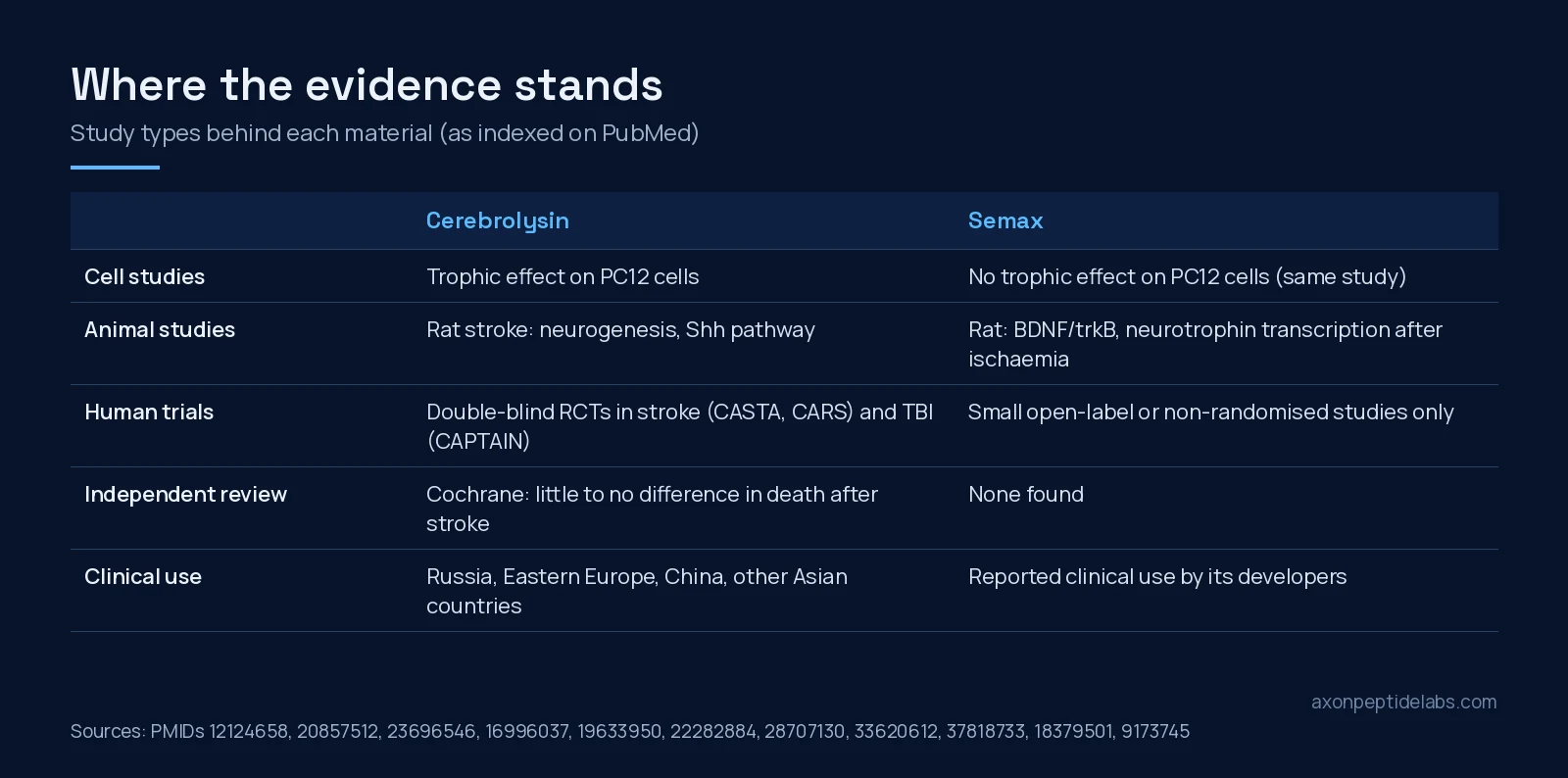
| Head-to-head cell result | Induced differentiation and improved survival of PC12 cells | No trophic effect on PC12 cells | [5] |
| Main animal model | Rat embolic stroke (neurogenesis) | Rat stroke and behaviour models | [7][11] |
| Largest human studies | Double-blind RCTs in stroke and traumatic brain injury | Small open-label or non-randomised studies | [14][15][16][17] |
| Independent systematic review | Cochrane (stroke 2023, vascular dementia 2019) | None found | [1][18] |
| Axon COA status | No certificate posted for Cerebrolysin 60mg | Semax 10mg: batch MP-SEMA-10-041626, purity 99.43%, 29 APR 2026, testides.com | COA page |
What the human trials found
Cerebrolysin
The picture splits by who did the analysis. In the CASTA trial, 1,070 patients with acute ischaemic stroke in Asia were randomised to Cerebrolysin or placebo, and the confirmatory combined endpoint showed no significant difference; a favourable trend appeared only in a post hoc subgroup with more severe strokes [14]. Trial-group meta-analyses of the CARS stroke-rehabilitation studies and the CAPTAIN traumatic brain injury trials reported favourable multi-scale outcomes [19][20], and the 46-patient CAPTAIN I trial called for confirmation in a larger trial [15].
Independent reviews are more cautious. The 2023 Cochrane review of seven trials (1,773 participants) found that Cerebrolysin or the similar agent Cortexin probably make little to no difference to all-cause death (moderate certainty), noted that the manufacturer supported three of the multicentre studies, and found more people with non-fatal serious adverse events in the Cerebrolysin groups [1]. The 2019 Cochrane review in vascular dementia judged the evidence base weak, with high risk of bias, and said any benefit may be too small to be clinically meaningful [18]. A 2021 meta-analysis of animal-derived nootropics (Cerebrolysin, Actovegin, Cortexin) rated certainty low to very low [21]. A 2015 Alzheimer’s meta-analysis by trialists reported favourable global outcomes [22], which sits against those independent reviews.
Semax
Of 208 PubMed records with Semax in the title or abstract (searched October 1, 2026), we found no double-blind randomised trial. The human literature consists of small Russian-language studies. A 1997 stroke study compared 30 treated patients with 80 conventionally treated controls, not a randomised placebo group [16]. A 2018 study of 110 post-stroke patients compared subgroups with and without Semax during rehabilitation [23]. In an open-label study of 27 patients with motor neuron disease, Semax did not change the course of denervation or the clinical rating scales, although a quality-of-life score improved [17]. The developers’ own 1997 review is uniformly positive [24], which is a reason to weigh it as a review by interested parties.
What the evidence does not show
- That Semax and Cerebrolysin work the same way. In the one direct comparison, only Cerebrolysin was trophic for PC12 cells; the authors concluded Semax acts by other mechanisms [5].
- That Cerebrolysin contains neurotrophins. The peptide-mapping study found no fragments of GDNF, NGF, BDNF or CNTF [2].
- That Cerebrolysin reduces death after stroke. Cochrane rates the effect on all-cause death as little to none, with a signal of more non-fatal serious adverse events [1].
- Controlled human evidence for Semax. The human studies are small and not double-blind [16][23][17]. The BDNF findings are from rats [4][11].
- That a vial sold under the Cerebrolysin name matches the original product. Preparations claiming similarity differed in composition and activity [6], and a purity percentage cannot describe a mixture of hundreds of peptides the way it describes one peptide.
Documentation for Axon’s Cerebrolysin and Semax listings
Axon lists Semax 10mg and Cerebrolysin 60mg under nootropic peptides. Our COA page lists a report for Semax 10mg: batch MP-SEMA-10-041626, purity 99.43%, dated 29 APR 2026, lab testides.com. That figure applies to that batch of the 10mg listing only. No certificate is posted for Cerebrolysin 60mg at the time of writing, so we make no purity or identity claim for it. For Semax, the expected mass from PubChem is about 813.9 Da; any report should show a matching identity result alongside purity. For a related comparison, see our Semax vs Selank guide.
If you buy lab-tested peptides in Canada, check each listing’s posted report first.
Frequently asked questions
What is the main difference between Cerebrolysin and Semax?
Cerebrolysin is a mixture of hundreds of low-molecular-weight peptides and amino acids made by digesting porcine brain proteins. Semax is a single synthetic seven-residue peptide (Met-Glu-His-Phe-Pro-Gly-Pro) derived from a fragment of ACTH.
Does Cerebrolysin contain BDNF or other neurotrophins?
A 2015 mass-spectrometry study identified 638 peptides in a Cerebrolysin sample, mainly from tubulin, actin and myelin basic protein, and found no fragments of GDNF, NGF, BDNF or CNTF.
Have Cerebrolysin and Semax been compared directly?
Yes, in one cell study. Cerebrolysin induced differentiation and improved survival of cultured rat PC12 cells, while Semax had no trophic effect, which the authors read as Semax acting through other mechanisms.
What did the Cochrane review conclude about Cerebrolysin in stroke?
The 2023 Cochrane review of seven trials found that Cerebrolysin or Cortexin probably make little to no difference to all-cause death, and found more non-fatal serious adverse events with Cerebrolysin. The manufacturer supported three of the multicentre studies.
Is there randomised controlled evidence for Semax?
We found no double-blind randomised trial among 208 PubMed records for Semax. The human studies are small, non-randomised or open-label, and most of the mechanistic work is in rats.
Does Axon post a COA for Semax or Cerebrolysin?
Semax 10mg has a posted report: batch MP-SEMA-10-041626, purity 99.43%, 29 APR 2026, testides.com. No certificate is posted for Cerebrolysin 60mg at the time of writing.
References
- Ziganshina LE, Abakumova T, Nurkhametova D et al. (2023). Cerebrolysin for acute ischaemic stroke. Cochrane Database Syst Rev. PMID: 37818733. doi: 10.1002/14651858.CD007026.pub7.
- Gevaert B, D’Hondt M, Bracke N et al. (2015). Peptide profiling of Internet-obtained Cerebrolysin using high performance liquid chromatography – electrospray ionization ion trap and ultra high performance liquid chromatography – ion mobility – quadrupole time of flight mass spectrometry. Drug Test Anal. PMID: 26017115. doi: 10.1002/dta.1817.
- Magrì A, Tabbì G, Giuffrida A et al. (2016). Influence of the N-terminus acetylation of Semax, a synthetic analog of ACTH(4-10), on copper(II) and zinc(II) coordination and biological properties. J Inorg Biochem. PMID: 27586814. doi: 10.1016/j.jinorgbio.2016.08.013.
- Dolotov OV, Karpenko EA, Inozemtseva LS et al. (2006). Semax, an analog of ACTH(4-10) with cognitive effects, regulates BDNF and trkB expression in the rat hippocampus. Brain Res. PMID: 16996037. doi: 10.1016/j.brainres.2006.07.108.
- Safarova ER, Shram SI, Grivennikov IA et al. (2002). Trophic effects of nootropic peptide preparations cerebrolysin and semax on cultured rat pheochromocytoma. Bull Exp Biol Med. PMID: 12124658. doi: 10.1023/a:1016270626439.
- Seidl LF, Aigner L (2024). Comparing the biological activity and composition of Cerebrolysin with other peptide preparations. J Med Life. PMID: 38737662. doi: 10.25122/jml-2024-0129.
- Zhang C, Chopp M, Cui Y et al. (2010). Cerebrolysin enhances neurogenesis in the ischemic brain and improves functional outcome after stroke. J Neurosci Res. PMID: 20857512. doi: 10.1002/jnr.22495.
- Zhang L, Chopp M, Meier DH et al. (2013). Sonic hedgehog signaling pathway mediates cerebrolysin-improved neurological function after stroke. Stroke. PMID: 23696546. doi: 10.1161/STROKEAHA.111.000831.
- Inozemtseva LS, Yatsenko KA, Glazova NY et al. (2024). Antidepressant-like and antistress effects of the ACTH(4-10) synthetic analogs Semax and Melanotan II on male rats in a model of chronic unpredictable stress. Eur J Pharmacol. PMID: 39442746. doi: 10.1016/j.ejphar.2024.177068.
- Zolotarev YA, Dolotov OV, Inozemtseva LS et al. (2006). Degradation of the ACTH(4-10) analog Semax in the presence of rat basal forebrain cell cultures and plasma membranes. Amino Acids. PMID: 16773243. doi: 10.1007/s00726-006-0328-8.
- Dmitrieva VG, Povarova OV, Skvortsova VI et al. (2010). Semax and Pro-Gly-Pro activate the transcription of neurotrophins and their receptor genes after cerebral ischemia. Cell Mol Neurobiol. PMID: 19633950. doi: 10.1007/s10571-009-9432-0.
- Filippenkov IB, Stavchansky VV, Denisova AE et al. (2020). Novel Insights into the Protective Properties of ACTH((4-7))PGP (Semax) Peptide at the Transcriptome Level Following Cerebral Ischaemia-Reperfusion in Rats. Genes (Basel). PMID: 32580520. doi: 10.3390/genes11060681.
- Eremin KO, Kudrin VS, Saransaari P et al. (2005). Semax, an ACTH(4-10) analogue with nootropic properties, activates dopaminergic and serotoninergic brain systems in rodents. Neurochem Res. PMID: 16362768. doi: 10.1007/s11064-005-8826-8.
- Heiss WD, Brainin M, Bornstein NM et al. (2012). Cerebrolysin in patients with acute ischemic stroke in Asia: results of a double-blind, placebo-controlled randomized trial. Stroke. PMID: 22282884. doi: 10.1161/STROKEAHA.111.628537.
- Poon W, Matula C, Vos PE et al. (2020). Safety and efficacy of Cerebrolysin in acute brain injury and neurorecovery: CAPTAIN I-a randomized, placebo-controlled, double-blind, Asian-Pacific trial. Neurol Sci. PMID: 31494820. doi: 10.1007/s10072-019-04053-5.
- Gusev EI, Skvortsova VI, Miasoedov NF et al. (1997). [Effectiveness of semax in acute period of hemispheric ischemic stroke (a clinical and electrophysiological study)]. Zh Nevrol Psikhiatr Im S S Korsakova. PMID: 11517472.
- Serdiuk AV, Levitskiĭ GN, Miasoedov NF et al. (2007). [The study of chronic partial denervation and quality of life in patients with motor neuron disease treated with semax]. Zh Nevrol Psikhiatr Im S S Korsakova. PMID: 18379501.
- Cui S, Chen N, Yang M et al. (2019). Cerebrolysin for vascular dementia. Cochrane Database Syst Rev. PMID: 31710397. doi: 10.1002/14651858.CD008900.pub3.
- Guekht A, Vester J, Heiss WD et al. (2017). Safety and efficacy of Cerebrolysin in motor function recovery after stroke: a meta-analysis of the CARS trials. Neurol Sci. PMID: 28707130. doi: 10.1007/s10072-017-3037-z.
- Vester JC, Buzoianu AD, Florian SI et al. (2021). Cerebrolysin after moderate to severe traumatic brain injury: prospective meta-analysis of the CAPTAIN trial series. Neurol Sci. PMID: 33620612. doi: 10.1007/s10072-020-04974-6.
- Alsulaimani RA, Quinn TJ (2021). The efficacy and safety of animal-derived nootropics in cognitive disorders: Systematic review and meta-analysis. Cereb Circ Cogn Behav. PMID: 36324709. doi: 10.1016/j.cccb.2021.100012.
- Gauthier S, Proaño JV, Jia J et al. (2015). Cerebrolysin in mild-to-moderate Alzheimer’s disease: a meta-analysis of randomized controlled clinical trials. Dement Geriatr Cogn Disord. PMID: 25832905. doi: 10.1159/000377672.
- Gusev EI, Martynov MY, Kostenko EV et al. (2018). [The efficacy of semax in the tretament of patients at different stages of ischemic stroke]. Zh Nevrol Psikhiatr Im S S Korsakova. PMID: 29798983. doi: 10.17116/jnevro20181183261-68.
- Asmarin IP, Nezavibat’ko VN, Miasoedov NF et al. (1997). [A nootropic adrenocorticotropin analog 4-10-semax (l5 years experience in its design and study)]. Zh Vyssh Nerv Deiat Im I P Pavlova. PMID: 9173745.