
hCG Stability: Lyophilized Storage for Labs
For laboratory research only. Not for human or animal use. This article gives no dosing, administration or therapeutic advice.
Short answer: hCG is a two-subunit glycoprotein held together by a disulphide “seat belt” [1], and its main stability risks in solution are dissociation into free subunits, cleavage (“nicking”) of the beta subunit and heat inactivation [2][3][4]. Dissociation runs faster at higher temperature and fastest in buffer and urine [2], which is one reason proteins like hCG are kept dry and cold until use [5][6]. For a lab, the practical rules are simple: keep the material dry until needed, keep solutions cold and short-lived, control proteases, and check the batch documentation.
Why hCG’s structure shapes its stability
Each hCG subunit is folded around a cystine knot of three disulphide bonds. The heterodimer is stabilised by a segment of the beta subunit that wraps around the alpha subunit and is fastened by the Cys26-Cys110 disulphide; the authors describe this as essential both for the association of the two subunits and for receptor binding [1]. Anything that separates the subunits therefore matters for activity, and that is what most hCG stability studies measure.
What the stability studies found
Dissociation over time and temperature
When seven hCG glycoforms were incubated in phosphate-buffered saline, serum, defibrinated blood and urine, all showed steady dissociation into free subunits over time, faster at higher temperatures. Nicked hCG dissociated faster than intact hCG, glycosylation slowed dissociation, and the process was quickest in urine and buffer and slowest in serum and defibrinated blood [2]. Simple buffer, the matrix many labs use, was among the least protective.
Heat
Solutions of native hCG were rapidly inactivated above 50 degrees C, and heating to 100 degrees C dissociated the hormone into subunits. After thermal denaturation, native hCG needed almost 48 hours at 37 degrees C to regain full receptor binding [3]. Chemically deglycosylated hCG was more heat-stable in the same study, which shows that the carbohydrate chains change how the molecule handles heat [3].
Proteases and nicking
Proteolytic enzymes cleave hCG, and elevated temperatures favour nicking of the molecule. In urine samples spiked with proteases and held at 37 degrees C, intact hCG fell; a stabilising mixture of antimicrobials and protease inhibitors prevented the degradation caused by four of the six proteases tested [4]. Clean handling and cold storage both reduce this route.
Freezing
In blood samples, hCG and its alpha subunit were stable unfrozen for at least 6 days and frozen for at least 6 months, and repeated freeze-thaw had no effect over that period [7]. That was serum and plasma, not a purified preparation; in simpler solutions, freezing brings low temperature, ice formation and freeze-concentration, all of which can stress proteins [8]. Aliquoting once remains the cautious default.
Why dry storage is the default
Proteins often have to be made into solid forms to reach an acceptable shelf life, and freeze-drying (lyophilization) is the most common method [5]. Liquid formulations of proteins and peptides often show chemical degradation during handling, and solid formulations are frequently needed to keep them stable through storage and transport [6]. The process is not stress-free: freezing and drying can denature proteins to various degrees, and a dried protein can still have limited long-term stability [5][9]. Dry and cold is the better starting point, not a guarantee.
Lab storage checklist for hCG
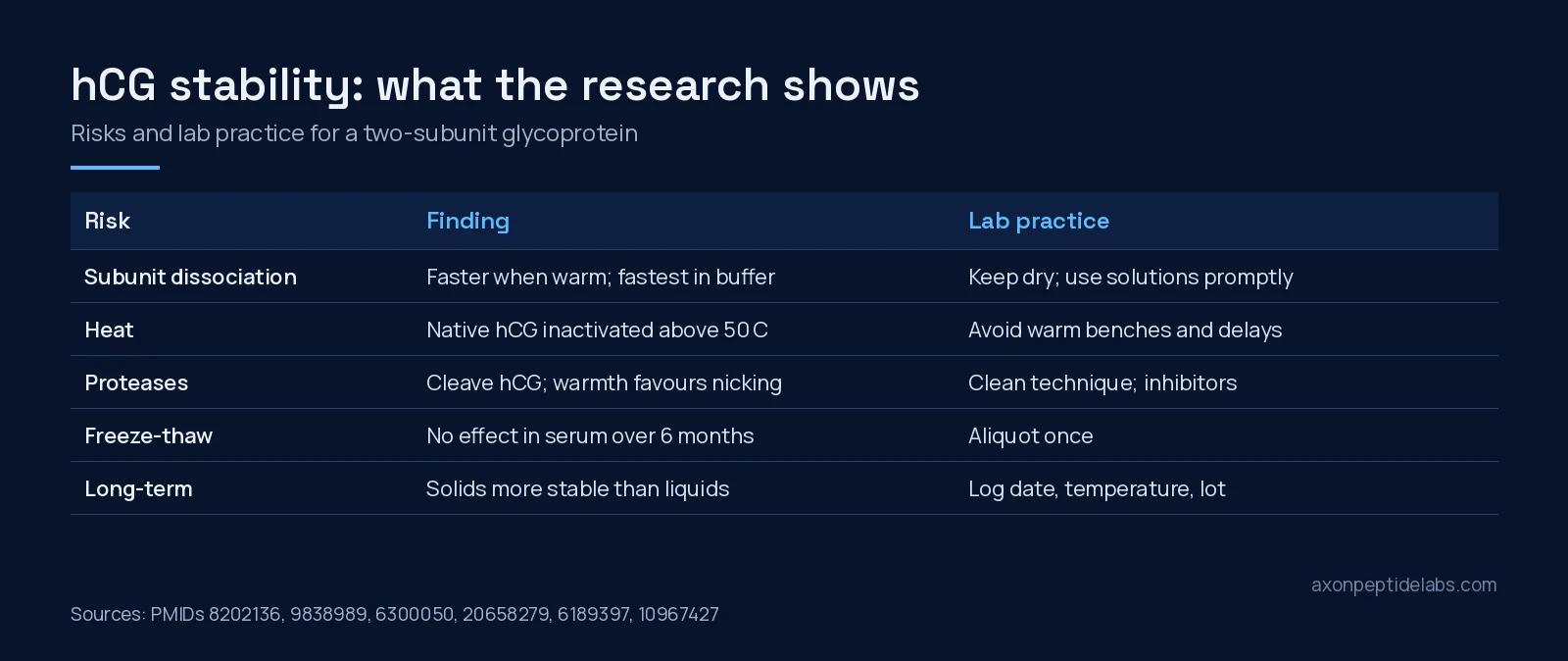
| Risk | What the research shows | Lab practice |
|---|---|---|
| Subunit dissociation | Steady over time, faster when warm, fastest in buffer and urine [2] | Keep dry until needed; keep solutions cold and use them promptly |
| Heat | Native hCG rapidly inactivated above 50 degrees C [3] | Avoid warm benches, heat blocks and warm shipping delays |
| Proteases (nicking) | Proteases cleave hCG; warmth favours nicking [4] | Clean technique; consider protease inhibitors where the assay allows |
| Freeze-thaw | No effect in serum over 6 months [7]; freezing stresses proteins in simple solutions [8] | Aliquot once rather than refreezing stock |
| Long-term storage | Solids are more stable than liquids but still age [5][6] | Log the receipt date, storage temperature and lot |
For the vial format and what Axon’s product page lists, see our hCG 5000IU research vial guide; for the structure and receptor background, see the hCG research overview.
What Axon’s product page says
The hCG 5000IU product page lists human chorionic gonadotropin at 5000 IU per vial (SKU APL-HCG-5000IU), not pre-mixed and not ready to use, with bacteriostatic water 10ml as a related supply. It warns that some peptides can turn cloudy, thick or gel-like depending on the reconstitution solution, and it asks buyers to review available COA and purity information and match the COA to the exact product and batch. Storage temperatures and shelf life for a given lot belong to that documentation, not to this article.
Limits of this article
- Several studies used clinical samples (serum, plasma, urine) [7][2][4], which contain proteins and enzymes a purified preparation does not.
- The heat study used solutions and extreme temperatures [3], not typical storage.
- The lyophilization reviews are general [5][6] and not specific to hCG.
- Research use only. Nothing here concerns human or animal use.
Sourcing for laboratory work
When you compare hCG peptides for sale in Canada, look at the IU amount, the batch documentation and how the material is shipped and stored. Axon lists hCG 5000IU with the other hormone peptides for research, plus bacteriostatic water 10ml as a related supply, for laboratory work only. To buy lab-tested peptides in Canada, review the available batch documentation in the COA library first.
Frequently asked questions
How stable is hCG in solution?
In a study of seven hCG glycoforms, hCG dissociated steadily into free subunits over time in buffer, serum, blood and urine, faster at higher temperatures and fastest in urine and buffer. Nicked hCG dissociated faster than intact hCG.
Why is hCG usually stored dry?
Proteins are commonly freeze-dried because they are more stable as solids than in liquid form. Freeze-drying has its own stresses, so dried material should still be kept cold and logged.
Does heat damage hCG?
Yes. Solutions of native hCG were rapidly inactivated above 50 degrees C, and heating to 100 degrees C dissociated the hormone into its subunits.
Does freeze-thaw damage hCG?
In serum and plasma, repeated freeze-thaw had no effect on hCG over 6 months. In simpler solutions freezing can stress proteins, so aliquoting once is the cautious approach.
What should I check when comparing hCG for sale in Canada?
The IU amount, the batch COA matched to the exact product and lot, and how the material is shipped and stored. Axon lists hCG 5000IU for laboratory research only.
References
- Lapthorn AJ, Harris DC, Littlejohn A et al. (1994). Crystal structure of human chorionic gonadotropin. Nature. PMID: 8202136. doi: 10.1038/369455a0.
- Butler SA, Cole LA, Chard T et al. (1998). Dissociation of human chorionic gonadotropin into its free subunits is dependent on naturally occurring molecular structural variation, sample matrix and storage conditions. Ann Clin Biochem. PMID: 9838989. doi: 10.1177/000456329803500608.
- Manjunath P, Sairam MR (1983). Enhanced thermal stability of chemically deglycosylated human choriogonadotropin. J Biol Chem. PMID: 6300050.
- Tsivou M, Dimopoulou HA, Georgakopoulos DG et al. (2010). Stabilization of human urine doping control samples: IV. Human chorionic gonadotropin. Anal Bioanal Chem. PMID: 20658279. doi: 10.1007/s00216-010-4033-9.
- Wang W (2000). Lyophilization and development of solid protein pharmaceuticals. Int J Pharm. PMID: 10967427. doi: 10.1016/s0378-5173(00)00423-3.
- Angkawinitwong U, Sharma G, Khaw PT et al. (2015). Solid-state protein formulations. Ther Deliv. PMID: 25565441. doi: 10.4155/tde.14.98.
- Rao CV, Hussa RO, Carman FR Jr et al. (1983). Stability of human chorionic gonadotropin and its alpha subunit in human blood. Am J Obstet Gynecol. PMID: 6189397. doi: 10.1016/0002-9378(83)90928-6.
- Bhatnagar BS, Bogner RH, Pikal MJ (2007). Protein stability during freezing: separation of stresses and mechanisms of protein stabilization. Pharm Dev Technol. PMID: 17963151. doi: 10.1080/10837450701481157.
- Manning MC, Chou DK, Murphy BM et al. (2010). Stability of protein pharmaceuticals: an update. Pharm Res. PMID: 20143256. doi: 10.1007/s11095-009-0045-6.