
Wolverine Stack: What BPC-157 + TB-500 Are in Tissue-Repair Research
For laboratory research only. Not for human or animal use. This article gives no dosing, administration or therapeutic advice.
“Wolverine stack” is the informal name labs use for a two-component blend of BPC-157 and TB-500. Both are studied in tissue-repair models, but they are different molecules with different origins and different proposed mechanisms. Labs sourcing a Wolverine stack in Canada should know what each component is, what the published record actually covers, and what a blend COA needs to show. This overview sets that out.
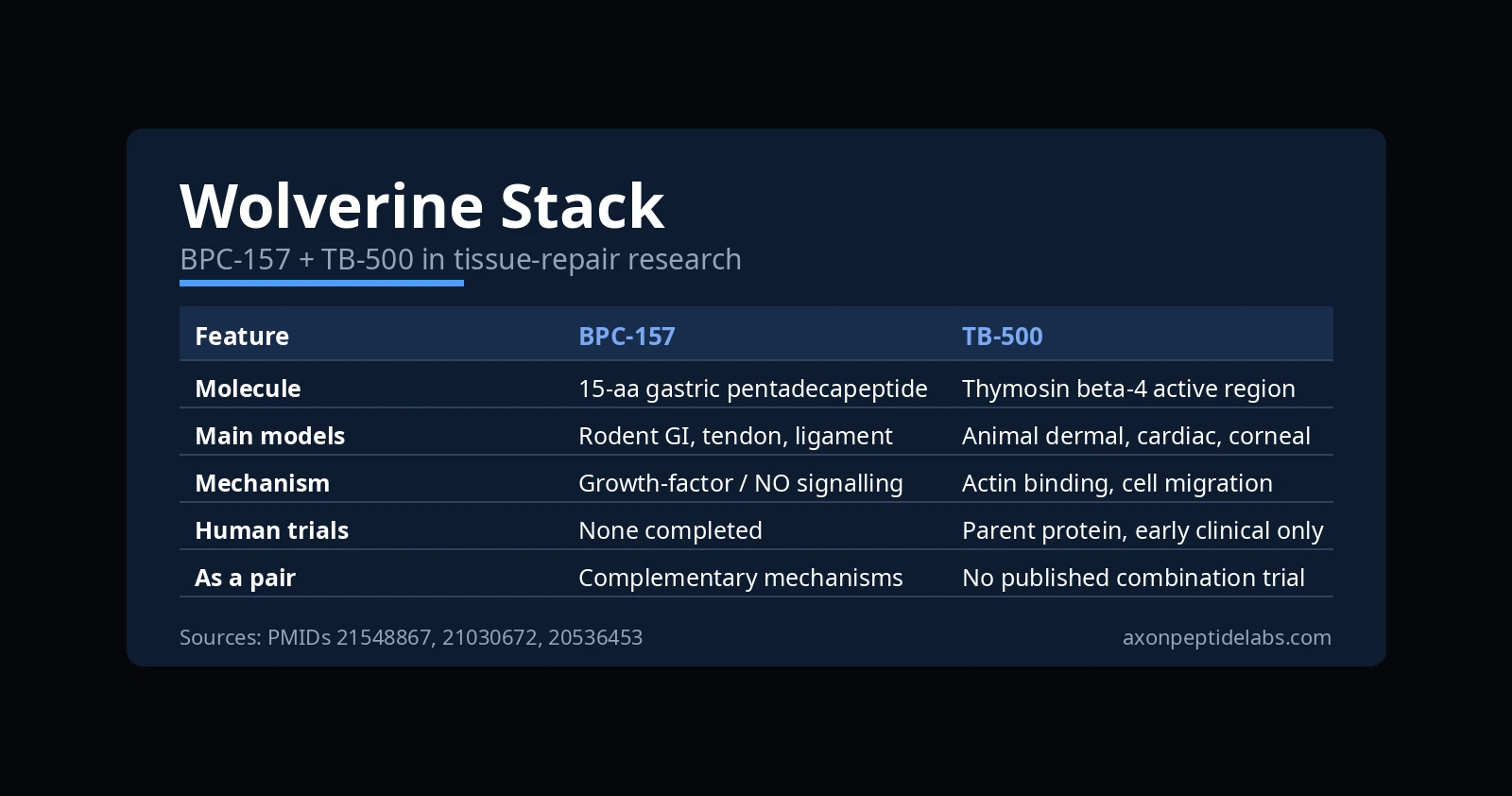
Short answer: BPC-157 is a fifteen-residue peptide derived from a human gastric protein, studied largely in gastrointestinal and tendon models in rodents [1][2]. TB-500 is a synthetic fragment corresponding to the active region of thymosin beta-4, an actin-binding protein studied in wound-repair animal models [3]. They are paired in research because their proposed mechanisms are complementary, not because any trial has tested the combination.
BPC-157: a stable gastric pentadecapeptide
BPC-157 is a fifteen-amino-acid peptide (GEPPPGKPADDAGLV) isolated from human gastric juice protein work and produced synthetically for research. It is unusually stable in gastric juice, which is part of why it drew research interest in the first place [1]. The published record is almost entirely preclinical: rodent studies on gastrointestinal lesions, tendon and ligament healing, and related injury models [1]. A tendon study in rats reported that BPC-157 treatment improved tendon outgrowth, cell survival and cell migration in culture and accelerated aspects of Achilles tendon healing [2]. No completed human clinical trials establish any of these effects in people.
TB-500: the thymosin beta-4 active region
TB-500 is a synthetic peptide that matches the actin-binding region of thymosin beta-4, a 43-residue protein found in almost all cell types. Thymosin beta-4 sequesters actin monomers and influences cell migration, which is why animal studies have examined it in dermal wound, cardiac and corneal repair models [3]. TB-500 itself, as a fragment, has a much smaller direct literature; most mechanistic claims about it extrapolate from the parent protein, and buyers should read them that way.
Why labs pair them
The pairing is mechanistic reasoning, not tested synergy. BPC-157’s record centres on growth-factor-related signalling and tendon and gut models, while thymosin beta-4’s record centres on actin dynamics and cell migration into damaged tissue [3][2]. In tissue-repair study designs those two angles cover different parts of the same problem: one strand looks at local repair signalling, the other at how cells move into and reorganize a wound area. A blend lets a lab run both in one protocol without preparing two separate materials. No published study we could find compares the blend against either component alone, so any claim of synergy goes beyond the literature.
BPC-157 and TB-500 at a glance
| Property | BPC-157 | TB-500 |
|---|---|---|
| Length | 15 amino acids | Fragment of the 43-residue thymosin beta-4 |
| Origin | Derived from a human gastric protein; synthetic for research | Synthetic analogue of the thymosin beta-4 active region |
| Main models | Rodent gastrointestinal, tendon and ligament injury [2] | Animal dermal, cardiac and corneal wound repair [3] |
| Proposed mechanism | Growth-factor and nitric-oxide-related signalling | Actin sequestration and cell-migration effects (from the parent protein) |
| Human trials | None completed that establish efficacy | Fragment not trialled; parent protein has early clinical work only |
How each component is made and verified
Both peptides are made by solid-phase synthesis. BPC-157 is fifteen residues and TB-500’s active-region fragment is similarly short, so each has a fixed expected molecular weight that mass spectrometry confirms directly. HPLC then reports purity against that identity peak. For a blend, the two assays run on the same vial contents, and the report should name both components with their own purity figures rather than a single combined number. That component-level reporting is the difference between a blend record a lab can rely on and one it cannot.
Axon posts batch documentation for the blend and for the single components through its COA records, tied to the lot on the vial.
Handling a two-component blend
A pre-mixed blend changes a few practical points for the lab. The ratio is fixed at manufacture, so a protocol that needs the components at a different ratio should source them separately. Reconstitution treats the blend as a single material: one vial, one solvent volume, and aliquoting after reconstitution to avoid freeze-thaw cycles, as with any peptide. The components have similar stability profiles as lyophilized powders, so co-formulation does not raise special storage demands beyond standard cold, dry, sealed handling.
Labs should also record the blend as two analytes in their own notes, not one. If a later experiment needs to attribute an effect, the component-level COA data is what lets them do it.
Related stacks and single components
The same two components appear alongside GHK-Cu in the three-component Glow70 stack, which adds a copper tripeptide with its own skin and connective-tissue literature. Labs that only need one side of the pairing can source TB-500 or BPC-157 individually. Choosing between the blend and the singles comes down to whether the protocol fixes the ratio.
What a blend COA needs to show
A two-component blend raises the verification bar. A useful batch record identifies each peptide separately, by mass spectrometry, and reports purity for each by HPLC, tied to the lot in the vial. A single combined purity figure can hide an imbalance between the two components. When a supplier cannot show component-level data for a blend, that is a reasonable thing to ask about before ordering.
Storage and handling
Both materials ship lyophilized and follow standard peptide handling: cold, dry, sealed storage until reconstitution, aliquots after reconstitution to avoid freeze-thaw cycles, and lot numbers tracked against the posted batch reports. These are general laboratory-handling points, not usage instructions.
What the evidence does not show
Neither component has an established human indication, dose or safety profile, and the combination has no published trial record at all. Claims online that the stack heals injuries in people go well beyond the literature: the strongest BPC-157 data are rodent injury models, and the thymosin beta-4 record behind TB-500 is likewise animal work. Neither peptide is approved by Health Canada, the FDA or any other regulator for human or veterinary use, and nothing here is a usage recommendation.
Sourcing for laboratory work
Axon’s Wolverine Stack (BPC-157 + TB-500) is supplied for in vitro and laboratory research only, with batch documentation available through our COA records. The components are also listed separately as TB-500, and alongside GHK-Cu in the Glow70 stack. For our handling and documentation standards, see lab standards, and for another much-read comparison, our GHK-Cu research overview.
Frequently asked questions
What is the Wolverine stack?
A research blend of BPC-157 and TB-500, named informally after tissue-repair themes in the preclinical literature. The name is marketing shorthand, not a scientific term, and it refers to the pairing itself rather than to any tested combination product.
Is TB-500 the same as thymosin beta-4?
No. TB-500 is a synthetic fragment matching the actin-binding region of the 43-residue thymosin beta-4 protein. Most mechanism claims for TB-500 are extrapolated from the parent protein.
Has the BPC-157 + TB-500 combination been tested?
Not in any published trial we could find. Each component has its own animal literature, but the pairing rests on complementary-mechanism reasoning only, and no regulator has reviewed the blend.
Are BPC-157 or TB-500 approved for human use?
No. Neither is approved anywhere for human or animal use. Everything Axon sells is for laboratory research only.
Where do labs buy the Wolverine stack in Canada?
Axon Peptide Labs ships the blend within Canada with batch documentation posted per lot. Single components are available separately when a protocol needs a different ratio.
Does the blend need different storage from single peptides?
No. Lyophilized, both components keep under standard cold, dry, sealed conditions, and reconstituted material follows the same aliquot-and-avoid-freeze-thaw practice as any research peptide.
How are BPC-157 and TB-500 made?
Both are short synthetic peptides made by solid-phase synthesis and verified by HPLC purity and mass-spectrometry identity per batch.
Is the Wolverine stack ratio fixed?
Yes. A pre-mixed blend has a set ratio between the two components. Protocols that need a different ratio should order BPC-157 and TB-500 separately.
What should a blend COA show?
Identity and purity for each component, by HPLC and mass spectrometry, tied to the specific lot in the vial. Axon posts these in its COA records per batch.
References
- Sikiric P, Seiwerth S, Rucman R, et al. (2011). Stable gastric pentadecapeptide BPC 157: novel therapy in gastrointestinal tract. Curr Pharm Des. PMID: 21548867.
- Chang CH, Tsai WC, Lin MS, Hsu YH, Pang JH (2011). The promoting effect of pentadecapeptide BPC 157 on tendon healing involves tendon outgrowth, cell survival, and cell migration. J Orthop Res. PMID: 21030672.
- Philp D, Kleinman HK (2010). Animal studies with thymosin beta, a multifunctional tissue repair and regeneration peptide. Ann N Y Acad Sci. PMID: 20536453.