
Tesamorelin vs Ipamorelin: GHRH Analogue vs Secretagogue
For laboratory research only. Not for human or animal use. This article gives no dosing, administration or therapeutic advice.
Short answer: Tesamorelin and ipamorelin both release growth hormone (GH) in research models, but through different receptors. Tesamorelin is a modified version of the full 44-residue growth hormone-releasing factor and acts at the GHRH receptor [1][2]. Ipamorelin is a synthetic pentapeptide that acts at the GH secretagogue (ghrelin) receptor [3], the receptor whose natural ligand is ghrelin [4]. Choose tesamorelin to study the GHRH pathway, ipamorelin to study the ghrelin-receptor pathway, and both when the question is how the two interact.
Two routes to the same cell
Pituitary somatotrophs receive two separate stimulatory signals. GHRH from the hypothalamus acts through a receptor in family B-III of the G protein-coupled receptors, expressed mainly in the pituitary and in somatotroph cells [5]. When the human GHRH receptor was cloned and expressed in cultured cells, GHRH bound it with high affinity and raised intracellular cAMP [2].
The second route was found from the other direction. Small synthetic GH secretagogues were known to work through a receptor called GHS-R before anyone knew its natural ligand. In 1999 that ligand was purified from rat stomach: a 28-amino-acid peptide with an n-octanoyl group on serine 3, named ghrelin. The authors concluded that GH release may be regulated not only by GHRH but also by ghrelin, through a mechanism distinct from GHRH [4].
Tesamorelin: a stabilised GHRH
Tesamorelin (TH9507) is hGRF(1-44)NH2 with a trans-3-hexenoyl group added to Tyr1 [1]. Native GHRH is cleaved quickly in plasma at the bond between residues 2 and 3 by dipeptidyl peptidase IV [6]. The hexenoyl group made tesamorelin resistant to that enzyme and slowed its degradation in rat, dog and human plasma in vitro, and in animal studies plasma GH and IGF-1 rose after repeated exposure [1]. In a lab model, tesamorelin is a way to drive the GHRH receptor with a longer-lived ligand than native GHRH.
Ipamorelin: a selective secretagogue
Ipamorelin is the pentapeptide Aib-His-D-2-Nal-D-Phe-Lys-NH2, developed from a series of compounds related to GHRP-1. In primary rat pituitary cells it released GH with potency and efficacy similar to GHRP-6, and antagonist profiling showed that it works through a GHRP-like receptor, not the GHRH receptor [3].
What set it apart was selectivity. In swine, none of the secretagogues tested changed FSH, LH, prolactin or TSH. GHRP-6 and GHRP-2 raised ACTH and cortisol, but ipamorelin did not raise them beyond what GHRH stimulation produced, even at levels far above those needed for GH release. The authors called it the first GHRP-receptor agonist with a GH selectivity similar to GHRH [3].
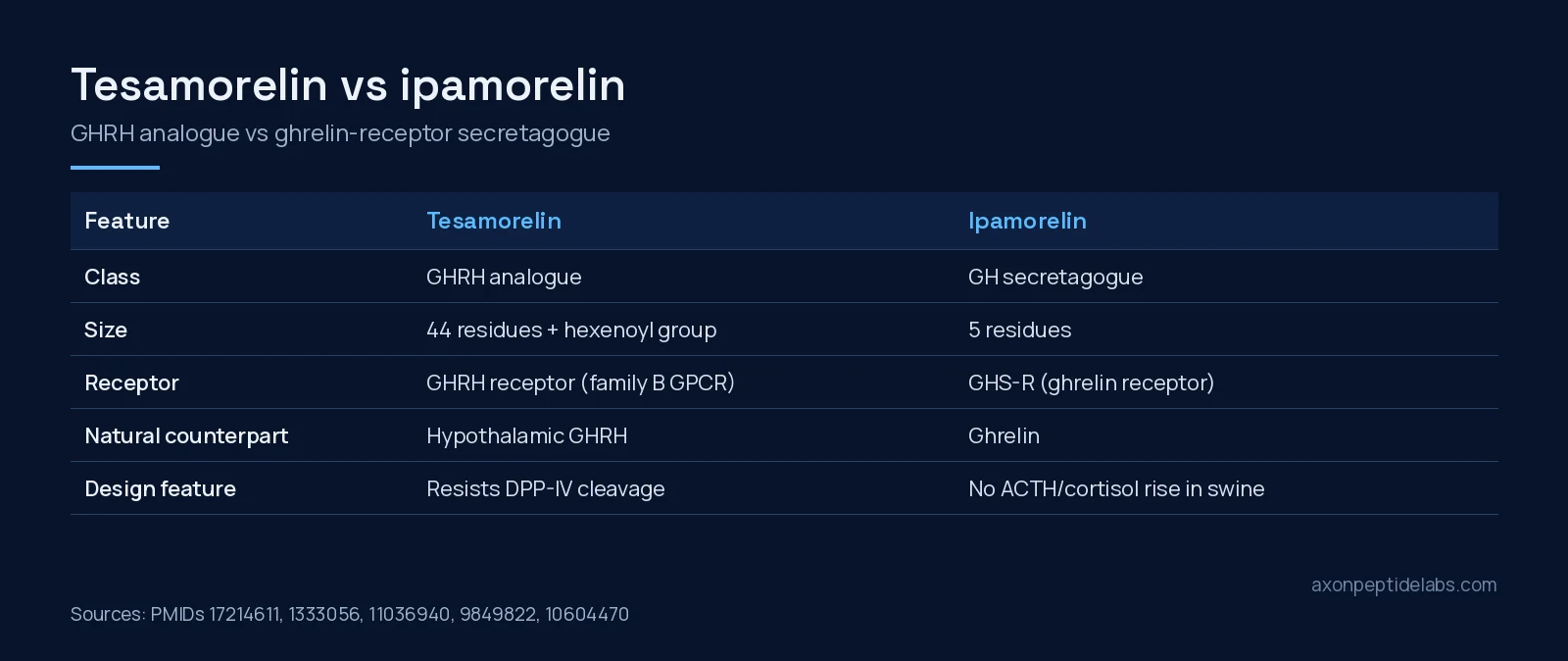
Tesamorelin vs ipamorelin at a glance
| Feature | Tesamorelin | Ipamorelin |
|---|---|---|
| Class | GHRH analogue [1] | GH secretagogue (GHRP-receptor agonist) [3] |
| Size | 44 residues plus N-terminal hexenoyl group | 5 residues, including non-natural Aib, D-2-Nal and D-Phe |
| Receptor | GHRH receptor, family B GPCR [5] | GHS-R, the ghrelin receptor [4] |
| Natural counterpart | Hypothalamic GHRH | Ghrelin, an acylated stomach peptide |
| Key design feature | Resistance to DPP-IV cleavage [1] | GH release without ACTH or cortisol rise in swine [3] |
| Typical lab question | GHRH-receptor signalling, cAMP, GH-IGF-1 axis | Ghrelin-receptor signalling and secretagogue selectivity |
Why researchers study them together
Because the two pathways are separate, they can be stimulated separately or together. In a study in healthy adult volunteers, a combined GHRH(1-29)NH2 and GHRP-2 challenge produced a larger GH response area than either peptide alone [7]. That study used GHRP-2, not ipamorelin, and native-sequence GHRH(1-29), not tesamorelin, but it is the kind of result that makes GHRH-plus-secretagogue designs a recurring research topic. Axon’s CJC-1295 and ipamorelin blend checklist covers the most common pairing.
Choosing between them for a study
- Isolating the GHRH receptor: tesamorelin, with a GHRH-receptor antagonist as the control.
- Isolating the ghrelin receptor: ipamorelin, whose selectivity profile in swine makes it a cleaner tool than GHRP-6 or GHRP-2 where ACTH and cortisol would confound the readout [3].
- Studying pathway interaction: both, with each alone as comparators.
- Studying peptide stability or enzyme resistance: tesamorelin against native GHRH, given the DPP-IV data [6][1].
Limits of this comparison
- No head-to-head study is cited. The two compounds are compared from separate papers, in different species and models.
- The ipamorelin selectivity data come from swine and rats [3], and the tesamorelin pharmacology from rats, dogs and pigs [1].
- The combination study used other peptides (GHRH(1-29) and GHRP-2) [7].
- Research use only. Nothing here concerns human or animal use.
Sourcing for laboratory work
Axon supplies tesamorelin 10mg for GHRH research and ipamorelin for in vitro and analytical work only. For more on the GHRH side, see tesamorelin vs CJC-1295; for the secretagogue side, see ipamorelin vs GHRP-2 vs GHRP-6 vs hexarelin. To buy lab-tested peptides in Canada, check the matching batch in the COA library first.
Frequently asked questions
What is the main difference between tesamorelin and ipamorelin?
They act at different receptors. Tesamorelin is a GHRH analogue that acts at the GHRH receptor; ipamorelin is a pentapeptide GH secretagogue that acts at the GHS-R, or ghrelin receptor.
Is tesamorelin a growth hormone secretagogue?
It releases GH, but it is classed as a GHRH analogue: hGRF(1-44)NH2 with a trans-3-hexenoyl group on Tyr1. The term GH secretagogue usually refers to compounds acting at the ghrelin receptor, such as ipamorelin.
Why is ipamorelin called selective?
In swine, ipamorelin released GH without raising ACTH or cortisol beyond what GHRH produced, unlike GHRP-6 and GHRP-2, and none of the secretagogues tested changed FSH, LH, prolactin or TSH.
Can tesamorelin and ipamorelin be studied together?
Yes, because the pathways are separate. A volunteer study found that combining GHRH(1-29) with GHRP-2 gave a larger GH response than either alone; that study did not use tesamorelin or ipamorelin.
Does Axon sell tesamorelin and ipamorelin in Canada?
Yes. Axon lists tesamorelin 10mg and ipamorelin for laboratory research only, with batch documentation in the COA library.
References
- Ferdinandi ES, Brazeau P, High K et al. (2007). Non-clinical pharmacology and safety evaluation of TH9507, a human growth hormone-releasing factor analogue. Basic Clin Pharmacol Toxicol. PMID: 17214611. doi: 10.1111/j.1742-7843.2007.00008.x.
- Mayo KE (1992). Molecular cloning and expression of a pituitary-specific receptor for growth hormone-releasing hormone. Mol Endocrinol. PMID: 1333056. doi: 10.1210/mend.6.10.1333056.
- Raun K, Hansen BS, Johansen NL et al. (1998). Ipamorelin, the first selective growth hormone secretagogue. Eur J Endocrinol. PMID: 9849822. doi: 10.1530/eje.0.1390552.
- Kojima M, Hosoda H, Date Y et al. (1999). Ghrelin is a growth-hormone-releasing acylated peptide from stomach. Nature. PMID: 10604470. doi: 10.1038/45230.
- Mayo KE, Miller T, DeAlmeida V et al. (2000). Regulation of the pituitary somatotroph cell by GHRH and its receptor. Recent Prog Horm Res. PMID: 11036940.
- Frohman LA, Downs TR, Heimer EP et al. (1989). Dipeptidylpeptidase IV and trypsin-like enzymatic degradation of human growth hormone-releasing hormone in plasma. J Clin Invest. PMID: 2565342. doi: 10.1172/JCI114049.
- Tiulpakov AN, Brook CG, Pringle PJ et al. (1995). GH responses to intravenous bolus infusions of GH releasing hormone and GH releasing peptide 2 separately and in combination in adult volunteers. Clin Endocrinol (Oxf). PMID: 7586605. doi: 10.1111/j.1365-2265.1995.tb02042.x.