
Tesamorelin vs CJC-1295: Capped GHRH vs Albumin-Bound GHRH
For laboratory research only. Not for human or animal use. This article gives no dosing, administration or therapeutic advice.
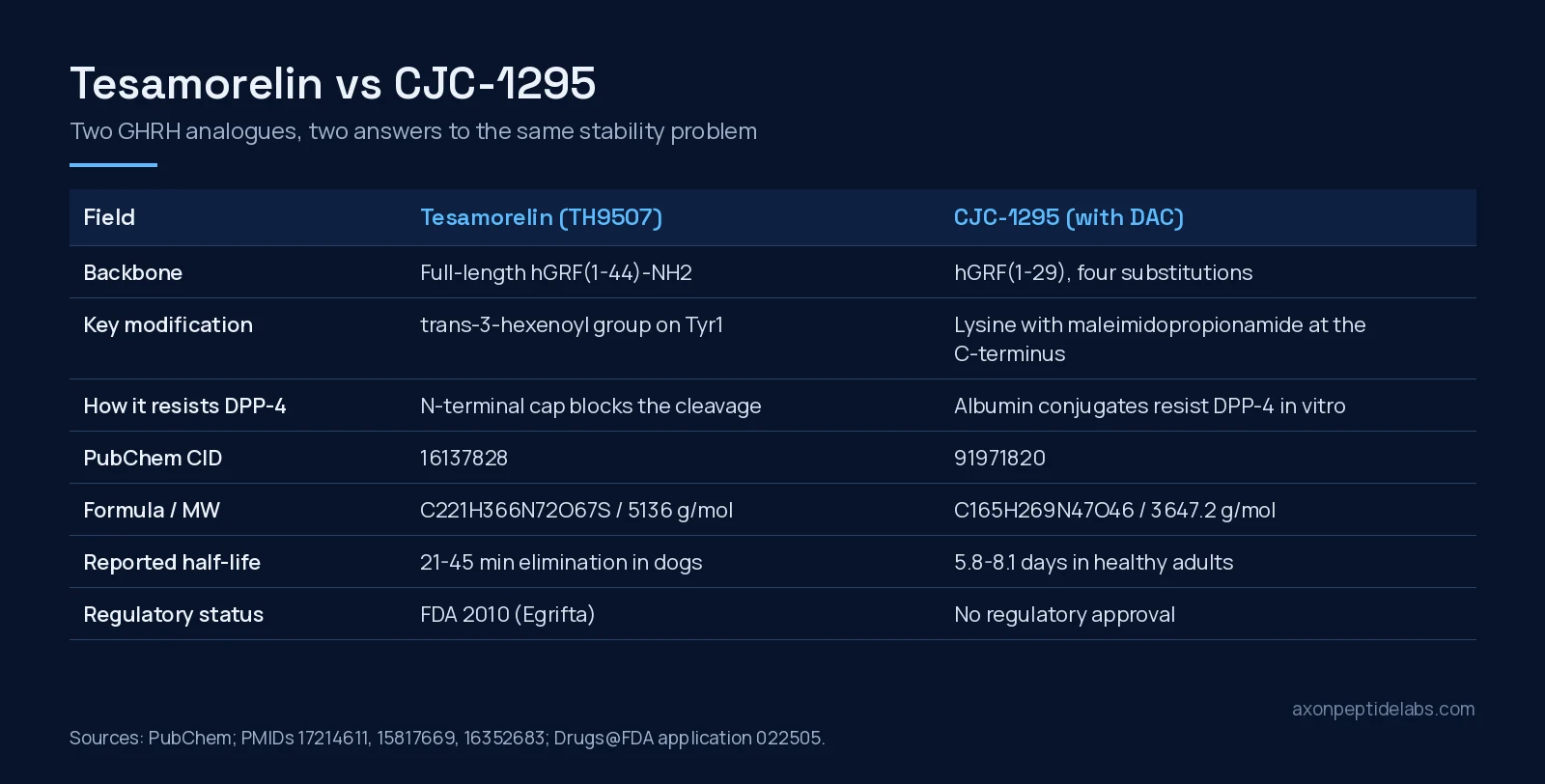
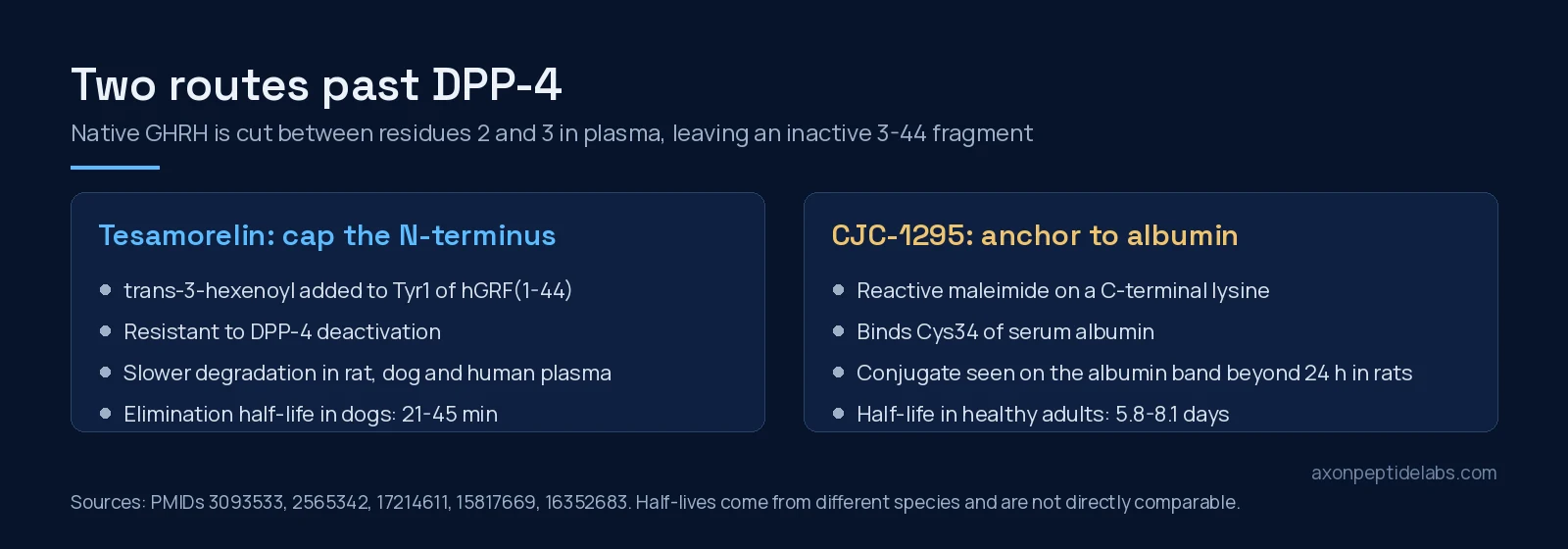
Short answer: tesamorelin and CJC-1295 are both synthetic analogues of growth hormone-releasing hormone (GHRH, also written GRF), and both were designed around the same weakness of the native peptide: rapid cleavage at its N-terminus in plasma[1]. They solve it in opposite ways. Tesamorelin keeps the full 44-residue human sequence and adds a trans-3-hexenoyl group to tyrosine 1, which makes it resistant to dipeptidyl aminopeptidase-IV (DPP-4)[2]. CJC-1295 is a shorter, tetrasubstituted GRF(1-29) carrying a reactive maleimide group that couples it to serum albumin[3]. The result is a large gap in persistence: an elimination half-life of 21 to 45 minutes for tesamorelin in dogs[2], against an estimated 5.8 to 8.1 days for CJC-1295 in healthy adults[4].
The problem both analogues address
Native GHRH is short-lived. When GRH(1-44)-NH2 was incubated with human plasma, HPLC showed it disappearing with a half-life of 17 minutes, replaced by GRH(3-44)-NH2, a fragment with less than one-thousandth of the parent’s biological activity. After intravenous injection in people, the intact peptide’s half-life was 6.8 minutes[1]. A follow-up study pinned the 2-3 cleavage on DPP-4: an aminopeptidase inhibitor did not prevent it, the DPP-4 inhibitor diprotin A did, and D-amino acid substitution at position 1 or 2 also blocked it. The same work found a second, trypsin-like cut at positions 11-12, with an extra 12-13 cleavage in the shorter GRH(1-32) and GRH(1-29) fragments[5].
That gives any long-acting design two jobs: protect the N-terminus and slow overall clearance. Tesamorelin focuses on the first. CJC-1295 tackles both at once by hitching a ride on albumin.
Structure and identity
Identity values below are from PubChem and describe reference compounds, not a specific batch. They are not certificate-of-analysis values.
| Field | Tesamorelin | CJC-1295 (with DAC) |
|---|---|---|
| Development code | TH9507 | CJC-1295 |
| PubChem CID | 16137828 | 91971820 |
| CAS (PubChem synonyms) | 218949-48-5 | 446262-90-4 |
| Molecular formula | C221H366N72O67S | C165H269N47O46 |
| Molecular weight | 5136 g/mol | 3647.2 g/mol |
| Peptide backbone | Human GRF(1-44)-NH2, native sequence[2] | Human GRF(1-29) with four substitutions, including D-Ala at position 2 in PubChem’s systematic name[3] |
| Added chemistry | trans-3-hexenoyl on Tyr1[2] | Lysine bearing an N-epsilon-3-maleimidopropionamide at the C-terminus[3] |
| Length | 44 residues plus the N-terminal acyl group | 30 amino acids[6] |
One naming issue causes real confusion. In the scientific literature, “CJC-1295” means the albumin-reactive molecule described above. In research catalogues, the same name is also used for the tetrasubstituted GRF(1-29) without the maleimide lysine, often called Modified GRF(1-29) or “CJC-1295 no DAC”. That version has no albumin anchor, so the multi-day figures below do not apply to it. Our CJC-1295 DAC vs no-DAC explainer covers that split; this article compares tesamorelin with the albumin-binding form unless stated otherwise.
How each one lasts longer
Tesamorelin: an N-terminal cap
The non-clinical package for TH9507 describes it as human GRF(1-44)-NH2 minimally modified by a trans-3-hexenoyl moiety on Tyr1. That change made it resistant to DPP-4 deactivation, slowed its in vitro degradation in rat, dog and human plasma, and prolonged in vivo elimination of immunoreactive peptide compared with natural hGRF(1-44)-NH2[2]. Repeated administration in pigs, rats and dogs markedly increased plasma GH and IGF-1. Even so, the apparent elimination half-life in dogs was 21 to 45 minutes[2]. Tesamorelin is a stabilised GHRH, not a depot.
The same study is worth reading for its toxicology. In subchronic studies of up to four months, dogs showed a more pronounced anabolic effect and reversible liver, kidney, haematology and organ-weight findings, which the authors attributed to prolonged exposure to supraphysiological GH and IGF-1[2].
CJC-1295: covalent albumin binding
The CJC-1295 discovery paper used a different idea: put a reactive group on the peptide so it bonds to the free thiol on Cys34 of serum albumin. Three maleimido derivatives of hGRF(1-29) were made and conjugated to human serum albumin ex vivo. All three conjugates were more stable against DPP-4 in vitro and still released GH from cultured rat anterior pituitary cells[3]. In rats, the selected compound gave a four-fold larger GH area under the curve over two hours than hGRF(1-29), stayed in plasma beyond 72 hours, and showed up on Western blot on the albumin band from 15 minutes to beyond 24 hours[3].
The conjugation also changes how CJC-1295 can be measured. Once bound to plasma proteins it effectively becomes a macromolecule of undefined mass, which hides it from top-down mass-spectrometry peptide screens; an immuno-PCR assay was developed to detect the conjugate in equine plasma for that reason[6].
What the human studies measured
Both molecules have been studied in people, but under very different programmes. The table lists design and primary measures only; it reports no treatment effects.
| Study | Compound | Population | Design and primary measure |
|---|---|---|---|
| Teichman et al. 2006[4] | CJC-1295 vs placebo | Healthy adults aged 21-61 | Two randomized, double-blind, ascending-dose trials (28 and 49 days); peak and area under the curve of GH and IGF-I, plus pharmacokinetics |
| Ionescu and Frohman 2006[7] | CJC-1295, single injection | Healthy men aged 20-40 | Overnight GH sampling every 20 minutes before and one week after; GH pulsatility |
| Falutz et al. 2010[8] | Tesamorelin vs placebo | 404 people with HIV and excess abdominal fat | 12 months in two phases, re-randomized at 6 months; visceral adipose tissue |
| Falutz et al. 2008[9] | Tesamorelin vs placebo | Extension of a 26-week trial in HIV | Re-randomized 26-week extension; long-term safety and glucose parameters |
| Stanley et al. 2019[10] | Tesamorelin vs placebo | 61 people with HIV and fatty liver | 12 months, double-blind; change in hepatic fat fraction |
Two pharmacology findings from the CJC-1295 studies help explain the molecule. In the ascending-dose trials, a single injection raised mean plasma GH for 6 days or more and IGF-I for 9 to 11 days, with an estimated half-life of 5.8 to 8.1 days[4]. In the pulsatility study, GH secretion rose mainly through markedly higher trough (basal) levels, while the frequency and size of GH pulses were unchanged[7]. A small proteomics study in 11 healthy young men used CJC-1295 as a tool to look for serum markers of GH and IGF-1 action one week after injection[11].
Those are measurements of the GH axis, not outcomes. They show that continuous GHRH receptor stimulation from an albumin-bound analogue behaves differently from the shorter exposure of a capped analogue like tesamorelin.
Regulatory status, stated neutrally
Drugs@FDA lists an original approval for Egrifta (tesamorelin) dated November 10, 2010 under application 022505. That approval covers a specific finished product for a specific indication in people with HIV. A research-grade tesamorelin peptide sold for laboratory use is not that product and carries no approval.
CJC-1295 has no regulatory approval. A 2026 review of approved and unapproved peptides in sports medicine groups it with compounds marketed direct to patients outside regulatory oversight and notes that rigorous human safety data for such unapproved peptides are scarce[12]. A qualitative study of internet forum posts also documented non-medical use of CJC-1295[13]. Both sources are a reminder that research peptides belong in the lab.
What the evidence does not show
- Not interchangeable. A capped 44-mer and an albumin-reactive 29-mer act on the same receptor class but with very different exposure profiles[2][3].
- The half-lives are not a fair contest. Tesamorelin’s 21-45 minute figure is from dogs[2]; CJC-1295’s multi-day figure is from people[4].
- “CJC-1295” can mean two things. Data on the albumin-binding form do not apply to the no-DAC peptide sold under the same name.
- No head-to-head studies. We found no study comparing tesamorelin and CJC-1295 directly. The human programmes differ in population, length and endpoints.
Sourcing for your lab
Axon carries Tesamorelin 10mg (also as a 10mg pen), CJC-1295 with DAC 2mg and CJC-1295 10mg for laboratory research. Batch documentation, where posted, is on our COA page. For another GHRH comparison, see tesamorelin vs sermorelin. To compare our wider catalogue, you can buy lab-tested peptides in Canada with documentation listed by batch.
Frequently asked questions
What is the main difference between tesamorelin and CJC-1295?
Both are GHRH analogues. Tesamorelin is full-length human GRF(1-44)-NH2 with a trans-3-hexenoyl group on tyrosine 1 that makes it resistant to DPP-4. CJC-1295 is a tetrasubstituted GRF(1-29) with a reactive maleimide lysine that binds serum albumin, which extends its persistence.
How long do tesamorelin and CJC-1295 last?
In the non-clinical studies, tesamorelin’s apparent elimination half-life in dogs was 21 to 45 minutes. In healthy adults, CJC-1295’s estimated half-life was 5.8 to 8.1 days. The figures come from different species and are not directly comparable.
Is CJC-1295 no DAC the same as CJC-1295?
No. In the literature, CJC-1295 is the albumin-binding molecule with a maleimidopropionamide lysine. The no-DAC peptide, often called Modified GRF(1-29), lacks that group, so the multi-day half-life data do not apply to it.
Has tesamorelin been approved?
Drugs@FDA lists an original approval for Egrifta (tesamorelin) dated November 10, 2010. That covers a specific finished product. CJC-1295 has no regulatory approval, and research-grade peptides are for laboratory use only.
Has anyone compared tesamorelin and CJC-1295 head to head?
We found no direct comparison. Tesamorelin was studied in people with HIV, while the CJC-1295 human studies were small pharmacokinetic and pharmacodynamic trials in healthy adults.
References
- Frohman LA, Downs TR, Williams TC et al. (1986). Rapid enzymatic degradation of growth hormone-releasing hormone by plasma in vitro and in vivo to a biologically inactive product cleaved at the NH2 terminus. J Clin Invest. PMID: 3093533. doi: 10.1172/JCI112679.
- Ferdinandi ES, Brazeau P, High K et al. (2007). Non-clinical pharmacology and safety evaluation of TH9507, a human growth hormone-releasing factor analogue. Basic Clin Pharmacol Toxicol. PMID: 17214611. doi: 10.1111/j.1742-7843.2007.00008.x.
- Jetté L, Léger R, Thibaudeau K et al. (2005). Human growth hormone-releasing factor (hGRF)1-29-albumin bioconjugates activate the GRF receptor on the anterior pituitary in rats: identification of CJC-1295 as a long-lasting GRF analog. Endocrinology. PMID: 15817669. doi: 10.1210/en.2004-1286.
- Teichman SL, Neale A, Lawrence B et al. (2006). Prolonged stimulation of growth hormone (GH) and insulin-like growth factor I secretion by CJC-1295, a long-acting analog of GH-releasing hormone, in healthy adults. J Clin Endocrinol Metab. PMID: 16352683. doi: 10.1210/jc.2005-1536.
- Frohman LA, Downs TR, Heimer EP et al. (1989). Dipeptidylpeptidase IV and trypsin-like enzymatic degradation of human growth hormone-releasing hormone in plasma. J Clin Invest. PMID: 2565342. doi: 10.1172/JCI114049.
- Timms M, Ganio K, Forbes G et al. (2019). An immuno polymerase chain reaction screen for the detection of CJC-1295 and other growth-hormone-releasing hormone analogs in equine plasma. Drug Test Anal. PMID: 30489688. doi: 10.1002/dta.2554.
- Ionescu M, Frohman LA (2006). Pulsatile secretion of growth hormone (GH) persists during continuous stimulation by CJC-1295, a long-acting GH-releasing hormone analog. J Clin Endocrinol Metab. PMID: 17018654. doi: 10.1210/jc.2006-1702.
- Falutz J, Potvin D, Mamputu JC et al. (2010). Effects of tesamorelin, a growth hormone-releasing factor, in HIV-infected patients with abdominal fat accumulation: a randomized placebo-controlled trial with a safety extension. J Acquir Immune Defic Syndr. PMID: 20101189. doi: 10.1097/QAI.0b013e3181cbdaff.
- Falutz J, Allas S, Mamputu JC et al. (2008). Long-term safety and effects of tesamorelin, a growth hormone-releasing factor analogue, in HIV patients with abdominal fat accumulation. AIDS. PMID: 18690162. doi: 10.1097/QAD.0b013e32830a5058.
- Stanley TL, Fourman LT, Feldpausch MN et al. (2019). Effects of tesamorelin on non-alcoholic fatty liver disease in HIV: a randomised, double-blind, multicentre trial. Lancet HIV. PMID: 31611038. doi: 10.1016/S2352-3018(19)30338-8.
- Sackmann-Sala L, Ding J, Frohman LA et al. (2009). Activation of the GH/IGF-1 axis by CJC-1295, a long-acting GHRH analog, results in serum protein profile changes in normal adult subjects. Growth Horm IGF Res. PMID: 19386527. doi: 10.1016/j.ghir.2009.03.001.
- Mendias CL, Awan TM (2026). Safety and Efficacy of Approved and Unapproved Peptide Therapies for Musculoskeletal Injuries and Athletic Performance. Sports Med. PMID: 41966639. doi: 10.1007/s40279-026-02437-0.
- Van Hout MC, Hearne E (2016). Netnography of Female Use of the Synthetic Growth Hormone CJC-1295: Pulses and Potions. Subst Use Misuse. PMID: 26771670. doi: 10.3109/10826084.2015.1082595.