
PT-141 vs Kisspeptin-10: Melanocortin and Kisspeptin Pathways Compared
For laboratory research only. Not for human or animal use. This article gives no dosing, administration or therapeutic advice.
Short answer: PT-141 (bremelanotide) and kisspeptin-10 both come up in reproductive neuroscience, but they enter the brain’s circuitry through different receptors. PT-141 is a cyclic alpha-MSH analogue that activates melanocortin receptors, including MC3R and MC4R[1], and in rodents it is studied mainly through behavioural readouts. Kisspeptin-10 is the shortest fully active fragment of the kisspeptins, the natural ligands of the receptor GPR54 (Kiss1R)[2]; it is studied mainly through the hormone cascade it starts, GnRH release followed by LH and FSH[3]. In female mice the two systems connect: MC4R on kisspeptin neurons helps control fertility[4].
Identity and structure
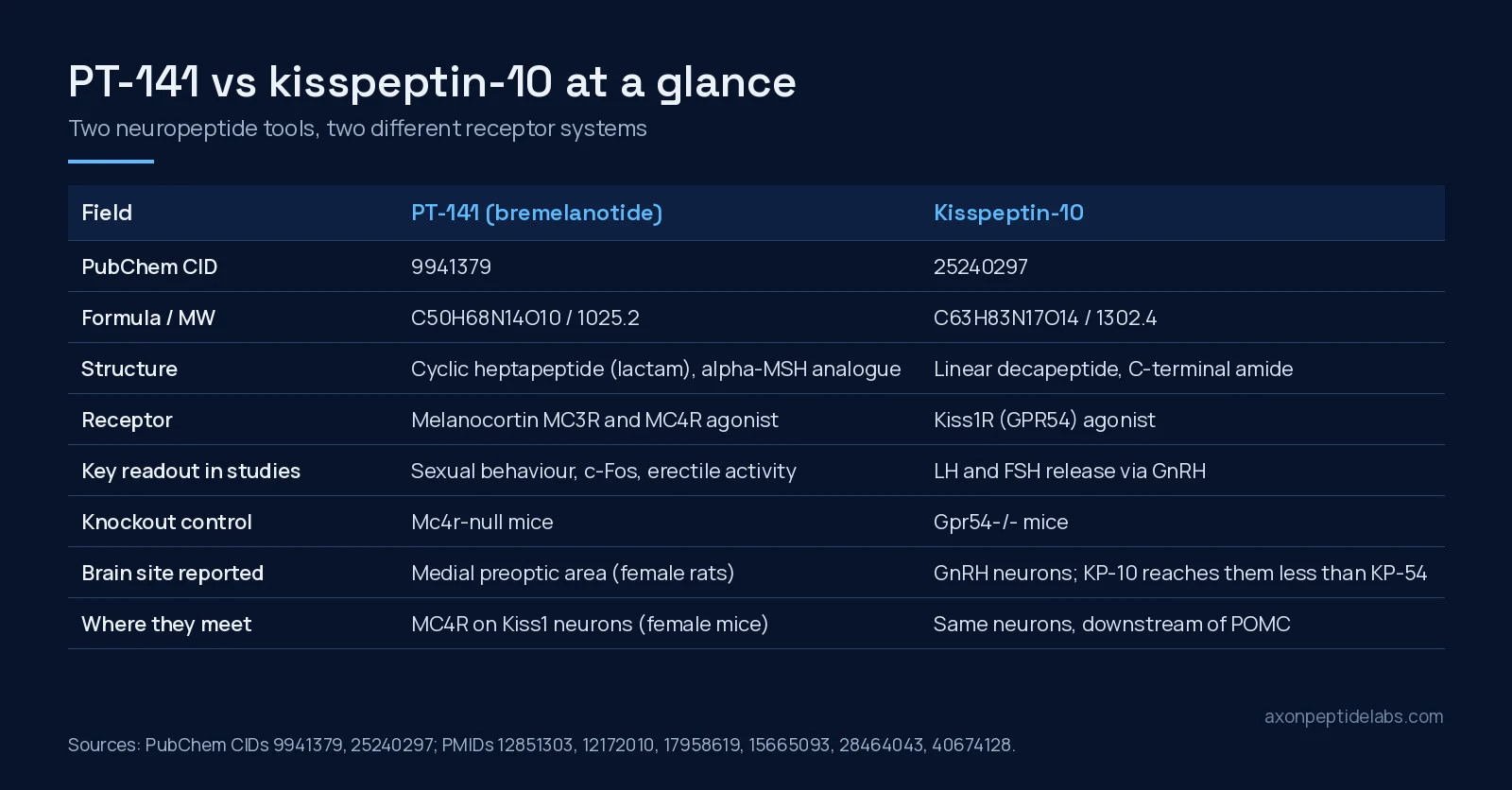
The identity values below are from PubChem and are not certificate-of-analysis values for any lot.
| Field | PT-141 (bremelanotide) | Kisspeptin-10 |
|---|---|---|
| PubChem CID | 9941379 | 25240297 |
| CAS (PubChem synonym) | 189691-06-3 | 374675-21-5 |
| Molecular formula | C50H68N14O10 | C63H83N17O14 |
| Molecular weight | 1025.2 g/mol | 1302.4 g/mol |
| Sequence / form | Ac-Nle-cyclo[Asp-His-D-Phe-Arg-Trp-Lys]-OH (lactam bridge) | YNWNSFGLRF-NH2[5] |
| Parent molecule | alpha-MSH (synthetic analogue)[6] | KiSS-1 gene product (kisspeptin-54 / metastin)[7] |
| Receptor | Melanocortin receptors incl. MC3R, MC4R[1] | GPR54 / Kiss1R[2][3] |
PT-141 belongs to the family of cyclic lactam alpha-MSH fragments designed in the late 1980s from molecular-dynamics models of alpha-melanotropin; the cyclic analogues in that work were up to about 100 times more potent than alpha-MSH in a lizard-skin bioassay[8]. Kisspeptin-10 is linear and ends in an amidated Arg-Phe, the RF-amide motif shared by the 54-, 14- and 13-residue kisspeptins first isolated from human placenta[2]. PT-141 and melanotan II are near-twins (one has a free acid, the other an amide), a difference covered in our PT-141 vs melanotan II post.
PT-141: the melanocortin route
A 2003 overview describes PT-141 as a melanocortin agonist acting at MC3R and MC4R, receptors expressed mainly in the central nervous system; in rats it increased c-Fos immunoreactivity in hypothalamic neurons, and it produced erections in rats and nonhuman primates[1]. Why MC4R in particular? A 2002 genetic and pharmacological study showed that a selective MC4R agonist increased erectile activity in wild-type but not Mc4r-null mice, that copulatory behaviour was reduced in mice lacking Mc4r, and that MC4R is expressed along spinal, hypothalamic and peripheral nerve pathways[9].
The female-rat work is the most specific. In a paced-mating model, PT-141 selectively increased solicitation (an appetitive, “approach” behaviour) without changing lordosis, pacing, general motor activity or measures of sexual reward[10]. A follow-up review traced this to the medial preoptic area: infusions there, or into the lateral ventricles, reproduced the effect, while infusions into the ventromedial hypothalamus did not[11]. Structurally, high-resolution structures of MC4R in complex with alpha-MSH, afamelanotide and bremelanotide show a conserved binding mode for these peptide agonists[12].
Regulatory status, stated neutrally: bremelanotide received its first approval in the USA in 2019 as Vyleesi, for a specific indication in premenopausal women[6]. That approval covers the finished drug product, not research-grade peptide.
Kisspeptin-10: the hormone-axis route
Kisspeptins were identified in 2001 by two groups as the natural ligands of the orphan receptor GPR54. They bound rat and human GPR54 with low-nanomolar affinity and triggered calcium mobilisation and MAP kinase signalling[2]; the 54-residue form (named metastin) also inhibited chemotaxis and invasion of receptor-expressing cells, linking it to the KiSS-1 metastasis-suppressor gene[7].
The reproductive role became clear in 2003, when loss-of-function mutations in GPR54 were found in families with hypogonadotropic hypogonadism and absent or impaired puberty[13][14]. Gpr54-deficient mice showed a matching phenotype[14]. In 2005, GPR54 transcripts were found in mouse GnRH neurons, and kisspeptin that robustly released LH and FSH in wild-type mice had no effect in gpr54-/- mice, showing it acts through GPR54 to drive the axis[3]. That knockout result makes Gpr54-null tissue the natural negative control for any kisspeptin-10 experiment.
Kisspeptin-10 is short-lived. In male mice its blood half-life was about 4 minutes against about 32 minutes for kisspeptin-54, and only kisspeptin-54 activated c-Fos in GnRH neurons after peripheral delivery, suggesting kisspeptin-10 crosses the blood-brain barrier less readily[15]. In rat plasma in vitro, kisspeptin-10 decomposed with half-lives of 6.8, 2.9 and 1.7 minutes at 4, 25 and 37 °C, mainly by losing its N-terminal tyrosine[5]. The hCG comparison in our kisspeptin-10 vs hCG article covers what happens further down the axis.
Behaviour: kisspeptin is not only a hormone switch
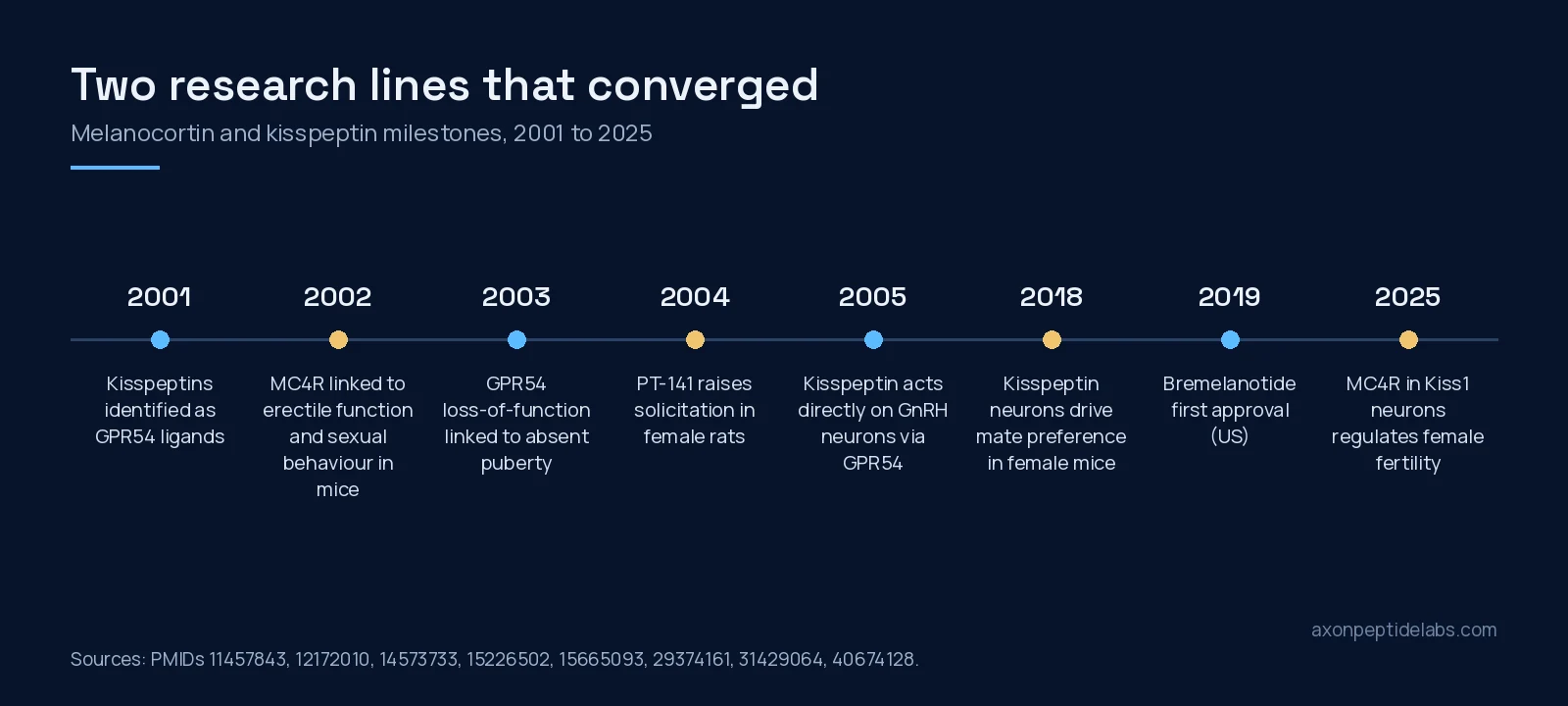
It would be neat to file PT-141 under “behaviour” and kisspeptin under “hormones”, but the mouse data do not allow it. In female mice, male odours detected by the vomeronasal organ activated kisspeptin neurons. Kisspeptin acting through Kiss1R then drove olfactory mate preference, while copulatory behaviour was elicited through a parallel kisspeptin-neuron circuit that did not need Kiss1R and involved nitric oxide signalling in the ventromedial hypothalamus[16]. So kisspeptin neurons, not only the kisspeptin peptide, sit at a branching point between ovulation and behaviour.
Where the two systems meet
The most direct link is a 2025 study. Deleting Mc4r only from Kiss1 neurons in female mice reproduced the reproductive impairment of whole-body Mc4r knockouts without causing obesity, and putting Mc4r back into Kiss1 neurons of Mc4r-null mice restored oestrous cycles and LH pulsatility without correcting the obesity. MC4R activation excited arcuate Kiss1 neurons (the GnRH “pulse generator”) and normally inhibited AVPV/PeN Kiss1 neurons except when oestradiol was high[4]. Earlier work in ewes pointed the same way: a melanocortin agonist (melanotan II) given into the brain increased LH secretion and up-regulated kisspeptin expression in the preoptic area, though it did not restore full ovulatory cycles in seasonal anoestrus[17].
| Experimental question | Better-matched tool | Typical readout and control |
|---|---|---|
| Does a behaviour depend on central melanocortin signalling? | PT-141 | Appetitive behaviour, c-Fos; Mc4r-null animals[9][10] |
| Is the GnRH/LH axis intact and responsive? | Kisspeptin-10 | LH and FSH release; Gpr54-/- animals[3] |
| Does metabolic (POMC) signalling reach reproduction? | Both, in sequence | MC4R on Kiss1 neurons, LH pulses[4] |
| Is a long-lasting central kisspeptin signal needed? | Kisspeptin-10 is a weak fit | Short half-life; KP-54 compared[15] |
Notes for the bench
- Handle kisspeptin-10 samples cold and fast. Its decomposition in rat plasma was much faster at 37 °C than at 4 °C[5], so sample handling time can change measured concentrations.
- Confirm identity by mass. At 1025.2 versus 1302.4 g/mol the two are easy to separate by mass spectrometry; PT-141 versus melanotan II (about 1 Da apart) is the harder pair.
- Use the right knockout. Mc4r-null and Gpr54-null models answer different questions[9][3]; the 2025 Kiss1-specific Mc4r deletion shows why cell-type-specific models matter[4].
Research-grade material is listed as PT-141 10mg and Kisspeptin-10 10mg. To see the rest of the catalogue and our lot documentation, you can buy lab-tested peptides in Canada.
Frequently asked questions
Do PT-141 and kisspeptin-10 act on the same receptor?
No. PT-141 activates melanocortin receptors, including MC3R and MC4R. Kisspeptin-10 activates GPR54, also called Kiss1R. The systems connect because MC4R is expressed on kisspeptin neurons in female mice.
Does PT-141 raise LH the way kisspeptin does?
Kisspeptin’s defining action is GnRH-driven LH and FSH release, which disappears in GPR54-knockout mice. PT-141 research has focused on behavioural and erectile readouts. Melanocortin signalling can influence LH indirectly, for example through MC4R on Kiss1 neurons in mice and a melanocortin agonist in ewes.
Why is kisspeptin-10 described as short-lived?
In male mice its blood half-life was about 4 minutes, versus about 32 minutes for kisspeptin-54. In rat plasma in vitro it decomposed within minutes at 37 °C, mainly by losing its N-terminal tyrosine.
Is bremelanotide an approved drug?
Bremelanotide received its first approval in the USA in 2019 under the name Vyleesi, for a specific indication. That approval applies to the finished drug product, not to research-grade PT-141.
How can a lab distinguish the two peptides?
By mass. PubChem lists bremelanotide at 1025.2 g/mol and kisspeptin-10 at 1302.4 g/mol. PT-141 is cyclic; kisspeptin-10 is a linear amidated decapeptide.
References
- Molinoff PB, Shadiack AM, Earle D et al. (2003). PT-141: a melanocortin agonist for the treatment of sexual dysfunction. Ann N Y Acad Sci. PMID: 12851303. doi: 10.1111/j.1749-6632.2003.tb03167.x.
- Kotani M, Detheux M, Vandenbogaerde A et al. (2001). The metastasis suppressor gene KiSS-1 encodes kisspeptins, the natural ligands of the orphan G protein-coupled receptor GPR54. J Biol Chem. PMID: 11457843. doi: 10.1074/jbc.M104847200.
- Messager S, Chatzidaki EE, Ma D et al. (2005). Kisspeptin directly stimulates gonadotropin-releasing hormone release via G protein-coupled receptor 54. Proc Natl Acad Sci U S A. PMID: 15665093. doi: 10.1073/pnas.0409330102.
- Talbi R, Stincic TL, Ferrari K et al. (2025). POMC neurons control fertility through differential signaling of MC4R in kisspeptin neurons. Elife. PMID: 40674128. doi: 10.7554/eLife.100722.
- Liu Z, Ren C, Jones W et al. (2013). LC-MS/MS quantification of a neuropeptide fragment kisspeptin-10 (NSC 741805) and characterization of its decomposition product and pharmacokinetics in rats. J Chromatogr B Analyt Technol Biomed Life Sci. PMID: 23524040. doi: 10.1016/j.jchromb.2013.02.027.
- Dhillon S, Keam SJ (2019). Bremelanotide: First Approval. Drugs. PMID: 31429064. doi: 10.1007/s40265-019-01187-w.
- Ohtaki T, Shintani Y, Honda S et al. (2001). Metastasis suppressor gene KiSS-1 encodes peptide ligand of a G-protein-coupled receptor. Nature. PMID: 11385580. doi: 10.1038/35079135.
- Al-Obeidi F, Castrucci AM, Hadley ME et al. (1989). Potent and prolonged acting cyclic lactam analogues of alpha-melanotropin: design based on molecular dynamics. J Med Chem. PMID: 2555512. doi: 10.1021/jm00132a010.
- Van der Ploeg LH, Martin WJ, Howard AD et al. (2002). A role for the melanocortin 4 receptor in sexual function. Proc Natl Acad Sci U S A. PMID: 12172010. doi: 10.1073/pnas.172378699.
- Pfaus JG, Shadiack A, Van Soest T et al. (2004). Selective facilitation of sexual solicitation in the female rat by a melanocortin receptor agonist. Proc Natl Acad Sci U S A. PMID: 15226502. doi: 10.1073/pnas.0400491101.
- Pfaus J, Giuliano F, Gelez H (2007). Bremelanotide: an overview of preclinical CNS effects on female sexual function. J Sex Med. PMID: 17958619. doi: 10.1111/j.1743-6109.2007.00610.x.
- Zhang H, Chen LN, Yang D et al. (2021). Structural insights into ligand recognition and activation of the melanocortin-4 receptor. Cell Res. PMID: 34433901. doi: 10.1038/s41422-021-00552-3.
- de Roux N, Genin E, Carel JC et al. (2003). Hypogonadotropic hypogonadism due to loss of function of the KiSS1-derived peptide receptor GPR54. Proc Natl Acad Sci U S A. PMID: 12944565. doi: 10.1073/pnas.1834399100.
- Seminara SB, Messager S, Chatzidaki EE et al. (2003). The GPR54 gene as a regulator of puberty. N Engl J Med. PMID: 14573733. doi: 10.1056/NEJMoa035322.
- d’Anglemont de Tassigny X, Jayasena CN, Murphy KG et al. (2017). Mechanistic insights into the more potent effect of KP-54 compared to KP-10 in vivo. PLoS One. PMID: 28464043. doi: 10.1371/journal.pone.0176821.
- Hellier V, Brock O, Candlish M et al. (2018). Female sexual behavior in mice is controlled by kisspeptin neurons. Nat Commun. PMID: 29374161. doi: 10.1038/s41467-017-02797-2.
- Backholer K, Smith J, Clarke IJ (2009). Melanocortins may stimulate reproduction by activating orexin neurons in the dorsomedial hypothalamus and kisspeptin neurons in the preoptic area of the ewe. Endocrinology. PMID: 19819961. doi: 10.1210/en.2009-0604.