
PT-141 vs Melanotan II: Bremelanotide, MT-II and Melanotan I
For laboratory research only. Not for human or animal use. This article gives no dosing, administration or therapeutic advice.
Short answer: PT-141 (bremelanotide) and Melanotan II are almost the same molecule. Both are cyclic seven-residue analogues of alpha-melanocyte-stimulating hormone (alpha-MSH); the difference PubChem records is the C-terminal end group, a free acid on bremelanotide and an amide on Melanotan II. Both act on several melanocortin receptors[3][4]. The real gap is in the evidence and the paperwork: bremelanotide went through a full clinical program and is an FDA-approved drug, while Melanotan II stopped at small pilot trials and now appears in the literature mostly through case reports tied to unregulated products[5][19].
This comparison covers where both came from, how they act, what the human studies found, the safety literature, and how Melanotan I (afamelanotide) fits in. For an overview of PT-141 documentation on its own, see our earlier PT-141 research and COA checklist.
Where both peptides came from
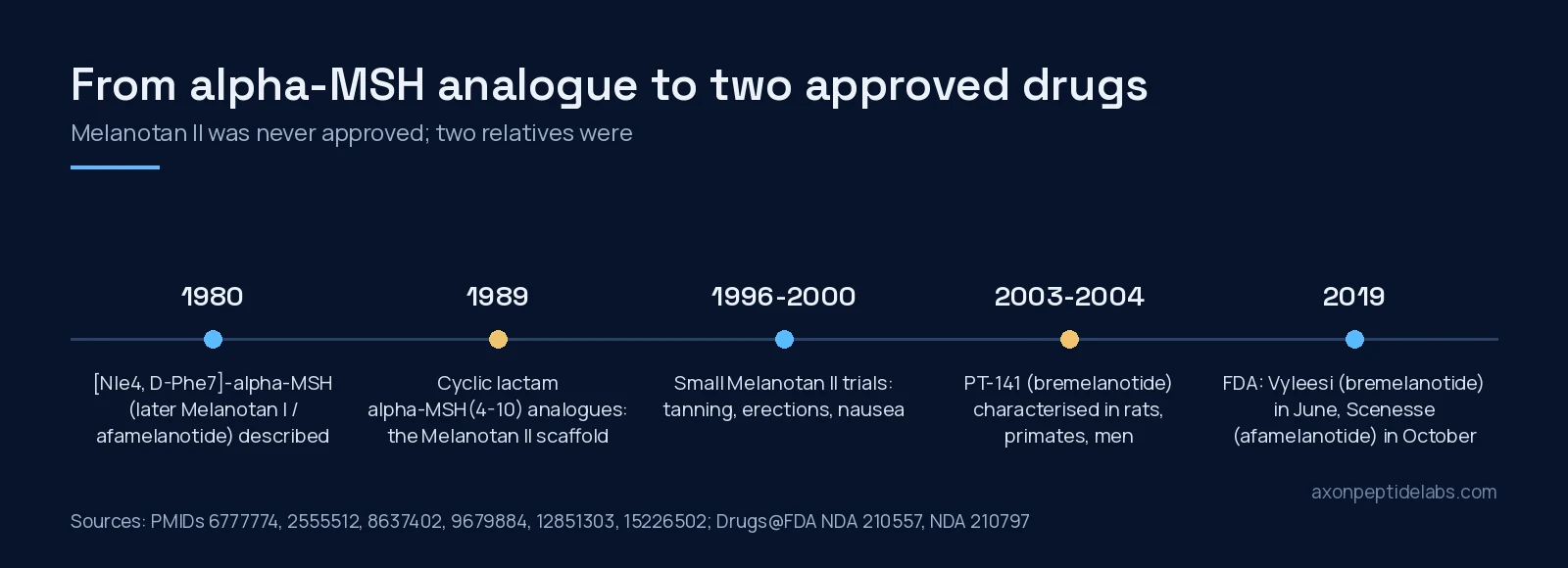
The family starts with alpha-MSH, a 13-residue hormone that darkens skin and has many effects in the brain. In 1980 researchers reported that swapping methionine-4 for norleucine and phenylalanine-7 for its D-isomer gave [Nle4, D-Phe7]-alpha-MSH, an analogue resistant to enzymatic breakdown and far more potent than the natural hormone in a pigment-cell assay[1]. That compound later became Melanotan I; PubChem files it as afamelanotide (CID 16197727) with “Melanotan” among its synonyms.
In 1989 a design study shortened the peptide to the 4–10 fragment and closed it into a ring with a lactam bridge between an acidic and a basic side chain. Ring size mattered: the 23-membered ring gave the most potent and longest-acting analogues in two pigment-cell assays, while smaller rings lost the prolonged activity[2]. Melanotan II is one of these cyclic lactams: Ac-Nle-cyclo[Asp-His-D-Phe-Arg-Trp-Lys]-NH2, as described in its first human study[9]. Bremelanotide (PT-141) followed as a synthetic alpha-MSH analogue developed specifically for sexual function[4][5].
Identity, side by side
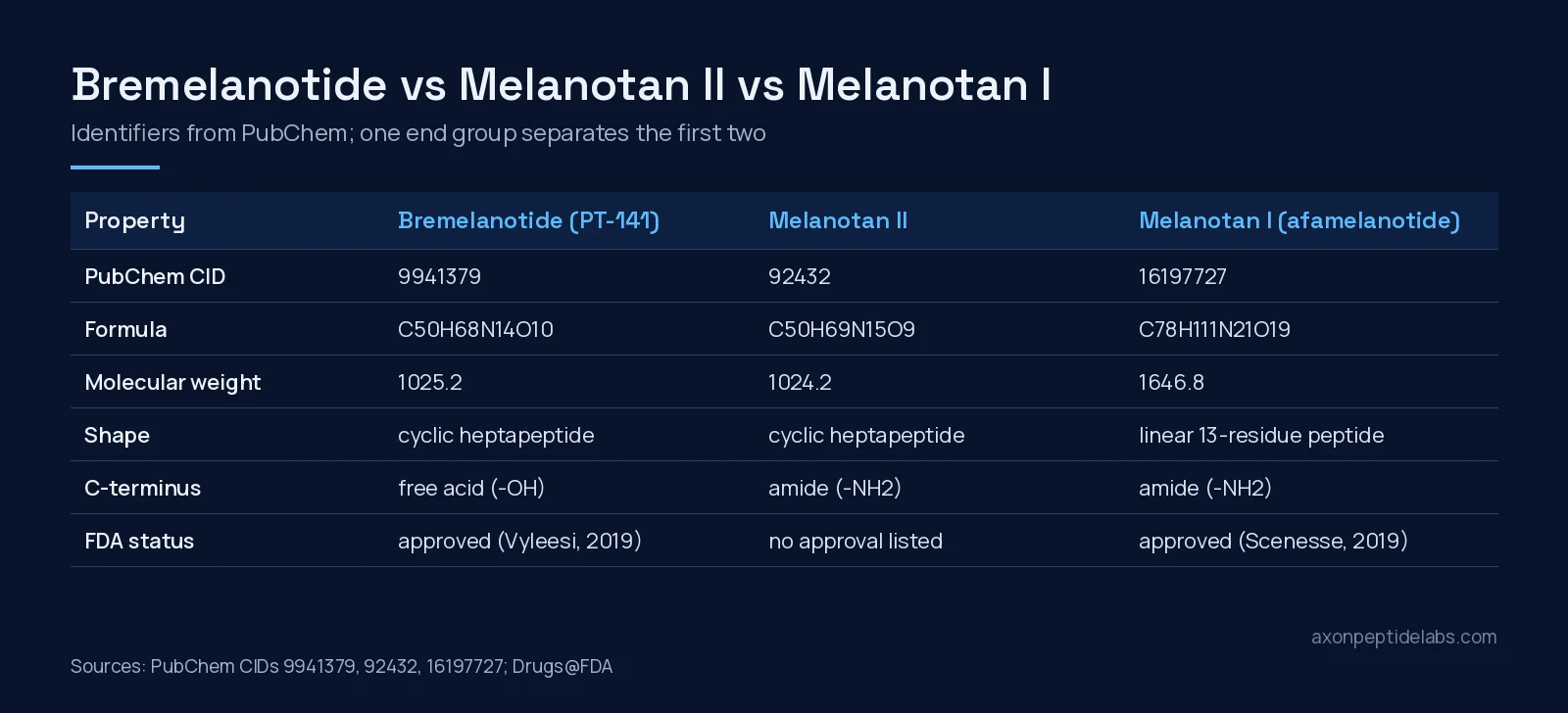
| Property | Bremelanotide (PT-141) | Melanotan II | Melanotan I (afamelanotide) |
|---|---|---|---|
| PubChem CID | 9941379 | 92432 | 16197727 |
| CAS (PubChem synonyms) | 189691-06-3 | 121062-08-6 | 75921-69-6 |
| Formula | C50H68N14O10 | C50H69N15O9 | C78H111N21O19 |
| Molecular weight | 1025.2 | 1024.2 | 1646.8 |
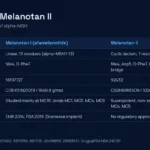
| Structure | Ac-Nle-cyclo[Asp-His-D-Phe-Arg-Trp-Lys], free acid | Same ring, C-terminal amide[9] | Linear [Nle4, D-Phe7]-alpha-MSH[1] |
| Receptor profile | Agonist at melanocortin receptors including MC3R and MC4R[4]; high MC4R affinity[5] | Potent, unselective agonist of human melanocortin receptors[3] | Potent melanotropin at pigment-cell receptors[1] |
The formulas tell the structural story precisely: Melanotan II carries one more nitrogen and one more hydrogen and one fewer oxygen, the signature of a C-terminal amide (-CONH2) where bremelanotide has a carboxylic acid (-COOH). On a mass spectrum the two differ by about 1 Da, which is one reason a report for one cannot stand in for the other.
How they act: the melanocortin system
Alpha-MSH analogues were first designed around their darkening effect on pigment cells[1][2], but the receptors behind sexual effects are different: MC3R and MC4R, which are expressed mainly in the brain[4]. A 2002 study combining knockout mice, a selective non-peptide MC4R agonist and tissue mapping tied MC4R to erectile function and sexual behaviour: the agonist augmented erectile responses in wild-type but not MC4R-null mice, and MC4R was found in nerve fibres of the penis in rats and humans[6].
Bremelanotide’s preclinical work pointed at the brain rather than the blood vessels. In rats and non-human primates it produced erections, and in rats it activated hypothalamic neurons (rising c-Fos)[4]. In female rats it selectively increased solicitational behaviour, the rat’s measure of sexual motivation, without changing lordosis, pacing or general motor activity[7], and peripheral dosing activated the medial preoptic area and other hypothalamic and limbic regions[8].
Melanotan II hits the same receptors with less discrimination. A 2022 medicinal chemistry paper used it as the reference “potent and unselective agonist of human MCRs” when designing analogues selective for MC1R[3]. That breadth explains why the first human study recorded tanning, spontaneous erections, yawning and stretching, and nausea all from one compound[9].
What the human studies looked at
For bremelanotide, which is an approved drug, this table lists design and endpoints only. No efficacy figures are given here for its labelled use.
| Study | Compound | Design and population | What was measured |
|---|---|---|---|
| Dorr 1996[9] | Melanotan II | Pilot phase I, single-blind, alternating days vs saline; 3 healthy men | Tolerability, skin pigmentation (reflectance) |
| Wessells 1998[10] | Melanotan II | Double-blind, placebo-controlled crossover; men with psychogenic erectile dysfunction | Penile rigidity monitoring, side effects |
| Wessells 2000[11] | Melanotan II | Double-blind, placebo-controlled crossover; men with organic erectile dysfunction | Erectile response, sexual desire, side effects |
| Diamond 2004[12] | Bremelanotide | Two placebo-controlled studies; healthy men and men with erectile dysfunction | Safety, pharmacokinetics, erectile response |
| Safarinejad 2008[13] | Bremelanotide | Randomised, double-blind, placebo-controlled; men who had not responded to sildenafil | Erectile response, satisfaction, adverse effects |
| RECONNECT 2019[14] | Bremelanotide | Two identical phase 3 RCTs, 24 weeks, premenopausal women with hypoactive sexual desire disorder | Co-primary: change in desire and related-distress scores |
Bremelanotide’s male erectile program did not lead to an approval; the 2008 authors called for more studies with different regimens[13]. The approval came from the female desire program. Melanotan II’s three small trials were the end of its formal clinical development; the investigators themselves flagged nausea, and in the 2000 study some injections were followed by severe nausea[11].
Safety findings
Bremelanotide. A 2022 review of the full development program (about 3,500 subjects in 43 studies) found adverse events were mostly mild to moderate; nausea, flushing and headache were the most common, and nausea was the main reason people stopped[15]. Ambulatory monitoring found small, transient rises in blood pressure with a fall in heart rate after dosing, which led to blood-pressure monitoring in the later trials[16], and the review advises caution where cardiovascular risk is present[15]. It also reports focal hyperpigmentation: rare at labelled use, but seen in more than a third of subjects after repeated dosing on consecutive days[15]. Bremelanotide is not free of pigment effects.
Melanotan II. With no development program behind it, its safety literature is case-based and comes largely from unregulated tanning products. A 2017 review describes changes in existing moles and new dysplastic naevi, notes four case reports of melanoma arising from moles during or soon after melanotan use, and says conclusive evidence of a causal link is lacking; several national health bodies have issued warnings about melanotan I and II[19]. Individual reports describe melanoma after Melanotan II use with sunbed tanning[20], systemic toxicity with rhabdomyolysis and kidney dysfunction[21], ischaemic priapism requiring surgery[22], and a renal infarction the authors attributed to Melanotan II[23]. Case reports cannot establish frequency or cause.
Product quality. When researchers bought Melanotan II vials from three online shops and analysed them by LC-UV and tandem mass spectrometry, every shop claimed 10 mg per vial but measured contents ranged from 4.32 to 8.84 mg, and vials from two of the three shops contained unknown impurities[18]. Identity and content testing is the only way to know what a vial holds.
Where Melanotan I (afamelanotide) fits
Afamelanotide is the linear [Nle4, D-Phe7]-alpha-MSH from 1980, not a cyclic peptide like the other two[1]. It was developed for skin photoprotection; two randomised, placebo-controlled trials in erythropoietic protoporphyria used it as a subcutaneous implant[17]. Drugs@FDA lists it as Scenesse (NDA 210797), original approval October 8, 2019. A research vial sold as “Melanotan I” is not that implant product.
Regulatory status, stated plainly
Drugs@FDA lists bremelanotide as Vyleesi (NDA 210557), original approval June 21, 2019; the first-approval summary describes it as an on-demand therapy for premenopausal women with acquired, generalised hypoactive sexual desire disorder[5]. Afamelanotide is listed as Scenesse, as above. We found no approval listing for Melanotan II, which the 2014 case report describes as unlicensed and incompletely tested[20]. These statements describe regulators’ listings for specific manufactured products; they say nothing about any research material in any country.
What the evidence does not show
- No head-to-head trial. No study has compared bremelanotide with Melanotan II in the same people or the same animal model. Differences in tolerability between their trials come from different populations, eras and designs.
- No measured receptor selectivity gap in this literature. Bremelanotide is described as an MC3R/MC4R agonist with high MC4R affinity[4][5], and Melanotan II as unselective[3]; the abstracts we cite do not give a side-by-side binding panel, so “PT-141 is more selective” should be read as a description, not a measured ratio.
- No modern Melanotan II trial. Its human data are three small studies from 1996–2000[9][10][11].
- No causal proof for the case reports. Melanoma, kidney and priapism reports are single cases, often involving products of unknown content[19][18].
- No claim about pigmentation-free action. Bremelanotide’s own program recorded focal hyperpigmentation with repeated dosing[15].
COA status at Axon
No certificate of analysis for PT-141 10mg, Melanotan II 10mg or Melanotan I 10mg is posted on our COA page at the time of writing, so we cannot quote purity or mass data for any of them. Given that the two cyclic peptides differ by about 1 Da, a report would need mass confirmation that resolves them, not just an HPLC purity figure. Related listings sit under sexual aid and skin and hair peptides. If you buy lab-tested peptides in Canada, the COA page shows which listings currently have a report.
Frequently asked questions
Is PT-141 the same as Melanotan II?
No, but they are close relatives. Both are cyclic alpha-MSH analogues with the same seven residues. PubChem lists bremelanotide (PT-141) as the free-acid form and Melanotan II as the C-terminal amide, which is why Melanotan II’s formula has one more nitrogen and hydrogen and one fewer oxygen, and the two weigh about 1 Da apart.
Does PT-141 cause tanning like Melanotan II?
Pigmentation is not unique to Melanotan II. In bremelanotide’s clinical program, focal hyperpigmentation was rare at labelled use but occurred in more than a third of subjects given repeated doses on consecutive days, according to the 2022 safety review. Melanotan II produced measurable tanning in its first small human study.
Which one is an approved drug?
Bremelanotide is: Drugs@FDA lists Vyleesi (NDA 210557) with an original approval dated June 21, 2019. Afamelanotide, the compound once called Melanotan I, is listed as Scenesse (NDA 210797), approved October 8, 2019. Melanotan II has no approval listed.
Why did Melanotan II never become a drug?
Its human data stop at small pilot and crossover trials from 1996 to 2000, which also recorded nausea, yawning and stretching. Development moved to bremelanotide. Since then the Melanotan II literature is mostly case reports linked to unregulated products.
Does Axon post a COA for PT-141, Melanotan II or Melanotan I?
Not at the time of writing. No certificate of analysis for PT-141 10mg, Melanotan II 10mg or Melanotan I 10mg is posted on the Axon COA page, so purity and identity cannot be confirmed from a report there.
References
- Sawyer TK, Sanfilippo PJ, Hruby VJ et al. (1980). 4-Norleucine, 7-D-phenylalanine-alpha-melanocyte-stimulating hormone: a highly potent alpha-melanotropin with ultralong biological activity. Proc Natl Acad Sci U S A. PMID: 6777774. doi: 10.1073/pnas.77.10.5754.
- Al-Obeidi F, Castrucci AM, Hadley ME et al. (1989). Potent and prolonged acting cyclic lactam analogues of alpha-melanotropin: design based on molecular dynamics. J Med Chem. PMID: 2555512. doi: 10.1021/jm00132a010.
- Tomassi S, Dimmito MP, Cai M et al. (2022). CLIPSing Melanotan-II to Discover Multiple Functionally Selective hMCR Agonists. J Med Chem. PMID: 35188390. doi: 10.1021/acs.jmedchem.1c01848.
- Molinoff PB, Shadiack AM, Earle D et al. (2003). PT-141: a melanocortin agonist for the treatment of sexual dysfunction. Ann N Y Acad Sci. PMID: 12851303. doi: 10.1111/j.1749-6632.2003.tb03167.x.
- Dhillon S, Keam SJ (2019). Bremelanotide: First Approval. Drugs. PMID: 31429064. doi: 10.1007/s40265-019-01187-w.
- Van der Ploeg LH, Martin WJ, Howard AD et al. (2002). A role for the melanocortin 4 receptor in sexual function. Proc Natl Acad Sci U S A. PMID: 12172010. doi: 10.1073/pnas.172378699.
- Pfaus JG, Shadiack A, Van Soest T et al. (2004). Selective facilitation of sexual solicitation in the female rat by a melanocortin receptor agonist. Proc Natl Acad Sci U S A. PMID: 15226502. doi: 10.1073/pnas.0400491101.
- Pfaus J, Giuliano F, Gelez H (2007). Bremelanotide: an overview of preclinical CNS effects on female sexual function. J Sex Med. PMID: 17958619. doi: 10.1111/j.1743-6109.2007.00610.x.
- Dorr RT, Lines R, Levine N et al. (1996). Evaluation of melanotan-II, a superpotent cyclic melanotropic peptide in a pilot phase-I clinical study. Life Sci. PMID: 8637402. doi: 10.1016/0024-3205(96)00160-9.
- Wessells H, Fuciarelli K, Hansen J et al. (1998). Synthetic melanotropic peptide initiates erections in men with psychogenic erectile dysfunction: double-blind, placebo controlled crossover study. J Urol. PMID: 9679884.
- Wessells H, Gralnek D, Dorr R et al. (2000). Effect of an alpha-melanocyte stimulating hormone analog on penile erection and sexual desire in men with organic erectile dysfunction. Urology. PMID: 11018622. doi: 10.1016/s0090-4295(00)00680-4.
- Rosen RC, Diamond LE, Earle DC et al. (2004). Evaluation of the safety, pharmacokinetics and pharmacodynamic effects of subcutaneously administered PT-141, a melanocortin receptor agonist, in healthy male subjects and in patients with an inadequate response to Viagra. Int J Impot Res. PMID: 14999221. doi: 10.1038/sj.ijir.3901200.
- Safarinejad MR, Hosseini SY (2008). Salvage of sildenafil failures with bremelanotide: a randomized, double-blind, placebo controlled study. J Urol. PMID: 18206919. doi: 10.1016/j.juro.2007.10.063.
- Kingsberg SA, Clayton AH, Portman D et al. (2019). Bremelanotide for the Treatment of Hypoactive Sexual Desire Disorder: Two Randomized Phase 3 Trials. Obstet Gynecol. PMID: 31599840. doi: 10.1097/AOG.0000000000003500.
- Clayton AH, Kingsberg SA, Portman D et al. (2022). Safety Profile of Bremelanotide Across the Clinical Development Program. J Womens Health (Larchmt). PMID: 35147466. doi: 10.1089/jwh.2021.0191.
- White WB, Myers MG, Jordan R et al. (2017). Usefulness of ambulatory blood pressure monitoring to assess the melanocortin receptor agonist bremelanotide. J Hypertens. PMID: 27977473. doi: 10.1097/HJH.0000000000001221.
- Langendonk JG, Balwani M, Anderson KE et al. (2015). Afamelanotide for Erythropoietic Protoporphyria. N Engl J Med. PMID: 26132941. doi: 10.1056/NEJMoa1411481.
- Breindahl T, Evans-Brown M, Hindersson P et al. (2015). Identification and characterization by LC-UV-MS/MS of melanotan II skin-tanning products sold illegally on the Internet. Drug Test Anal. PMID: 24771717. doi: 10.1002/dta.1655.
- Habbema L, Halk AB, Neumann M et al. (2017). Risks of unregulated use of alpha-melanocyte-stimulating hormone analogues: a review. Int J Dermatol. PMID: 28266027. doi: 10.1111/ijd.13585.
- Hjuler KF, Lorentzen HF (2014). Melanoma associated with the use of melanotan-II. Dermatology. PMID: 24355990. doi: 10.1159/000356389.
- Nelson ME, Bryant SM, Aks SE (2012). Melanotan II injection resulting in systemic toxicity and rhabdomyolysis. Clin Toxicol (Phila). PMID: 23121206. doi: 10.3109/15563650.2012.740637.
- Mallory CW, Lopategui DM, Cordon BH (2021). Melanotan Tanning Injection: A Rare Cause of Priapism. Sex Med. PMID: 33460908. doi: 10.1016/j.esxm.2020.100298.
- Peters B, Hadimeri H, Wahlberg R et al. (2020). Melanotan II: a possible cause of renal infarction: review of the literature and case report. CEN Case Rep. PMID: 31953620. doi: 10.1007/s13730-020-00447-z.