
Methylene Blue vs SS-31: Two Ways to Target Mitochondria in Research
For laboratory research only. Not for human or animal use. This article gives no dosing, administration or therapeutic advice.
Short answer: methylene blue and SS-31 both act on mitochondria, but by unrelated mechanisms. Methylene blue is a small phenothiazinium dye that cycles between oxidised and reduced forms; in cell and isolated-mitochondria studies it accepted electrons from NADH via flavin enzymes and passed them to cytochrome c, acting as an alternative electron carrier[1][2]. SS-31 (elamipretide) is a synthetic tetrapeptide that concentrates at the inner mitochondrial membrane and binds the phospholipid cardiolipin, where it limits cytochrome c peroxidase activity and is proposed to stabilise cristae[7][9][10]. One donates a detour for electrons; the other changes the membrane the electron transport chain sits in. Each also has a documented limitation the other does not share[3][5][14].
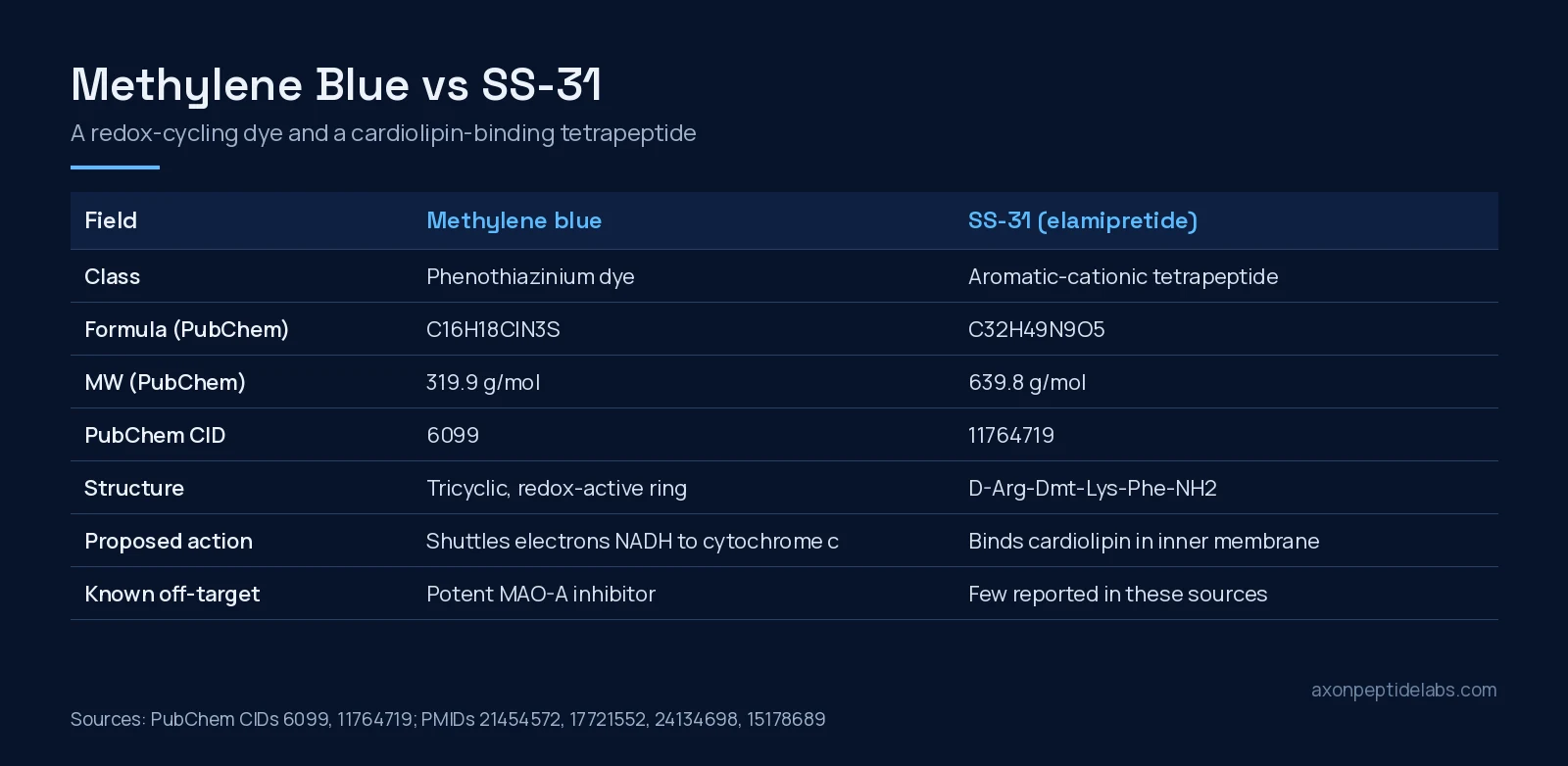
Identity table
Values come from PubChem, not from certificates of analysis.
| Field | Methylene blue | SS-31 |
|---|---|---|
| PubChem CID | 6099 | 11764719 |
| PubChem title | Methylene Blue | Elamipretide |
| Synonyms (PubChem) | methylthioninium chloride, Basic Blue 9, C.I. Basic Blue 9 | SS-31, MTP-131, Bendavia, Szeto-Schiller peptide |
| CAS (PubChem synonym) | 61-73-4 | 736992-21-5 |
| Molecular formula | C16H18ClN3S | C32H49N9O5 |
| Molecular weight | 319.9 g/mol | 639.8 g/mol |
| Chemical class | Phenothiazinium salt (chloride) | Tetrapeptide amide: D-Arg-Dmt-Lys-Phe-NH2 (Dmt = 2′,6′-dimethyltyrosine)[9] |
| Charge at neutral pH | Cationic dye | Net positive (aromatic-cationic motif)[8] |
The two are not chemical relatives. Methylene blue is a planar tricyclic dye that is roughly half the mass of SS-31. SS-31 alternates aromatic and basic residues, starts with a D-amino acid and carries a C-terminal amide, features the Szeto-Schiller design uses for cell permeability and inner-membrane targeting[8][7].
How methylene blue is proposed to work
An alternative electron carrier
Flavin-dependent enzymes use NAD(P)H to reduce methylene blue to leucomethylene blue, and cytochrome c re-oxidises it. In human IMR90 fibroblasts, nanomolar methylene blue and related diaminophenothiazines raised complex IV activity and oxygen consumption, increased heme synthesis and extended replicative lifespan in culture; experiments in rat liver mitochondrial lysates suggested the ratio of methylene blue to cytochrome c matters[2]. A 2011 study showed methylene blue taking electrons from NADH and handing them to cytochrome c while bypassing complex I/III blockade. A derivative with its redox centre disabled by N-acetylation had no effect on complex activities, which ties the effect to redox cycling rather than to a generic antioxidant action[1].
Animal models
In mice given intravitreal rotenone, a complex I inhibitor, co-administered methylene blue limited loss of the retinal ganglion cell layer, measured by histology and stereological cell counts[4]. The 2011 study above also reported reduced damage in a rotenone model used to study Parkinson-type dopaminergic loss and in a transient focal cerebral ischemia model[1]. These are short-term, toxin-induced models, chosen precisely because they create the complex I problem methylene blue is thought to bypass.
Where the bypass fails
The bypass has limits. In isolated mouse brain mitochondria, methylene blue did not restore membrane potential or respiration inhibited by antimycin, a complex III blocker, and antimycin suppressed methylene-blue-driven hydrogen peroxide generation. The authors concluded that electrons from methylene blue enter at the Qo site of complex III, so it may not help where complex III itself is inhibited[3]. That is a direct, mechanistic null result that commercial summaries rarely mention.
The MAO-A problem
Methylene blue is also a potent, tight-binding, reversible inhibitor of purified human monoamine oxidase A, with weaker inhibition of MAO B[5]. A systematic review of case reports and audits linked intravenous methylene blue given alongside serotonin reuptake inhibitors to presentations consistent with serotonin syndrome[6]. The U.S. prescribing information for the approved injection carries a boxed warning on serotonin syndrome with serotonergic drugs and opioids (FDA label, ProvayBlue). For research design, this means methylene blue is never a “clean” mitochondrial tool: any cell or animal study involving monoaminergic readouts has a second mechanism to control for.
How SS-31 is proposed to work
Targeting the inner membrane
The Szeto-Schiller peptides were designed around alternating aromatic and basic residues; they are cell-permeable and were reported to concentrate about 1,000-fold at the inner mitochondrial membrane, where they reduced ROS and cell death in neuronal N2A cells and inhibited mitochondrial swelling[7]. An early review described their ability to scavenge hydrogen peroxide and peroxynitrite and inhibit lipid peroxidation[8].
Cardiolipin and cytochrome c
Later work shifted the emphasis from scavenging to cardiolipin. In liposome and bicelle studies, SS-31 interacted only with membranes containing cardiolipin and inhibited the peroxidase activity cytochrome c acquires when it binds cardiolipin, while protecting its electron-carrier function[9]. In rats, a fluorescent SS-31 analogue bound cardiolipin with high affinity, and pretreatment protected cristae membranes and sped ATP recovery after renal ischemia[10]. A review by the peptide’s inventor framed SS-31 as the first cardiolipin-protective compound[11].
Biophysics and protein partners
Biophysical work found SS-31 partitions into the membrane interfacial region in proportion to surface charge and does not destabilise lamellar bilayers, but alters surface electrostatics[12]. Chemical cross-linking with mass spectrometry in mitochondria identified SS-31 interacting proteins that were all known cardiolipin binders, mainly OXPHOS and 2-oxoglutarate-metabolism proteins[13]. In rat hearts after ischemia-reperfusion, elamipretide lessened cristae fragmentation and losses in complex I, II and IV activity, but did not prevent the fall in cardiolipin concentration[14].
Aged-mouse muscle
A single treatment restored in vivo mitochondrial ATP production and coupling in aged mouse skeletal muscle within an hour, with no observable effect in young muscle[15]. An eight-week study in aged mice reported improved in vivo ATP production and redox balance, yet respiration in permeabilised muscle fibres did not differ between treated and untreated aged mice[16], a reminder that in vivo and ex vivo readouts can disagree.
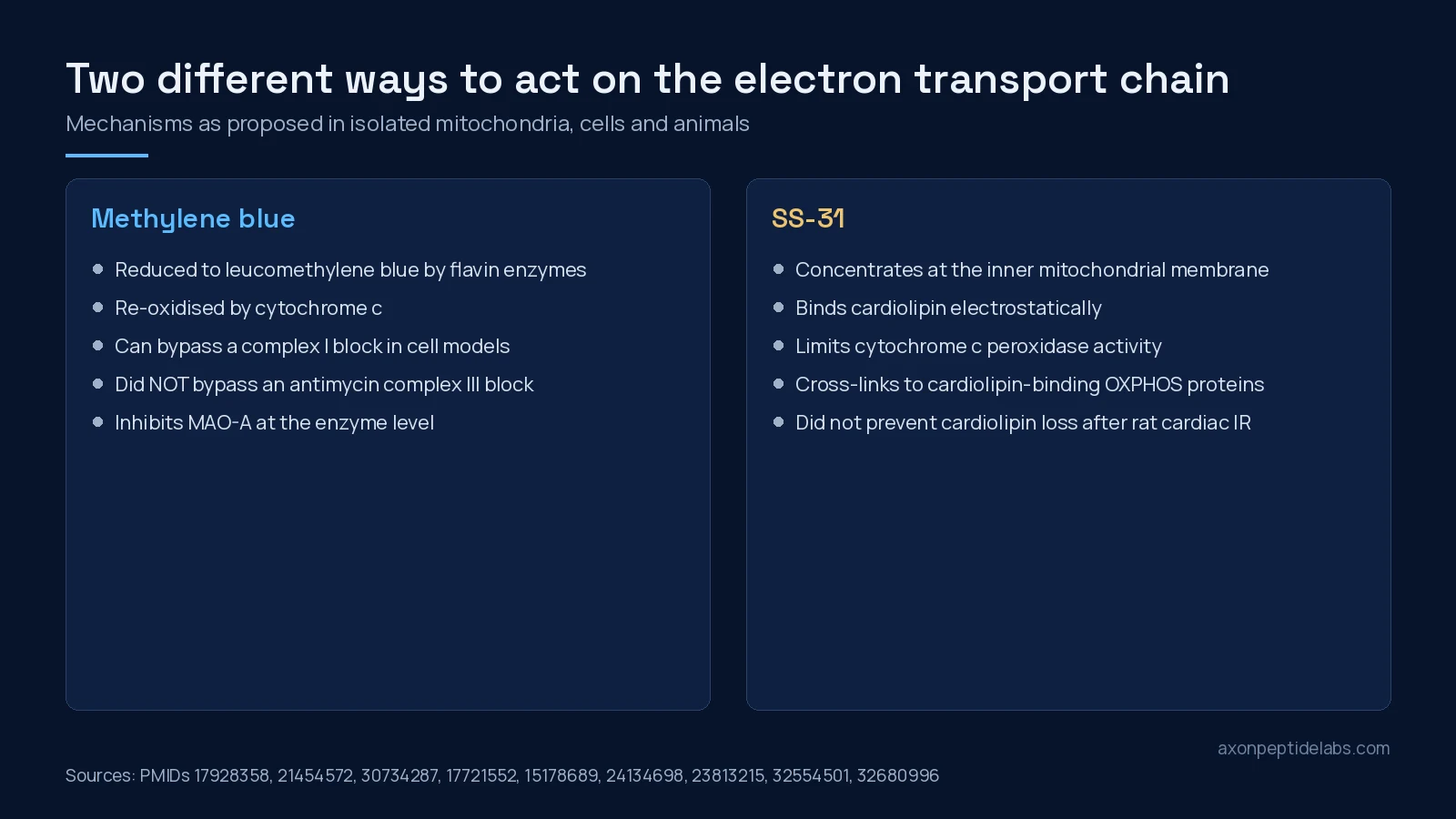
Side-by-side comparison
| Question | Methylene blue | SS-31 (elamipretide) |
|---|---|---|
| Primary proposed mechanism | Redox cycling; NADH to cytochrome c shuttle[2][1] | Cardiolipin binding at the inner membrane[9][10] |
| Needs an intact complex III? | Yes, per isolated mouse brain mitochondria[3] | Not applicable; acts on membrane and cytochrome c/cardiolipin[9] |
| Control used to prove mechanism | Redox-dead N-acetyl derivative[1] | Cardiolipin-free vs cardiolipin-containing membranes[9] |
| Notable off-target activity | MAO-A inhibition[5] | None prominent in these sources |
| Typical research models | Fibroblasts, neuronal cells, rotenone retina[2][4] | Kidney and heart ischemia, aged mouse muscle[10][14][15] |
| Phase 3-type human trials | Not reviewed here | MMPOWER-3 (primary mitochondrial myopathy); Barth syndrome crossover trial[18][17] |
Regulatory status, stated neutrally
Both compounds exist as approved drug products in the United States, in specific forms and for specific indications. Methylene blue injection (ProvayBlue) is FDA-approved for acquired methemoglobinemia, with an initial U.S. approval in 2016 (FDA prescribing information). On September 19, 2025 the FDA granted accelerated approval to elamipretide injection (Forzinity) for Barth syndrome (FDA announcement), a decision also summarised in a 2026 review[19]. Neither approval applies to research-grade material, and nothing here implies any use outside the laboratory.
What the human trials tested (design only)
MMPOWER-3 was a phase 3, randomized, double-blind, placebo-controlled trial of elamipretide in genetically confirmed primary mitochondrial myopathy, with the 6-minute walk test and a fatigue score as primary endpoints; it did not improve either at 24 weeks[18]. In Barth syndrome, a randomized crossover trial followed by an open-label extension met neither primary endpoint in its controlled part[17]; the review notes that a confirmatory trial is a condition of the accelerated approval[19]. We report these null controlled results for completeness, not as claims of any effect.
What the evidence does not show
- It does not show the two compounds are interchangeable. No study we found tested methylene blue and SS-31 side by side in the same model.
- It does not show methylene blue rescues every respiratory-chain defect. It failed to bypass a complex III block in mouse brain mitochondria[3].
- It does not show methylene blue acts only on mitochondria. MAO-A inhibition is a second, potent mechanism[5][6].
- It does not show SS-31 restores cardiolipin levels. In rat cardiac ischemia-reperfusion it preserved cristae structure without preventing cardiolipin loss[14].
- It does not show animal-muscle results carry over. Controlled trials in mitochondrial myopathy and Barth syndrome did not meet their primary endpoints[18][17], and even in aged mice ex vivo fibre respiration did not change[16].
Documentation at Axon
Axon lists Methylene Blue Capsules 20mg in its nootropic peptide category and also carries SS-31 10mg. No certificate is posted for this product on our COA page at the time of writing, for either Methylene Blue Capsules or SS-31; check the COA page for any report added later. Identity values above are from PubChem, not batch documents. When you are ready, you can buy lab-tested peptides in Canada.
Frequently asked questions
What is the main difference between methylene blue and SS-31?
Methylene blue is a small phenothiazinium dye that cycles between oxidised and reduced forms and can shuttle electrons from NADH to cytochrome c. SS-31 (elamipretide) is a synthetic tetrapeptide that concentrates at the inner mitochondrial membrane and binds cardiolipin, limiting cytochrome c peroxidase activity.
Can methylene blue bypass any blocked step in the electron transport chain?
No. Cell studies showed it can bypass a complex I block, but in isolated mouse brain mitochondria it did not restore respiration blocked at complex III by antimycin, suggesting its electrons enter at complex III.
Does SS-31 work as an antioxidant?
Early papers described SS peptides scavenging hydrogen peroxide and peroxynitrite. Later work emphasised selective binding to cardiolipin and protection of cytochrome c’s electron-carrier function as the main proposed mechanism.
Why does MAO-A matter in methylene blue research?
Methylene blue is a potent reversible inhibitor of human MAO-A in enzyme assays, and case reports link it to serotonin syndrome with serotonin reuptake inhibitors. That second mechanism has to be controlled for in any study with monoaminergic readouts.
Are methylene blue and elamipretide approved drugs?
In the United States, methylene blue injection (ProvayBlue) is FDA-approved for acquired methemoglobinemia, and elamipretide injection (Forzinity) received FDA accelerated approval for Barth syndrome in September 2025. Research-grade material is not covered by either approval.
Does Axon post a COA for Methylene Blue or SS-31?
No certificate is posted for either product on the Axon COA page at the time of writing. Check the COA page for any report added later.
References
- Wen Y, Li W, Poteet EC et al. (2011). Alternative mitochondrial electron transfer as a novel strategy for neuroprotection. J Biol Chem. PMID: 21454572. doi: 10.1074/jbc.M110.208447.
- Atamna H, Nguyen A, Schultz C et al. (2008). Methylene blue delays cellular senescence and enhances key mitochondrial biochemical pathways. FASEB J. PMID: 17928358. doi: 10.1096/fj.07-9610com.
- Gureev AP, Shaforostova EA, Popov VN et al. (2019). Methylene blue does not bypass Complex III antimycin block in mouse brain mitochondria. FEBS Lett. PMID: 30734287. doi: 10.1002/1873-3468.13332.
- Zhang X, Rojas JC, Gonzalez-Lima F (2006). Methylene blue prevents neurodegeneration caused by rotenone in the retina. Neurotox Res. PMID: 16464752. doi: 10.1007/BF03033307.
- Ramsay RR, Dunford C, Gillman PK (2007). Methylene blue and serotonin toxicity: inhibition of monoamine oxidase A (MAO A) confirms a theoretical prediction. Br J Pharmacol. PMID: 17721552. doi: 10.1038/sj.bjp.0707430.
- Ng BK, Cameron AJ (2010). The role of methylene blue in serotonin syndrome: a systematic review. Psychosomatics. PMID: 20484716. doi: 10.1176/appi.psy.51.3.194.
- Zhao K, Zhao GM, Wu D et al. (2004). Cell-permeable peptide antioxidants targeted to inner mitochondrial membrane inhibit mitochondrial swelling, oxidative cell death, and reperfusion injury. J Biol Chem. PMID: 15178689. doi: 10.1074/jbc.M402999200.
- Szeto HH (2006). Cell-permeable, mitochondrial-targeted, peptide antioxidants. AAPS J. PMID: 16796378. doi: 10.1007/BF02854898.
- Birk AV, Chao WM, Bracken C et al. (2014). Targeting mitochondrial cardiolipin and the cytochrome c/cardiolipin complex to promote electron transport and optimize mitochondrial ATP synthesis. Br J Pharmacol. PMID: 24134698. doi: 10.1111/bph.12468.
- Birk AV, Liu S, Soong Y et al. (2013). The mitochondrial-targeted compound SS-31 re-energizes ischemic mitochondria by interacting with cardiolipin. J Am Soc Nephrol. PMID: 23813215. doi: 10.1681/ASN.2012121216.
- Szeto HH (2014). First-in-class cardiolipin-protective compound as a therapeutic agent to restore mitochondrial bioenergetics. Br J Pharmacol. PMID: 24117165. doi: 10.1111/bph.12461.
- Mitchell W, Ng EA, Tamucci JD et al. (2020). The mitochondria-targeted peptide SS-31 binds lipid bilayers and modulates surface electrostatics as a key component of its mechanism of action. J Biol Chem. PMID: 32273339. doi: 10.1074/jbc.RA119.012094.
- Chavez JD, Tang X, Campbell MD et al. (2020). Mitochondrial protein interaction landscape of SS-31. Proc Natl Acad Sci U S A. PMID: 32554501. doi: 10.1073/pnas.2002250117.
- Allen ME, Pennington ER, Perry JB et al. (2020). The cardiolipin-binding peptide elamipretide mitigates fragmentation of cristae networks following cardiac ischemia reperfusion in rats. Commun Biol. PMID: 32680996. doi: 10.1038/s42003-020-1101-3.
- Siegel MP, Kruse SE, Percival JM et al. (2013). Mitochondrial-targeted peptide rapidly improves mitochondrial energetics and skeletal muscle performance in aged mice. Aging Cell. PMID: 23692570. doi: 10.1111/acel.12102.
- Campbell MD, Duan J, Samuelson AT et al. (2019). Improving mitochondrial function with SS-31 reverses age-related redox stress and improves exercise tolerance in aged mice. Free Radic Biol Med. PMID: 30597195. doi: 10.1016/j.freeradbiomed.2018.12.031.
- Reid Thompson W, Hornby B, Manuel R et al. (2021). A phase 2/3 randomized clinical trial followed by an open-label extension to evaluate the effectiveness of elamipretide in Barth syndrome, a genetic disorder of mitochondrial cardiolipin metabolism. Genet Med. PMID: 33077895. doi: 10.1038/s41436-020-01006-8.
- Karaa A, Bertini E, Carelli V et al. (2023). Efficacy and Safety of Elamipretide in Individuals With Primary Mitochondrial Myopathy: The MMPOWER-3 Randomized Clinical Trial. Neurology. PMID: 37268435. doi: 10.1212/WNL.0000000000207402.
- Zhao C, Zhuang X, Gao J (2026). Elamipretide: The first cardiolipin-directed mitochondrial therapeutic for Barth syndrome approved under accelerated approval. Drug Discov Ther. PMID: 41260682. doi: 10.5582/ddt.2025.01111.