
Ipamorelin vs GHRP-2 vs GHRP-6 vs Hexarelin: What Differs
For laboratory research only. Not for human or animal use. This article gives no dosing, administration or therapeutic advice.
Short answer: ipamorelin, GHRP-2, GHRP-6 and hexarelin are all short synthetic peptides that release growth hormone through the same receptor, GHS-R1a, now known as the ghrelin receptor.[1],[2] What separates them in the literature is selectivity, not the target. GHRP-2 and hexarelin raise prolactin, ACTH and cortisol alongside GH in human studies[3]; GHRP-6 and GHRP-2 raised ACTH and cortisol in swine, while ipamorelin did not move them above the level seen with GHRH, even far above its GH-releasing dose.[4] Hexarelin also binds a second, non-ghrelin target in heart tissue, CD36.[5]
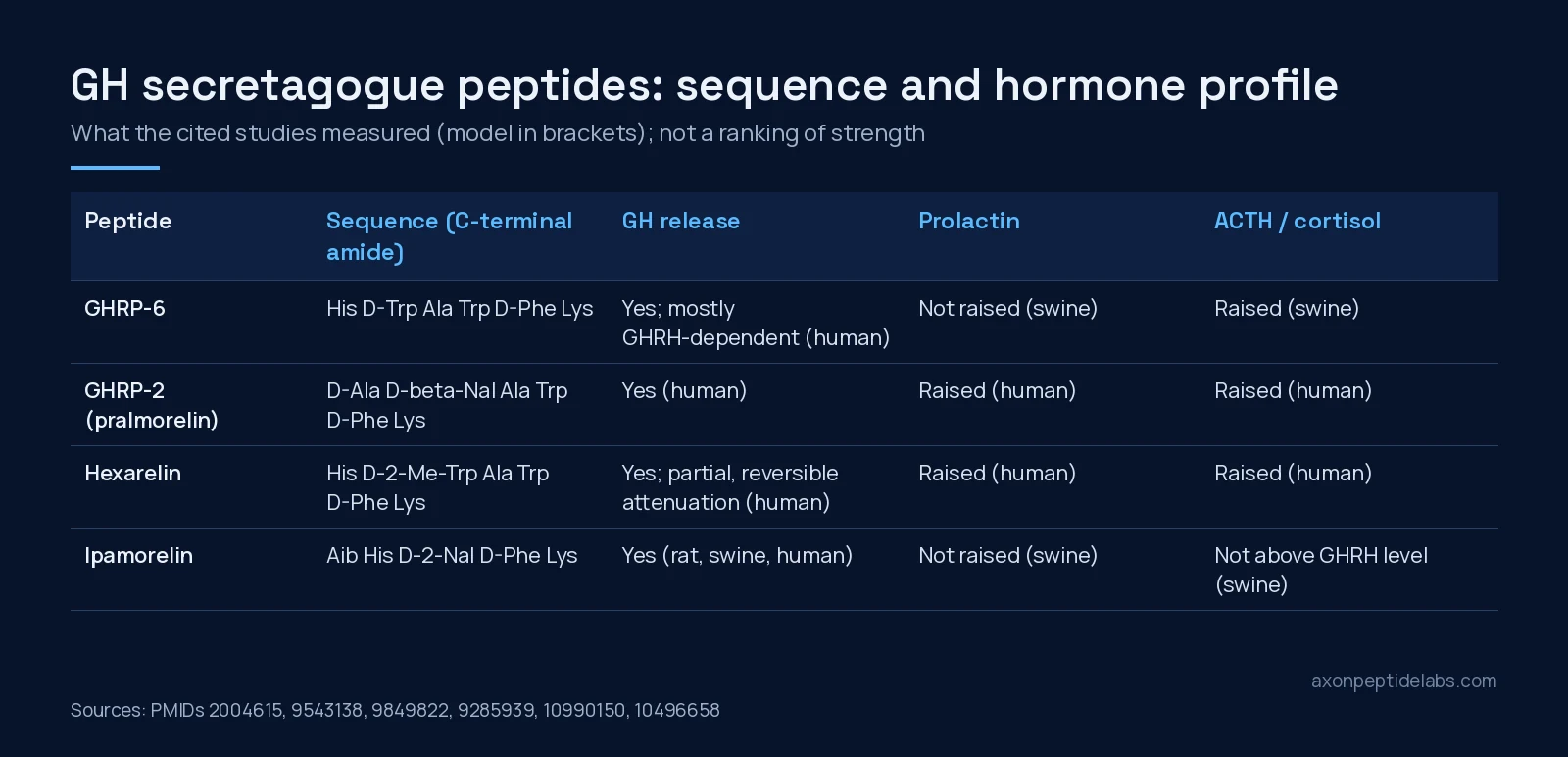
Online comparisons of these four tend to rank them by “strength” and repeat the claim that ipamorelin leaves cortisol and prolactin untouched. The primary papers are more specific about which species each finding comes from, and they contain results that cut against the simple ranking: GHRP-6 needs the body’s own GHRH for most of its GH effect in humans, hexarelin’s GH response fades partly with repeated exposure, and the one controlled clinical trial of ipamorelin did not meet its efficacy endpoint. Those details are below.
Identity of the four peptides
Formula, molecular weight and CID are taken from PubChem. Sequences are as written in the cited primary papers.
| Peptide | Other names | Sequence (all C-terminal amides) | Formula (PubChem) | MW (PubChem) | PubChem CID |
|---|---|---|---|---|---|
| Ipamorelin | NNC 26-0161; CAS 170851-70-4 | Aib-His-D-2-Nal-D-Phe-Lys-NH2 (pentapeptide)[4] | C38H49N9O5 | 711.9 | 9831659 |
| GHRP-2 | Pralmorelin, KP-102; CAS 158861-67-7 | D-Ala-D-βNal-Ala-Trp-D-Phe-Lys-NH2[3],[6] | C45H55N9O6 | 818.0 | 6918245 |
| GHRP-6 | Growth hormone-releasing hexapeptide | His-D-Trp-Ala-Trp-D-Phe-Lys-NH2[7] | C46H56N12O6 | 873.0 | 4345065 |
| Hexarelin | Examorelin, EP-23905; CAS 140703-51-1 | His-D-2-methyl-Trp-Ala-Trp-D-Phe-Lys-NH2[3],[8] | C47H58N12O6 | 887.0 | 6918297 |
Three of the four are hexapeptides built on the GHRP-6 template; GHRP-2 and hexarelin were made as “super-analogues” of GHRP-6.[3] Ipamorelin came out of a medicinal-chemistry programme that removed the central Ala-Trp dipeptide of GHRP-1, leaving a pentapeptide.[4]
One receptor, discovered backwards
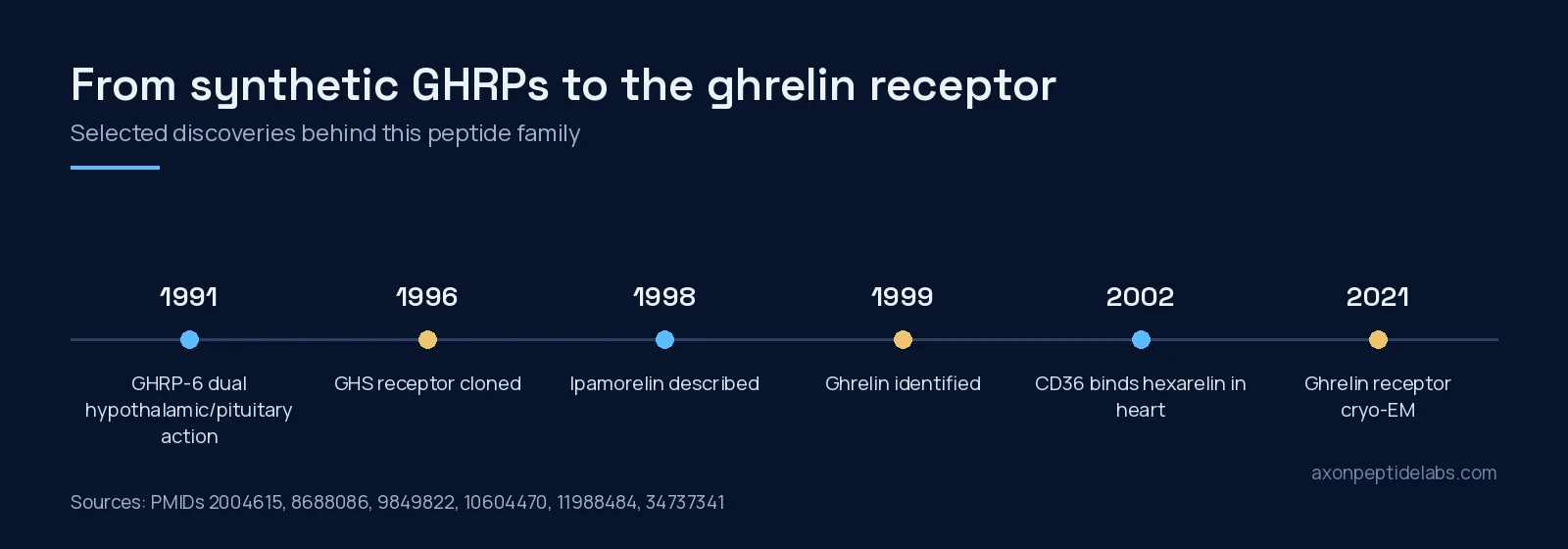
These peptides were made before anyone knew what they bound. GHRP-6 was shown in rats to release GH through a dual hypothalamic and pituitary action that did not run through GHRH or opiate receptors.[7] In 1996 a G-protein-coupled receptor in pituitary and hypothalamus was cloned and shown to be the target of these secretagogues, with the authors suggesting they mimicked an undiscovered hormone.[1] That hormone, ghrelin, was identified from rat stomach in 1999: a 28-residue peptide whose serine-3 octanoyl group is essential for activity.[2] Cryo-EM structures of the human ghrelin receptor bound to ghrelin and to a non-peptide agonist were published in 2021, giving a structural framework for how agonists engage the binding pocket.[9]
Selectivity: the real point of difference
Ipamorelin. In the 1998 characterisation, ipamorelin released GH from rat pituitary cells with potency and efficacy similar to GHRP-6, and its effect was blocked by GHRP-receptor antagonists. In conscious swine none of the secretagogues tested altered FSH, LH, prolactin or TSH, but GHRP-6 and GHRP-2 raised ACTH and cortisol, while ipamorelin did not raise them beyond the level seen after GHRH, even at doses more than 200-fold above its GH-releasing ED50.[4] That is the source of the “selective” label. It is a swine result. In healthy men, a pharmacokinetic and pharmacodynamic study described a single episode of GH release per infusion and a terminal half-life of about two hours, dose-proportional across the range tested.[10]
GHRP-2 and hexarelin. A 1997 human comparison found the two gave a similar, strong GH response, higher than GHRH, and similar increases in prolactin, ACTH and cortisol; the authors concluded that neither is fully GH-specific, with ACTH/cortisol release comparable to that after human CRH.[3] Hexarelin’s prolactin and ACTH/cortisol responses vary with age.[11] In a sleep study in young men, repeated hexarelin decreased slow-wave sleep and increased night-time GH, prolactin, ACTH and cortisol, while leptin and TNF-alpha measures were unchanged.[12]
GHRP-6. In healthy young men, a GHRH antagonist removed most of the GH response to GHRP-6, showing that endogenous GHRH is needed for most of its effect in humans.[13] In rats, GHRP-6 injected into the brain ventricles stimulated eating in a dose-related way while plasma GH did not change in a dose-related way, an early sign that the feeding and GH actions can be separated.[14]
Hexarelin’s second target: CD36 in the heart
Hexarelin is the member of this group with the clearest evidence for an action outside the ghrelin receptor. Photo-affinity labelling of rat cardiac membranes with a hexarelin derivative pulled out an 84 kDa protein whose sequence matched CD36, a glycoprotein on cardiomyocytes and microvascular endothelium; hexarelin raised coronary perfusion pressure in perfused hearts, and the effect was missing in hearts from CD36-null mice.[5] In hypophysectomised rats, which cannot make GH, a week of hexarelin still protected explanted hearts in an ischaemia-reperfusion model, while a different GH-releasing peptide that does not bind heart tissue had no effect, pointing to a GH-independent cardiac mechanism.[15] These are rat and mouse tissue findings.
Repeated exposure: desensitisation and adrenal data
Whether the GH response holds up with repeated exposure was studied most closely for hexarelin. In 12 healthy older adults given hexarelin repeatedly for 16 weeks, the GH response fell significantly by weeks 4 and 16, then recovered to baseline four weeks after stopping; the authors described the attenuation as partial and reversible.[16] In short-statured children given intranasal hexarelin for 6 to 10 months, the GH peak dropped within the first week and then stayed at that lower level.[8] In the 16-week adult study’s adrenal arm, the cortisol response to hexarelin was lower at week 16 and back to baseline four weeks later, while urinary free cortisol, basal cortisol and the ACTH response did not change significantly.[17]
The other peptides have thinner repeated-exposure records. In chronically cannulated guinea pigs, GH responses to GHRP-6 given at short intervals were variable and cyclic, but became more regular when the interval was lengthened; the authors concluded the variability was a property of the conscious animal rather than of any one secretagogue, since GHRF behaved the same way.[18] For GHRP-2, a 12-month oral study in ten children with GH deficiency reported a transient rise in appetite in the first six months, with no statistically significant change in BMI score.[19] We did not find a long-term repeated-exposure study of ipamorelin in humans.
Side-by-side comparison
| Question | Ipamorelin | GHRP-2 | GHRP-6 | Hexarelin |
|---|---|---|---|---|
| Primary receptor | GHS-R1a (ghrelin receptor)[4] | GHS-R1a; hypothalamic and pituitary sites[6] | GHS-R1a; dual hypothalamic/pituitary action[7] | GHS-R1a, plus CD36 in heart tissue[5] |
| Prolactin, ACTH, cortisol | No ACTH/cortisol rise beyond GHRH level (swine)[4] | Raised (human)[3] | ACTH/cortisol raised (swine)[4] | Raised (human); age-dependent[3],[11] |
| Dependence on GHRH | Not tested in the cited human work | Not tested in the cited human work | Most of the GH response needs endogenous GHRH (human)[13] | Not tested in the cited human work |
| Repeated-exposure data | None found (human) | 12-month oral study in children: transient appetite rise, no significant BMI change[19] | Guinea pig: variable with short intervals, steadier with longer[18] | Partial, reversible attenuation (human)[16],[8] |
| Controlled clinical trial | Phase 2 post-operative ileus RCT; no significant efficacy difference[20] | Used as a diagnostic stimulation test[21],[22] | Endocrine physiology studies only in the cited set | Endocrine and sleep studies[12] |
| Status in the literature | Non-approved[23] | The one approved pharmaceutical among these peptides[23] | Non-approved[23] | Non-approved[23] |
| COA on our COA page | Ipamorelin 10mg, MP-IPAM-10-041626, 99.76%, 29 APR 2026 | None posted | None posted | None posted |
Animal findings beyond GH release
Ipamorelin and GHRP-6 were both tested in a 12-week study in young adult female rats. Both raised bone mineral content, but the increase tracked bone size and body weight: content corrected for body weight was unaffected, and volumetric bone mineral density was unchanged.[24] In a rat model of post-operative ileus, a single dose of ipamorelin or GHRP-6 shortened the time to first bowel movement but had no effect on cumulative faecal output or food intake.[25] GHRP-2 was put through a standard general-pharmacology screen in animals, which found no obvious central nervous system, cardiovascular or respiratory effects at GH-releasing doses.[6]
Null and negative results
- Ipamorelin, human: the phase 2, double-blind, placebo-controlled trial in 114 patients after bowel resection found no significant difference from placebo in time to a tolerated solid meal or in secondary efficacy analyses. The authors note the study was small and enrolled a broad patient mix.[20]
- Ipamorelin and GHRP-6, rat: no change in bone-weight-corrected mineral content or volumetric density despite larger bones.[24]
- GHRP-6, rat: brain-ventricle injection changed feeding without a dose-related change in plasma GH.[14]
- Hexarelin, human: no change in leptin or TNF-alpha measures in the sleep study[12], and no significant change in urinary free cortisol or the ACTH response over 16 weeks.[17]
Regulatory status
A 2012 analytical review of this peptide class states that, with the exception of GHRP-2, these GH-releasing peptides are non-approved pharmaceuticals.[23] GHRP-2 (pralmorelin) was developed as a diagnostic agent for GH deficiency, based on its ability to raise GH in healthy people while patients with GH deficiency respond much less[21], and clinical studies describe the GHRP-2 stimulation test as widely used in diagnosing GH deficiency.[22] Its diagnostic use also extends to the adrenal axis: one study examined it as a substitute for the insulin tolerance test in hypopituitarism.[26] GH-releasing peptides are listed on the World Anti-Doping Agency prohibited list.[27] This article makes no statement about the legal status of any of these peptides in Canada.
Identity testing matters more than usual here
Because these peptides are small and closely related, mislabelling and look-alike analogues are a documented problem. A doping-control analysis of black-market products identified glycine-extended versions of GHRP-6, GHRP-2 and ipamorelin, compounds that differ from the named peptide by one residue.[28] Metabolism studies show that GHRP-2 and hexarelin are partly broken down while GHRP-6 is excreted largely unchanged, which shapes how each is detected by LC-MS.[27],[23] For a lab, a certificate that reports an observed mass consistent with the PubChem monoisotopic mass (ipamorelin 711.39, GHRP-2 817.43, GHRP-6 872.44, hexarelin 886.46) is the practical way to tell these four apart; HPLC purity alone cannot.
On our COA page, the only report in this group is for Ipamorelin 10mg: batch MP-IPAM-10-041626, purity 99.76%, dated 29 APR 2026, from testides.com. No certificate is posted for GHRP-2 10mg, GHRP-6 Acetate 5mg or Hexarelin 5mg at the time of writing. The Ipamorelin listing and our ipamorelin research hub carry more on that compound, and the growth hormone peptide category lists the rest of the GH-axis catalogue. If you buy lab-tested peptides in Canada, check which listings carry a lot-specific report before treating a vial as identity-confirmed.
What the evidence does not show
- It does not show that ipamorelin is free of prolactin or cortisol effects in humans. The selectivity data come from swine; the human ipamorelin papers cited here measured GH and pharmacokinetics.[4],[10]
- It does not provide a head-to-head human comparison of all four peptides. The closest is the two-peptide GHRP-2 versus hexarelin study in six young adults.[3]
- It does not show that hexarelin’s CD36-mediated cardiac effects in rat and mouse hearts occur in humans.
- It does not show long-term human GH-response data for ipamorelin or GHRP-6; the GHRP-6 repeated-exposure work cited here is in guinea pigs.
- It does not show any clinical benefit for ipamorelin; its one controlled trial was null.[20]
- It does not establish that “GH release” in a study equals any downstream outcome. The rat bone data show how a larger number can hide no change in density.[24]
Frequently asked questions
What is the difference between ipamorelin and GHRP-6?
Both act on the ghrelin receptor and released GH with similar potency in rat pituitary cells. In swine, GHRP-6 raised ACTH and cortisol while ipamorelin did not raise them beyond the level seen with GHRH. Ipamorelin is a pentapeptide; GHRP-6 is a hexapeptide.
Is GHRP-2 the same as pralmorelin?
Yes. Pralmorelin, KP-102 and GHRP-2 name the same hexapeptide (PubChem CID 6918245). It is the one member of this group described in the literature as an approved pharmaceutical, used as a diagnostic agent for GH deficiency.
Why is hexarelin studied for the heart?
Rat studies found that hexarelin binds CD36 in cardiac tissue and protected hearts in an ischaemia-reperfusion model even in animals that cannot make GH. These are animal findings and have not been shown in humans.
Does the GH response to these peptides fade with repeated exposure?
For hexarelin, partly: in a 16-week human study the GH response fell and then returned to baseline four weeks after stopping. GHRP-6 responses in guinea pigs varied with injection interval, and no long-term repeated-exposure study of ipamorelin in humans was found.
Which of these Axon listings has a COA?
Only Ipamorelin 10mg: batch MP-IPAM-10-041626, 99.76%, 29 APR 2026, testides.com. No certificate is posted for GHRP-2, GHRP-6 or hexarelin on our COA page at the time of writing.
References
- Howard AD, Feighner SD, Cully DF et al. (1996). A receptor in pituitary and hypothalamus that functions in growth hormone release. Science. PMID: 8688086. doi: 10.1126/science.273.5277.974.
- Kojima M, Hosoda H, Date Y et al. (1999). Ghrelin is a growth-hormone-releasing acylated peptide from stomach. Nature. PMID: 10604470. doi: 10.1038/45230.
- Arvat E, di Vito L, Maccagno B et al. (1997). Effects of GHRP-2 and hexarelin, two synthetic GH-releasing peptides, on GH, prolactin, ACTH and cortisol levels in man. Comparison with the effects of GHRH, TRH and hCRH. Peptides. PMID: 9285939. doi: 10.1016/s0196-9781(97)00016-8.
- Raun K, Hansen BS, Johansen NL et al. (1998). Ipamorelin, the first selective growth hormone secretagogue. Eur J Endocrinol. PMID: 9849822. doi: 10.1530/eje.0.1390552.
- Bodart V, Febbraio M, Demers A et al. (2002). CD36 mediates the cardiovascular action of growth hormone-releasing peptides in the heart. Circ Res. PMID: 11988484. doi: 10.1161/01.res.0000016164.02525.b4.
- Furuta S, Shimada O, Doi N et al. (2004). General pharmacology of KP-102 (GHRP-2), a potent growth hormone-releasing peptide. Arzneimittelforschung. PMID: 15646371. doi: 10.1055/s-0031-1297042.
- Bowers CY, Sartor AO, Reynolds GA et al. (1991). On the actions of the growth hormone-releasing hexapeptide, GHRP. Endocrinology. PMID: 2004615. doi: 10.1210/endo-128-4-2027.
- Klinger B, Silbergeld A, Deghenghi R et al. (1996). Desensitization from long-term intranasal treatment with hexarelin does not interfere with the biological effects of this growth hormone-releasing peptide in short children. Eur J Endocrinol. PMID: 8766941. doi: 10.1530/eje.0.1340716.
- Liu H, Sun D, Myasnikov A et al. (2021). Structural basis of human ghrelin receptor signaling by ghrelin and the synthetic agonist ibutamoren. Nat Commun. PMID: 34737341. doi: 10.1038/s41467-021-26735-5.
- Gobburu JV, Agersø H, Jusko WJ et al. (1999). Pharmacokinetic-pharmacodynamic modeling of ipamorelin, a growth hormone releasing peptide, in human volunteers. Pharm Res. PMID: 10496658. doi: 10.1023/a:1018955126402.
- Arvat E, Ramunni J, Bellone J et al. (1997). The GH, prolactin, ACTH and cortisol responses to Hexarelin, a synthetic hexapeptide, undergo different age-related variations. Eur J Endocrinol. PMID: 9437229. doi: 10.1530/eje.0.1370635.
- Frieboes RM, Antonijevic IA, Held K et al. (2004). Hexarelin decreases slow-wave sleep and stimulates the secretion of GH, ACTH, cortisol and prolactin during sleep in healthy volunteers. Psychoneuroendocrinology. PMID: 15177700. doi: 10.1016/S0306-4530(03)00152-5.
- Pandya N, DeMott-Friberg R, Bowers CY et al. (1998). Growth hormone (GH)-releasing peptide-6 requires endogenous hypothalamic GH-releasing hormone for maximal GH stimulation. J Clin Endocrinol Metab. PMID: 9543138. doi: 10.1210/jcem.83.4.4711.
- Locke W, Kirgis HD, Bowers CY et al. (1995). Intracerebroventricular growth-hormone-releasing peptide-6 stimulates eating without affecting plasma growth hormone responses in rats. Life Sci. PMID: 8614257. doi: 10.1016/0024-3205(95)00087-9.
- Locatelli V, Rossoni G, Schweiger F et al. (1999). Growth hormone-independent cardioprotective effects of hexarelin in the rat. Endocrinology. PMID: 10465272. doi: 10.1210/endo.140.9.6948.
- Rahim A, Shalet SM (1998). Does desensitization to hexarelin occur?. Growth Horm IGF Res. PMID: 10990150. doi: 10.1016/s1096-6374(98)80039-7.
- Rahim A, O’Neill PA, Shalet SM (1999). The effect of chronic hexarelin administration on the pituitary-adrenal axis and prolactin. Clin Endocrinol (Oxf). PMID: 10341859. doi: 10.1046/j.1365-2265.1999.00609.x.
- Fairhall KM, Mynett A, Smith RG et al. (1995). Consistent GH responses to repeated injection of GH-releasing hexapeptide (GHRP-6) and the non-peptide GH secretagogue, L-692,585. J Endocrinol. PMID: 7636426. doi: 10.1677/joe.0.1450417.
- Mericq V, Cassorla F, Bowers CY et al. (2003). Changes in appetite and body weight in response to long-term oral administration of the ghrelin agonist GHRP-2 in growth hormone deficient children. J Pediatr Endocrinol Metab. PMID: 14513874. doi: 10.1515/jpem.2003.16.7.981.
- Beck DE, Sweeney WB, McCarter MD et al. (2014). Prospective, randomized, controlled, proof-of-concept study of the Ghrelin mimetic ipamorelin for the management of postoperative ileus in bowel resection patients. Int J Colorectal Dis. PMID: 25331030. doi: 10.1007/s00384-014-2030-8.
- (2004). Pralmorelin: GHRP 2, GPA 748, growth hormone-releasing peptide 2, KP-102 D, KP-102 LN, KP-102D, KP-102LN. Drugs R D. PMID: 15230633. doi: 10.2165/00126839-200405040-00011.
- Suzuki S, Ruike Y, Ishiwata K et al. (2022). Clinical Usefulness of the Growth Hormone-Releasing Peptide-2 Test for Hypothalamic-Pituitary Disorder. J Endocr Soc. PMID: 35795807. doi: 10.1210/jendso/bvac088.
- Thomas A, Delahaut P, Krug O et al. (2012). Metabolism of growth hormone releasing peptides. Anal Chem. PMID: 23101768. doi: 10.1021/ac302034w.
- Svensson J, Lall S, Dickson SL et al. (2000). The GH secretagogues ipamorelin and GH-releasing peptide-6 increase bone mineral content in adult female rats. J Endocrinol. PMID: 10828840. doi: 10.1677/joe.0.1650569.
- Venkova K, Mann W, Nelson R et al. (2009). Efficacy of ipamorelin, a novel ghrelin mimetic, in a rodent model of postoperative ileus. J Pharmacol Exp Ther. PMID: 19289567. doi: 10.1124/jpet.108.149211.
- Kageyama K, Nigawara T, Sakihara S et al. (2008). Diagnostic usefulness of the growth hormone-releasing peptide-2 test as a substitute for the insulin tolerance test in hypopituitarism. Endocr J. PMID: 18493103. doi: 10.1507/endocrj.k07e-168.
- Semenistaya E, Zvereva I, Thomas A et al. (2015). Determination of growth hormone releasing peptides metabolites in human urine after nasal administration of GHRP-1, GHRP-2, GHRP-6, Hexarelin, and Ipamorelin. Drug Test Anal. PMID: 25869809. doi: 10.1002/dta.1787.
- Krug O, Thomas A, Malerød-Fjeld H et al. (2018). Analysis of new growth promoting black market products. Growth Horm IGF Res. PMID: 29864719. doi: 10.1016/j.ghir.2018.05.001.