
Retatrutide vs Mazdutide: Triple vs Dual Agonist Research
For laboratory research only. Not for human or animal use. This article gives no dosing, administration or therapeutic advice.
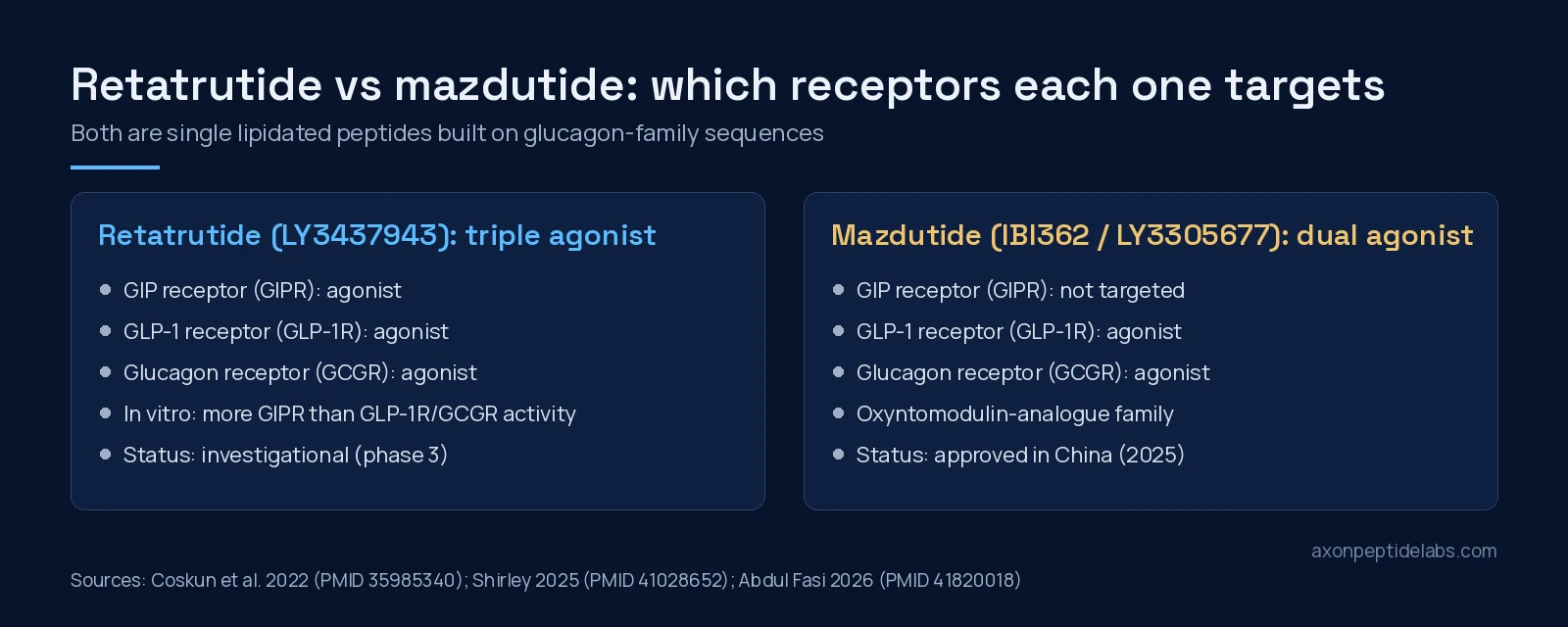
Short answer: retatrutide and mazdutide are both lipidated peptides from the glucagon family, and both activate the GLP-1 receptor and the glucagon receptor. Retatrutide (LY3437943) also activates the GIP receptor, which makes it a triple agonist; mazdutide (IBI362, LY3305677) is a dual agonist with no GIP-receptor activity.[1],[2] Their regulatory positions differ too: mazdutide received its first approval in China in 2025, while retatrutide remains an investigational compound in phase 3 trials.[2],[3] No published trial has compared the two directly.
This article sets out what each molecule is, how the receptor profiles differ, what the trial programmes were designed to measure, and where the evidence stops. It complements our earlier post comparing semaglutide, tirzepatide and retatrutide, which covers the GLP-1 and GLP-1/GIP side of the family. Here the focus is the glucagon receptor, the one target both compounds share beyond GLP-1.
Identity at a glance
Identifiers below come from the PubChem compound records (formula and molecular weight as PubChem computes them), not from supplier documents.
| Field | Retatrutide | Mazdutide |
|---|---|---|
| Development codes | LY3437943 | IBI362, LY3305677 |
| Class | Single-peptide GIP / GLP-1 / glucagon receptor tri-agonist[1] | Single-peptide GLP-1 / glucagon receptor dual agonist; oxyntomodulin-analogue family[2],[4] |
| PubChem CID | 171390338 (record title “Triple G”) | 167312357 |
| Molecular formula (PubChem) | C221H342N46O68 | C207H317N45O65 |
| Molecular weight (PubChem) | 4731 g/mol | 4476 g/mol |
| CAS number | Not listed among this PubChem record’s synonyms | 2259884-03-0 (PubChem synonym) |
| Developer named in the literature | Eli Lilly[5] | Eli Lilly with Innovent Biologics[2] |
| Regulatory position (Oct 2026) | Investigational; phase 3[6],[3] | Approved in China (2025) for weight management and for glycaemic control in type 2 diabetes[2] |
The two molecular weights differ by roughly 255 g/mol. For a lab receiving material, that gap is large enough that an intact-mass measurement on the certificate of analysis can tell the two compounds apart, which is one reason an identity result matters as much as an HPLC purity figure.
Where the mechanisms overlap and where they split
The shared part: GLP-1 plus glucagon. Both molecules combine GLP-1 receptor agonism with glucagon receptor agonism. The rationale, as a 2026 IUPHAR review describes it, is that glucagon-receptor signalling may raise energy expenditure while GLP-1 signalling reduces intake; the review is explicit that this rests largely on preclinical evidence because clinical data on glucagon-receptor agonism are limited.[7] Mazdutide sits in the oxyntomodulin-analogue lineage, the natural gut hormone that already activates both receptors, and its patent history traces from early peptide design at Eli Lilly to later formulation and indication work led by Innovent.[4]
The extra part: GIP. Retatrutide adds GIP-receptor agonism. In the discovery paper, cell assays showed roughly balanced activity at the glucagon and GLP-1 receptors but more activity at the GIP receptor. In obese mice, the authors attributed part of the body-weight effect to glucagon-receptor-driven increases in energy expenditure on top of reduced calorie intake.[1] That mouse finding has not reproduced cleanly in every model: a 2026 study in diet-induced obese MASH mice found that retatrutide reduced food intake early in treatment while energy expenditure was not significantly altered.[8] The two results come from different labs, protocols and mouse models, so they do not cancel each other out, but they show that the energy-expenditure part of the story is still a working hypothesis rather than a settled measurement.
Pharmacokinetics. In the phase 1b study in people with type 2 diabetes, retatrutide’s pharmacokinetics were dose-proportional and its half-life was about six days.[9] Mazdutide’s early-phase trials in China characterised safety, tolerability and pharmacokinetics in adults with overweight or obesity and in type 2 diabetes.[10],[11] These are human pharmacology descriptions from the trial reports, not handling guidance.
The trial programmes compared by design (not by result)
The table lists what each study was built to measure. It deliberately leaves out effect sizes: the trials enrolled different populations, ran for different lengths and used different statistical estimands, so placing their headline numbers side by side would suggest a comparison the data cannot support.
| Compound | Study (phase) | Population | Comparator | Primary endpoint | Ref |
|---|---|---|---|---|---|
| Retatrutide | Phase 1b, multiple ascending dose, 12 weeks | Adults with type 2 diabetes, USA | Placebo; dulaglutide | Safety and tolerability | [9] |
| Retatrutide | Phase 2, 48 weeks | Adults with obesity, or overweight with a weight-related condition | Placebo | Percentage change in body weight at 24 weeks | [5] |
| Retatrutide | Phase 2 | Adults with type 2 diabetes, USA | Placebo; dulaglutide | Change in HbA1c at 24 weeks | [12] |
| Retatrutide | Phase 2a substudy | Participants with MASLD and at least 10% liver fat | Placebo | Relative change in liver fat at 24 weeks | [13] |
| Retatrutide | Phase 3, 40 weeks | Type 2 diabetes on diet and exercise alone; USA, Mexico, India | Placebo | Change in HbA1c at week 40 | [6] |
| Retatrutide | Phase 3, 80 weeks | Adults with obesity without diabetes; nested knee-osteoarthritis and sleep-apnoea groups | Placebo | Body-weight change; WOMAC pain (knee OA); apnoea-hypopnoea index (OSA) | [14],[15] |
| Retatrutide | Phase 3 (TRIUMPH-2), 80 weeks | Adults with obesity and type 2 diabetes, eight countries | Placebo | Percentage change in body weight at week 80 | [3] |
| Mazdutide | Phase 1b, 12 weeks | Chinese adults with overweight or obesity | Placebo | Safety and tolerability | [10] |
| Mazdutide | Phase 1b, 12 weeks | Chinese adults with type 2 diabetes | Placebo; open-label dulaglutide | Safety and tolerability | [11] |
| Mazdutide | Phase 2, 20 weeks | Chinese adults with type 2 diabetes | Placebo; open-label dulaglutide | Change in HbA1c at week 20 | [16] |
| Mazdutide | Phase 2, 24 weeks | Chinese adults with overweight or obesity | Placebo | Percentage change in body weight at week 24 | [17] |
| Mazdutide | Phase 1, higher target dose, 20 weeks | Adults with overweight or obesity without diabetes | Placebo | Safety and efficacy at the higher target dose | [18] |
| Mazdutide | Phase 2, 48 weeks | Adults with obesity or overweight without diabetes, USA | Placebo | Percentage change in body weight at 32 weeks | [19] |
| Mazdutide | Phase 3, 24 weeks plus extension | Chinese adults with type 2 diabetes on diet and exercise | Placebo | Change in HbA1c at week 24 | [20] |
| Mazdutide | Phase 3, 28 weeks | Chinese adults with type 2 diabetes on oral agents | Dulaglutide | Change in HbA1c at week 28 | [21] |
| Mazdutide | Phase 3 (DREAMS-3), open-label | Chinese adults with type 2 diabetes and obesity | Semaglutide | Design paper; primary period 32 weeks | [22] |
Why the headline numbers on other sites don’t line up
Most pages ranking for this comparison put one trial’s weight figure for retatrutide next to another trial’s figure for mazdutide and declare a winner. Four design differences make that unreliable:
- Population. Most published mazdutide trials enrolled Chinese adults, with BMI entry thresholds of 24 and 28 kg/m2[17],[2]; the retatrutide programme recruited mainly in the USA and then across several countries.[5],[3] A US-based mazdutide phase 2 trial was published in August 2026.[19]
- Duration. Primary endpoints range from 20 weeks to 80 weeks across the two programmes (see the table).
- Estimand. The US mazdutide phase 2 trial reported its primary endpoint with an efficacy (hypothetical) estimand[19], while TRIUMPH-2 used a treatment-regimen estimand with multiple imputation for missing data.[3] These answer different statistical questions.
- Comparator. Some studies used placebo only; others added dulaglutide or, in DREAMS-3, semaglutide.[16],[22]
A PubMed search on October 1, 2026 found no randomised trial comparing retatrutide with mazdutide head to head. Network meta-analyses exist, but they inherit every one of these differences.
Adverse-event patterns the trial reports describe
Both programmes report gastrointestinal events as the most common adverse events. In the retatrutide phase 2 obesity trial these were dose-related and mostly mild to moderate, and were partly mitigated by a lower starting dose; the same paper reported dose-dependent increases in heart rate that peaked at 24 weeks and declined afterwards.[5] Mazdutide’s phase 2 and phase 3 diabetes trials list diarrhoea, nausea, decreased appetite and vomiting as the most common events[16],[20], and in the US phase 2 trial discontinuation for adverse events was most frequent in the highest-dose arm, mainly for gastrointestinal reasons.[19]
Heart rate is the question the glucagon receptor raises for both molecules. A 2026 narrative review notes that high-dose exogenous glucagon has acute effects on heart rate and blood pressure, that evidence for glucagon-receptor expression in the human heart is not unequivocal, and that clinical studies of dual GLP-1/glucagon agonists such as mazdutide have generally shown heart-rate increases similar to GLP-1 monoagonists.[23] None of this settles long-term cardiovascular questions, which require dedicated outcome trials.
Preclinical work: what the animal and cell studies add
Several laboratory studies explore organs beyond weight and glucose. In high-fat-diet mice treated for four weeks, mazdutide reduced liver steatosis, injury markers and inflammatory signalling, with changes in ER-stress (PERK) and lipogenic regulators; the same effects were seen in a free-fatty-acid hepatocyte model.[24] In male db/db mice, a model of type 2 diabetes, mazdutide improved behavioural measures of cognition compared with dulaglutide; the authors state the findings apply to male mice only.[25] A 9.4-T MRI study in high-fat-diet mice compared mazdutide with semaglutide on liver fat and iron.[26]
For retatrutide, a diet-induced obese MASH study in mice and hamsters reported reductions in insulin-resistance indices and liver lipids in both species.[8] In humans, the phase 2a MASLD substudy measured liver fat by imaging as its primary endpoint.[13] Animal results describe biology in that model under that protocol; they do not predict human outcomes.
Null and mixed results worth knowing
- In the retatrutide phase 2 diabetes trial, HbA1c reductions were significantly greater than placebo in every retatrutide group except the lowest-dose group.[12]
- In the mouse and hamster MASH study, retatrutide did not reduce histopathological liver scoring in hamsters, even though hepatic triglyceride content fell; in mice, energy expenditure was not significantly altered.[8] That sits awkwardly beside the discovery paper’s energy-expenditure explanation in a different mouse model.[1]
- In the MRI mouse study, mazdutide and semaglutide did not differ in liver-fat reduction at one week, and liver iron (R2*) reductions did not differ between them at one or four weeks; a difference in liver fat appeared only at four weeks.[26]
Regulatory status, stated plainly
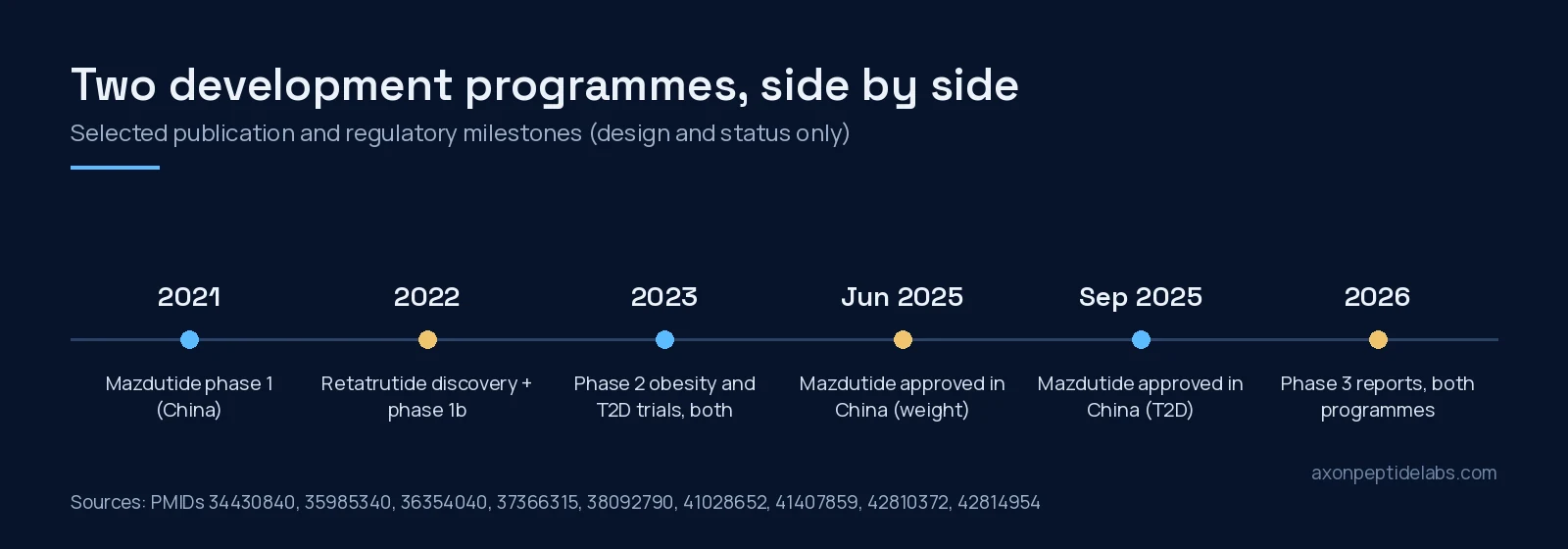
Mazdutide: in June 2025 it received its first approval, in China, for long-term body-weight management in adults with obesity or overweight (alongside diet and physical activity), followed in September 2025 by a Chinese approval for glycaemic control in adults with type 2 diabetes. It is under clinical evaluation for fatty liver disease, obstructive sleep apnoea and alcohol use disorder.[2] We found no approval by another regulator in the indexed literature.
Retatrutide: the 2026 phase 3 reports describe it as under clinical development and under investigation for obesity, type 2 diabetes and related conditions.[6],[3] It is not an approved medicine. This article makes no statement about the legal status of either compound in Canada.
Documentation for these two listings
Our COA library lists one retatrutide report: GLP-3 10 mg pen and GLP-3 10mg vial (retatrutide), batch MP-RETA-10-041626, purity 99.60%, dated 29 APR 2026, from testides.com. That report covers the 10 mg vial and pen; no separate certificate is posted for the 20 mg option of the GLP-3 (retatrutide) listing. No certificate is posted for Mazdutide 10mg on our COA page at the time of writing. The retatrutide background on our retatrutide research hub covers the GLP-3 listings in more depth. Researchers who want to buy lab-tested peptides in Canada can compare what each listing documents before ordering, and treat an undocumented lot as unverified until a report exists.
What the evidence does not show
- It does not show that one compound outperforms the other. No head-to-head trial exists, and cross-trial comparisons are confounded by population, duration, estimand and comparator.
- It does not show that adding GIP agonism, the one mechanistic difference, is what produces any between-programme difference. That would require the same population studied under the same protocol.
- It does not show long-term cardiovascular safety for either molecule; heart-rate changes are documented, outcome trials are not yet reported in the papers cited here.
- It does not show that the energy-expenditure mechanism attributed to glucagon-receptor agonism operates in humans to the extent seen in some mouse models; the IUPHAR review calls the clinical data on this extremely limited.[7]
- It does not show that preclinical liver, kidney or brain findings in mice or hamsters translate to people.
- It does not show that any research-supply material matches the trial material. Only a lot-specific certificate with identity and purity data speaks to that.
Frequently asked questions
Is mazdutide the same as retatrutide?
No. Both activate the GLP-1 and glucagon receptors, but retatrutide also activates the GIP receptor, making it a triple agonist. Mazdutide is a dual agonist. They are different peptides with different PubChem records (CID 171390338 and CID 167312357).
Which is stronger, retatrutide or mazdutide?
The published record cannot answer that. No head-to-head trial exists, and the two programmes differ in population, trial length, comparator and statistical estimand, so cross-trial comparisons are unreliable.
Is mazdutide approved anywhere?
Yes. Mazdutide received its first approval in China in June 2025 for long-term weight management in adults with obesity or overweight, and a second Chinese approval in September 2025 for glycaemic control in type 2 diabetes. Retatrutide is still investigational.
Why do both molecules target the glucagon receptor?
The working hypothesis is that glucagon-receptor signalling adds energy expenditure to the intake effects of GLP-1 signalling. A 2026 IUPHAR review notes that this rests mainly on preclinical evidence, and one 2026 mouse study found no significant change in energy expenditure with retatrutide.
Do Axon’s retatrutide and mazdutide listings have a COA?
The COA library shows one retatrutide report, batch MP-RETA-10-041626 (99.60%, 29 APR 2026, testides.com), covering the 10 mg vial and pen. No certificate is posted for the 20 mg option or for mazdutide at the time of writing.
References
- Coskun T, Urva S, Roell WC et al. (2022). LY3437943, a novel triple glucagon, GIP, and GLP-1 receptor agonist for glycemic control and weight loss: From discovery to clinical proof of concept. Cell Metab. PMID: 35985340. doi: 10.1016/j.cmet.2022.07.013.
- Shirley M (2025). Mazdutide: First Approval. Drugs. PMID: 41028652. doi: 10.1007/s40265-025-02249-y.
- Bellido V, le Roux CW, Ekinci EI et al. (2026). Retatrutide in adults with obesity and type 2 diabetes (TRIUMPH-2): a double-blind, parallel-group, randomised, placebo-controlled, phase 3 trial. Lancet. PMID: 42810372. doi: 10.1016/S0140-6736(26)01861-1.
- Abdul Fasi M (2026). Patent landscape and therapeutic evolution of mazdutide: a dual GLP-1/Glucagon receptor agonist for obesity and type 2 diabetes. Expert Opin Ther Pat. PMID: 41820018. doi: 10.1080/13543776.2026.2645812.
- Jastreboff AM, Kaplan LM, Frías JP et al. (2023). Triple-Hormone-Receptor Agonist Retatrutide for Obesity – A Phase 2 Trial. N Engl J Med. PMID: 37366315. doi: 10.1056/NEJMoa2301972.
- Bajaj HS, Welch M, Shah P et al. (2026). Efficacy and safety of retatrutide, a GIP, GLP-1, and glucagon receptor agonist, in people with type 2 diabetes and inadequate glycaemic control with diet and exercise (TRANSCEND-T2D-1): a double-blind, randomised, phase 3 trial. Lancet. PMID: 42250575. doi: 10.1016/S0140-6736(26)00967-0.
- Elmendorf AJ, Yousefian M, Kim IM et al. (2026). IUPHAR review: From foe to friend: Repurposing glucagon to treat obesity and type 2 diabetes. Pharmacol Res. PMID: 41478576. doi: 10.1016/j.phrs.2025.108077.
- Briand F, Le Cudennec C, Grasset E et al. (2026). Retatrutide Shows Multiple Metabolic Benefits in Diet-Induced Obese MASH Mouse and Hamster Models. Obesity (Silver Spring). PMID: 41741376. doi: 10.1002/oby.70155.
- Urva S, Coskun T, Loh MT et al. (2022). LY3437943, a novel triple GIP, GLP-1, and glucagon receptor agonist in people with type 2 diabetes: a phase 1b, multicentre, double-blind, placebo-controlled, randomised, multiple-ascending dose trial. Lancet. PMID: 36354040. doi: 10.1016/S0140-6736(22)02033-5.
- Ji L, Jiang H, An P et al. (2021). IBI362 (LY3305677), a weekly-dose GLP-1 and glucagon receptor dual agonist, in Chinese adults with overweight or obesity: A randomised, placebo-controlled, multiple ascending dose phase 1b study. EClinicalMedicine. PMID: 34430840. doi: 10.1016/j.eclinm.2021.101088.
- Jiang H, Pang S, Zhang Y et al. (2022). A phase 1b randomised controlled trial of a glucagon-like peptide-1 and glucagon receptor dual agonist IBI362 (LY3305677) in Chinese patients with type 2 diabetes. Nat Commun. PMID: 35750681. doi: 10.1038/s41467-022-31328-x.
- Rosenstock J, Frias J, Jastreboff AM et al. (2023). Retatrutide, a GIP, GLP-1 and glucagon receptor agonist, for people with type 2 diabetes: a randomised, double-blind, placebo and active-controlled, parallel-group, phase 2 trial conducted in the USA. Lancet. PMID: 37385280. doi: 10.1016/S0140-6736(23)01053-X.
- Sanyal AJ, Kaplan LM, Frias JP et al. (2024). Triple hormone receptor agonist retatrutide for metabolic dysfunction-associated steatotic liver disease: a randomized phase 2a trial. Nat Med. PMID: 38858523. doi: 10.1038/s41591-024-03018-2.
- Jastreboff AM, Kaplan LM, Davies MJ et al. (2026). Retatrutide, a Triple Hormone Receptor Agonist, for Treatment of Obesity. N Engl J Med. PMID: 42814954. doi: 10.1056/NEJMoa2604169.
- Giblin K, Kaplan LM, Somers VK et al. (2026). Retatrutide for the treatment of obesity, obstructive sleep apnea and knee osteoarthritis: Rationale and design of the TRIUMPH registrational clinical trials. Diabetes Obes Metab. PMID: 41090431. doi: 10.1111/dom.70209.
- Zhang B, Cheng Z, Chen J et al. (2024). Efficacy and Safety of Mazdutide in Chinese Patients With Type 2 Diabetes: A Randomized, Double-Blind, Placebo-Controlled Phase 2 Trial. Diabetes Care. PMID: 37943529. doi: 10.2337/dc23-1287.
- Ji L, Jiang H, Cheng Z et al. (2023). A phase 2 randomised controlled trial of mazdutide in Chinese overweight adults or adults with obesity. Nat Commun. PMID: 38092790. doi: 10.1038/s41467-023-44067-4.
- Bhattachar SN, Tham LS, Li Y et al. (2025). Mazdutide reduces body weight in adults with overweight or obesity: A high-dose Phase 1 trial. Diabetes Obes Metab. PMID: 40832785. doi: 10.1111/dom.70040.
- Hsia SH, Bays HE, Billings LK et al. (2026). Efficacy and safety of mazdutide in adults with obesity or overweight: a US-based, multicentre, phase 2, randomised, placebo-controlled clinical trial. Lancet Diabetes Endocrinol. PMID: 42628555. doi: 10.1016/S2213-8587(26)00160-9.
- Zhu D, Zhao J, Cai H et al. (2026). Mazdutide versus placebo in Chinese adults with type 2 diabetes. Nature. PMID: 41407859. doi: 10.1038/s41586-025-10026-w.
- Guo L, Zhang B, Xue X et al. (2026). Mazdutide versus dulaglutide in Chinese adults with type 2 diabetes. Nature. PMID: 41407860. doi: 10.1038/s41586-025-10031-z.
- Luo Y, Jiang H, Shi B et al. (2026). Mazdutide versus Semaglutide for the treatment of type 2 diabetes and obesity: Rationale, design and baseline data of DREAMS-3 phase 3 trial. Contemp Clin Trials. PMID: 41260459. doi: 10.1016/j.cct.2025.108150.
- Kushner PR, Michos ED (2026). Cardiovascular Effects of Glucagon Receptor Signaling Alone and Combined With Glucagon-Like Peptide-1 Receptor Signaling in Multiagonists: A Narrative Review With a Translational Focus. J Am Heart Assoc. PMID: 42535526. doi: 10.1161/JAHA.126.049727.
- Gan L, Duan L, Zheng X (2026). Mazdutide Ameliorates Metabolic Dysfunction-Associated Steatotic Liver Disease by Modulating Endoplasmic Reticulum Stress, Improving Lipid Metabolism and Alleviating Inflammation. Pharmaceuticals (Basel). PMID: 41901218. doi: 10.3390/ph19030371.
- Dong W, Bai J, Yuan Q et al. (2025). Mazdutide, a dual agonist targeting GLP-1R and GCGR, mitigates diabetes-associated cognitive dysfunction: mechanistic insights from multi-omics analysis. EBioMedicine. PMID: 40479843. doi: 10.1016/j.ebiom.2025.105791.
- Xia H, Min Y, Wang Y et al. (2025). Multiparametric MRI Evaluation of Liver Fat and Iron after Glucagon-like Peptide-1 Receptor and Glucagon Receptor Dual-Agonist Treatment in a High-Fat Diet-induced Mouse Model. Radiology. PMID: 40828048. doi: 10.1148/radiol.243780.