
Mazdutide vs Survodutide: Two Glucagon/GLP-1 Dual Agonists Compared
For laboratory research only. Not for human or animal use. This article gives no dosing, administration or therapeutic advice.
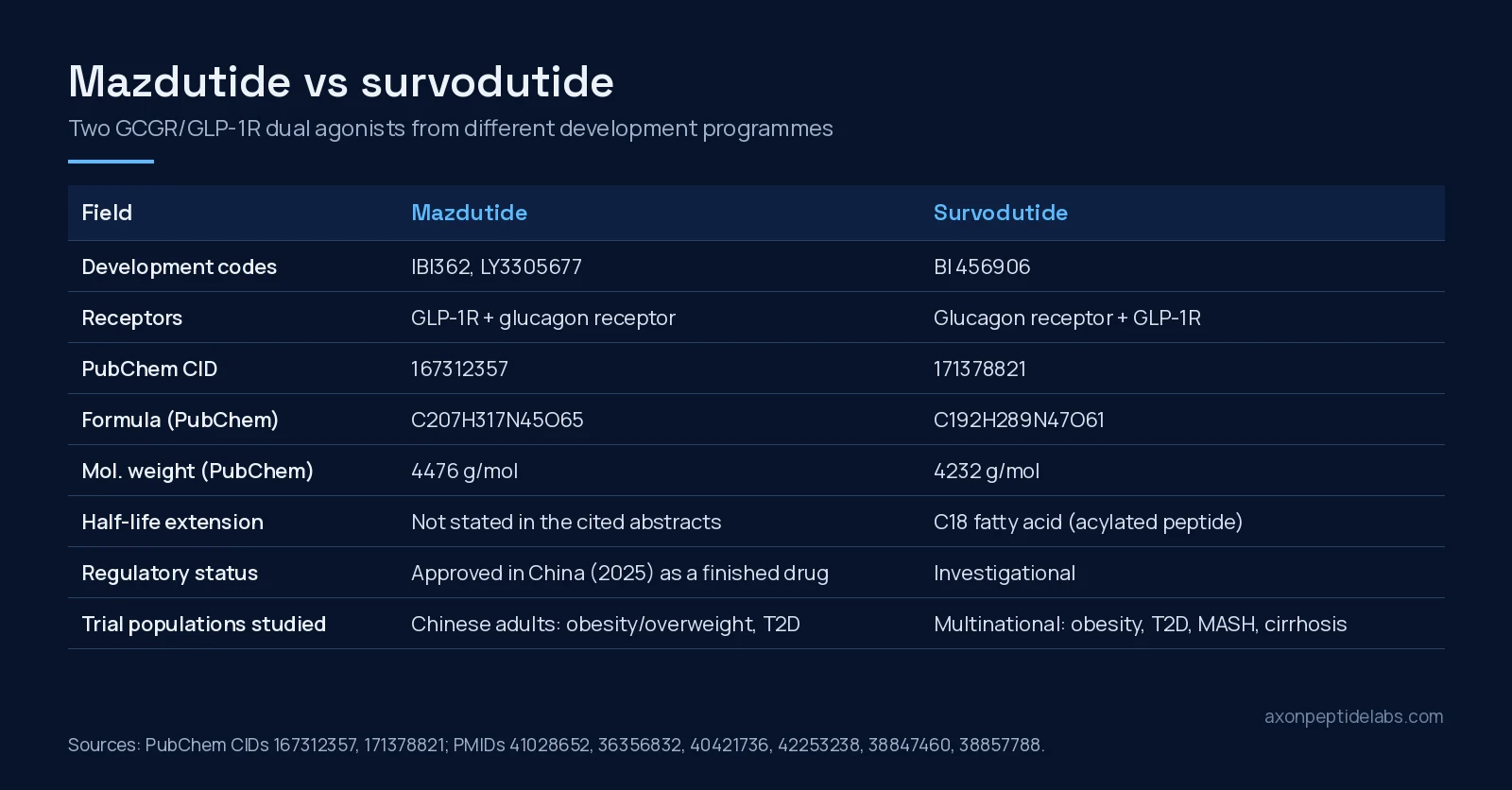
Short answer: mazdutide and survodutide are both once-weekly peptides that activate two receptors at once, the glucagon-like peptide-1 receptor (GLP-1R) and the glucagon receptor (GCGR). They come from separate programmes. Mazdutide (IBI362, LY3305677) is developed by Eli Lilly with Innovent Biologics and received its first approval in China in June 2025 [1]. Survodutide (BI 456906) is an acylated peptide carrying a C18 fatty acid [2] and is still described as investigational in its 2026 phase 3 reports [3]. No published trial has compared the two directly.
Why pair GLP-1 with glucagon at all?
The idea starts with oxyntomodulin, a gut peptide that activates both GCGR and GLP-1R. The survodutide discovery paper frames its design around that hormone, noting that oxyntomodulin lowers body weight in humans by raising energy expenditure as well as lowering energy intake [2]. GLP-1R agonism covers the intake side; adding glucagon receptor activity is meant to bring in the expenditure side and the liver.
Both molecules are therefore balanced on a knife edge. The two activities have to be weighted against each other. How each programme tuned that balance is where most of the published pharmacology sits, and it is better documented for survodutide than for mazdutide.
Identity at a glance
| Property | Mazdutide | Survodutide |
|---|---|---|
| Development codes | IBI362, LY3305677 | BI 456906 |
| PubChem CID | 167312357 | 171378821 |
| CAS (PubChem synonyms) | 2259884-03-0 | 2805997-46-8 |
| Molecular formula | C207H317N45O65 | C192H289N47O61 |
| Molecular weight | 4476 g/mol | 4232 g/mol |
| Receptor targets | GLP-1R and GCGR [1] | GCGR and GLP-1R [2] |
| Half-life extension | Once-weekly profile in trials [4] | C18 fatty acid acylation [2] |
| Status | Approved in China (2025) as a finished drug [1] | Investigational [3] |
Identity values are from the linked PubChem records, not from a certificate of analysis. The two formulas differ by fifteen carbons and two nitrogens, so these are distinct sequences and side chains, not two names for one compound.
Survodutide: the preclinical record
How it was chosen
Survodutide was picked from a set of 19 dual GCGR/GLP-1R agonists. The selection paper measured cAMP potency at human GCGR and GLP-1R in CHO-K1 cells, then checked engagement of each receptor in mice: oral glucose tolerance as the GLP-1R read-out, and plasma FGF21 plus liver nicotinamide N-methyltransferase (NNMT) mRNA as the GCGR read-out. Across the 19 candidates, these in vivo biomarkers correlated with the in vitro potencies, and survodutide was one of three taken forward for deeper profiling in diet-induced obese and db/db mice [5].
What the mouse work showed
In the discovery paper, survodutide produced greater body-weight reductions in mice than maximally effective doses of semaglutide, which the authors attribute to higher energy expenditure together with lower food intake. Dual activity was supported using GLP-1R knockout mice and transgenic reporter mice, and an ex vivo bioactivity assay [2]. These are rodent findings and say nothing on their own about other species.
Mazdutide: what the literature covers
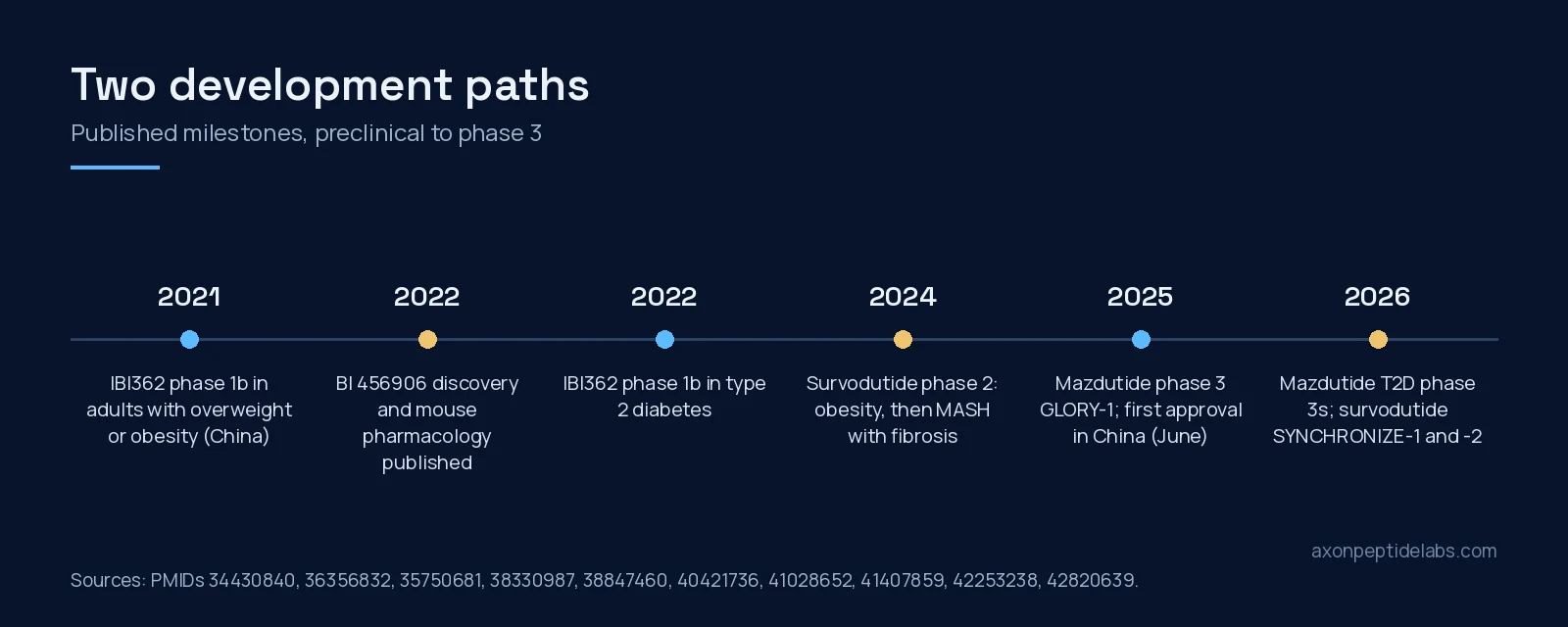
Mazdutide’s published record is mostly clinical. Two phase 1b studies in China, one in adults with overweight or obesity [4] and one in people with type 2 diabetes that included an open-label dulaglutide arm [6], had safety and tolerability as their primary focus. Gastrointestinal events and decreased appetite were the most common adverse events in the obesity study [4].
Preclinical work on mazdutide in the public record is thinner and more recent. One 2025 study in male db/db mice compared mazdutide with dulaglutide on cognitive behaviour and brain pathology, using transcriptomic, proteomic and metabolomic analyses; the authors note the findings apply to male mice only [7].
The clinical programmes, by design
As with our other posts on approved and late-stage compounds, we list trial designs and primary endpoints only. This article reports no efficacy results.
| Trial | Compound vs comparator | Population and size | Primary endpoint and length |
|---|---|---|---|
| GLORY-1 (phase 3) [8] | Mazdutide vs placebo | 610 Chinese adults with obesity, or overweight plus a weight-related condition | Percent change in body weight and share reaching at least 5% loss at week 32; 48 weeks |
| Phase 3, T2D monotherapy [9] | Mazdutide vs placebo | 320 Chinese adults with type 2 diabetes on diet and exercise alone | Change in HbA1c at week 24, then a 24-week extension |
| Phase 3, T2D active comparator [10] | Mazdutide vs dulaglutide | 731 Chinese adults with type 2 diabetes on oral agents | Change in HbA1c at week 28 (non-inferiority, then superiority) |
| Phase 2, obesity [11] | Survodutide vs placebo | 387 adults with BMI 27 or more, without diabetes; 43 centres in 12 countries | Percent change in body weight at week 46 |
| Phase 2, MASH [12] | Survodutide vs placebo | 293 adults with biopsy-confirmed MASH and fibrosis F1 to F3 | Histologic improvement in MASH with no worsening of fibrosis; 48 weeks |
| SYNCHRONIZE-1 (phase 3) [3] | Survodutide vs placebo | 725 adults with obesity, excluding diabetes | Percent change in body weight and share reaching at least 5% loss at week 76 |
| SYNCHRONIZE-2 (phase 3) [13] | Survodutide vs placebo | 752 adults with type 2 diabetes and BMI 27 or more | Same two endpoints at week 76 |
Two patterns stand out. Mazdutide’s trials so far enrolled Chinese adults, which matches its first approval in China [1]. Survodutide’s programme is multinational and leans harder into the liver: besides the MASH trial, a phase 1 study gave single and repeated doses to people with Child-Pugh class A, B or C cirrhosis and found exposure after a single dose similar to that in matched healthy volunteers [14].
Can the two be compared?
Only indirectly. A 2026 network meta-analysis pooled 14 randomised trials of glucagon receptor agonists, including retatrutide, cotadutide, mazdutide and survodutide, and ranked them on weight, HbA1c and adverse events [15]. A network meta-analysis estimates differences through shared placebo arms; it cannot remove differences in population, ethnicity, trial length and estimand, and the trials above differ on all four.
What the evidence does not show
- No head-to-head study. We found no trial or animal study testing mazdutide against survodutide in the same model.
- Unequal preclinical detail. Survodutide’s receptor-balance and biomarker work is published in depth [2][5]; comparable mazdutide receptor pharmacology was not in the abstracts we reviewed.
- Different populations. Mazdutide data come mainly from Chinese adults; survodutide data from multinational cohorts. Results do not transfer cleanly between them.
- Approval is product-specific. Mazdutide’s approval covers a finished drug in China [1]. A research-grade peptide carries no approval anywhere.
Sourcing for laboratory work
Axon carries mazdutide 10 mg for in vitro and preclinical research; we do not sell survodutide. For related reading, our tirzepatide vs mazdutide comparison covers the GIP side of the incretin field, and retatrutide vs mazdutide sets the dual agonist against a triple agonist. When you are ready to buy lab-tested peptides in Canada, check the batch report in our COA library first.
Frequently asked questions
What is the difference between mazdutide and survodutide?
Both are once-weekly dual agonists of the glucagon receptor and the GLP-1 receptor. They are different molecules from different programmes: mazdutide (IBI362, LY3305677) from Eli Lilly and Innovent, survodutide (BI 456906), an acylated peptide with a C18 fatty acid.
Is mazdutide approved?
Mazdutide received its first approval in China in June 2025 for long-term body weight management in adults, followed by a September 2025 approval in China for glycaemic control in type 2 diabetes. That approval covers a finished drug product, not research-grade peptide.
Is survodutide approved?
No. Its 2026 phase 3 reports describe survodutide as an investigational glucagon receptor and GLP-1 receptor dual agonist.
Has anyone compared mazdutide and survodutide directly?
Not in a published head-to-head trial. A 2026 network meta-analysis compared glucagon receptor agonists indirectly across 14 randomised trials, which cannot correct for differences in population and trial design.
How was survodutide selected?
It was chosen from 19 dual GCGR/GLP-1R agonists using in vitro cAMP potency and mouse biomarkers: glucose tolerance for GLP-1R engagement, and plasma FGF21 and liver NNMT mRNA for glucagon receptor engagement.
References
- Shirley M (2025). Mazdutide: First Approval. Drugs. PMID: 41028652. doi: 10.1007/s40265-025-02249-y.
- Zimmermann T, Thomas L, Baader-Pagler T et al. (2022). BI 456906: Discovery and preclinical pharmacology of a novel GCGR/GLP-1R dual agonist with robust anti-obesity efficacy. Mol Metab. PMID: 36356832. doi: 10.1016/j.molmet.2022.101633.
- le Roux CW, Wharton S, Startseva E et al. (2026). Survodutide Once Weekly for the Treatment of Adults with Obesity. N Engl J Med. PMID: 42253238. doi: 10.1056/NEJMoa2600751.
- Ji L, Jiang H, An P et al. (2021). IBI362 (LY3305677), a weekly-dose GLP-1 and glucagon receptor dual agonist, in Chinese adults with overweight or obesity: A randomised, placebo-controlled, multiple ascending dose phase 1b study. EClinicalMedicine. PMID: 34430840. doi: 10.1016/j.eclinm.2021.101088.
- Thomas L, Martel E, Rist W et al. (2024). The dual GCGR/GLP-1R agonist survodutide: Biomarkers and pharmacological profiling for clinical candidate selection. Diabetes Obes Metab. PMID: 38560764. doi: 10.1111/dom.15551.
- Jiang H, Pang S, Zhang Y et al. (2022). A phase 1b randomised controlled trial of a glucagon-like peptide-1 and glucagon receptor dual agonist IBI362 (LY3305677) in Chinese patients with type 2 diabetes. Nat Commun. PMID: 35750681. doi: 10.1038/s41467-022-31328-x.
- Dong W, Bai J, Yuan Q et al. (2025). Mazdutide, a dual agonist targeting GLP-1R and GCGR, mitigates diabetes-associated cognitive dysfunction: mechanistic insights from multi-omics analysis. EBioMedicine. PMID: 40479843. doi: 10.1016/j.ebiom.2025.105791.
- Ji L, Jiang H, Bi Y et al. (2025). Once-Weekly Mazdutide in Chinese Adults with Obesity or Overweight. N Engl J Med. PMID: 40421736. doi: 10.1056/NEJMoa2411528.
- Zhu D, Zhao J, Cai H et al. (2026). Mazdutide versus placebo in Chinese adults with type 2 diabetes. Nature. PMID: 41407859. doi: 10.1038/s41586-025-10026-w.
- Guo L, Zhang B, Xue X et al. (2026). Mazdutide versus dulaglutide in Chinese adults with type 2 diabetes. Nature. PMID: 41407860. doi: 10.1038/s41586-025-10031-z.
- le Roux CW, Steen O, Lucas KJ et al. (2024). Glucagon and GLP-1 receptor dual agonist survodutide for obesity: a randomised, double-blind, placebo-controlled, dose-finding phase 2 trial. Lancet Diabetes Endocrinol. PMID: 38330987. doi: 10.1016/S2213-8587(23)00356-X.
- Sanyal AJ, Bedossa P, Fraessdorf M et al. (2024). A Phase 2 Randomized Trial of Survodutide in MASH and Fibrosis. N Engl J Med. PMID: 38847460. doi: 10.1056/NEJMoa2401755.
- Wharton S, le Roux CW, Startseva E et al. (2026). Survodutide Once Weekly in Adults with Obesity and Type 2 Diabetes. N Engl J Med. PMID: 42820639. doi: 10.1056/NEJMoa2607219.
- Lawitz EJ, Fraessdorf M, Neff GW et al. (2024). Efficacy, tolerability and pharmacokinetics of survodutide, a glucagon/glucagon-like peptide-1 receptor dual agonist, in cirrhosis. J Hepatol. PMID: 38857788. doi: 10.1016/j.jhep.2024.06.003.
- Abulehia A, Ayesh H, Ayesh O et al. (2026). Comparative Efficacy and Safety of Glucagon Receptor Agonists on Metabolic Outcomes: A Network Meta-Analysis of Randomised Controlled Trials. Endocrinol Diabetes Metab. PMID: 41787737. doi: 10.1002/edm2.70187.