
Tirzepatide research overview: the dual GIP/GLP-1 agonist, SURPASS-2 and SURMOUNT-1 findings, and how to verify a batch COA for tirzepatide in Canada.
For laboratory research only. Not for human or animal use. This article gives no dosing, administration or therapeutic advice.
Tirzepatide is a dual GIP/GLP-1 receptor agonist: a single synthetic peptide that activates two incretin receptors at once. It has one of the deepest clinical records of any compound in the metabolic research space. Labs looking for tirzepatide in Canada usually ask three questions: what it is, what the trial record shows, and how to verify a vial before ordering. This overview answers those three from the peer-reviewed literature.
Short answer: Tirzepatide is a 39-amino-acid synthetic peptide engineered as a dual agonist of the GIP and GLP-1 receptors. In the SURPASS-2 trial it outperformed semaglutide 1 mg on glycaemic control and body weight in type 2 diabetes [1], and in SURMOUNT-1 it produced mean weight reductions of up to 20.9% over 72 weeks in adults with obesity [2]. It is a prescription drug in some jurisdictions under brand names, but research-market material is a different supply chain that stands on its own batch testing.
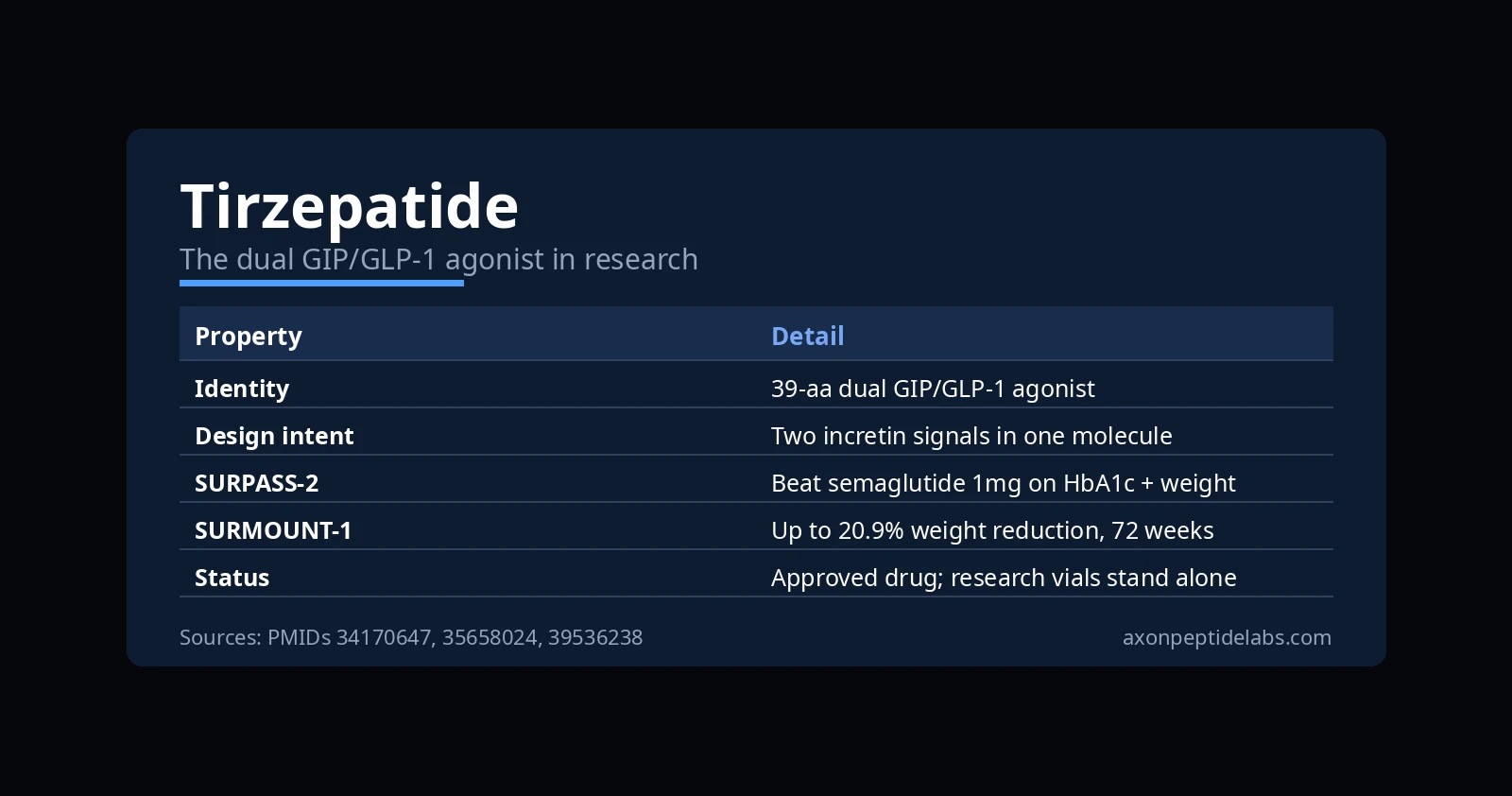
What tirzepatide is
Tirzepatide (development code LY3298176) was designed to merge two incretin signals. GLP-1 receptor agonism reduces appetite and slows gastric emptying; GIP receptor agonism adds a complementary metabolic signal that appears to improve insulin sensitivity and tolerability. The question behind the design was whether activating both receptors in one molecule could outperform GLP-1 agonism alone, and the SURPASS program was built to answer exactly that.
As a defined synthetic sequence, research tirzepatide is produced by solid-phase peptide synthesis. Identity and purity are confirmed the standard way: mass spectrometry for identity, HPLC for purity, measured on the specific lot and reported on its certificate of analysis. Any lot whose mass-spec main peak does not match the expected molecular weight of the 39-residue sequence is not the material on the label.
One structural note for buyers: tirzepatide carries a C20 fatty diacid side chain that extends its half-life to roughly five days, which is what makes once-weekly administration practical in the clinical literature [1]. That side chain is part of the molecule’s identity, and a correct mass-spec trace is the check that it is actually present.
What the clinical record shows
The head-to-head evidence is the SURPASS-2 trial, published in the New England Journal of Medicine in 2021. In patients with type 2 diabetes, tirzepatide at 5, 10 and 15 mg reduced HbA1c and body weight more than semaglutide 1 mg over 40 weeks, with a dose-response across all three doses [1]. Adverse events were predominantly gastrointestinal, consistent with the GLP-1 class.
In obesity without diabetes, SURMOUNT-1 reported mean weight reductions of 15.0% to 20.9% over 72 weeks depending on dose, against 3.1% on placebo [2]. A later three-year analysis found tirzepatide reduced progression to type 2 diabetes in adults with prediabetes and obesity by over 90% relative to placebo [3]. Few research-market compounds carry this depth of controlled human data.
Two caveats belong beside those numbers. First, approved pharmaceutical tirzepatide and research-market tirzepatide are different supply chains: a vial sold for laboratory use is not the drug, and its quality is only what its batch documentation shows. Second, long-term effects beyond trial durations and in non-trial populations remain open questions, which is exactly why the compound stays interesting to study.
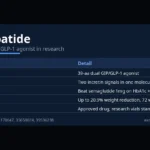
| Attribute | Detail |
|---|---|
| Type | Synthetic dual agonist peptide (GIP + GLP-1 receptors) |
| Development code | LY3298176 |
| Structure | 39 amino acids with a C20 fatty diacid side chain |
| Headline findings | Beat semaglutide 1 mg in SURPASS-2 [1]; up to 20.9% weight reduction in SURMOUNT-1 [2] |
| Main adverse events | Gastrointestinal, dose-related, GLP-1 class-typical |
| Research format | Lyophilized vial; identity by MS, purity by HPLC per lot |
What the evidence does not show
- Research vials are not the approved drug. Clinical-grade material is made to pharmaceutical GMP; a research vial is only as good as its own lot testing.
- No tirzepatide-vs-retatrutide head-to-head. Cross-trial comparisons with the newer triple agonist are indirect and carry the usual caveats.
- Long-term data is still accumulating. Trial durations run one to three years; effects beyond that horizon are not yet characterized.
- GIP’s contribution is not fully settled. How much of tirzepatide’s advantage over GLP-1 agonism comes from the GIP component remains an active research question.
Checking a tirzepatide batch record
Our Tirzepatide 10mg (GLP-1/GIP) listing is a lyophilized research vial. Before relying on any vial, match three things on the lot certificate: HPLC purity, mass-spec identity against the expected molecular weight, and the lot number on the vial against the lot number on the report. Batch reports are posted per lot in our COA library. For context against the other agonists, see our comparisons of Semaglutide vs Tirzepatide vs Retatrutide and Tirzepatide vs Mazdutide.
When you are ready to order, you can buy tirzepatide in Canada through the catalogue page, with each vial tied to its posted batch record.
Formats and handling in the lab
Research tirzepatide ships as a lyophilized powder, the standard format for synthetic peptides because the dry cake degrades far more slowly than a solution. General peptide handling applies: keep the vial sealed, cold and dry until use, limit freeze-thaw cycles after reconstitution, and record the lot number in the lab notebook so every result traces back to a specific batch report.
Treat the certificate of analysis as part of the material. A useful COA names the analytical methods, shows measured values for that specific lot, and carries a date and batch identifier. A certificate without a lot number does not document the material in your hands.
Frequently asked questions
What is tirzepatide?
A synthetic 39-amino-acid peptide that activates both the GIP and GLP-1 receptors. It was developed as LY3298176 and is one of the most clinically studied metabolic peptides.
How is tirzepatide different from semaglutide?
Semaglutide is a GLP-1-only agonist. Tirzepatide adds GIP receptor agonism, and in the SURPASS-2 head-to-head trial it produced larger reductions in HbA1c and body weight than semaglutide 1 mg [1].
What did SURMOUNT-1 find?
In adults with obesity, once-weekly tirzepatide produced mean weight reductions of 15.0% to 20.9% over 72 weeks depending on dose, versus 3.1% on placebo [2].
Is research tirzepatide the same as the prescription drug?
The sequence is the same, but the supply chains are not. Research vials are sold for laboratory use only and their quality is established by their own batch documentation, not by pharmaceutical manufacturing oversight.
How should a lab verify a tirzepatide vial?
Check the lot’s HPLC purity and mass-spec identity on its certificate of analysis and confirm the lot number matches the vial. Reports for our batches are posted per lot in the COA library.
What format does research tirzepatide come in?
As a lyophilized powder in a sealed vial, the standard format for synthetic research peptides because it keeps best during storage and transport.
Why does tirzepatide have a fatty acid side chain?
The C20 fatty diacid chain binds albumin and extends the molecule’s half-life to roughly five days, which is what makes once-weekly administration practical in the clinical literature [1].
What purity should a tirzepatide COA show?
Research-grade synthetic peptides are typically supplied at 98% purity or higher by HPLC, with mass spectrometry confirming the expected molecular weight. The values should be measured on your lot, not copied from a generic specification.
How tirzepatide fits among the metabolic peptides
Tirzepatide sits between two better-known reference points. Against semaglutide, the GLP-1-only benchmark, it has direct head-to-head evidence of superiority on both glycaemic control and weight in SURPASS-2, which is rare in this field: most comparisons between metabolic peptides are cross-trial guesses, but this one was measured in the same study population [1]. Against retatrutide, the newer triple agonist, no direct comparison exists yet, and the cross-trial weight numbers favor retatrutide at its highest doses.
For a lab, the useful reading is that tirzepatide is now the best-characterized dual agonist available as a research compound: a defined sequence, a deep controlled-trial record, and an established analytical fingerprint. That combination makes it a practical reference standard when a study design calls for a dual GIP/GLP-1 agonist with known human pharmacology. As always, the trial record describes the sequence; the batch certificate describes the vial.
What does GIP add to a GLP-1 agonist?
GIP receptor activation adds a second incretin signal that appears to improve insulin sensitivity and the tolerability profile. The clearest evidence is SURPASS-2, where the dual agonist outperformed GLP-1-only semaglutide on both HbA1c and weight [1].
Is tirzepatide being studied beyond diabetes and obesity?
Yes. The published program includes metabolic-dysfunction-associated conditions, and the three-year SURMOUNT-1 analysis showed a large reduction in progression to type 2 diabetes in adults with prediabetes [3].
References
- Frías J.P. et al. (2021), New England Journal of Medicine — Tirzepatide versus Semaglutide Once Weekly in Patients with Type 2 Diabetes (SURPASS-2). PMID 34170647
- Jastreboff A.M. et al. (2022), New England Journal of Medicine — Tirzepatide Once Weekly for the Treatment of Obesity (SURMOUNT-1). PMID 35658024
- Jastreboff A.M. et al. (2025), New England Journal of Medicine — Tirzepatide for Obesity Treatment and Diabetes Prevention. PMID 39536238