
Semaglutide Research Overview: The Long-Acting GLP-1 Analogue
For laboratory research only. Not for human or animal use. This article gives no dosing, administration or therapeutic advice.
Semaglutide is a long-acting analogue of the human incretin hormone GLP-1. It is one of the most studied peptides in metabolic research, with a human trial record far larger than any other compound in our catalogue, and it is also one of the most counterfeited. Labs sourcing semaglutide in Canada for research work should know exactly what the molecule is, what the published evidence does and does not say, and how to verify a vial before it enters an experiment. This overview covers those three points.
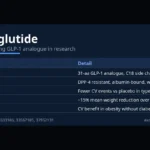
Short answer: Semaglutide is a 31-residue GLP-1 analogue with two structural changes that extend its half-life: an amino-acid swap that protects it from DPP-4 breakdown, and a fatty-acid side chain that binds it to albumin. Large human trials have measured its effects on body weight and cardiovascular outcomes [2][3], but those are prescription-drug results, not guidance for research use, and they say nothing about any given research vial, which still stands or falls on its own batch testing.
What semaglutide is
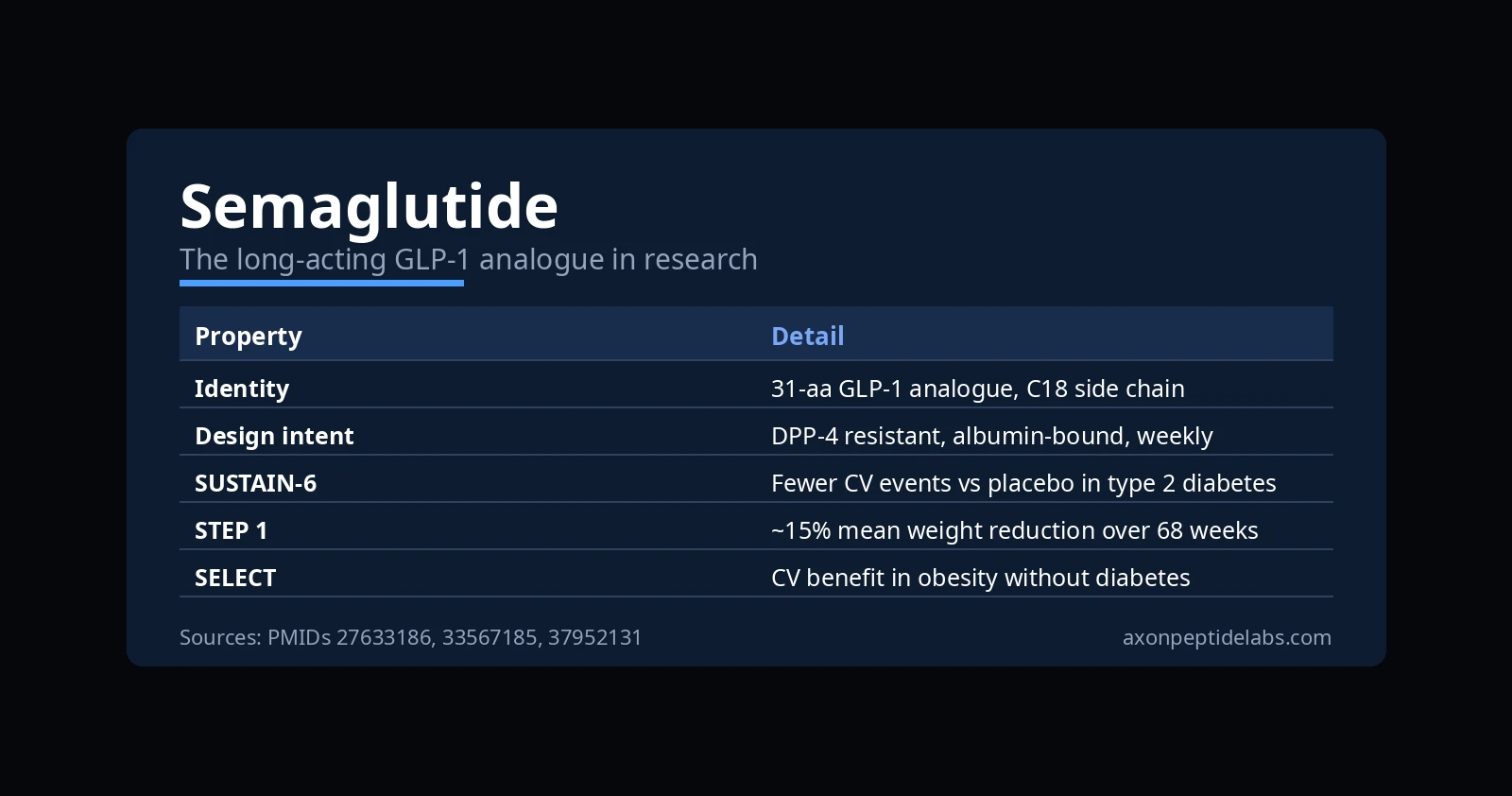
GLP-1 is a hormone released from the gut after eating. It acts on the GLP-1 receptor in the pancreas, brain and elsewhere, and native GLP-1 survives only minutes in circulation before the enzyme DPP-4 cuts it. Semaglutide keeps the receptor activity of GLP-1 while fixing both weaknesses: a substitution at position 8 blocks DPP-4 cleavage, and a C18 fatty-diacid chain attached at lysine 26 makes the peptide ride on albumin, stretching its half-life to roughly a week. That engineering is why it became a once-weekly drug and a widely used research tool.
For lab work the practical point is sourcing discipline. Because semaglutide is in high demand, the gray market is full of underfilled, mislabelled and outright fake vials. A research vial is only as good as its lot-specific certificate: HPLC for purity and mass spectrometry for identity against the known molecular weight of the 31-residue sequence. We post those reports per lot in our COA library.
What the published record shows
Semaglutide is unusual in this catalogue because its evidence base includes very large randomized human trials. The SUSTAIN-6 trial followed over 3,000 patients with type 2 diabetes and found fewer major cardiovascular events on semaglutide than placebo over about two years [1]. The STEP 1 trial measured weight outcomes in adults with overweight or obesity and reported a mean weight reduction near 15 percent over 68 weeks with once-weekly semaglutide alongside lifestyle intervention [2]. The SELECT trial later reported cardiovascular benefit in people with overweight or obesity but without diabetes [3].
For researchers, the value of that record is mechanistic confidence: the GLP-1 receptor pharmacology behind semaglutide is about as well characterized as any peptide pathway in current use. The limits matter just as much. Trial doses, titration schedules and patient monitoring belong to the prescription context. They do not translate into research protocols, and nothing in the trial record certifies any material sold for laboratory use.
| Attribute | Detail |
|---|---|
| Type | GLP-1 receptor agonist, 31-amino-acid analogue of human GLP-1 |
| Key modifications | Position-8 substitution (DPP-4 resistance) and C18 fatty-diacid side chain (albumin binding) |
| Half-life | Roughly one week in human pharmacokinetics, versus minutes for native GLP-1 |
| Evidence base | Large randomized human trials plus extensive preclinical literature |
| Main research uses | Incretin signalling, appetite and metabolic pathway studies, receptor pharmacology |
| Research format | Lyophilized vial; identity by MS, purity by HPLC per lot |
How it acts in lab models
At the receptor level, semaglutide is a selective GLP-1 receptor agonist. In cell and animal work, GLP-1 receptor activation drives glucose-dependent insulin secretion, slows gastric emptying and acts on appetite centres in the hindbrain and hypothalamus. The long half-life changes experimental design compared with native GLP-1 or shorter analogues: signalling persists for days rather than minutes, so washout periods, sampling schedules and comparator choices all need to account for that. For labs moving from liraglutide or exenatide work, the practical difference is duration, not direction, of effect.
The engineering details matter for analytical work too. The fatty-diacid side chain changes how the molecule behaves in solution and on HPLC columns, so labs comparing retention times or spectra against native GLP-1 standards should expect a distinct profile. This is one more reason identity confirmation belongs to the lot’s own mass-spec trace rather than to a generic reference.
What the evidence does not show
- Trial results are not research-vial results. SUSTAIN-6, STEP 1 and SELECT tested a regulated drug product. They characterize the molecule, not any specific batch sold for research.
- No research dosing guidance exists here. Clinical titration schedules are medical information, and this article deliberately contains none.
- Long-term data are still accumulating. The large trials run two to five years; longer-horizon questions remain open in the literature.
- Counterfeit risk is real. Demand has made semaglutide one of the most falsified peptides on the gray market, which is why lot-level verification matters more for this compound than almost any other.
Checking a semaglutide batch record
Our semaglutide 10mg listing is a lyophilized research vial. Before relying on any vial, confirm three things on the lot’s certificate: the HPLC purity value, the mass-spec identity match to the semaglutide molecular weight, and that the lot number on the report equals the lot number on the vial. Because this molecule is heavily counterfeited, treat any seller who cannot produce a lot-matched report as a hard stop. Our reports are posted per batch in the COA library. For context on how semaglutide compares with related compounds, see our earlier analyses of semaglutide vs liraglutide and semaglutide vs cagrilintide.
Storage and handling in the lab
Research semaglutide ships lyophilized. General peptide practice applies: keep the vial sealed, cold and dry; protect it from repeated temperature swings; and once a vial is reconstituted for an experiment, record the date and treat the solution as short-lived unless your own stability data says otherwise. Log the lot number with every use so results trace back to the batch report.
Frequently asked questions
Is semaglutide the same as GLP-1?
No. It is an engineered analogue: same receptor, much longer life in circulation. Native GLP-1 lasts minutes; semaglutide lasts about a week because of its DPP-4 protection and albumin binding.
Why is semaglutide studied so widely?
Because the GLP-1 receptor sits at the junction of appetite, insulin secretion and cardiovascular signalling, and semaglutide is the best-characterized long-acting tool for activating it.
What is the difference between semaglutide and tirzepatide?
Semaglutide acts on the GLP-1 receptor alone. Tirzepatide adds a second receptor, GIP, on top of GLP-1. They are distinct molecules with distinct trial records.
Has semaglutide been tested in humans?
Yes, extensively, in large randomized trials as a prescription drug [1][2][3]. That record belongs to the regulated product. Research material is sold for laboratory use only and is not a medicine.
How should a lab verify a semaglutide vial?
Match the lot number on the vial to a batch COA, check HPLC purity and the mass-spec identity peak, and be extra strict with this compound because falsified semaglutide is common in unregulated channels.
How long has semaglutide been studied?
The molecule was developed in the early 2010s and the large outcomes trials published from 2016 onward [1]. It now has one of the deepest evidence bases of any peptide in metabolic research.
Can labs use semaglutide as a reference standard?
Yes. Because its sequence, molecular weight and pharmacology are fully characterized, verified research semaglutide is often used as a comparator or positive control in incretin-pathway work. That only works if the reference vial itself is verified against its batch COA.
What form does research semaglutide come in?
As a lyophilized powder in a sealed vial, the standard format for synthetic research peptides, chosen because the dry form keeps best in storage and transit.
What does the fatty-acid chain on semaglutide do?
It lets the peptide bind albumin in solution, which shields it from clearance and stretches its half-life from minutes to about a week. The same albumin-binding idea is used in other long-acting peptide drugs.
Is semaglutide the same as retatrutide?
No. Retatrutide is a triple agonist (GLP-1, GIP and glucagon receptors), while semaglutide targets GLP-1 alone. See our semaglutide vs tirzepatide vs retatrutide comparison for the side-by-side.
Why does semaglutide need stricter sourcing checks than other peptides?
Demand. High-volume drugs attract falsified and underfilled gray-market vials, and semaglutide is currently one of the most counterfeited peptides. A lot-matched COA with HPLC and mass-spec data is the minimum acceptable documentation.
References
- Marso S.P. et al. (2016), New England Journal of Medicine — Semaglutide and cardiovascular outcomes in patients with type 2 diabetes (SUSTAIN-6). PMID 27633186
- Wilding J.P.H. et al. (2021), New England Journal of Medicine — Once-weekly semaglutide in adults with overweight or obesity (STEP 1). PMID 33567185
- Lincoff A.M. et al. (2023), New England Journal of Medicine — Semaglutide and cardiovascular outcomes in obesity without diabetes (SELECT). PMID 37952131