
GHK-Cu Purity: What HPLC and Copper-Content Checks Show
For laboratory research only. Not for human or animal use. This article gives no dosing, administration or therapeutic advice.
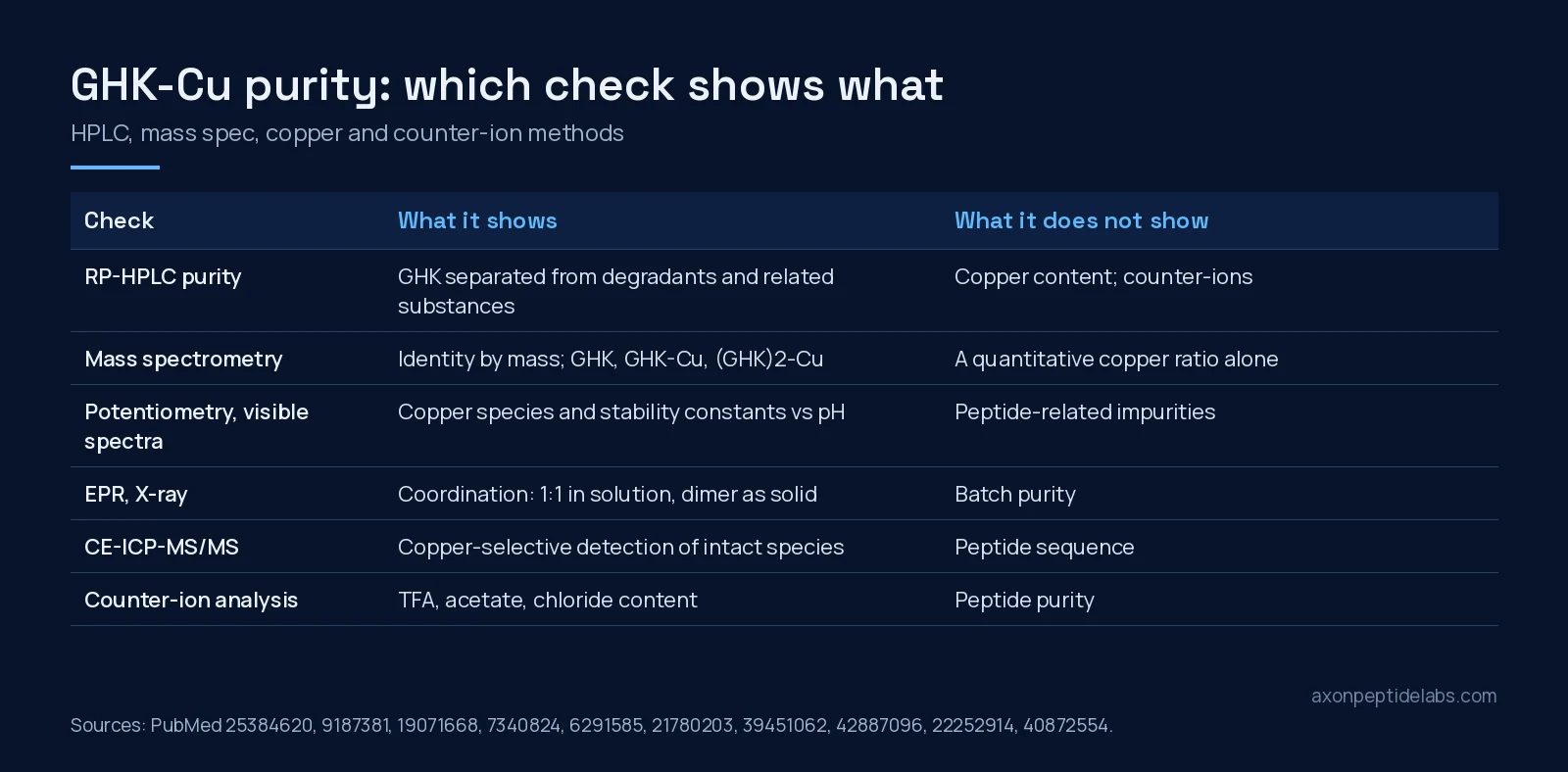
Short answer: an HPLC purity figure, a mass-spectrometry identity check and a copper-content measurement answer three different questions about GHK-Cu. Reversed-phase HPLC can be run as a validated stability-indicating method that separates GHK from its degradation products [1]. Mass spectrometry identifies what the peaks are, and for this complex it has shown free GHK, GHK-Cu and (GHK)2-Cu species [2]. Neither tells you directly how much copper is bound or in what ratio: copper speciation has been measured by potentiometry and spectroscopy [3][4] and, more recently, by copper-selective CE-ICP-MS/MS [5]. Counter-ions left from synthesis are a fourth question again [6][7].
What reversed-phase HPLC purity shows
In a 2016 preformulation study, GHK concentrations were measured with a validated stability-indicating RP-HPLC method; coupled with mass spectrometry, it identified three main degradation products of GHK-Cu under stress, one of them histidine [1]. An earlier HPLC method for rat plasma separated GHK from its metabolite L-histidyl-L-lysine (HK), using ion-pair chromatography on a C18 column with post-column o-phthalaldehyde derivatization for detection [8]. Shorter fragments such as HK and free histidine are the kind of related substances a GHK purity method has to resolve.
Purity of a synthetic peptide is more than a single peak. A review of peptide-related impurities lists deletion and insertion sequences from solid-phase synthesis, diastereomers from racemization, protection-group adducts, side-chain oxidation, dimers and oligomers, and residual counter-ions such as trifluoroacetate [6]. Work on peptide reference materials adds that every route to a purity value, whether mass balance, amino acid analysis, quantitative NMR or nitrogen determination, needs a correction for structurally related peptide impurities; liquid chromatography with high-resolution mass spectrometry identified and quantified more than 65 of them in one synthetic C-peptide material [9].
What mass spectrometry adds
Mass spectrometry confirms identity by mass rather than by retention time. For GHK-Cu, electrospray (ESI-MS) was used to evaluate the copper complexes present in solutions of different pH, and only GHK and its complexes GHK-Cu and (GHK)2-Cu migrated through a model stratum corneum membrane [2]. The appearance of a 2:1 peptide-to-copper species matters for interpretation: a 2011 structural study linked fast copper exchange in GHK-Cu solutions to a [Cu(GHK)2] complex [10], and another found complexes of several stoichiometries, including binuclear species [11].
Copper content and stoichiometry
The copper side of the complex has its own methods. Potentiometric titration with visible-absorption spectrophotometry was used to work out the species distribution and stability constants of copper(II) with GHK between pH 3.5 and 10.6 [3]. EPR and electron spin-echo spectroscopy showed a mononuclear 1:1 complex at neutral pH with a histidine imidazole nitrogen bound to copper, and found that the polymeric structure of the crystal is not present in solution [4]. X-ray structures later confirmed a dimer in the solid state [10].
Capillary electrophoresis coupled to inductively coupled plasma tandem mass spectrometry (CE-ICP-MS/MS) separates species under mild conditions and detects copper selectively. It was used to follow GHK-Cu during liposome encapsulation by monitoring copper and phosphorus signals [5], and to check the stability of encapsulated GHK-Cu in cosmetic emulsions and serums [12].
Metals also change how the peptide behaves in chromatography. During isolation of GHK from plasma, co-isolating copper and iron interfered with gel filtration and silica-gel steps, and removing them with a chelating resin raised recovery of labelled peptide eight-fold [13]. A method developed for the free peptide may therefore not behave the same way with the copper complex.
Which check answers which question
| Check | What it shows | What it does not show |
|---|---|---|
| RP-HPLC purity | Separation of GHK from degradants and related substances [1][8] | Copper content; counter-ion content |
| Mass spectrometry (ESI-MS, LC-MS) | Identity by mass; GHK, GHK-Cu and (GHK)2-Cu species [2] | A quantitative copper ratio on its own |
| Potentiometry and visible-absorption spectroscopy | Copper species distribution and stability constants across pH [3] | Peptide-related impurities |
| EPR and X-ray structure | Copper coordination; 1:1 in solution at neutral pH, dimer in the solid [4][10] | Batch purity |
| CE-ICP-MS/MS | Copper-selective detection of intact species [5][12] | The peptide sequence |
| Counter-ion analysis (IC, CE, 19F-NMR) | Trifluoroacetate, acetate, chloride content [7][14] | Peptide purity |
Counter-ions: the part a purity figure skips
Peptides made by solid-phase synthesis usually come out as trifluoroacetate salts, because TFA is used for cleavage and as an ion-pairing reagent in purification. In a 2025 study, residual TFA was measured by FT-IR, 19F-NMR and HPLC with an evaporative light-scattering detector, and exchanging TFA for chloride had no impact on peptide purity [14]. In other words, the HPLC purity number stayed the same while the salt form changed. Ion chromatography gave the best results among three techniques tested for acetate, trifluoroacetate and chloride, and lyophilization from hydrochloric or acetic acid removed trifluoroacetate to satisfactory levels [7].
Reading a GHK-Cu COA
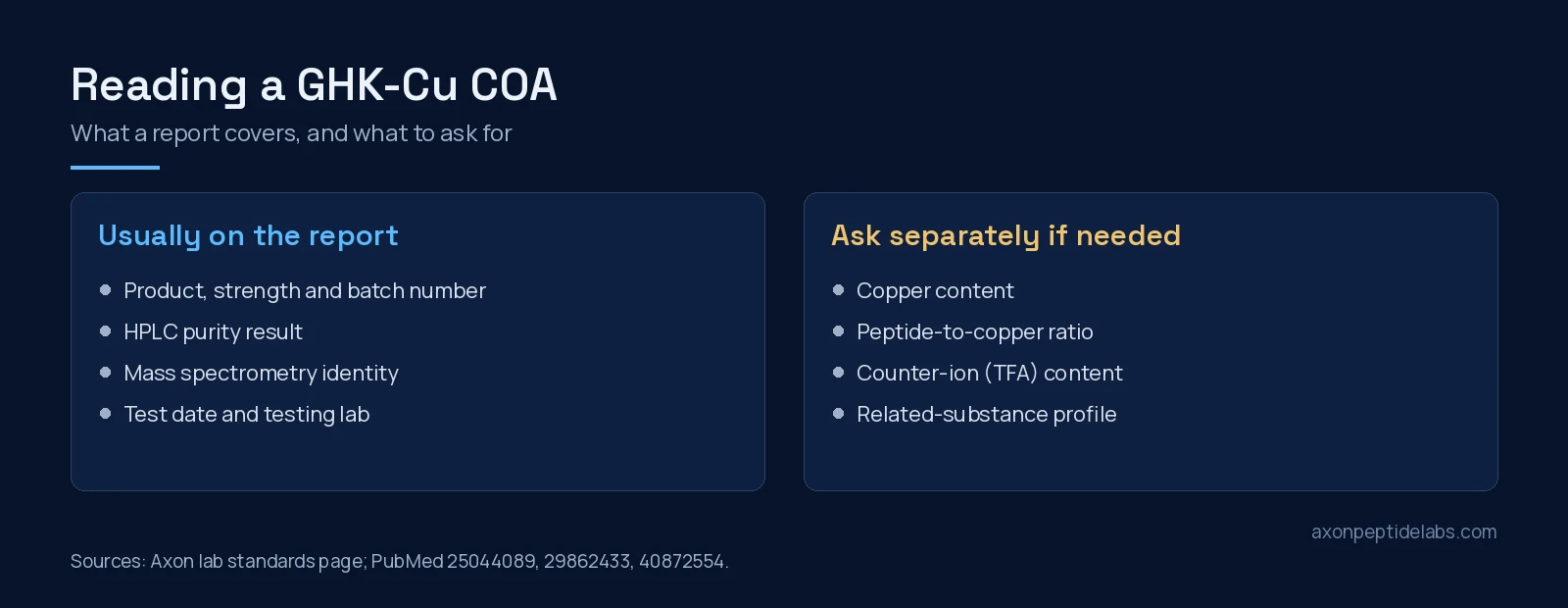
- Batch. The GHK-Cu listing names batch MP-GHKC-100-041626 for the 100 mg material, with a reported purity of 99.72%, dated 29 April 2026 and tested by testides.com; the same batch is listed for the 100 mg pen. Match the batch on your material to the report in the COA library.
- Method. Look for HPLC for purity and mass spectrometry for identity, as Axon’s lab standards page describes.
- Copper. If a report gives only HPLC purity and a mass match, it does not state copper content or the peptide-to-copper ratio. Ask for that separately if your work depends on it.
- Salt form. A purity percentage does not report counter-ion content.
Limits
- The analytical studies cited here are method and chemistry papers; none tested a commercial research batch.
- The CE-ICP-MS/MS work was done on cosmetic and liposome samples, not on lyophilized research material [5][12].
- The impurity reviews describe synthetic peptides in general, not GHK specifically [6][9].
Sourcing for laboratory work
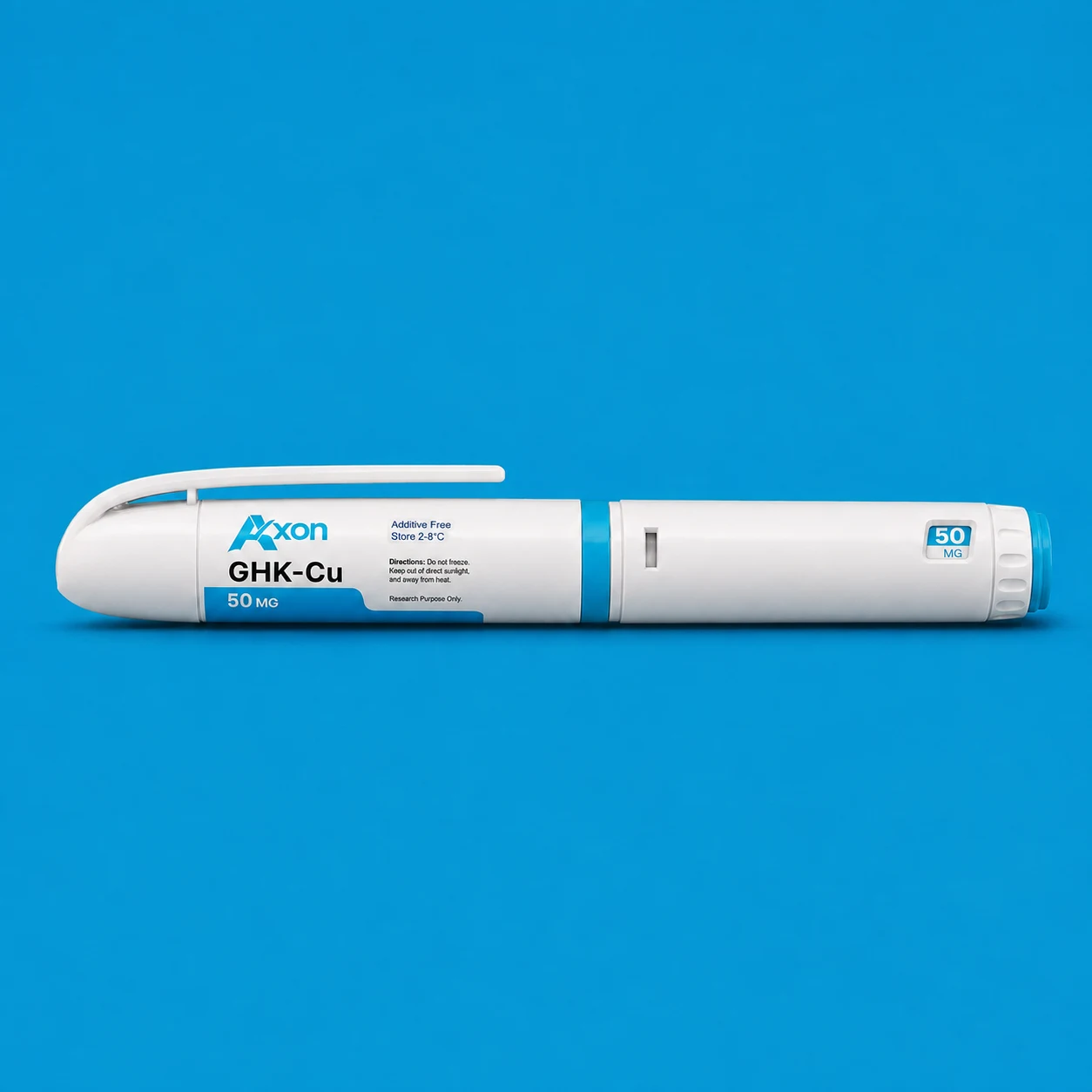
Researchers comparing a GHK-Cu peptide supplier in Canada can review the batch reports in the Axon COA library and the walkthrough in how to verify peptide purity before ordering. The GHK-Cu Canada guide compares the vial and the 50 mg and 100 mg GHK-Cu pen, and GHK-Cu vial vs pen covers the format choice. For other compounds, buy lab-tested peptides in Canada from the full catalogue.
Frequently asked questions
What does an HPLC purity figure tell you about GHK-Cu?
It shows how well GHK separates from degradation products and related substances under that method. It does not report copper content or counter-ions.
Does mass spectrometry confirm the copper complex?
ESI-MS has shown GHK, GHK-Cu and (GHK)2-Cu species in solution, which confirms identity by mass. A quantitative copper ratio needs a separate measurement.
How is copper binding in GHK-Cu measured?
Studies used potentiometric titration with visible spectroscopy for species distribution, EPR and X-ray work for coordination, and CE-ICP-MS/MS for copper-selective detection.
Why do counter-ions matter if purity is high?
Synthetic peptides are often trifluoroacetate salts. In one study, exchanging TFA for chloride did not change measured peptide purity, so the purity figure does not show the salt form.
Where can I check a GHK-Cu COA in Canada?
Axon Peptide Labs publishes batch COAs in its COA library and on the GHK-Cu product page. Match the batch number on your material to the report.
References
- Badenhorst T, Svirskis D, Wu Z (2016). Physicochemical characterization of native glycyl-l-histidyl-l-lysine tripeptide for wound healing and anti-aging: a preformulation study for dermal delivery. Pharm Dev Technol. PMID: 25384620. doi: 10.3109/10837450.2014.979944.
- Mazurowska L, Mojski M (2007). ESI-MS study of the mechanism of glycyl-l-histidyl-l-lysine-Cu(II) complex transport through model membrane of stratum corneum. Talanta. PMID: 19071668. doi: 10.1016/j.talanta.2006.11.034.
- Lau SJ, Sarkar B (1981). The interaction of copper(II) and glycyl-L-histidyl-L-lysine, a growth-modulating tripeptide from plasma. Biochem J. PMID: 7340824. doi: 10.1042/bj1990649.
- Freedman JH, Pickart L, Weinstein B et al. (1982). Structure of the Glycyl-L-histidyl-L-lysine–copper(II) complex in solution. Biochemistry. PMID: 6291585. doi: 10.1021/bi00262a004.
- Zajda J, Wadych E, Ogórek K et al. (2024). Novel Applications of CE-ICP-MS/MS: Monitoring of Antiaging GHK-Cu Cosmetic Component Encapsulation in Liposomes. Electrophoresis. PMID: 39451062. doi: 10.1002/elps.202400047.
- D’Hondt M, Bracke N, Taevernier L et al. (2014). Related impurities in peptide medicines. J Pharm Biomed Anal. PMID: 25044089. doi: 10.1016/j.jpba.2014.06.012.
- Mrozik W, Markowska A, Guzik L et al. (2012). Determination of counter-ions in synthetic peptides by ion chromatography, capillary isotachophoresis and capillary electrophoresis. J Pept Sci. PMID: 22252914. doi: 10.1002/psc.1436.
- Endo T, Miyagi M, Ujiie A (1997). Simultaneous determination of glycyl-L-histidyl-L-lysine and its metabolite, L-histidyl-L-lysine, in rat plasma by high-performance liquid chromatography with post-column derivatization. J Chromatogr B Biomed Sci Appl. PMID: 9187381. doi: 10.1016/s0378-4347(96)00460-4.
- Li M, Josephs RD, Daireaux A et al. (2018). Identification and accurate quantification of structurally related peptide impurities in synthetic human C-peptide by liquid chromatography-high resolution mass spectrometry. Anal Bioanal Chem. PMID: 29862433. doi: 10.1007/s00216-018-1155-y.
- Hureau C, Eury H, Guillot R et al. (2011). X-ray and solution structures of Cu(II) GHK and Cu(II) DAHK complexes: influence on their redox properties. Chemistry. PMID: 21780203. doi: 10.1002/chem.201100751.
- Conato C, Gavioli R, Guerrini R et al. (2001). Copper complexes of glycyl-histidyl-lysine and two of its synthetic analogues: chemical behaviour and biological activity. Biochim Biophys Acta. PMID: 11325542. doi: 10.1016/s0304-4165(01)00127-1.
- Ogórek K, Mierzwa M, Drozd M et al. (2026). Characterization of copper tripeptide-loaded lipid carriers and their stability in complex cosmetic matrices. J Chromatogr A. PMID: 42887096. doi: 10.1016/j.chroma.2026.467540.
- Pickart L, Thaler MM, Millard M (1979). Effect of transition metals on recovery from plasma of the growth-modulating tripeptide glycylhistidyllysine. J Chromatogr. PMID: 546910. doi: 10.1016/s0021-9673(00)86403-1.
- Erckes V, Streuli A, Chamera Rendueles L et al. (2025). Towards a Consensus for the Analysis and Exchange of TFA as a Counterion in Synthetic Peptides and Its Influence on Membrane Permeation. Pharmaceuticals (Basel). PMID: 40872554. doi: 10.3390/ph18081163.