
GHK-Cu Vial vs GHK-Cu Pen: Which Research Format
For laboratory research only. Not for human or animal use. This article gives no dosing, administration or therapeutic advice.
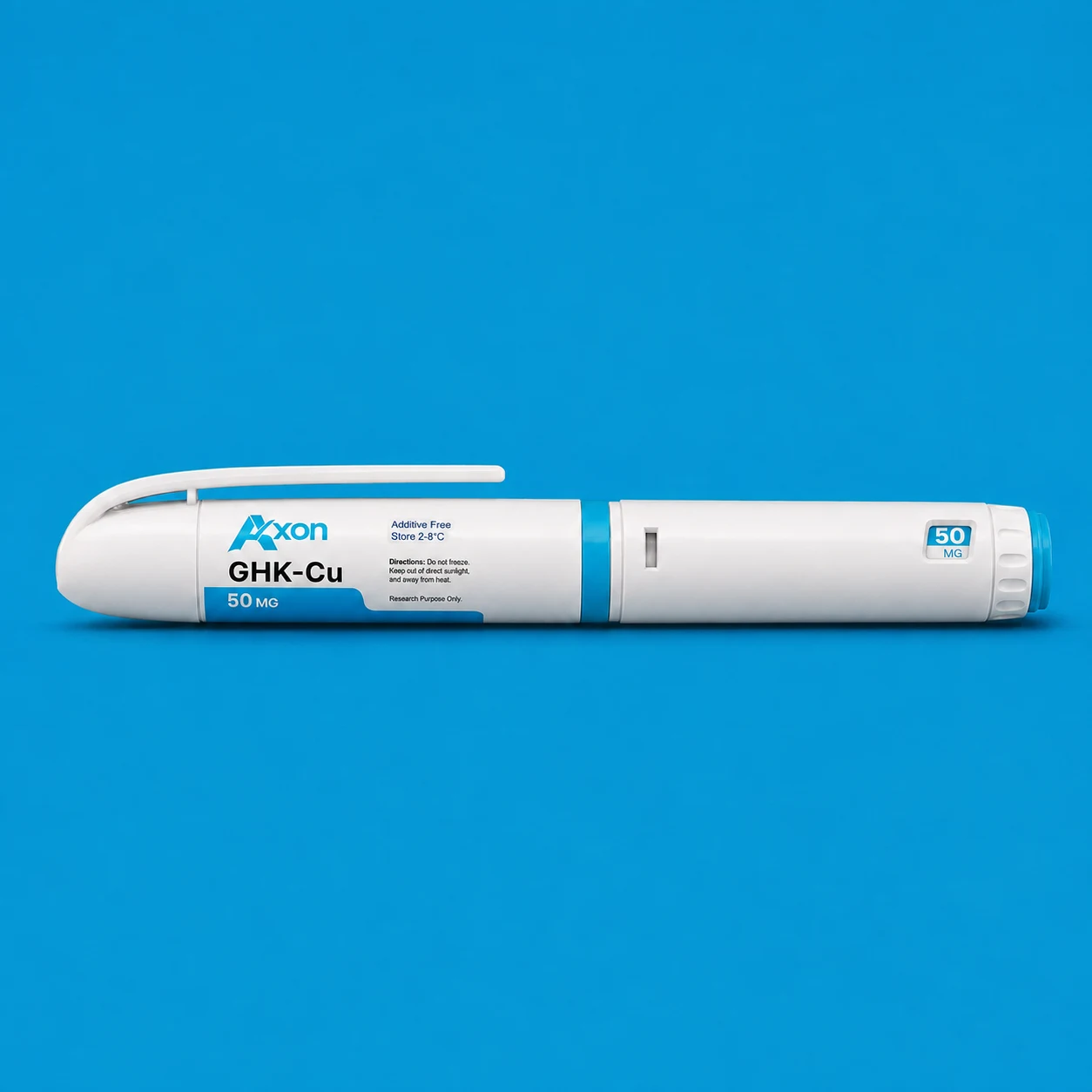
Short answer: the vial and the pen hold the same compound in two physical states. Axon describes the GHK-Cu vial as lyophilized material that the lab prepares itself, and the pen as a pre-formatted cartridge holding a stated amount (50 mg or 100 mg), chosen to cut reconstitution steps. Formulation science treats freeze-dried solids as the route to longer shelf life [1] and solutions as exposed to more degradation pathways [2][3]. GHK-Cu itself held up well in water and mild buffers under heat stress but was cleaved under basic and oxidative stress [4]. For a copper complex there is one more factor: in solution, the copper species present depend on pH and on what else is dissolved [5][6].
The two formats on the listing
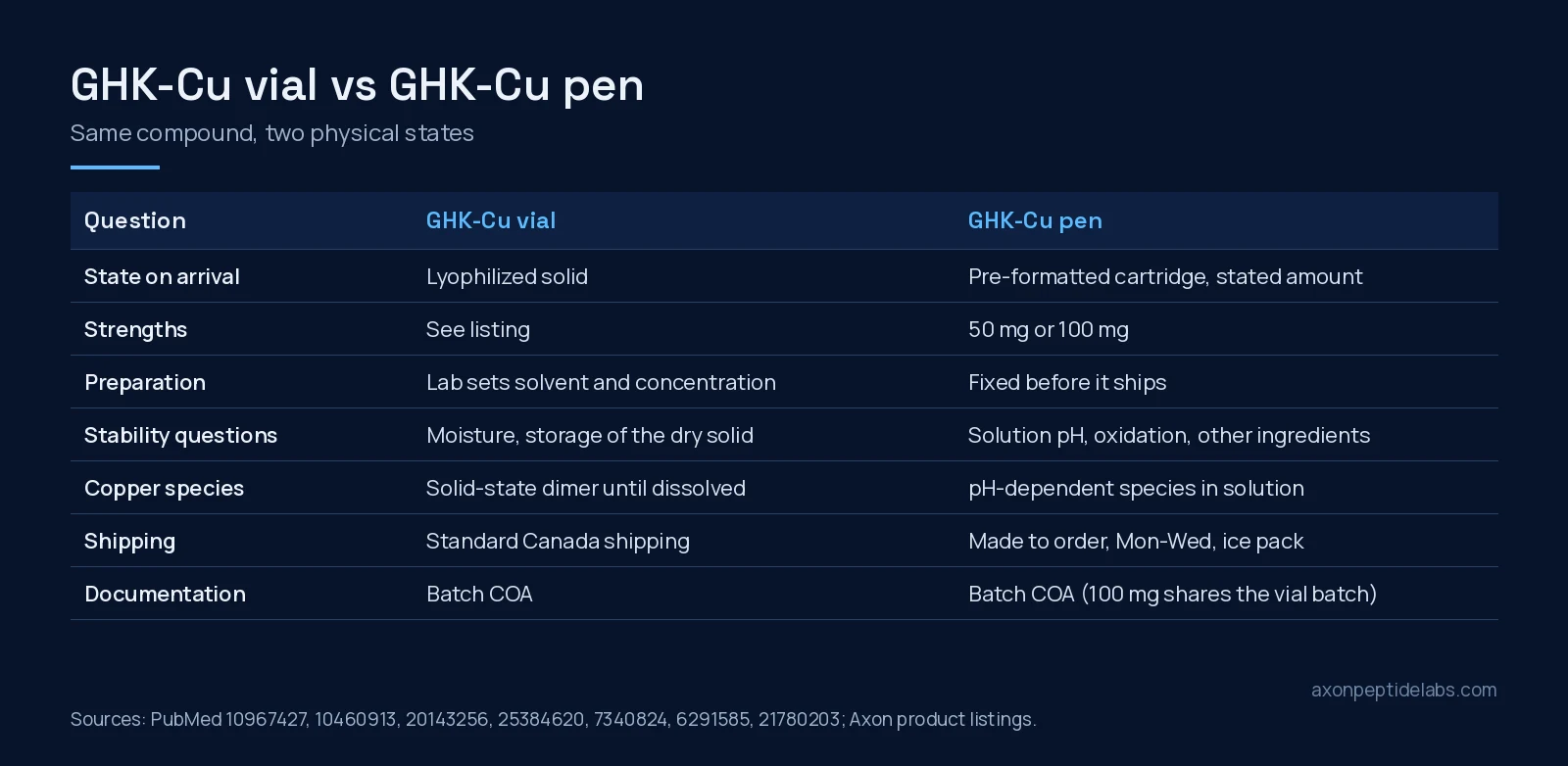
The GHK-Cu vial is listed as not pre-mixed, with a note that some peptides may turn cloudy, thick or gel-like depending on the reconstitution solution chosen. The GHK-Cu pen comes in 50 mg and 100 mg strength options. Pens are made to order, ship Monday to Wednesday by express delivery, and are packed with an ice pack in insulated packaging; the listing states that continuous refrigeration during transit cannot be guaranteed. The research pens page sums up the trade-off: the pen means fewer handling steps and a standardized format, while the vial lets the lab set its own concentration.
Solid vs solution: what formulation reviews say
Most of what is known about peptide and protein stability by physical state comes from pharmaceutical formulation work. A review of liquid formulations notes that these molecules usually have to be stored cold or freeze-dried to reach an acceptable shelf life, and it covers the chemical and physical instabilities seen in aqueous state [2]. A companion review on lyophilization describes freeze-drying as the most common way to make solid forms for that reason, while warning that freezing and drying impose their own stresses and that solids can still have limited long-term stability [1]. A 2010 update covers chemical and physical instability in both aqueous solution and the dried state, and how the two interact [3].
These reviews deal mostly with larger proteins. GHK is a tripeptide with no folded structure to lose, so their aggregation and unfolding sections apply less directly than their chemistry sections. That is why GHK-Cu data of its own matter.
What GHK-Cu data show about solution stability
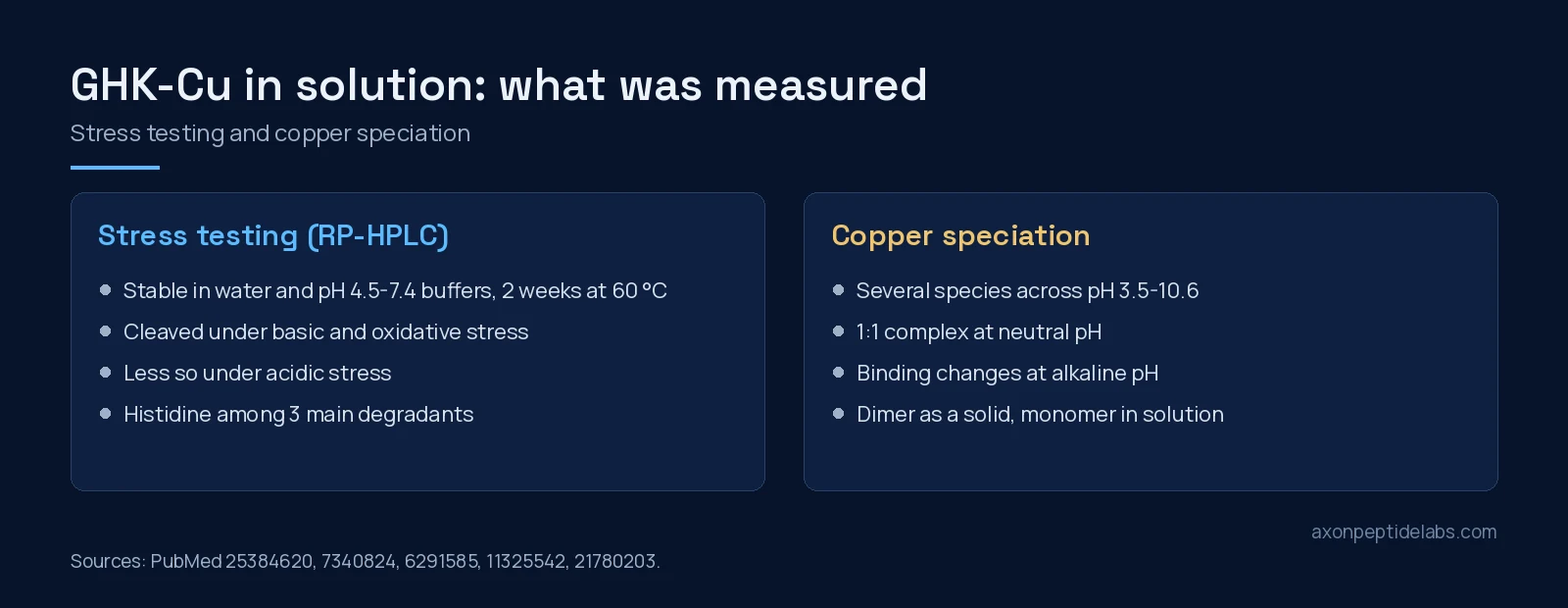
A 2016 preformulation study measured GHK-Cu with a validated stability-indicating reversed-phase HPLC method. The peptide was susceptible to hydrolytic cleavage under basic and oxidative stress, and to a lesser extent acidic stress, following first-order degradation. It was stable in water and in pH 4.5 to 7.4 buffers for at least two weeks at 60 °C. HPLC with mass spectrometry identified three main degradation products, one of them histidine. The complex was highly hydrophilic, and it was less stable in the presence of the negatively charged lipid dicetyl phosphate [4].
So the useful questions about any solution of GHK-Cu are about its pH, oxidants and other ingredients, not only its temperature history.
The copper complex in solution
GHK-Cu is not a single fixed object once dissolved. Potentiometric and spectroscopic work across pH 3.5 to 10.6 found multiple copper species in solution, plus ternary complexes when histidine was present [5]. At neutral pH the main species is a 1:1 complex with nitrogen coordination; at higher pH the copper environment changes, although the histidine imidazole stays bound [7]. Another study reported complexes of different stoichiometries, including binuclear species, and found that the lysine side-chain amine joins copper binding only at alkaline pH [8].
The dry and dissolved forms also differ structurally. GHK-Cu is dimeric in the solid state and monomeric in solution, and in solution it exchanges copper quickly and forms ternary complexes with glycine or histidine [6][7]. A freeze-dried cake and a solution are therefore different starting points even when the label is the same.
Side by side
| Question | GHK-Cu vial | GHK-Cu pen |
|---|---|---|
| Physical state on arrival | Lyophilized solid; lab prepares its own solution | Pre-formatted cartridge with a stated amount |
| Strength options on the listing | See listing | 50 mg or 100 mg |
| Who controls preparation | Your lab: solvent, concentration, timing | Fixed before it reaches you |
| Main stability questions | Moisture and storage of the dry solid [1] | Solution chemistry: pH, oxidation, other ingredients [2][4] |
| Copper species | Solid-state dimer until dissolved [6] | pH-dependent species in solution [5][7] |
| Shipping | Standard Canada shipping | Made to order; ships Monday to Wednesday with an ice pack |
| Documentation | Batch COA in the COA library | Batch COA; the 100 mg pen shares a listed batch with the 100 mg vial |
A third route: fill your own pen
The Peptide Pen Kit is supplied empty, with no peptide. It contains a disposable pen, an empty 3 mL cartridge, 10 mL of bacteriostatic water and 10 pen needles, and the cartridge is filled with a solution the lab prepares from a vial. That keeps preparation in your hands while using a pen-style cartridge. Bacteriostatic water is also listed on its own. For how the same choice plays out for a larger peptide, see retatrutide pen vs vial.
Documentation to check for either format
- Batch match. The GHK-Cu listing names a 100 mg batch, MP-GHKC-100-041626, with a reported purity of 99.72% dated 29 April 2026, and lists the same batch for the 100 mg pen. Match the batch number on what you receive to the report.
- Method. Check that purity was measured by HPLC and identity by mass spectrometry, and read the test date and the lab name.
- What a purity figure covers. As the pen listing itself notes, a purity result is one measurement, not proof of sterility, stability or suitability for every protocol.
- Storage on arrival. Follow the label and product page, and log the date each item is received and opened.
Limits of this comparison
- The formulation reviews are about proteins in general, not GHK-Cu [1][2][3].
- The GHK-Cu stress study ran in water, buffers and with formulation excipients; its results do not describe any particular cartridge [4].
- Neither format has published head-to-head stability data in this article; the comparison is about workflow and chemistry, not a measured shelf life.
Sourcing for laboratory work
For GHK-Cu in Canada, Axon lists the GHK-Cu research pen in 50 mg and 100 mg and the GHK-Cu copper peptide vial. Batch reports are in the Axon COA library, and the GHK-Cu research overview covers what the compound is. Labs building a wider panel can buy lab-tested peptides in Canada from the full catalogue.
Frequently asked questions
What is the difference between a GHK-Cu vial and a GHK-Cu pen?
The vial holds lyophilized GHK-Cu that the lab prepares itself. The pen is a pre-formatted cartridge holding a stated amount, 50 mg or 100 mg, chosen to cut reconstitution steps.
Is a lyophilized vial more stable than a solution?
Formulation reviews describe freeze-dried solids as the usual route to longer shelf life, with solutions open to more degradation pathways. GHK-Cu itself was stable in water and pH 4.5 to 7.4 buffers under heat stress but degraded under basic and oxidative stress.
Does pH matter for GHK-Cu in solution?
Yes. Studies found several copper species across the pH range, a 1:1 complex at neutral pH, and changes in copper binding at alkaline pH.
Can I fill my own research pen with GHK-Cu?
The Peptide Pen Kit is supplied empty with no peptide. Its cartridge is filled with a solution the lab prepares from vial material.
Where can I buy GHK-Cu in Canada for research?
Axon Peptide Labs lists a GHK-Cu vial and a GHK-Cu pen in 50 mg and 100 mg options, with batch COAs in its COA library. Both are for laboratory research use only.
References
- Wang W (2000). Lyophilization and development of solid protein pharmaceuticals. Int J Pharm. PMID: 10967427. doi: 10.1016/s0378-5173(00)00423-3.
- Wang W (1999). Instability, stabilization, and formulation of liquid protein pharmaceuticals. Int J Pharm. PMID: 10460913. doi: 10.1016/s0378-5173(99)00152-0.
- Manning MC, Chou DK, Murphy BM et al. (2010). Stability of protein pharmaceuticals: an update. Pharm Res. PMID: 20143256. doi: 10.1007/s11095-009-0045-6.
- Badenhorst T, Svirskis D, Wu Z (2016). Physicochemical characterization of native glycyl-l-histidyl-l-lysine tripeptide for wound healing and anti-aging: a preformulation study for dermal delivery. Pharm Dev Technol. PMID: 25384620. doi: 10.3109/10837450.2014.979944.
- Lau SJ, Sarkar B (1981). The interaction of copper(II) and glycyl-L-histidyl-L-lysine, a growth-modulating tripeptide from plasma. Biochem J. PMID: 7340824. doi: 10.1042/bj1990649.
- Hureau C, Eury H, Guillot R et al. (2011). X-ray and solution structures of Cu(II) GHK and Cu(II) DAHK complexes: influence on their redox properties. Chemistry. PMID: 21780203. doi: 10.1002/chem.201100751.
- Freedman JH, Pickart L, Weinstein B et al. (1982). Structure of the Glycyl-L-histidyl-L-lysine–copper(II) complex in solution. Biochemistry. PMID: 6291585. doi: 10.1021/bi00262a004.
- Conato C, Gavioli R, Guerrini R et al. (2001). Copper complexes of glycyl-histidyl-lysine and two of its synthetic analogues: chemical behaviour and biological activity. Biochim Biophys Acta. PMID: 11325542. doi: 10.1016/s0304-4165(01)00127-1.