
Retatrutide Storage and Stability: Handling a Lyophilized Peptide
For laboratory research only. Not for human or animal use. This article gives no dosing, administration or therapeutic advice.
Short answer: Retatrutide (LY3437943) is a single peptide with agonist activity at the glucagon, GIP and GLP-1 receptors [1]. Peptides and proteins are freeze-dried mainly because they are less stable in solution [2][3], but a dry powder is not automatically safe from damage. In published stability work on lyophilized proteins, residual moisture, storage temperature relative to the glass transition, light, freeze-thaw cycles and the choice of reconstitution liquid all changed how much degradation or aggregation appeared [4][5][6][8][10][12]. None of these studies tested retatrutide itself, so they describe risks to plan around rather than a shelf life for any vial.
What retatrutide is, chemically
LY3437943, now known as retatrutide, was described in 2022 as a triple agonist peptide at the glucagon receptor (GCGR), the GIP receptor (GIPR) and the GLP-1 receptor (GLP-1R). In vitro it showed balanced GCGR and GLP-1R activity with more GIPR activity [1]. Axon lists it as GLP-3 (retatrutide), in 10mg and 20mg vials; the product page notes it is not pre-mixed. Being a peptide, it falls under the same general physical and chemical instability pathways reviewed for peptide and protein materials [7].
Why peptides are freeze-dried
Wang’s 1999 review notes that protein pharmaceuticals usually have to be stored cold or freeze-dried to reach an acceptable shelf life, and it covers instability in aqueous solution, including under freeze-thawing and drying [3]. The companion review on lyophilization adds two cautions. The process itself creates freezing and drying stresses that can denature proteins to various degrees, and even a well-stabilized solid may still have limited long-term storage stability [2]. Manning and colleagues’ 2010 update separates chemical instability (covalent changes) from physical instability (unfolding, aggregation) and discusses how the two interact, in solution and in the dried state [7].
For a lab, the practical point is that the dry cake is the more stable form of the material, and most of the variables below are about keeping it that way until the moment it is used.
Moisture: not simply “the drier the better”
An early study on lyophilized tissue plasminogen activator (tPA) estimated the water needed to cover the protein’s polar groups as a monolayer. Samples dried below that level turned opalescent on reconstitution, while samples at or above it lost more biological activity under temperature stress. The authors concluded that “the drier the better” may not hold for tPA and that an optimum residual moisture balances physical and biological stability [4].
A later study of a lyophilized monoclonal antibody varied residual moisture from 1 to 8%. The glass transition temperature (Tg) fell from 80 °C at 1% moisture to 25 °C at 8%. All formulations were stable at 5 °C. Higher-moisture cakes aggregated faster when stored above their Tg, and higher moisture increased aspartate isomerization at elevated temperatures whether the cake was above or below Tg [5].
What a lab can take from this is narrow but useful: moisture uptake changes a dry peptide’s behaviour, which is why vials stay sealed until use and why a cake that looks wet, shrunken or collapsed is worth recording before anything else is done with it.
Temperature and the glass transition
In ten freeze-dried interleukin-1 receptor antagonist formulations with Tg values from 20 to 56 °C, deamidation and aggregation were greatly accelerated above Tg, and some formulations still degraded below it. The authors’ conclusion was that storage below Tg is necessary but not sufficient. In a second experiment, protein that had partly unfolded during freeze-drying degraded more during storage at 50 °C, even below Tg [6]. Together with the antibody data above [5], this is the basis for keeping freeze-dried peptides cold and away from heat during receipt and storage, and for not treating a warm excursion as harmless just because the powder still looks dry.
Light
A review titled “Protect from light” lists tryptophan, tyrosine, phenylalanine and cysteine/cystine as the residues that undergo primary photooxidation, and notes that light-induced damage can change primary, secondary and tertiary structure [8]. A 2020 review adds that UV A and visible light can drive photo-degradation of therapeutic proteins, through protein structure, oxidative modifications or impurities [9]. Keeping vials in their box or an opaque container is a low-cost way to remove this variable.
Freeze-thaw and aggregation in solution
Once a peptide is in solution, freezing and thawing become a stress of their own. A 2021 study on protein drug products notes that aggregation can arise during freeze-thaw, manufacturing, shipping and storage, and that freezing and thawing cause complex physical and chemical changes [10]. Work on liraglutide, a GLP-1 agonist peptide, showed that its oligomer state affected its tendency to aggregate and form fibrils, and that a lyophilized powder kept the oligomer state carried over from synthesis and purification [11]. That is a GLP-1 analogue, not retatrutide, but it shows that incretin-type peptides can have aggregation behaviour set before the vial is ever opened.
Reconstitution liquid matters
In a study of a lyophilized interleukin-1 receptor antagonist, reconstituting with 0.9% benzyl alcohol caused more aggregation than reconstituting with water, and the extent depended on how much native structure the protein had kept through freeze-drying. Benzyl alcohol did not accelerate aggregation during later room-temperature storage, and the authors suggested that keeping reconstituted samples at reduced temperature could lower the risk of preservative-induced aggregation [12]. Axon’s own product page carries a related caution: some peptides may turn cloudy, thick or gel-like depending on the reconstitution solution. If your method uses bacteriostatic water, record that choice with the lot.
Solid vs solution at a glance
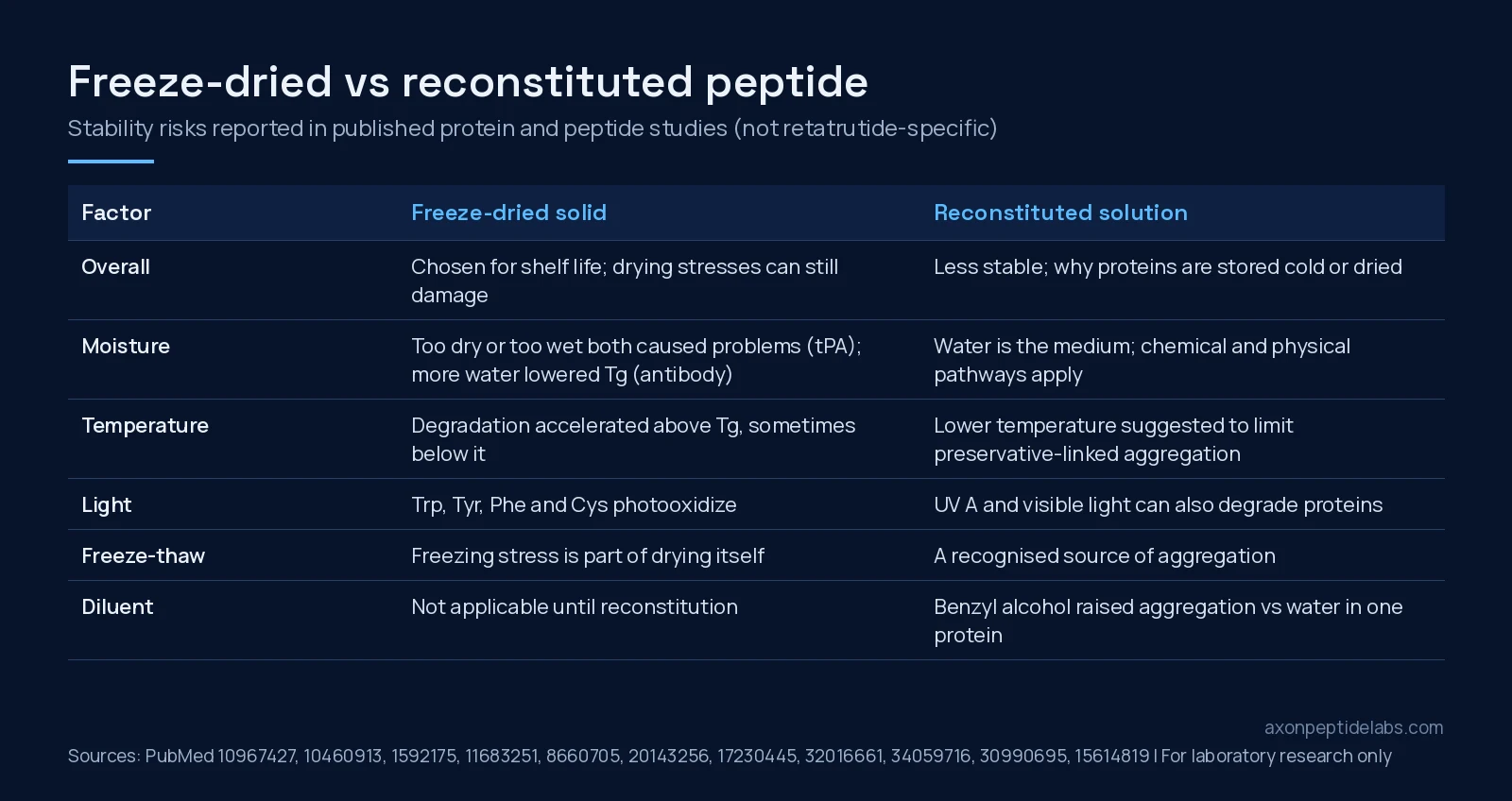
| Factor | Freeze-dried solid | Reconstituted solution |
|---|---|---|
| Overall | The form chosen for shelf life; drying stresses can still leave damage [2] | Less stable; the reason proteins are stored cold or dried [3] |
| Moisture | Too dry or too wet both caused problems in tPA [4]; more water lowered Tg in an antibody cake [5] | Chemical and physical instability pathways both apply in solution [7] |
| Temperature | Degradation accelerated above Tg and sometimes below it [6] | Lower storage temperature suggested to limit preservative-linked aggregation [12] |
| Light | Aromatic and sulphur-containing residues photooxidize [8] | UV A and visible light can also degrade proteins [9] |
| Freeze-thaw | Freezing stress is part of the drying process itself [2] | A recognised source of aggregation [10] |
| Diluent | Not applicable until reconstitution | Benzyl alcohol increased aggregation vs water in one protein [12] |
A lab handling record for a freeze-dried peptide
- On arrival: lot number, arrival date, packaging condition and the appearance of the cake.
- Storage: where the sealed vial was kept, protected from light, and any temperature excursion.
- Reconstitution: the date, the liquid used and its lot, and the appearance of the solution (clear, cloudy or gel-like).
- After reconstitution: storage location, any freeze-thaw cycles, and the date the material was discarded.
- Documentation: the matching certificate from the COA library.
These records do not prove stability, but they let a lab connect an odd result to a handling event rather than to the peptide.
Limits of this evidence
- No retatrutide-specific stability data. The moisture, temperature, light, freeze-thaw and preservative findings come from tPA, antibodies, interleukin-1 receptor antagonist and liraglutide [4][5][6][12][11].
- Formulations differ. The studied cakes contained stabilizers such as sucrose [6][5]; a research vial’s composition may not match.
- Accelerated conditions. Several results come from storage at up to 50 °C, used to speed up degradation [5][6], not from ordinary cold storage.
- No shelf life is implied. Nothing here sets an expiry; follow the label and your institution’s procedures.
Sourcing for laboratory work
Axon supplies GLP-3 (retatrutide) vials in 10mg and 20mg for in vitro research; if you plan to buy retatrutide in Canada, the retatrutide Canada page lists vials, pens and batch documentation together. For the format choice, see retatrutide pen vs vial, and for how it compares with other incretin peptides, retatrutide vs mazdutide. To buy lab-tested peptides in Canada, check the relevant batch in our COA library first.
Frequently asked questions
Why is retatrutide supplied freeze-dried?
Peptides and proteins are generally less stable in solution, so they are freeze-dried or stored cold to reach an acceptable shelf life. Freeze-drying has its own stresses, so a dry cake is more stable but not immune to damage.
Does moisture affect a lyophilized peptide?
Yes, in published protein studies. In tPA, both over-drying and higher moisture caused problems, and in a lyophilized antibody more residual moisture lowered the glass transition temperature and increased some degradation at elevated temperatures.
Why does light matter for peptide storage?
Residues such as tryptophan, tyrosine, phenylalanine and cysteine can photooxidize, and UV A and visible light have been linked to protein photo-degradation. Keeping vials in their box removes this variable.
Is there published stability data for retatrutide itself?
Not in the sources cited here. The findings on moisture, temperature, light, freeze-thaw and preservatives come from other proteins and from liraglutide, so they describe risks rather than a shelf life for retatrutide.
Where can I buy retatrutide in Canada for research?
Axon lists GLP-3 (retatrutide) in 10mg and 20mg vials for laboratory research only. Match the lot on your vial to a certificate in the COA library before use.
References
- Coskun T, Urva S, Roell WC et al. (2022). LY3437943, a novel triple glucagon, GIP, and GLP-1 receptor agonist for glycemic control and weight loss: From discovery to clinical proof of concept. Cell Metab. PMID: 35985340. doi: 10.1016/j.cmet.2022.07.013.
- Wang W (2000). Lyophilization and development of solid protein pharmaceuticals. Int J Pharm. PMID: 10967427. doi: 10.1016/s0378-5173(00)00423-3.
- Wang W (1999). Instability, stabilization, and formulation of liquid protein pharmaceuticals. Int J Pharm. PMID: 10460913. doi: 10.1016/s0378-5173(99)00152-0.
- Hsu CC, Ward CA, Pearlman R et al. (1992). Determining the optimum residual moisture in lyophilized protein pharmaceuticals. Dev Biol Stand. PMID: 1592175.
- Breen ED, Curley JG, Overcashier DE et al. (2001). Effect of moisture on the stability of a lyophilized humanized monoclonal antibody formulation. Pharm Res. PMID: 11683251. doi: 10.1023/a:1013054431517.
- Chang BS, Beauvais RM, Dong A et al. (1996). Physical factors affecting the storage stability of freeze-dried interleukin-1 receptor antagonist: glass transition and protein conformation. Arch Biochem Biophys. PMID: 8660705. doi: 10.1006/abbi.1996.0305.
- Manning MC, Chou DK, Murphy BM et al. (2010). Stability of protein pharmaceuticals: an update. Pharm Res. PMID: 20143256. doi: 10.1007/s11095-009-0045-6.
- Kerwin BA, Remmele RL Jr (2007). Protect from light: photodegradation and protein biologics. J Pharm Sci. PMID: 17230445. doi: 10.1002/jps.20815.
- Schöneich C (2020). Photo-Degradation of Therapeutic Proteins: Mechanistic Aspects. Pharm Res. PMID: 32016661. doi: 10.1007/s11095-020-2763-8.
- Jain K, Salamat-Miller N, Taylor K (2021). Freeze-thaw characterization process to minimize aggregation and enable drug product manufacturing of protein based therapeutics. Sci Rep. PMID: 34059716. doi: 10.1038/s41598-021-90772-9.
- Bothe JR, Andrews A, Smith KJ et al. (2019). Peptide Oligomerization Memory Effects and Their Impact on the Physical Stability of the GLP-1 Agonist Liraglutide. Mol Pharm. PMID: 30990695. doi: 10.1021/acs.molpharmaceut.9b00106.
- Roy S, Jung R, Kerwin BA et al. (2005). Effects of benzyl alcohol on aggregation of recombinant human interleukin-1-receptor antagonist in reconstituted lyophilized formulations. J Pharm Sci. PMID: 15614819. doi: 10.1002/jps.20258.