
GHK-Cu Research Overview: Copper Tripeptide Basics
For laboratory research only. Not for human or animal use. This article gives no dosing, administration or therapeutic advice.
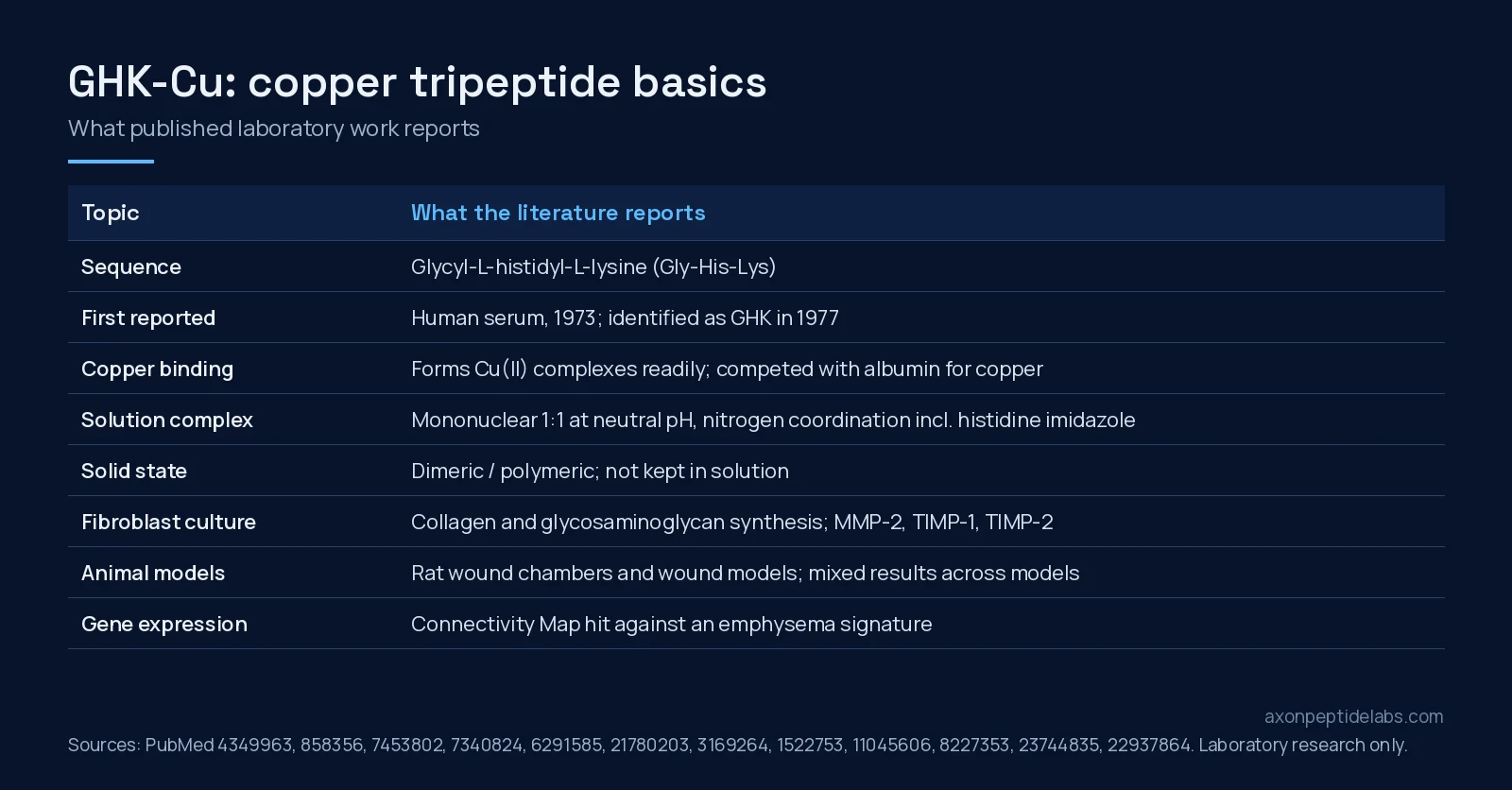
Short answer: GHK is the tripeptide glycyl-L-histidyl-L-lysine. It was reported in human serum in 1973 [1] and identified by sequence in 1977 [2]. It binds copper(II) readily, and in 1980 the copper complex was shown to enhance copper uptake into cultured hepatoma cells [3]. At neutral pH in solution it forms a 1:1 copper complex coordinated through nitrogen atoms, one of them from the histidine ring [4]. Most laboratory work on GHK-Cu since then has looked at extracellular matrix production in fibroblast cultures [5][6], matrix remodelling enzymes [7], rat wound models [8] and gene-expression signatures [9].
Where GHK came from
The first report described a tripeptide in human serum that prolonged survival of normal liver cells and stimulated growth in neoplastic liver cells [1]. A 1977 paper identified this growth-modulating serum tripeptide as glycyl-histidyl-lysine [2]. During later isolation work, the peptide kept co-purifying with roughly equimolar copper and about one-fifth molar iron, which pointed the research toward metal binding [3].
That metal association turned out to matter for chemistry as well as biology. In a 1979 isolation study, copper and iron interfered with several purification steps, and removing them with a chelating resin raised recovery of labelled peptide from plasma eight-fold [10]. A 2015 review describes GHK as present in human plasma, saliva and urine and declining with age [11]; that statement comes from the review and is not something this article tested.
How GHK holds copper
At physiological pH in vitro, GHK associated with copper, cobalt, iron, nickel, zinc and several other transition metals, but showed no affinity for calcium, potassium or sodium [12]. Potentiometric titration and visible spectroscopy found several copper species across pH 3.5 to 10.6, and equilibrium dialysis showed GHK could compete with albumin for copper(II): at equimolar albumin and peptide, about 42% of the copper was bound to the peptide [13].
Structure depends on state. In solution at neutral pH, EPR and electron spin-echo work showed a mononuclear 1:1 complex with two or three nitrogens in the equatorial plane, one from the histidyl imidazole; the oxygen-bridged polymeric arrangement seen in the crystal does not exist in solution [4]. A 2011 study confirmed a dimeric solid-state structure and a monomeric solution complex with three nitrogen ligands (the amino terminus, an amide nitrogen and the imidazole), and attributed fast copper exchange to a [Cu(GHK)2] species [14].
Identity at a glance
| Property | What the literature reports |
|---|---|
| Sequence | Glycyl-L-histidyl-L-lysine (Gly-His-Lys) [2] |
| First reported | Human serum, 1973 [1] |
| Metal partners | Copper and other transition metals; no affinity for calcium, potassium, sodium [12] |
| Complex at neutral pH (solution) | Mononuclear 1:1 Cu(II), nitrogen coordination incl. histidine imidazole [4][14] |
| Solid state | Dimeric / polymeric arrangement that is not kept in solution [4][14] |
| Copper competition | Competed with albumin for Cu(II) in equilibrium dialysis [13] |
| Main model systems | Fibroblast cultures, rat wound chambers, gene-expression analysis [5][8][9] |
What lab models study
Collagen and glycosaminoglycans in fibroblast culture
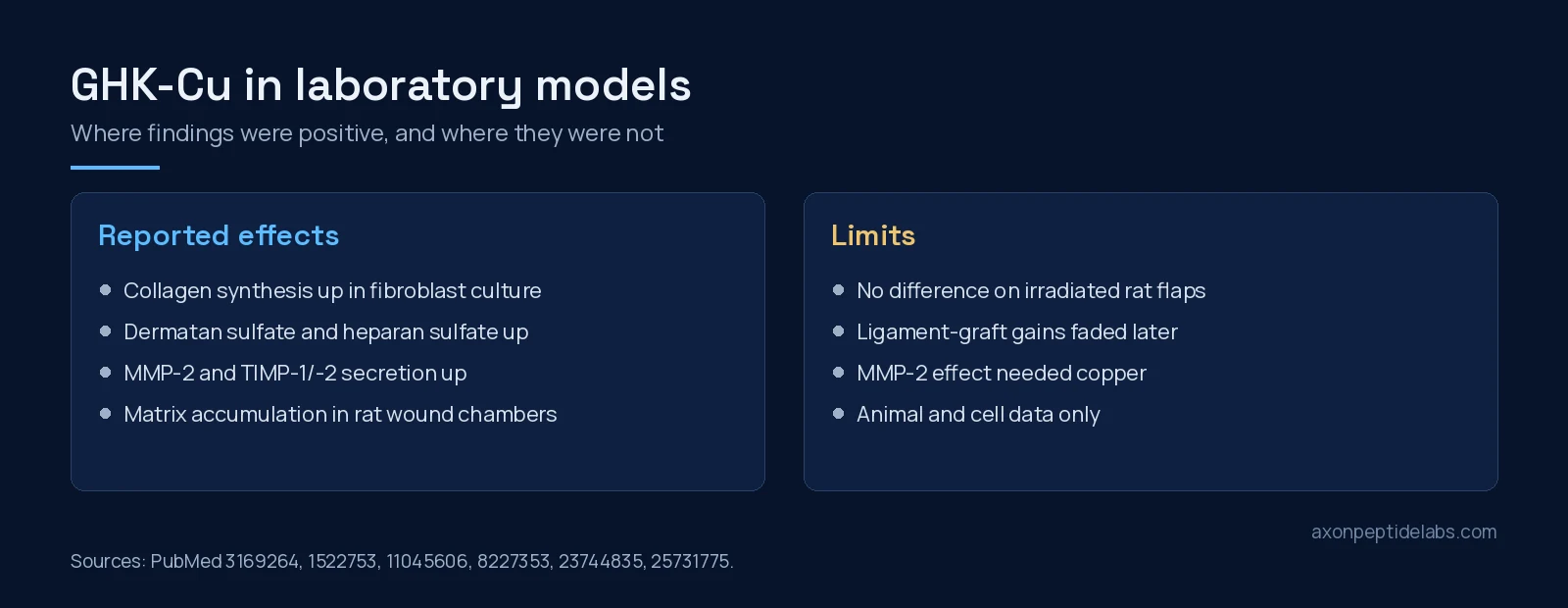
In 1988, GHK-Cu stimulated collagen synthesis by fibroblasts starting between 10-12 and 10-11 M and peaking at 10-9 M, with no change in cell number. The authors noted a GHK triplet in the alpha 2(I) chain of type I collagen and suggested the tripeptide might be released by proteases at a wound site [5]. A follow-up found a biphasic rise in glycosaminoglycan synthesis by human fibroblasts, favouring dermatan sulfate and cell-layer heparan sulfate, with no effect on hyaluronic acid [6].
Remodelling enzymes
GHK-Cu raised MMP-2 protein and mRNA in dermal fibroblast cultures and also increased secretion of the inhibitors TIMP-1 and TIMP-2. Copper ions alone reproduced the MMP-2 effect, while GHK without copper did not [7]. That detail is a reminder to state clearly which form, peptide or copper complex, a study used.
Rat wound models
In stainless-steel wound chambers implanted in rats, GHK-Cu produced a concentration-dependent increase in dry weight, DNA, protein, collagen and glycosaminoglycan content, with higher type I and III collagen mRNA but no change in TGF-beta mRNA; a control tripeptide had no significant effect [8]. In the same model, GHK-Cu raised pro- and active MMP-2 in later healing stages [15]. In ischemic open wounds in rats, a topical copper tripeptide gel reduced wound area and lowered TNF-alpha, MMP-2 and MMP-9 compared with untreated wounds [16].
Gene-expression signatures
A 2012 study built a gene-expression signature of emphysema severity from lung tissue and, using the Connectivity Map, identified GHK as a compound predicted to reverse it. In cultured fibroblasts from COPD lungs, GHK or TGF-beta restored collagen I gel contraction and remodelling [9].
What the evidence does not show
- Results are not uniform. Topical GHK-Cu gel on irradiated rat skin flaps showed no difference from control in flap ischemia, vessel number or VEGF expression [17].
- Effects can be short-lived. In a rat ligament-graft model, early differences between GHK-Cu and saline groups were not present at the later time point [18].
- Peptide and complex are not interchangeable. In fibroblasts the MMP-2 response needed copper; GHK alone did not reproduce it [7].
- Solid and solution are different objects. The crystal structure does not describe the complex in solution [4].
- These are laboratory and animal findings. None of them is evidence of an effect in people.
Sourcing for laboratory work
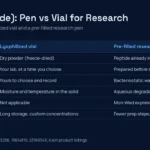
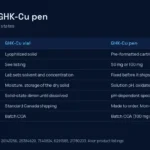
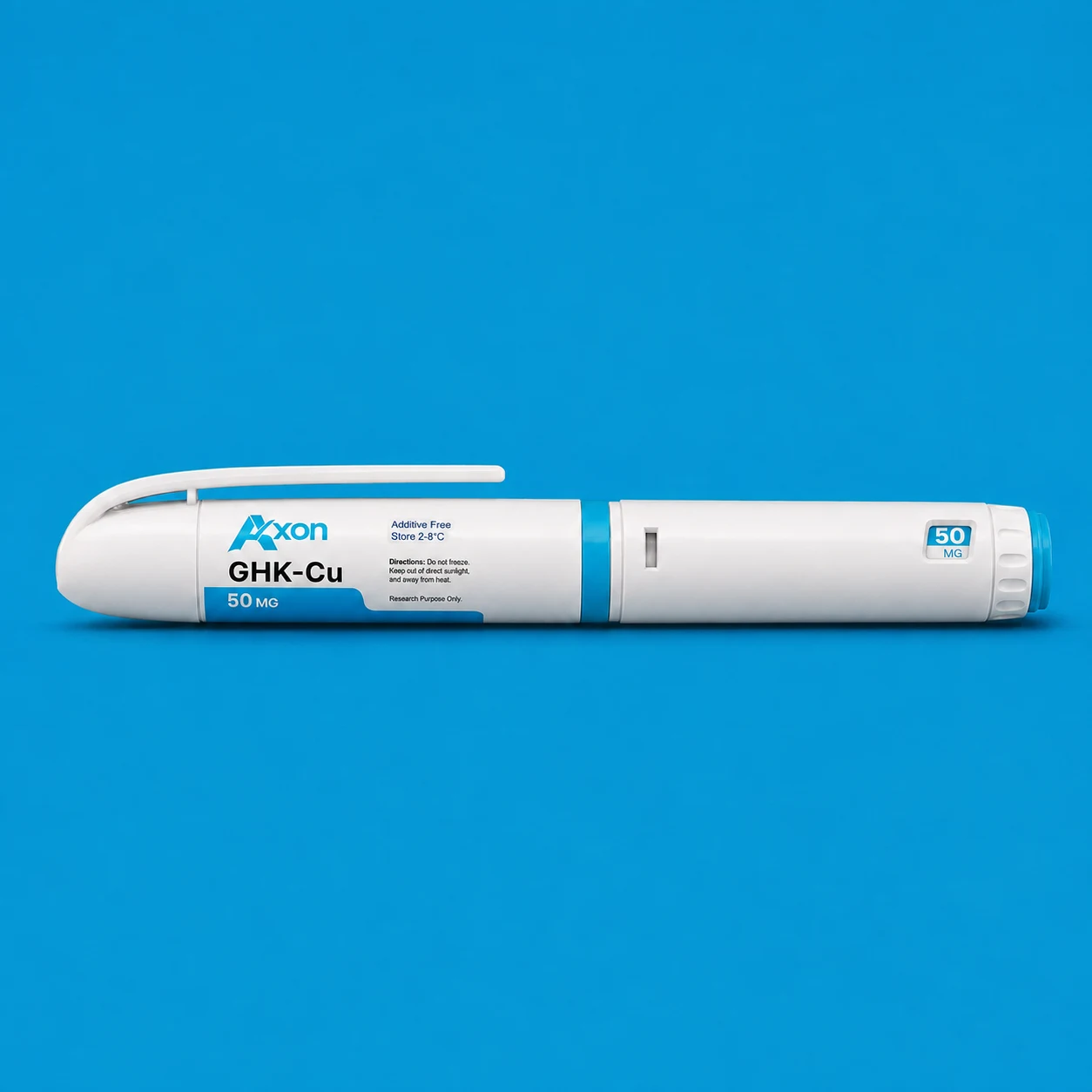
Axon lists GHK-Cu copper peptide in Canada as a vial for research procurement, and the same compound in a GHK-Cu research pen with 50 mg and 100 mg options. The GHK-Cu Canada guide compares the formats. Before ordering, match the batch on your material to the report in the Axon COA library and read the method used for purity and identity. For related reading, see GHK-Cu vs AHK-Cu and GHK-Cu vs Matrixyl. Researchers comparing several compounds can also buy lab-tested peptides in Canada across the full catalogue.
Frequently asked questions
What is GHK-Cu?
GHK-Cu is the copper(II) complex of the tripeptide glycyl-L-histidyl-L-lysine. The peptide was first reported in human serum in 1973 and identified by sequence in 1977.
How does GHK bind copper?
In solution at neutral pH it forms a 1:1 complex in which copper is held by nitrogen atoms, including one from the histidine ring. The solid-state structure is different and is not kept in solution.
What do laboratory studies of GHK-Cu look at?
Mostly extracellular matrix work: collagen and glycosaminoglycan synthesis in fibroblast cultures, matrix metalloproteinases and their inhibitors, rat wound-chamber models and gene-expression signatures.
Is GHK the same as GHK-Cu?
No. GHK is the peptide alone; GHK-Cu is the copper complex. In one fibroblast study the MMP-2 response was seen with GHK-Cu and with copper ions, but not with GHK alone.
Where can I find GHK-Cu peptide in Canada for research?
Axon Peptide Labs lists GHK-Cu as a vial and as a 50 mg or 100 mg research pen, with batch COAs in its COA library. It is sold for laboratory research use only.
References
- Pickart L, Thaler MM (1973). Tripeptide in human serum which prolongs survival of normal liver cells and stimulates growth in neoplastic liver. Nat New Biol. PMID: 4349963.
- Schlesinger DH, Pickart L, Thaler MM (1977). Growth-modulating serum tripeptide is glycyl-histidyl-lysine. Experientia. PMID: 858356. doi: 10.1007/BF02002806.
- Pickart L, Freedman JH, Loker WJ et al. (1980). Growth-modulating plasma tripeptide may function by facilitating copper uptake into cells. Nature. PMID: 7453802. doi: 10.1038/288715a0.
- Freedman JH, Pickart L, Weinstein B et al. (1982). Structure of the Glycyl-L-histidyl-L-lysine–copper(II) complex in solution. Biochemistry. PMID: 6291585. doi: 10.1021/bi00262a004.
- Maquart FX, Pickart L, Laurent M et al. (1988). Stimulation of collagen synthesis in fibroblast cultures by the tripeptide-copper complex glycyl-L-histidyl-L-lysine-Cu2+. FEBS Lett. PMID: 3169264. doi: 10.1016/0014-5793(88)80509-x.
- Wegrowski Y, Maquart FX, Borel JP (1992). Stimulation of sulfated glycosaminoglycan synthesis by the tripeptide-copper complex glycyl-L-histidyl-L-lysine-Cu2+. Life Sci. PMID: 1522753. doi: 10.1016/0024-3205(92)90504-i.
- Siméon A, Emonard H, Hornebeck W et al. (2000). The tripeptide-copper complex glycyl-L-histidyl-L-lysine-Cu2+ stimulates matrix metalloproteinase-2 expression by fibroblast cultures. Life Sci. PMID: 11045606. doi: 10.1016/s0024-3205(00)00803-1.
- Maquart FX, Bellon G, Chaqour B et al. (1993). In vivo stimulation of connective tissue accumulation by the tripeptide-copper complex glycyl-L-histidyl-L-lysine-Cu2+ in rat experimental wounds. J Clin Invest. PMID: 8227353. doi: 10.1172/JCI116842.
- Campbell JD, McDonough JE, Zeskind JE et al. (2012). A gene expression signature of emphysema-related lung destruction and its reversal by the tripeptide GHK. Genome Med. PMID: 22937864. doi: 10.1186/gm367.
- Pickart L, Thaler MM, Millard M (1979). Effect of transition metals on recovery from plasma of the growth-modulating tripeptide glycylhistidyllysine. J Chromatogr. PMID: 546910. doi: 10.1016/s0021-9673(00)86403-1.
- Pickart L, Vasquez-Soltero JM, Margolina A (2015). GHK Peptide as a Natural Modulator of Multiple Cellular Pathways in Skin Regeneration. Biomed Res Int. PMID: 26236730. doi: 10.1155/2015/648108.
- Pickart L, Thaler MM (1980). Growth-modulating tripeptide (glycylhistidyllysine): association with copper and iron in plasma, and stimulation of adhesiveness and growth of hepatoma cells in culture by tripeptide-metal ion complexes. J Cell Physiol. PMID: 6246126. doi: 10.1002/jcp.1041020205.
- Lau SJ, Sarkar B (1981). The interaction of copper(II) and glycyl-L-histidyl-L-lysine, a growth-modulating tripeptide from plasma. Biochem J. PMID: 7340824. doi: 10.1042/bj1990649.
- Hureau C, Eury H, Guillot R et al. (2011). X-ray and solution structures of Cu(II) GHK and Cu(II) DAHK complexes: influence on their redox properties. Chemistry. PMID: 21780203. doi: 10.1002/chem.201100751.
- Siméon A, Monier F, Emonard H et al. (1999). Expression and activation of matrix metalloproteinases in wounds: modulation by the tripeptide-copper complex glycyl-L-histidyl-L-lysine-Cu2+. J Invest Dermatol. PMID: 10383745. doi: 10.1046/j.1523-1747.1999.00606.x.
- Canapp SO Jr, Farese JP, Schultz GS et al. (2003). The effect of topical tripeptide-copper complex on healing of ischemic open wounds. Vet Surg. PMID: 14648529. doi: 10.1111/j.1532-950x.2003.00515.x.
- Parker NP, Ardeshirpour F, Schmechel SC et al. (2013). Effects of topical copper tripeptide complex on wound healing in an irradiated rat model. Otolaryngol Head Neck Surg. PMID: 23744835. doi: 10.1177/0194599813492644.
- Fu SC, Cheuk YC, Chiu WY et al. (2015). Tripeptide-copper complex GHK-Cu (II) transiently improved healing outcome in a rat model of ACL reconstruction. J Orthop Res. PMID: 25731775. doi: 10.1002/jor.22831.