
Tesamorelin vs HGH: GHRH Analogue or Growth Hormone Itself?
For laboratory research only. Not for human or animal use. This article gives no dosing, administration or therapeutic advice.
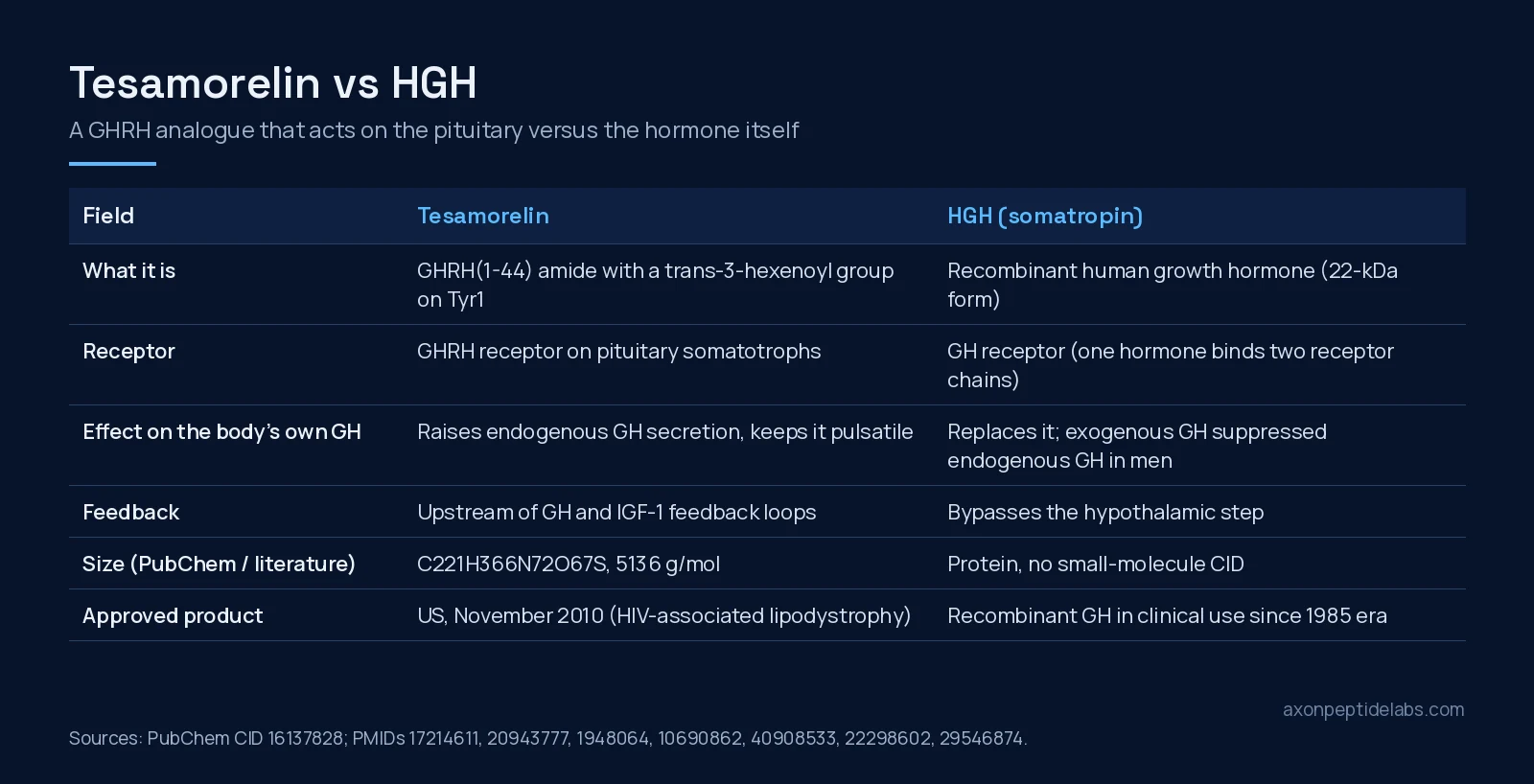
Short answer: tesamorelin is not growth hormone. It is an analogue of growth hormone-releasing hormone, GHRH(1-44) amide with a trans-3-hexenoyl group added to tyrosine 1, which makes it resistant to DPP-4 inactivation [1]. It acts upstream, prompting the pituitary to release its own growth hormone (GH) [2], and in healthy men it raised overnight GH while keeping secretion pulsatile [3]. HGH (somatropin) is the hormone itself: one GH molecule binds two receptor chains and switches on JAK2 signalling directly [4][5].
Upstream versus downstream on one axis
GH is made by somatotroph cells of the anterior pituitary and released in pulses. Hypothalamic factors reaching the pituitary through the portal circulation drive that release, and several negative feedback loops that sense circulating GH or IGF-1 act at both pituitary and hypothalamic levels [6]. Where a compound enters this circuit decides what an experiment measures.
Tesamorelin enters at the top. Its stimulus still passes through the pituitary, so the GH that results is the animal’s own and remains subject to the feedback loops above. Exogenous GH enters below the pituitary. In a phase 1 study in normal men, giving the 20-kDa GH isoform markedly suppressed secretion of the body’s own 22-kDa GH [7], an illustration of the feedback that an added hormone triggers.
Identity at a glance
| Property | Tesamorelin | HGH (somatropin) |
|---|---|---|
| Class | Synthetic GHRH analogue [2] | Recombinant human growth hormone [8] |
| Sequence basis | Human GRF(1-44)NH2 with trans-3-hexenoyl on Tyr1 [1] | Human GH; 22-kDa main form, 20-kDa minor isoform [7] |
| PubChem | CID 16137828; C221H366N72O67S; 5136 g/mol | Not a small-molecule record |
| Development code | TH9507 [1] | Not applicable |
| Target receptor | GHRH receptor (pituitary) | GH receptor, a cytokine-type receptor [4] |
| Main read-out in studies | Endogenous GH pulses and IGF-1 [3] | Direct GH receptor signalling and IGF-1 |
Identity values for tesamorelin are from its PubChem record, not a certificate of analysis. Somatropin is a full protein, so it has no small-molecule CID.
Tesamorelin: what the studies measured
Why the hexenoyl group
The N-terminal modification makes the peptide resistant to dipeptidyl aminopeptidase-IV. The non-clinical package for TH9507 showed it slowed degradation in rat, dog and human plasma in vitro and prolonged plasma elimination in vivo. Repeated administration raised plasma GH and IGF-1 in pigs, rats and dogs. Subchronic studies in rats and dogs found it generally well tolerated, with more pronounced, reversible findings in dogs that the authors attributed to prolonged supraphysiological GH and/or IGF-1 exposure [1].
Pulses, not a flat line
The most informative human pharmacodynamic study gave tesamorelin to 13 healthy men for two weeks, then measured again after two weeks off. Frequent overnight sampling showed increases in mean overnight GH, GH peak area and basal GH secretion, plus a rise in IGF-1. Fasting glucose and insulin-stimulated glucose uptake, measured by clamp, did not change significantly [3]. A population pharmacokinetic analysis across HIV-infected patients and healthy volunteers described tesamorelin with a one-compartment model and found that age, body size, race and health status did not affect its pharmacokinetic parameters in the range studied [9].
Liver tissue
In paired liver biopsies from a randomised trial in people with HIV-associated fatty liver disease, gene set enrichment analysis found tesamorelin increased hepatic expression of oxidative phosphorylation gene sets and decreased expression of inflammation-related gene sets relative to placebo [10].
HGH: what the studies measured
One hormone, two receptors
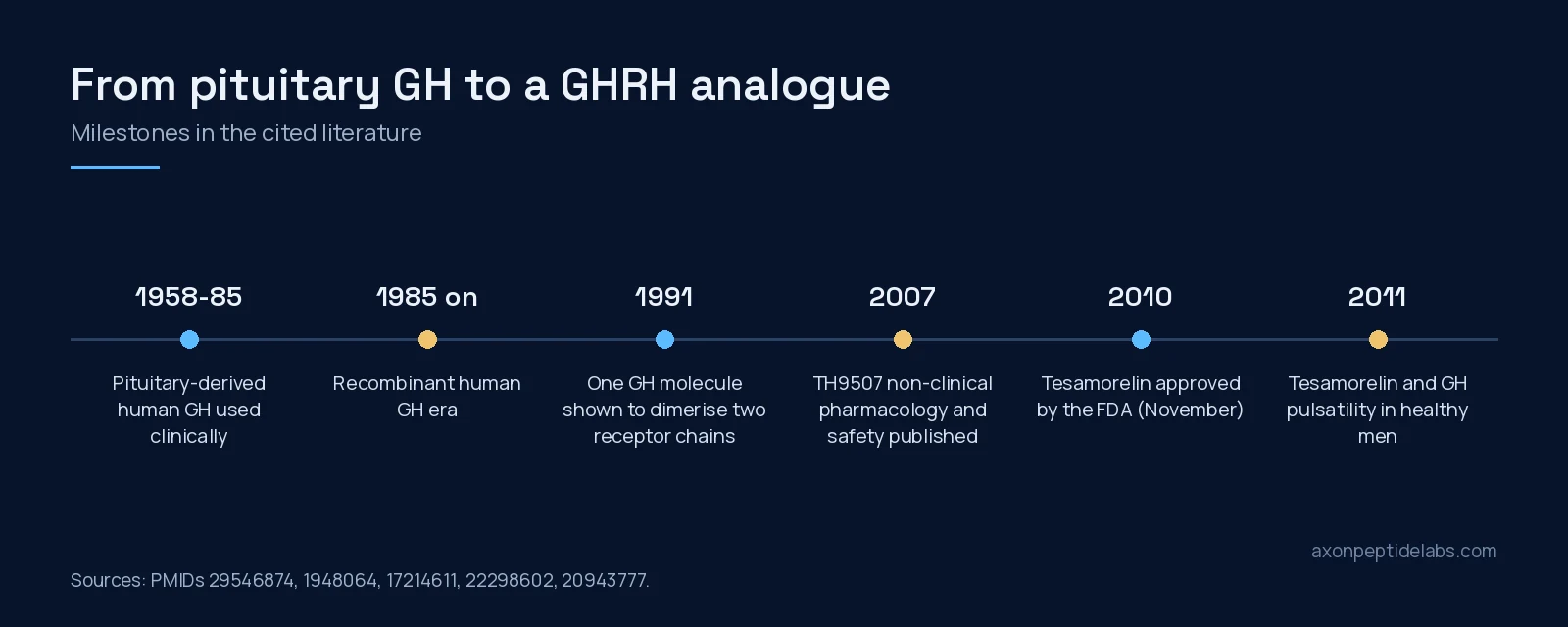
The defining structural fact about GH came in 1991. Human GH formed a 1:2 complex with the extracellular domain of its receptor, binding sequentially through two distinct sites, first site 1 and then site 2. The authors proposed hormone-induced receptor dimerisation as the signalling mechanism for GH and related cytokine receptors [4].
From receptor to nucleus
GH binding activates the tyrosine kinase JAK2, which phosphorylates the receptor and recruits STAT transcription factors, SHC and insulin receptor substrates, leading on to MAP kinase, protein kinase C and PI3-kinase pathways [5]. Later work refined the picture: many such receptors exist as pre-formed dimers, and GH binding rotates and repositions the receptor subunits, sliding the inhibitory pseudokinase domain of one JAK2 away from the kinase domain of the other [11].
Where it came from
Human GH used clinically from 1958 to 1985 was extracted from pituitaries. Since 1985, recombinant human GH has replaced it, and the authors of a 2018 review note that safety questions still accompany its use [8].
Side-by-side research comparison
| Question | Tesamorelin | HGH (somatropin) |
|---|---|---|
| Needs a functioning pituitary? | Yes; it acts through pituitary GH release [2] | No; acts at GH receptors directly [5] |
| Pattern of GH exposure | Endogenous, pulsatile [3] | Set by the exogenous hormone; endogenous GH suppressed [7] |
| Subject to GH/IGF-1 feedback? | Yes, upstream of those loops [6] | Triggers the loops rather than passing through them |
| Typical model questions | GHRH receptor pharmacology, GH pulsatility, liver gene expression | GH receptor activation, JAK2/STAT signalling |
Human trials, by design
Tesamorelin was approved by the US FDA in November 2010 for lipodystrophy associated with HIV infection [12], and recombinant GH is used clinically for GH deficiency and other conditions [8]. We list trial designs and primary endpoints only, with no efficacy results.
- Visceral and liver fat trial (2014). Double-blind, placebo-controlled, 50 antiretroviral-treated adults with HIV and abdominal fat accumulation, six months; primary endpoints were changes in visceral adipose tissue and liver fat [13].
- NAFLD trial (2019). Randomised, double-blind, multicentre, people with HIV and a hepatic fat fraction of at least 5% by proton MR spectroscopy; 12 months against identical placebo, then a six-month open-label phase [14].
- Meta-analysis (2026). Five randomised placebo-controlled trials in adults with HIV, covering body composition, liver, metabolic, hormonal and safety outcomes, rated with RoB 2.0 and GRADE [15].
What the evidence does not show
- No head-to-head trial. We found no study that randomised tesamorelin against somatropin.
- Small pharmacodynamic samples. The pulsatility study enrolled 13 men for two weeks [3].
- The feedback example uses an isoform. The endogenous-suppression data came from the 20-kDa GH form [7], not the 22-kDa form most products contain.
- Approval is product-specific. Neither approval extends to research-grade material.
Sourcing for laboratory work
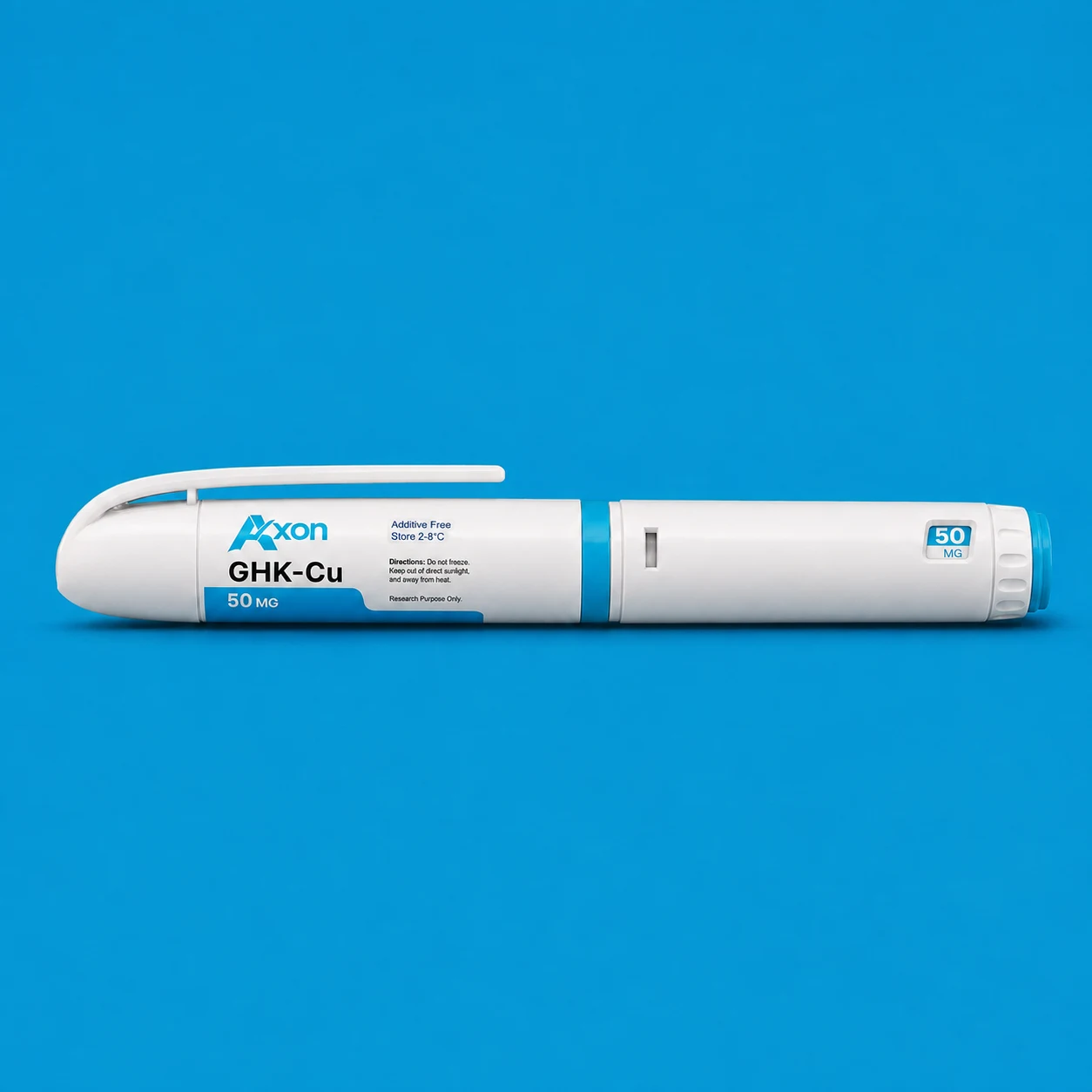
Axon carries tesamorelin 10 mg, also as a 10 mg pen, and HGH 20iu for in vitro and preclinical research. For the other GHRH-side comparison, see sermorelin vs HGH. To buy lab-tested peptides in Canada, check the batch report in our COA library first.
Frequently asked questions
Is tesamorelin the same as HGH?
No. Tesamorelin is a modified growth hormone-releasing hormone, GHRH(1-44) amide with a trans-3-hexenoyl group on tyrosine 1. It prompts the pituitary to release its own GH. HGH (somatropin) is growth hormone itself.
Does tesamorelin keep GH secretion pulsatile?
In a two-week study in 13 healthy men, tesamorelin increased mean overnight GH, GH peak area and basal secretion while secretion remained pulsatile.
How does HGH signal in cells?
One GH molecule binds two GH receptor chains. That activates the kinase JAK2, which recruits STAT transcription factors and other signalling proteins.
Why was the hexenoyl group added to tesamorelin?
It makes the peptide resistant to dipeptidyl aminopeptidase-IV. In non-clinical work this slowed its breakdown in plasma and prolonged its elimination compared with native GHRH.
Is tesamorelin approved?
Tesamorelin (Egrifta) was approved by the US FDA in November 2010 for lipodystrophy associated with HIV infection. Research-grade tesamorelin is not that product and carries no approval.
References
- Ferdinandi ES, Brazeau P, High K et al. (2007). Non-clinical pharmacology and safety evaluation of TH9507, a human growth hormone-releasing factor analogue. Basic Clin Pharmacol Toxicol. PMID: 17214611. doi: 10.1111/j.1742-7843.2007.00008.x.
- Dhillon S (2011). Tesamorelin: a review of its use in the management of HIV-associated lipodystrophy. Drugs. PMID: 21668043. doi: 10.2165/11202240-000000000-00000.
- Stanley TL, Chen CY, Branch KL et al. (2011). Effects of a growth hormone-releasing hormone analog on endogenous GH pulsatility and insulin sensitivity in healthy men. J Clin Endocrinol Metab. PMID: 20943777. doi: 10.1210/jc.2010-1587.
- Cunningham BC, Ultsch M, De Vos AM et al. (1991). Dimerization of the extracellular domain of the human growth hormone receptor by a single hormone molecule. Science. PMID: 1948064. doi: 10.1126/science.1948064.
- Argetsinger LS, Carter-Su C (1996). Mechanism of signaling by growth hormone receptor. Physiol Rev. PMID: 8874495. doi: 10.1152/physrev.1996.76.4.1089.
- de Sousa LMM, Vicente VAN, Donato J Jr (2025). Negative Feedback Loops and Hormonal Factors that Regulate GH Secretion. Endocrinology. PMID: 40908533. doi: 10.1210/endocr/bqaf139.
- Hashimoto Y, Kamioka T, Hosaka M et al. (2000). Exogenous 20K growth hormone (GH) suppresses endogenous 22K GH secretion in normal men. J Clin Endocrinol Metab. PMID: 10690862. doi: 10.1210/jcem.85.2.6377.
- Ranke MB, Wit JM (2018). Growth hormone – past, present and future. Nat Rev Endocrinol. PMID: 29546874. doi: 10.1038/nrendo.2018.22.
- González-Sales M, Barrière O, Tremblay PO et al. (2015). Population pharmacokinetic analysis of tesamorelin in HIV-infected patients and healthy subjects. Clin Pharmacokinet. PMID: 25358450. doi: 10.1007/s40262-014-0202-x.
- Fourman LT, Billingsley JM, Agyapong G et al. (2020). Effects of tesamorelin on hepatic transcriptomic signatures in HIV-associated NAFLD. JCI Insight. PMID: 32701508. doi: 10.1172/jci.insight.140134.
- Waters MJ, Brooks AJ (2015). JAK2 activation by growth hormone and other cytokines. Biochem J. PMID: 25656053. doi: 10.1042/BJ20141293.
- Spooner LM, Olin JL (2012). Tesamorelin: a growth hormone-releasing factor analogue for HIV-associated lipodystrophy. Ann Pharmacother. PMID: 22298602. doi: 10.1345/aph.1Q629.
- Stanley TL, Feldpausch MN, Oh J et al. (2014). Effect of tesamorelin on visceral fat and liver fat in HIV-infected patients with abdominal fat accumulation: a randomized clinical trial. JAMA. PMID: 25038357. doi: 10.1001/jama.2014.8334.
- Stanley TL, Fourman LT, Feldpausch MN et al. (2019). Effects of tesamorelin on non-alcoholic fatty liver disease in HIV: a randomised, double-blind, multicentre trial. Lancet HIV. PMID: 31611038. doi: 10.1016/S2352-3018(19)30338-8.
- Badran AS, Helal A, Shata KS et al. (2026). Body composition, hepatic fat, metabolic, and safety outcomes of Tesamorelin, a GHRH analogue, in HIV-associated lipodystrophy: A meta-analysis of randomized controlled trials. Obes Res Clin Pract. PMID: 41545261. doi: 10.1016/j.orcp.2026.01.002.