
Melanotan I vs PT-141: Afamelanotide and Bremelanotide Compared
For laboratory research only. Not for human or animal use. This article gives no dosing, administration or therapeutic advice.
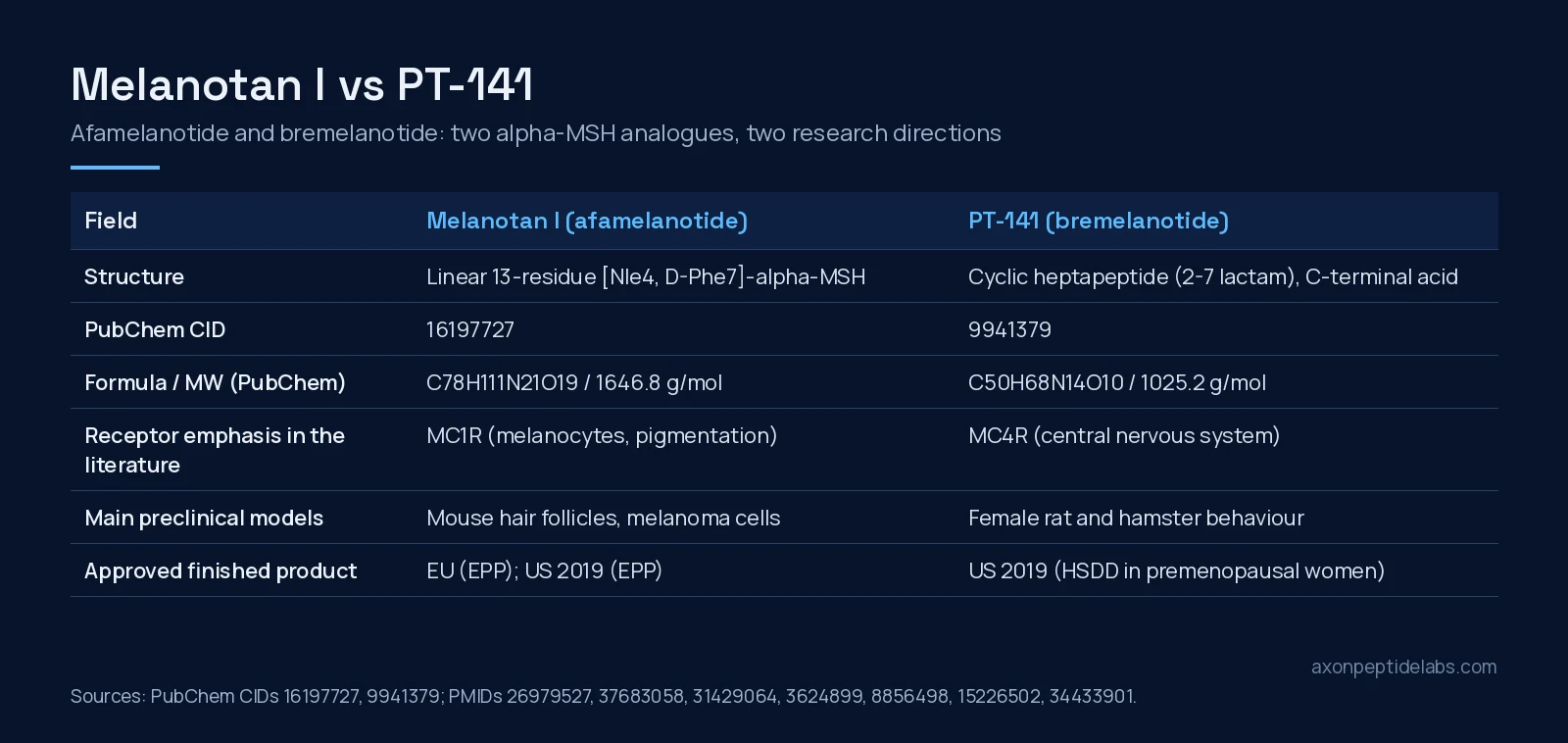
Short answer: Melanotan I and PT-141 are both synthetic analogues of alpha-melanocyte-stimulating hormone (alpha-MSH), but they were developed toward opposite ends of the melanocortin system. Melanotan I is afamelanotide, the linear [Nle4, D-Phe7]-alpha-MSH, described as a first-in-class melanocortin-1 receptor (MC1R) agonist [1]. PT-141 is bremelanotide, a cyclic heptapeptide [2] with high affinity for the melanocortin-4 receptor (MC4R) [3]. One is studied mainly in pigment cells; the other mainly in the brain.
Same hormone, different edits
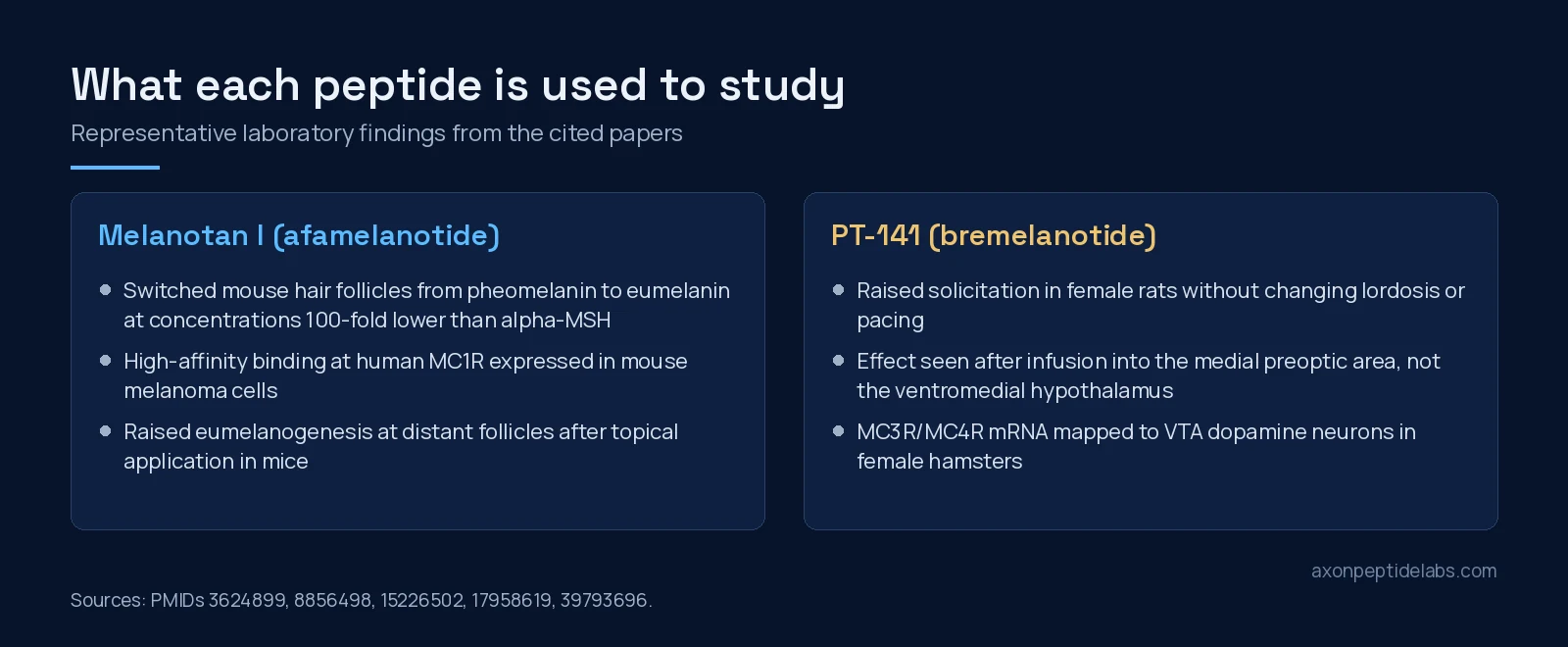
Alpha-MSH regulates pigmentation through MC1R [4]. Afamelanotide keeps the full alpha-MSH length and changes two positions [5]: norleucine at position 4 and D-phenylalanine at position 7. In mice, that analogue and two shorter fragments built on the same changes switched hair follicles from pheomelanin to eumelanin production at concentrations 100-fold lower than native alpha-MSH, which the authors linked to the analogues resisting breakdown [6].
Bremelanotide keeps the core His-D-Phe-Arg-Trp motif but is much shorter and ring-closed: PubChem describes it as N-acetyl-norleucyl-aspartyl-histidyl-D-phenylalanyl-arginyl-tryptophyl-lysine with a lactam bridge between the aspartate and lysine side chains, ending in a free acid. A 2026 medicinal chemistry paper groups bremelanotide with setmelanotide as clinically successful macrocyclic peptides and notes that selective targeting of individual melanocortin receptors is still hard to achieve [7].
Identity at a glance
| Property | Melanotan I (afamelanotide) | PT-141 (bremelanotide) |
|---|---|---|
| PubChem CID | 16197727 | 9941379 |
| CAS (PubChem synonyms) | 75921-69-6 | 189691-06-3 |
| Molecular formula | C78H111N21O19 | C50H68N14O10 |
| Molecular weight | 1646.8 g/mol | 1025.2 g/mol |
| Shape | Linear, full-length alpha-MSH analogue [5] | Cyclic heptapeptide [2] |
| Receptor emphasis | MC1R [1] | MC4R [3] |
| Trade name of the approved product | Scenesse [1] | Vyleesi [3] |
Identity values are from the linked PubChem records, not a certificate of analysis. “Receptor emphasis” describes where each programme focused. Neither peptide is exclusive to one receptor, and both were among the ligands solved bound to MC4R in the 2021 structure paper discussed below.
Melanotan I in the laboratory
Melanocytes and MC1R
The classic cell work used the human MC1R. When the human receptor gene was stably expressed in an amelanotic mouse melanoma clone that lacks its own MC1R, [Nle4, D-Phe7]-alpha-MSH bound with dissociation constants in the sub-nanomolar range, matching values from human melanoma lines; some clones began producing and secreting melanin [8].
Crossing the skin
The same 1987 mouse study applied the analogues topically. Eumelanogenesis increased in hair follicles away from the application site, showing the peptides reached the systemic circulation through the skin [6].
Newer formulations
Formulation research continues. A palmitoylated afamelanotide analogue formed liquid gels and, given to rats as a gel, stayed in circulation for more than 12 days [4]. In patients treated with the approved implant for up to six years, a dedicated ELISA found no anti-drug antibody reactivity in 23 of 26 people tested [5].
PT-141 in the laboratory
Appetitive behaviour in female rats
The key preclinical result came in 2004. In female rats that controlled the timing of contact with males, PT-141 selectively increased solicitation behaviour without changing lordosis, pacing or other sexual behaviours, did not cause general motor activation, and did not change measures of sexual reward [9].
Where in the brain
A follow-up review mapped the site of action. The solicitation effect appeared after peripheral administration and after infusion into the lateral ventricles or the medial preoptic area, but not the ventromedial hypothalamus. Peripheral administration activated the medial preoptic area and other hypothalamic and limbic regions, and the authors proposed a role for dopamine terminals there [10]. In female Syrian hamsters, most MC3R and MC4R mRNA in the mesolimbic system sat in dopamine neurons of the ventral tegmental area, and bremelanotide did not change melanocortin receptor expression in that system [11].
One receptor, both ligands: the MC4R structures
The most direct molecular comparison is structural. A 2021 study reported four high-resolution structures of full-length MC4R coupled to the Gs protein, bound to alpha-MSH, afamelanotide, bremelanotide and the small molecule THIQ. The peptides shared a conserved binding mode, while the small molecule revealed the features behind subtype selectivity [12]. For laboratories, that means the two peptides cannot be separated by how they sit in MC4R; the differences lie in length, ring closure and how each behaves across the wider receptor family.
Human studies, by design
Both peptides exist as approved finished drugs, so we give regulatory status neutrally and trial designs only, with no efficacy results.
| Item | Melanotan I (afamelanotide) | PT-141 (bremelanotide) |
|---|---|---|
| Regulatory status | Approved in the EU for prevention of phototoxicity in adults with erythropoietic protoporphyria (EPP) [1]; approved in the US in 2019 for EPP [13] | Approved in the US for premenopausal women with acquired, generalised hypoactive sexual desire disorder (HSDD) [3] |
| Product form | Biodegradable controlled-release implant [1] | Self-administered, on-demand injection [3] |
| Other human study | Long-term immunogenicity survey in EPP patients [5] | Safety and pharmacokinetic study in healthy men and men with erectile dysfunction [2] |
| Safety study of note | Phase III CUV039 tolerability (headache and implant-site reactions among the common adverse reactions) [1] | Randomised, placebo-controlled ambulatory blood pressure trial in 397 premenopausal women [14] |
The blood pressure trial reflects a known property of MC4R agonists: the authors note that agonists binding MC4R may raise blood pressure, and they recorded small increases relative to placebo, with peaks typically lasting under 15 minutes [14].
What the evidence does not show
- No head-to-head study. We found no study testing Melanotan I against PT-141 in the same behavioural or pigmentation model.
- Receptor profiles are not clean. Both bind MC4R in the same way [12], so “MC1R peptide” and “MC4R peptide” are shorthand for research focus, not selectivity.
- Rodent behaviour is a model. The solicitation findings come from ovariectomised, hormone-primed female rats [10].
- Approval is product-specific. Scenesse and Vyleesi are finished drug products. A research-grade peptide carries no approval.
Sourcing for laboratory work
Axon carries Melanotan I 10 mg and PT-141 10 mg for in vitro and preclinical research. Our Melanotan I vs Melanotan II comparison covers the cyclic analogue PT-141 is often grouped with. To buy lab-tested peptides in Canada, start with the batch details in our COA library.
Frequently asked questions
Is Melanotan I the same as afamelanotide?
Yes. PubChem lists Melanotan as a synonym of afamelanotide, the linear alpha-MSH analogue with norleucine at position 4 and D-phenylalanine at position 7.
Is PT-141 the same as bremelanotide?
Yes. PT-141 is the development code for bremelanotide, a cyclic heptapeptide analogue of alpha-MSH.
Which receptor does each peptide target?
Afamelanotide is described as a first-in-class MC1R agonist and is studied mainly in pigment cells. Bremelanotide is described as having high affinity for MC4R and is studied mainly in the brain. Both bind MC4R in a conserved peptide binding mode.
Are Melanotan I and PT-141 approved drugs?
Afamelanotide is approved as the implant Scenesse for erythropoietic protoporphyria in the EU and, since 2019, the US. Bremelanotide is approved in the US as Vyleesi for HSDD in premenopausal women. Research-grade peptides carry no approval.
What did PT-141 do in female rats?
In a 2004 study it selectively increased solicitation behaviour without changing lordosis, pacing, motor activity or measures of sexual reward.
References
- Kim ES, Garnock-Jones KP (2016). Afamelanotide: A Review in Erythropoietic Protoporphyria. Am J Clin Dermatol. PMID: 26979527. doi: 10.1007/s40257-016-0184-6.
- Rosen RC, Diamond LE, Earle DC et al. (2004). Evaluation of the safety, pharmacokinetics and pharmacodynamic effects of subcutaneously administered PT-141, a melanocortin receptor agonist, in healthy male subjects and in patients with an inadequate response to Viagra. Int J Impot Res. PMID: 14999221. doi: 10.1038/sj.ijir.3901200.
- Dhillon S, Keam SJ (2019). Bremelanotide: First Approval. Drugs. PMID: 31429064. doi: 10.1007/s40265-019-01187-w.
- Chang CL, Cai Z, Hsu SYT (2023). A gel-forming α-MSH analog promotes lasting melanogenesis. Eur J Pharmacol. PMID: 37673364. doi: 10.1016/j.ejphar.2023.176008.
- Lengweiler S, Kreim S, Barman-Aksözen J et al. (2015). Evaluation of the immunogenicity of the synthetic α-melanocyte-stimulating hormone (α-MSH) analogue afamelanotide ([Nle4-D-Phe7]-α-MSH, Scenesse®) in erythropoietic protoporphyria patients by ELISA detecting both anti-afamelanotide and anti-α-MSH antibodies. Skin Pharmacol Physiol. PMID: 25402764. doi: 10.1159/000362174.
- Levine N, Lemus-Wilson A, Wood SH et al. (1987). Stimulation of follicular melanogenesis in the mouse by topical and injected melanotropins. J Invest Dermatol. PMID: 3624899. doi: 10.1111/1523-1747.ep12471337.
- Merlino F, Jia L, Boccino I et al. (2026). Goldilocks-Inspired Design of Mid-Size Macrocycles for Selective Targeting of Human Melanocortin Receptors. J Med Chem. PMID: 42340853. doi: 10.1021/acs.jmedchem.6c01074.
- Chluba-de Tapia J, Bagutti C, Cotti R et al. (1996). Induction of constitutive melanogenesis in amelanotic mouse melanoma cells by transfection of the human melanocortin-1 receptor gene. J Cell Sci. PMID: 8856498. doi: 10.1242/jcs.109.8.2023.
- Pfaus JG, Shadiack A, Van Soest T et al. (2004). Selective facilitation of sexual solicitation in the female rat by a melanocortin receptor agonist. Proc Natl Acad Sci U S A. PMID: 15226502. doi: 10.1073/pnas.0400491101.
- Pfaus J, Giuliano F, Gelez H (2007). Bremelanotide: an overview of preclinical CNS effects on female sexual function. J Sex Med. PMID: 17958619. doi: 10.1111/j.1743-6109.2007.00610.x.
- Borland JM, Kohut-Jackson AL, Peyla AC et al. (2025). Female Syrian hamster analyses of bremelanotide, a US FDA approved drug for the treatment of female hypoactive sexual desire disorder. Neuropharmacology. PMID: 39793696. doi: 10.1016/j.neuropharm.2025.110299.
- Zhang H, Chen LN, Yang D et al. (2021). Structural insights into ligand recognition and activation of the melanocortin-4 receptor. Cell Res. PMID: 34433901. doi: 10.1038/s41422-021-00552-3.
- Resnik SR, Targett D, Resnik BI (2023). Into the Light: Afamelanotide and the Treatment of Erythropoietic Protoporphyria in the United States. J Drugs Dermatol. PMID: 37683058. doi: 10.36849/JDD.7126.
- White WB, Myers MG, Jordan R et al. (2017). Usefulness of ambulatory blood pressure monitoring to assess the melanocortin receptor agonist bremelanotide. J Hypertens. PMID: 27977473. doi: 10.1097/HJH.0000000000001221.