
GHK-Cu vs Matrixyl: Copper Tripeptide vs Palmitoyl Pentapeptide-4
For laboratory research only. Not for human or animal use. This article gives no dosing, administration or therapeutic advice.
Short answer: GHK-Cu and Matrixyl are both small peptides studied for their effects on the extracellular matrix, but they come from different proteins and were developed for different purposes. GHK (glycyl-histidyl-lysine) is a tripeptide found in human plasma that binds copper(II); as GHK-Cu it stimulated collagen synthesis in fibroblast cultures and connective tissue accumulation in rat wound chambers[1][2]. Matrixyl is the trade name for palmitoyl pentapeptide-4 (Pal-KTTKS), a fatty-acid-modified version of the pentapeptide Lys-Thr-Thr-Lys-Ser, which is the minimum sequence from type I procollagen needed to stimulate collagen and fibronectin production in mesenchymal cells[3]. GHK-Cu has a broad laboratory literature across wound, lung, gut and gene-expression models; Pal-KTTKS is almost entirely a cosmetic ingredient, designed to get a matrix signal into skin. The two even overlap commercially: a later product, Matrixyl 3000, contains palmitoyl tripeptide-1, which is palmitoylated GHK[4].
Two matrix signals with different origins
GHK came from blood. A growth-modulating tripeptide in human serum was identified as glycyl-histidyl-lysine in 1977[5]. During its isolation it co-purified with roughly equimolar copper, and its maximal effects on hepatoma cells were seen when copper and iron were added with it, which led to the proposal that it works partly by facilitating copper uptake into cells[6]. Spectroscopy showed that at neutral pH it forms a 1:1 copper(II) complex with the metal coordinated by nitrogen atoms, one from the histidine imidazole ring[7]. The 1988 collagen study added a structural clue: a GHK triplet sits in the alpha-2(I) chain of type I collagen, so the tripeptide might be released by proteases at a wound site[1].
KTTKS came from procollagen. Katayama and colleagues had shown that a fragment of the carboxyl-terminal propeptide of type I collagen stimulated matrix production in fibroblasts. Dissecting that fragment, they found that Lys-Thr-Thr-Lys-Ser (residues 212 to 216) was the minimum sequence needed for potent stimulation of collagen and fibronectin production, and proposed a feedback loop in which collagen fragments regulate new matrix synthesis[3].
So both peptides are thought of as matrikines, fragments of matrix proteins that signal back to the cells that make the matrix. GHK carries a metal and acts across many tissues in the laboratory literature; KTTKS is a collagen-specific fragment whose main research question became skin delivery.
Identity at a glance
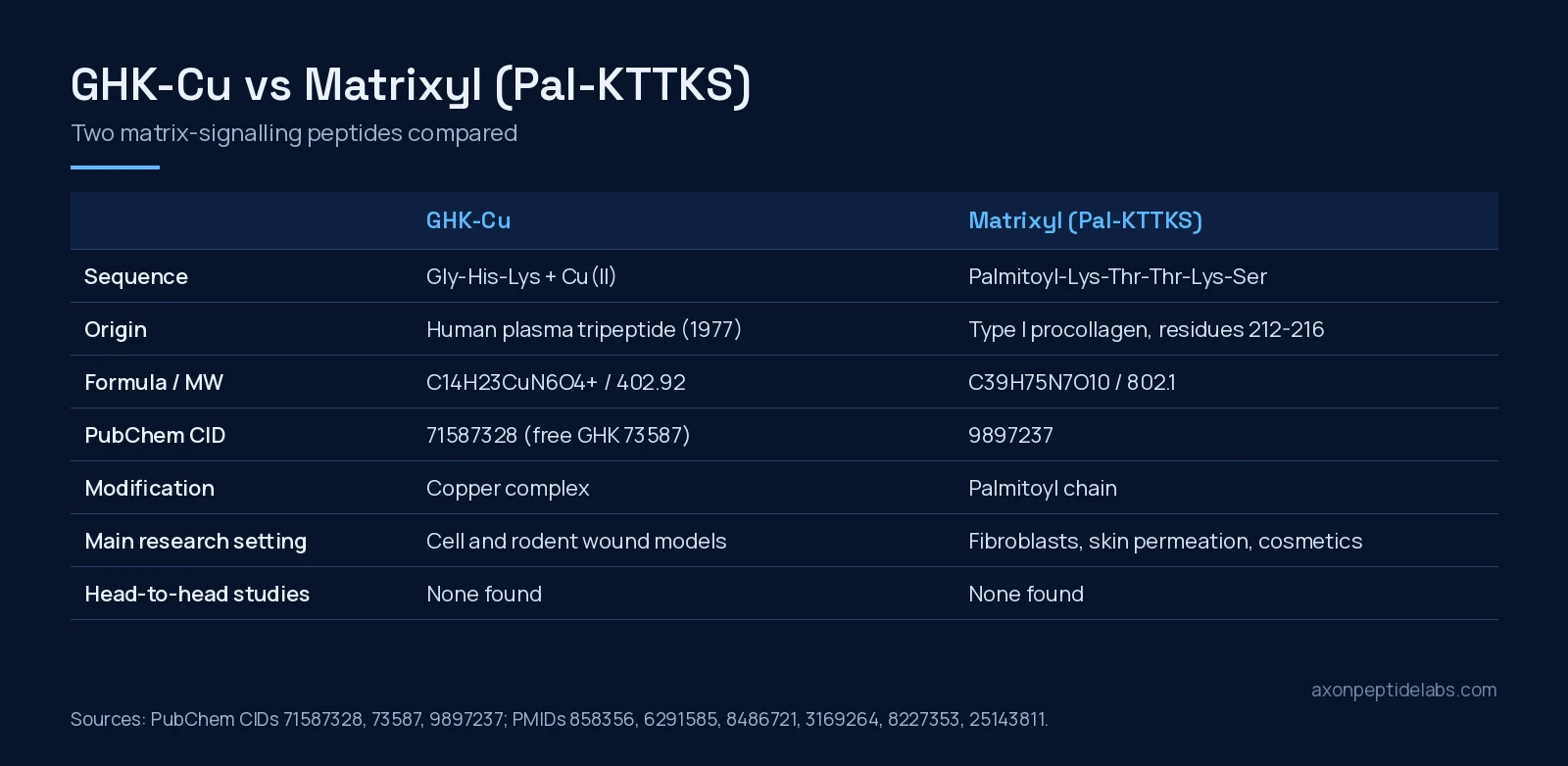
| Property | GHK-Cu | Matrixyl (Pal-KTTKS) |
|---|---|---|
| Other names | Prezatide copper, copper tripeptide-1 | Palmitoyl pentapeptide-4 (INCI), Pal-KTTKS |
| Sequence | Gly-His-Lys, complexed with Cu(II) | Palmitoyl-Lys-Thr-Thr-Lys-Ser |
| Source sequence | Human plasma tripeptide; also present in collagen alpha-2(I) | Type I procollagen C-propeptide, residues 212-216 |
| Molecular formula | C14H23CuN6O4+ (free GHK: C14H24N6O4) | C39H75N7O10 |
| Molecular weight | 402.92 g/mol (free GHK: 340.38) | 802.1 g/mol |
| CAS (PubChem synonym) | 89030-95-5 (free GHK: 49557-75-7) | 214047-00-4 |
| PubChem CID | 71587328 (free GHK 73587) | 9897237 |
| Main research setting | Cell, rodent wound and organ models | Fibroblast culture, skin permeation, cosmetic studies |
Identity values are from the linked PubChem records. PubChem lists “Matrixyl” as a synonym of palmitoyl pentapeptide-4; note that some older sources label it palmitoyl pentapeptide-3.
GHK-Cu: what the laboratory studies report
Collagen and matrix
In fibroblast cultures, GHK-Cu stimulated collagen synthesis from the picomolar to nanomolar range, independent of any change in cell number[1]. In rats with subcutaneous wound chambers, repeated GHK-Cu injections produced a concentration-dependent increase in dry weight, DNA, total protein, collagen and glycosaminoglycans; collagen synthesis rose twice as much as non-collagen protein, type I and III collagen mRNAs increased but TGF-beta mRNA did not[2]. The same model showed GHK-Cu modulating the expression and activation of matrix metalloproteinases in wound fluid[8], which suggests it affects matrix turnover as well as synthesis.
Growth factors in damaged cells
In primary human dermal fibroblasts from irradiated tissue, grown without serum, GHK-Cu was tested for effects on cell growth and on autocrine production of basic FGF, TGF-beta1 and VEGF alongside normal fibroblasts[9]. Reviews built on gene-expression data describe a wide range of actions, from angiogenesis and nerve outgrowth to anti-inflammatory and protective effects across skin, lung, bone, liver and stomach lining models[10].
The delivery problem
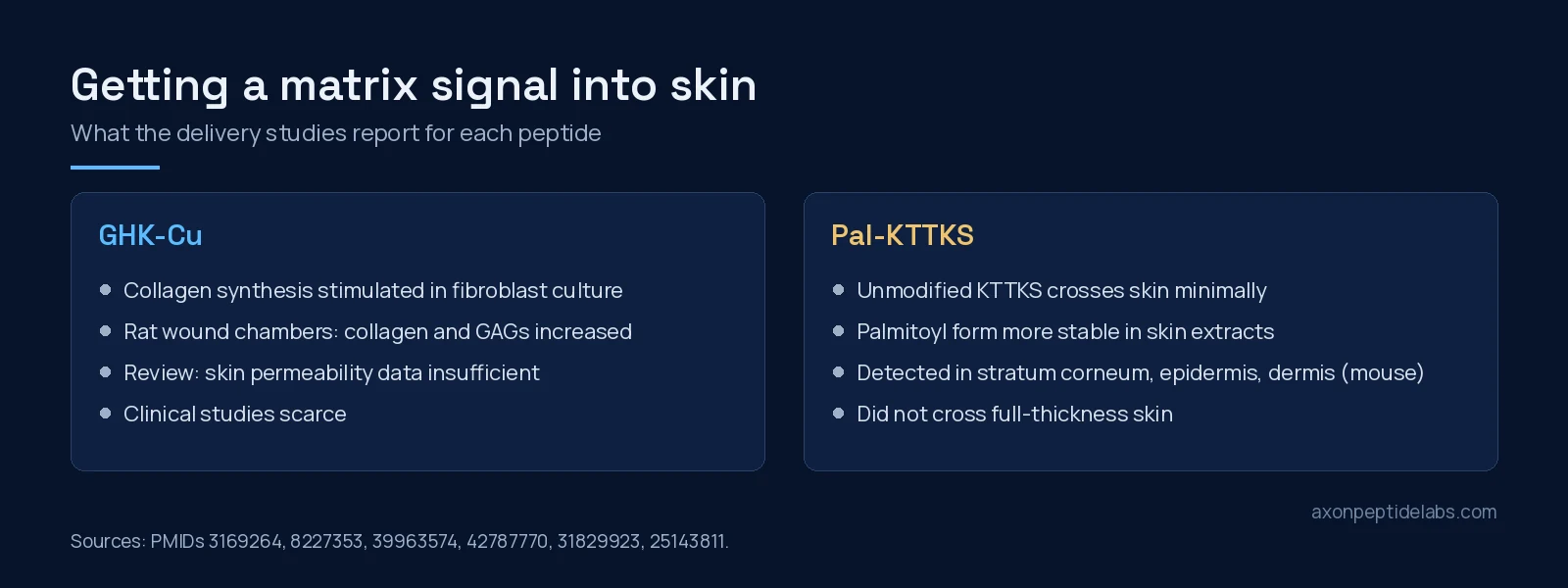
GHK-Cu shares Matrixyl’s main obstacle. A 2025 review asks whether GHK’s skin permeability is enough for it to act at its site of action and notes a surprising absence of clinical studies of GHK-Cu and Pal-GHK, despite their wide use in cosmetic products[11]. A 2026 systematic review reaches a similar view: four decades of preclinical work, but a thin and fragmented human literature made up mostly of small cosmetic-cream trials[12].
Matrixyl: what the studies report
Why add a palmitoyl chain?
KTTKS on its own is hydrophilic and crosses skin minimally, which is why the palmitoyl derivative is the form used in cosmetics[13]. A 2011 review found a sound in vitro basis for KTTKS acting on fibroblasts, specific to collagen types I and III and fibronectin, but a surprising absence of skin penetration data and relatively few clinical studies[14].
Stability and permeation
Hairless mouse skin experiments answered part of that. Both KTTKS and Pal-KTTKS were rapidly degraded in skin extracts and homogenates, though the palmitoylated form was more stable, and protease inhibitors improved the stability of both. Neither peptide crossed full-thickness skin into the receptor solution. KTTKS was not detected in any skin layer, while Pal-KTTKS was found in the stratum corneum, epidermis and dermis, with the amount falling sharply with depth[15].
Self-assembly
Pal-KTTKS (also called C16-KTTKS) is a peptide amphiphile. In human dermal and corneal fibroblasts, it stimulated collagen production in a concentration-dependent way close to its critical aggregation concentration, where it self-assembles into nanotapes, suggesting that self-assembly and collagen stimulation are linked[16].
Cosmetic studies
The human data are cosmetic studies. A 12-week double-blind, placebo-controlled, split-face study in 93 women aged 35 to 55 compared a moisturiser with and without Pal-KTTKS and reported improvement in image-analysed wrinkle measures[17]. A small 8-week trial in 21 Indonesian women compared palmitoyl pentapeptide-4, acetyl hexapeptide-3 and placebo creams, and its authors called for a larger, longer study[18]. A 2026 meta-analysis of 19 randomised trials of oral and topical peptides found effects on elasticity and density inconsistent and called for larger trials with standardised outcomes[19].
Side-by-side research comparison
| Question | GHK-Cu | Matrixyl (Pal-KTTKS) |
|---|---|---|
| Origin of sequence | Human plasma tripeptide[5] | Type I procollagen propeptide[3] |
| Role of the modification | Copper binding; 1:1 complex via histidine[7] | Palmitoyl chain for skin entry and stability[13][15] |
| Collagen effect in cells | Stimulated in fibroblasts[1] | Stimulated near aggregation concentration[16] |
| In vivo animal data | Rat wound chambers: collagen, GAGs, MMPs[2][8] | Mouse skin stability and permeation[15] |
| Skin penetration evidence | Described as insufficient[11] | Reaches dermis in mouse skin; does not cross[15] |
| Human data | Small cosmetic trials; thin overall[12] | Cosmetic split-face and small trials[17][18] |
What the evidence does not show
- No head-to-head study. We found no published study comparing GHK-Cu with Pal-KTTKS in the same model.
- Limited skin delivery data. Reviews of both peptides point to weak or missing penetration data[14][11]; the mouse-skin result for Pal-KTTKS is one study in one species[15].
- Wound and organ results are animal data. The GHK-Cu collagen and MMP findings come from rat wound chambers and cell cultures[2][8][1]. Broad reviews of protective actions rest mostly on preclinical and gene-expression work[10][12].
- Cosmetic trials are small and heterogeneous. The pooled trial evidence for peptides is inconsistent on several outcomes[19]. None of this supports use beyond research, and we found no FDA drug approval listing for GHK-Cu or Pal-KTTKS.
- Commercial blends complicate the literature. Products such as Matrixyl 3000 combine palmitoyl tripeptide-1 (Pal-GHK) with palmitoyl tetrapeptide-7[4], so results with a blend cannot be assigned to either peptide alone.
Sourcing GHK-Cu for research
Axon carries GHK-Cu 100 mg and a GHK-Cu 100 mg pen; we do not sell Matrixyl or Pal-KTTKS. Our COA library lists GHK-Cu 100 mg, batch MP-GHKC-100-041626, 99.72% purity, analysed 29 APR 2026 by testides.com, and the same batch report is listed for the 100 mg pen. For more on copper peptides, see our GHK-Cu research overview and the GHK-Cu vs AHK-Cu comparison. When you buy lab-tested peptides in Canada for matrix research, choose GHK-Cu for copper-dependent and wound-model questions; Pal-KTTKS questions belong to cosmetic formulation science.
Frequently asked questions
What is Matrixyl?
Matrixyl is the trade name for palmitoyl pentapeptide-4 (Pal-KTTKS): the pentapeptide Lys-Thr-Thr-Lys-Ser from type I procollagen with a palmitoyl chain attached. PubChem lists it as CID 9897237.
Where does GHK come from?
GHK (glycyl-histidyl-lysine) was identified in 1977 as a growth-modulating tripeptide in human serum. It binds copper(II) in a 1:1 complex, and a GHK triplet also occurs in the alpha-2 chain of type I collagen.
Why is KTTKS palmitoylated?
KTTKS is hydrophilic and crosses skin minimally. In hairless mouse skin, Pal-KTTKS was more stable than KTTKS and was detected in the stratum corneum, epidermis and dermis, while KTTKS was not detected in any layer.
Do GHK-Cu and Matrixyl stimulate collagen?
In cell culture, GHK-Cu stimulated collagen synthesis in fibroblasts, and Pal-KTTKS stimulated collagen production near its critical aggregation concentration. These are laboratory findings.
Is there a link between GHK and Matrixyl products?
Yes. Matrixyl 3000 contains palmitoyl tripeptide-1, which is palmitoylated GHK, together with palmitoyl tetrapeptide-7. That is a different product from original Matrixyl (Pal-KTTKS).
References
- Maquart FX, Pickart L, Laurent M et al. (1988). Stimulation of collagen synthesis in fibroblast cultures by the tripeptide-copper complex glycyl-L-histidyl-L-lysine-Cu2+. FEBS Lett. PMID: 3169264. doi: 10.1016/0014-5793(88)80509-x.
- Maquart FX, Bellon G, Chaqour B et al. (1993). In vivo stimulation of connective tissue accumulation by the tripeptide-copper complex glycyl-L-histidyl-L-lysine-Cu2+ in rat experimental wounds. J Clin Invest. PMID: 8227353. doi: 10.1172/JCI116842.
- Katayama K, Armendariz-Borunda J, Raghow R et al. (1993). A pentapeptide from type I procollagen promotes extracellular matrix production. J Biol Chem. PMID: 8486721.
- Trzaska AH, Kotowska AM, Starr NJ et al. (2026). Permeation behaviour of cosmetic actives into the human stratum corneum. Int J Pharm. PMID: 42790608. doi: 10.1016/j.ijpharm.2026.127447.
- Schlesinger DH, Pickart L, Thaler MM (1977). Growth-modulating serum tripeptide is glycyl-histidyl-lysine. Experientia. PMID: 858356. doi: 10.1007/BF02002806.
- Pickart L, Freedman JH, Loker WJ et al. (1980). Growth-modulating plasma tripeptide may function by facilitating copper uptake into cells. Nature. PMID: 7453802. doi: 10.1038/288715a0.
- Freedman JH, Pickart L, Weinstein B et al. (1982). Structure of the Glycyl-L-histidyl-L-lysine–copper(II) complex in solution. Biochemistry. PMID: 6291585. doi: 10.1021/bi00262a004.
- Siméon A, Monier F, Emonard H et al. (1999). Expression and activation of matrix metalloproteinases in wounds: modulation by the tripeptide-copper complex glycyl-L-histidyl-L-lysine-Cu2+. J Invest Dermatol. PMID: 10383745. doi: 10.1046/j.1523-1747.1999.00606.x.
- Pollard JD, Quan S, Kang T et al. (2005). Effects of copper tripeptide on the growth and expression of growth factors by normal and irradiated fibroblasts. Arch Facial Plast Surg. PMID: 15655171. doi: 10.1001/archfaci.7.1.27.
- Pickart L, Margolina A (2018). Regenerative and Protective Actions of the GHK-Cu Peptide in the Light of the New Gene Data. Int J Mol Sci. PMID: 29986520. doi: 10.3390/ijms19071987.
- Mortazavi SM, Mohammadi Vadoud SA, Moghimi HR (2025). Topically applied GHK as an anti-wrinkle peptide: Advantages, problems and prospective. Bioimpacts. PMID: 39963574. doi: 10.34172/bi.30071.
- Najafi N, Maatouk H, Vardanyan KG et al. (2026). A Systematic Review of the Mechanisms and Therapeutic Applications of GHK-Cu (Glycyl-L-Histidyl-L-Lysine-Copper Complex) in Topical Microneedle Delivery: A Case for Expanded Clinical Trials. Arch Intern Med Res. PMID: 42787770. doi: 10.26502/aimr.0255.
- Mortazavi SM, Kobarfard F, Maibach HI et al. (2019). Effect of Palmitic Acid Conjugation on Physicochemical Properties of Peptide KTTKS: A Preformulation Study. J Cosmet Sci. PMID: 31829923.
- Abu Samah NH, Heard CM (2011). Topically applied KTTKS: a review. Int J Cosmet Sci. PMID: 21535443. doi: 10.1111/j.1468-2494.2011.00657.x.
- Choi YL, Park EJ, Kim E et al. (2014). Dermal Stability and In Vitro Skin Permeation of Collagen Pentapeptides (KTTKS and palmitoyl-KTTKS). Biomol Ther (Seoul). PMID: 25143811. doi: 10.4062/biomolther.2014.053.
- Jones RR, Castelletto V, Connon CJ et al. (2013). Collagen stimulating effect of peptide amphiphile C16-KTTKS on human fibroblasts. Mol Pharm. PMID: 23320752. doi: 10.1021/mp300549d.
- Robinson LR, Fitzgerald NC, Doughty DG et al. (2005). Topical palmitoyl pentapeptide provides improvement in photoaged human facial skin. Int J Cosmet Sci. PMID: 18492182. doi: 10.1111/j.1467-2494.2005.00261.x.
- Aruan RR, Hutabarat H, Widodo AA et al. (2023). Double-blind, Randomized Trial on the Effectiveness of Acetylhexapeptide-3 Cream and Palmitoyl Pentapeptide-4 Cream for Crow’s Feet. J Clin Aesthet Dermatol. PMID: 36909866.
- Nukaly HY, Halawani IR, Irtaza HM et al. (2026). Oral and topical peptides for skin aging: systematic review and meta-analysis of randomized controlled trials. Front Med (Lausanne). PMID: 41924746. doi: 10.3389/fmed.2026.1618306.