
Cagrilintide vs Pramlintide: Two Generations of Amylin Analogue
For laboratory research only. Not for human or animal use. This article gives no dosing, administration or therapeutic advice.
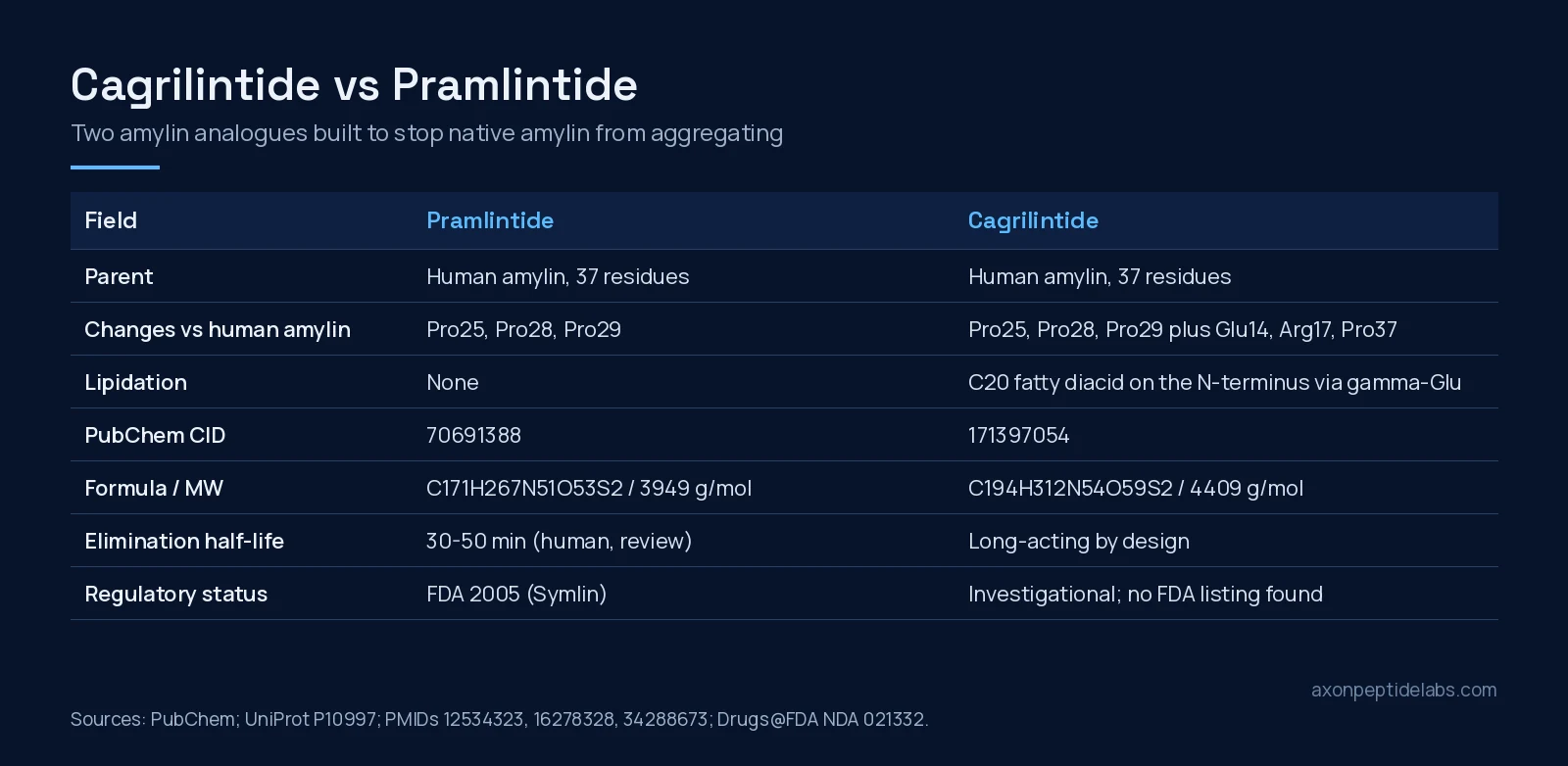
Short answer: pramlintide and cagrilintide are both analogues of amylin, the 37-residue peptide hormone co-secreted with insulin by pancreatic beta cells[1]. Pramlintide was the first-generation fix for amylin’s tendency to aggregate: three proline substitutions at positions 25, 28 and 29, borrowed from rat amylin[2][3]. Cagrilintide keeps those three prolines, adds three more changes and an N-terminal fatty diacid, and was developed as a stable, lipidated, long-acting analogue[4]. The practical gap between them is persistence: pramlintide’s mean elimination half-life is 30 to 50 minutes[5], while cagrilintide was engineered to last far longer.
Why native amylin is a hard starting point
Amylin acts on receptors built from two parts: the calcitonin receptor at the core plus one of three receptor activity-modifying proteins (RAMP1, RAMP2 or RAMP3). The resulting receptors are named AMY1, AMY2 and AMY3[6]. The hormone acts mainly in the circumventricular organs of the central nervous system and interacts with other metabolic hormones such as cholecystokinin, leptin and estradiol[1].
The obstacle for drug design is physical, not pharmacological. The cagrilintide development paper opens on it directly: amylin’s hallmark is a high propensity to form amyloid fibrils, which makes it a challenging design target[4]. A 2016 review adds that the poor aggregation and solubility behaviour of the native sequence is a major reason so little is known about amylin’s structure-function relationships[7].
Pramlintide: the proline solution
Rat amylin differs from human amylin at six residues and does not form amyloid fibrils. Pramlintide takes three of those differences, prolines at positions 25, 28 and 29, and places them in the human sequence[3]. An early drug profile describes the result as a synthetic human amylin analogue whose prolines limit the self-aggregation seen with native amylin[2].
Why three prolines rather than one? A molecular simulation study of the human amylin monomer found that the proline substitutions disrupt the formation of long beta-sheets and that all three of pramlintide’s prolines were needed to suppress beta conformations and stabilise the alpha-helical form; fewer substitutions had no significant inhibiting effect[3]. That is a computational result, but it fits the design logic.
What prolines do not fix is clearance. A 2005 review reported linear pharmacokinetics, peak serum levels within 30 minutes, predominantly renal elimination and a mean elimination half-life of 30 to 50 minutes[5]. Rat work points the same way: functional nephrectomy raised the amylin elimination half-life from 17 to 26 minutes and cut plasma amylin clearance by more than half, leading the authors to conclude that the kidney is important for metabolising both amylin and pramlintide in the rat[8].
Cagrilintide: prolines plus a lipid
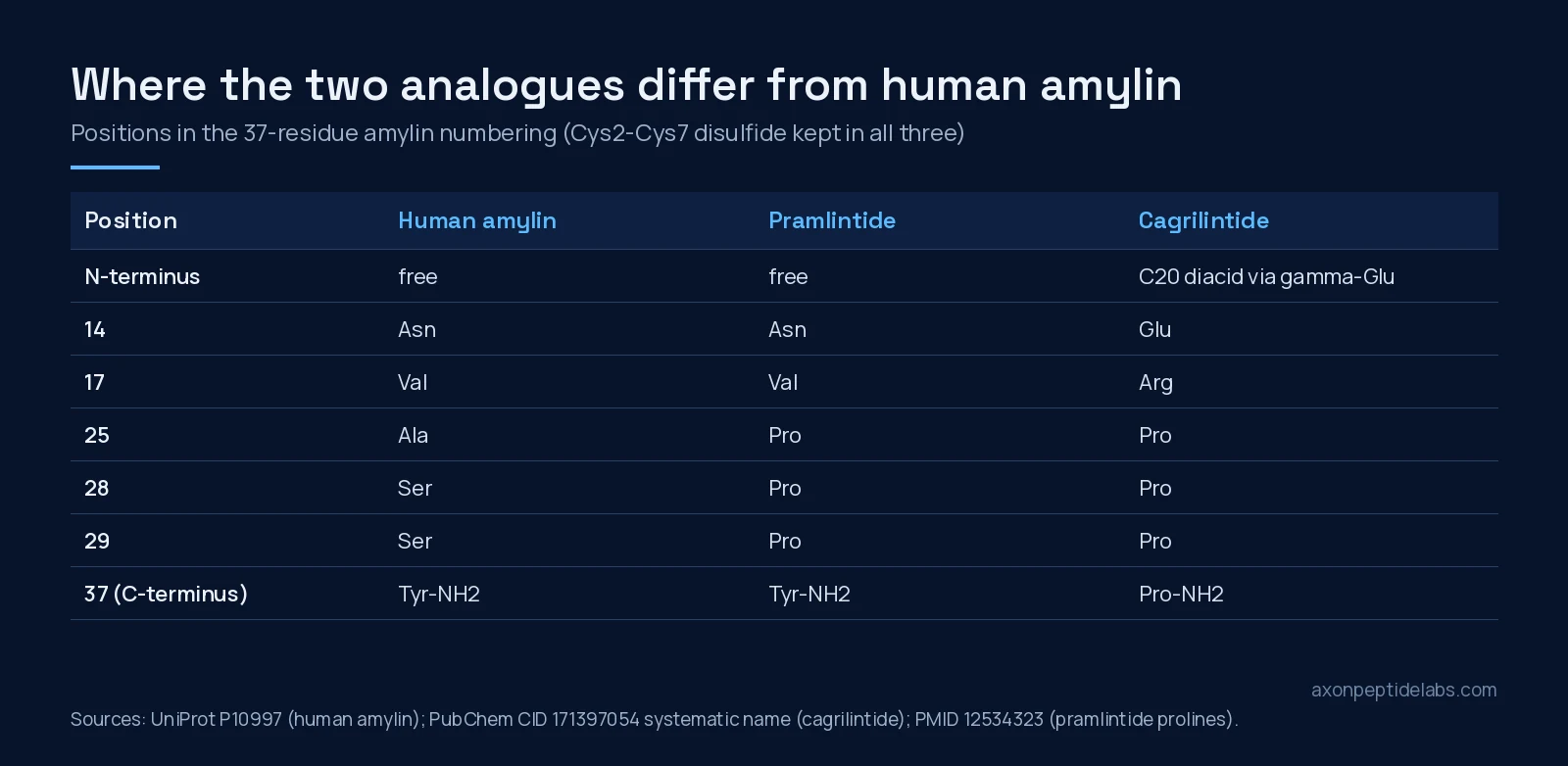
Cagrilintide is the compound labelled analogue 23 in its 2021 development paper, chosen from structure-activity work for clinical development as a stable, lipidated, long-acting amylin analogue[4]. Reading PubChem’s systematic name against the human amylin sequence (UniProt P10997) gives the full picture:
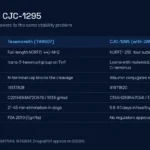
| Position | Human amylin | Pramlintide | Cagrilintide |
|---|---|---|---|
| N-terminus | Free amine | Free amine | 19-carboxynonadecanoyl (C20 fatty diacid) attached through gamma-glutamic acid |
| 2 and 7 | Cys-Cys disulfide | Cys-Cys disulfide | Cys-Cys disulfide |
| 14 | Asn | Asn | Glu |
| 17 | Val | Val | Arg |
| 25 | Ala | Pro[2] | Pro |
| 28 | Ser | Pro[2] | Pro |
| 29 | Ser | Pro[2] | Pro |
| 37 | Tyr-NH2 | Tyr-NH2 | Pro-NH2 |
So cagrilintide is not a different family from pramlintide. It contains pramlintide’s proline triad and builds on it in two ways: three further sequence changes and a lipid at the N-terminus, the feature that makes it the lipidated, long-acting analogue described in its development paper[4]. The identity values in the table below are from PubChem; they describe reference compounds, not a specific batch.
| Field | Pramlintide | Cagrilintide |
|---|---|---|
| PubChem CID | 70691388 | 171397054 |
| CAS (PubChem synonyms) | 151126-32-8 | 1415456-99-3 |
| Other names | AC137, tripro-amylin | Analogue 23 in the development paper[4] |
| Molecular formula | C171H267N51O53S2 | C194H312N54O59S2 |
| Molecular weight | 3949 g/mol | 4409 g/mol |
Receptor pharmacology
Cagrilintide is usually described as a dual amylin and calcitonin receptor agonist. A 2025 mouse study compared it with salmon calcitonin in diet-induced obese wild-type mice and in mice lacking RAMP1 and RAMP3, which removes the AMY1 and AMY3 receptors while leaving the calcitonin receptor[9]. In wild-type mice, cagrilintide reduced body weight and early food intake. In the knockout mice, cagrilintide’s potency was impaired, while salmon calcitonin’s effect on weight was improved, and cagrilintide’s activation of area postrema neurons (measured by cFos) was 57% lower than in wild-type animals[9]. The authors’ reading is in the title: cagrilintide lowers body weight in mice through brain AMY1 and AMY3 receptors.
For pramlintide, the clinical literature describes the amylin-like actions that the analogue was designed to reproduce, including suppression of post-meal glucagon secretion and slowed gastric emptying[5]. Those are effects reported in people with diabetes using the approved product; we cite them here as pharmacology, not as claims about research material.
What the clinical programmes looked like
The two compounds sit at very different points in development. The table lists design and primary endpoints only; it reports no treatment effects.
| Trial | Compound | Population | Design and primary endpoint |
|---|---|---|---|
| Lau et al. 2021 (phase 2)[10] | Cagrilintide vs placebo and liraglutide | Adults without diabetes with obesity or overweight plus a comorbidity; 57 sites in ten countries, including Canada | Randomised, double-blind, dose-finding, 26 weeks plus 6 weeks follow-up; percentage change in body weight |
| REDEFINE 1 (phase 3a)[11] | Cagrilintide plus semaglutide vs each alone vs placebo | 3,417 adults without diabetes | 68 weeks, double-blind, 21:3:3:7 randomisation; co-primary relative change in body weight and the share reaching at least 5% reduction |
For pramlintide, the regulatory history itself is informative. A 2003 drug profile records that an FDA advisory committee voted in July 2001 not to recommend approval because of safety concerns, followed by an approvable letter in October 2001 and further trials[2]. The 2005 review lists an increased risk of insulin-induced severe hypoglycaemia among the adverse events[5].
Regulatory status, stated neutrally
Drugs@FDA lists an original approval for Symlin (pramlintide acetate) dated March 16, 2005 under NDA 021332, for use alongside insulin in type 1 and type 2 diabetes[5]. That approval covers a specific finished product. At the time of writing, a Drugs@FDA search returned no approval listing for cagrilintide, alone or in combination; it remains investigational. Research-grade peptides sold for laboratory use carry no approval of any kind.
What the evidence does not show
- Not interchangeable. Same proline core, but cagrilintide’s extra substitutions and lipid change both its behaviour in solution and its persistence[4].
- Receptor data are from mice. The AMY1 and AMY3 findings come from knockout mice[9].
- The beta-sheet argument is partly computational. The three-proline result is from molecular simulation[3].
- No head-to-head trial. We found no study comparing cagrilintide with pramlintide directly.
Sourcing for your lab
Axon carries Cagrilintide 5mg for laboratory research, alongside other compounds in our metabolic research peptides category. We do not sell pramlintide. Batch documentation, where posted, is on our COA page. For cagrilintide’s best-known pairing, see semaglutide vs cagrilintide. To compare our wider catalogue, you can buy lab-tested peptides in Canada with documentation listed by batch.
Frequently asked questions
How is cagrilintide related to pramlintide?
Both are human amylin analogues. Pramlintide adds prolines at positions 25, 28 and 29 to limit aggregation. Cagrilintide keeps those three prolines and adds Glu14, Arg17, Pro37 and an N-terminal C20 fatty diacid attached through gamma-glutamic acid.
Why was pramlintide made with three prolines?
Native human amylin readily forms amyloid fibrils. Rat amylin, which does not, carries prolines at those positions. A simulation study found all three prolines were needed to suppress beta-sheet conformations in the human amylin monomer.
What is the half-life of pramlintide?
A 2005 review reported a mean elimination half-life of 30 to 50 minutes, with predominantly renal elimination. Cagrilintide was developed as a long-acting, lipidated analogue to overcome that short persistence.
Which receptors does cagrilintide act on?
It is described as a dual amylin and calcitonin receptor agonist. In mice lacking RAMP1 and RAMP3, its potency on body weight was impaired, pointing to AMY1 and AMY3 receptors in the brain.
Are pramlintide and cagrilintide approved?
Drugs@FDA lists Symlin (pramlintide acetate) as approved on March 16, 2005. At the time of writing, cagrilintide had no FDA approval listing and remained investigational. Research-grade peptides are for laboratory use only.
References
- Hay DL, Chen S, Lutz TA et al. (2015). Amylin: Pharmacology, Physiology, and Clinical Potential. Pharmacol Rev. PMID: 26071095. doi: 10.1124/pr.115.010629.
- (2003). Pramlintide: (AC 137, AC 0137, Symlin, Tripro-Amylin). BioDrugs. PMID: 12534323. doi: 10.2165/00063030-200317010-00008.
- Chiu CC, Singh S, de Pablo JJ (2013). Effect of proline mutations on the monomer conformations of amylin. Biophys J. PMID: 24010666. doi: 10.1016/j.bpj.2013.07.029.
- Kruse T, Hansen JL, Dahl K et al. (2021). Development of Cagrilintide, a Long-Acting Amylin Analogue. J Med Chem. PMID: 34288673. doi: 10.1021/acs.jmedchem.1c00565.
- McQueen J (2005). Pramlintide acetate. Am J Health Syst Pharm. PMID: 16278328. doi: 10.2146/ajhp050341.
- Hay DL, Christopoulos G, Christopoulos A et al. (2004). Amylin receptors: molecular composition and pharmacology. Biochem Soc Trans. PMID: 15494035. doi: 10.1042/BST0320865.
- Bower RL, Hay DL (2016). Amylin structure-function relationships and receptor pharmacology: implications for amylin mimetic drug development. Br J Pharmacol. PMID: 27061187. doi: 10.1111/bph.13496.
- Vine W, Smith P, LaChappell R et al. (1998). Nephrectomy decreases amylin and pramlintide clearance in rats. Horm Metab Res. PMID: 9761382. doi: 10.1055/s-2007-978923.
- Carvas AO, Leuthardt A, Kulka P et al. (2025). Cagrilintide lowers bodyweight through brain amylin receptors 1 and 3. EBioMedicine. PMID: 40609154. doi: 10.1016/j.ebiom.2025.105836.
- Lau DCW, Erichsen L, Francisco AM et al. (2021). Once-weekly cagrilintide for weight management in people with overweight and obesity: a multicentre, randomised, double-blind, placebo-controlled and active-controlled, dose-finding phase 2 trial. Lancet. PMID: 34798060. doi: 10.1016/S0140-6736(21)01751-7.
- Garvey WT, Blüher M, Osorto Contreras CK et al. (2025). Coadministered Cagrilintide and Semaglutide in Adults with Overweight or Obesity. N Engl J Med. PMID: 40544433. doi: 10.1056/NEJMoa2502081.