
DSIP vs Epitalon: Sleep Peptide vs Pineal Tetrapeptide
Short answer: DSIP (delta sleep-inducing peptide) and Epitalon are both small peptides filed under “sleep” in many catalogues, but they come from different research programmes and rest on different kinds of evidence. DSIP is a nine-residue peptide isolated from rabbit blood in 1977 because it increased delta-wave EEG activity in rabbits [1]; nearly fifty years later its gene, precursor protein and receptor are still unknown [2]. Epitalon is a synthetic four-residue peptide (Ala-Glu-Asp-Gly) designed from the amino-acid composition of a bovine pineal extract, and it is studied mainly in cell culture and rodents for telomerase and ageing markers [3][4]. Neither has a modern, adequately powered human trial behind it.
For laboratory research only. Not for human or animal use. This article gives no dosing, administration or therapeutic advice.
Because both sit in the same product category, they are often compared as if they did the same job. They do not, and the honest comparison is less about which is “better” than about how much weight each body of evidence can carry. That is what this post sets out.
Identity
Values below were read from PubChem on October 1, 2026.
| Item | DSIP | Epitalon |
|---|---|---|
| Sequence | Trp-Ala-Gly-Gly-Asp-Ala-Ser-Gly-Glu (WAGGDASGE) | Ala-Glu-Asp-Gly (AEDG) |
| Length | 9 residues | 4 residues |
| Molecular formula | C35H48N10O15 | C14H22N4O9 |
| Molecular weight | 848.8 | 390.35 |
| PubChem CID | 68816 | 219042 |
| CAS (PubChem synonyms) | 62568-57-4 | 307297-39-8 |
| Other names | Emideltide (INN), delta sleep-inducing peptide | Epithalon, Epithalone, AEDG peptide |
| Origin | Isolated from rabbit cerebral venous blood [1][5] | Synthetic; designed from the composition of Epithalamin, a bovine pineal extract [3] |
| Known gene / receptor | None identified [2] | None; proposed to act on chromatin and histones [6][7] |
DSIP: a sleep peptide that never found its gene
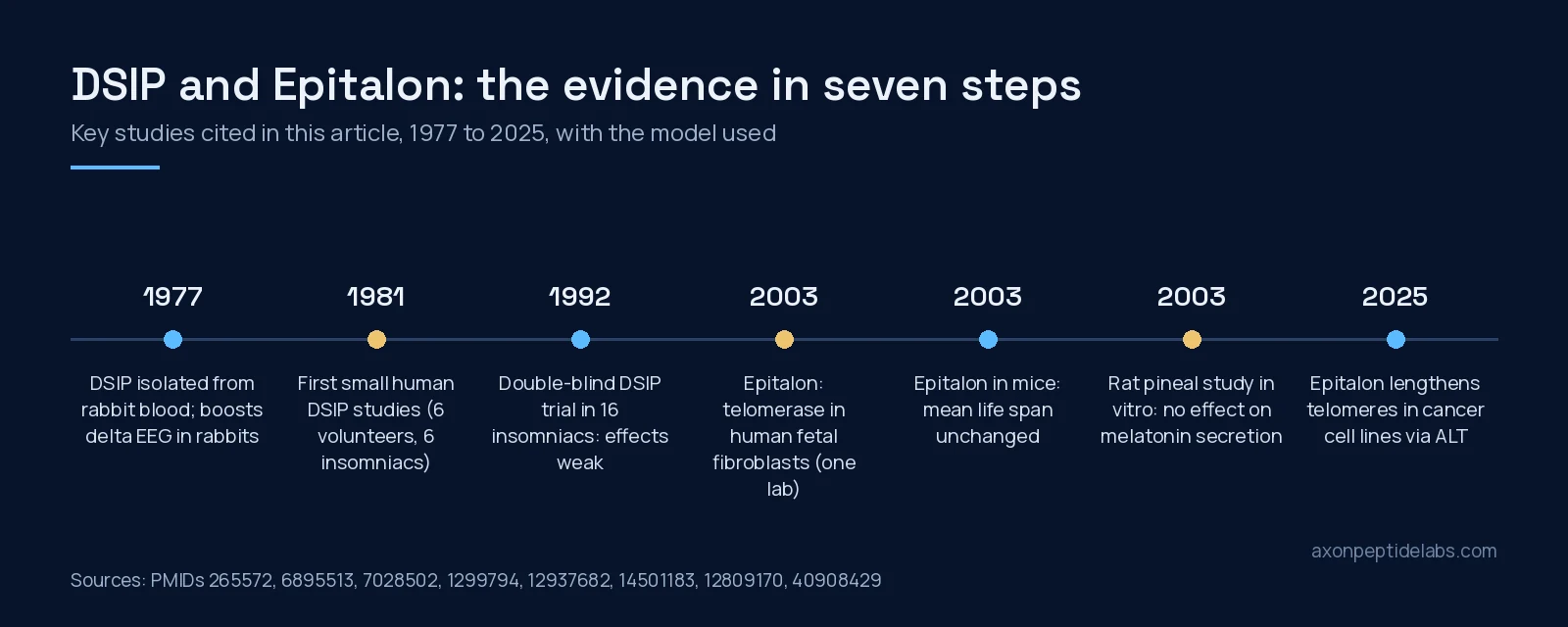
Schoenenberger and Monnier isolated DSIP from the venous blood of rabbits whose thalamus had been electrically stimulated to induce sleep. Infused into the brain ventricles of other rabbits under double-blind conditions, the synthetic nonapeptide, but none of eight related fragments or analogues, enhanced delta and spindle EEG activity [1][5]. A 1984 review summarised early animal work in rabbits, rats, mice and cats, and noted a U-shaped response: more peptide did not mean more effect [8].
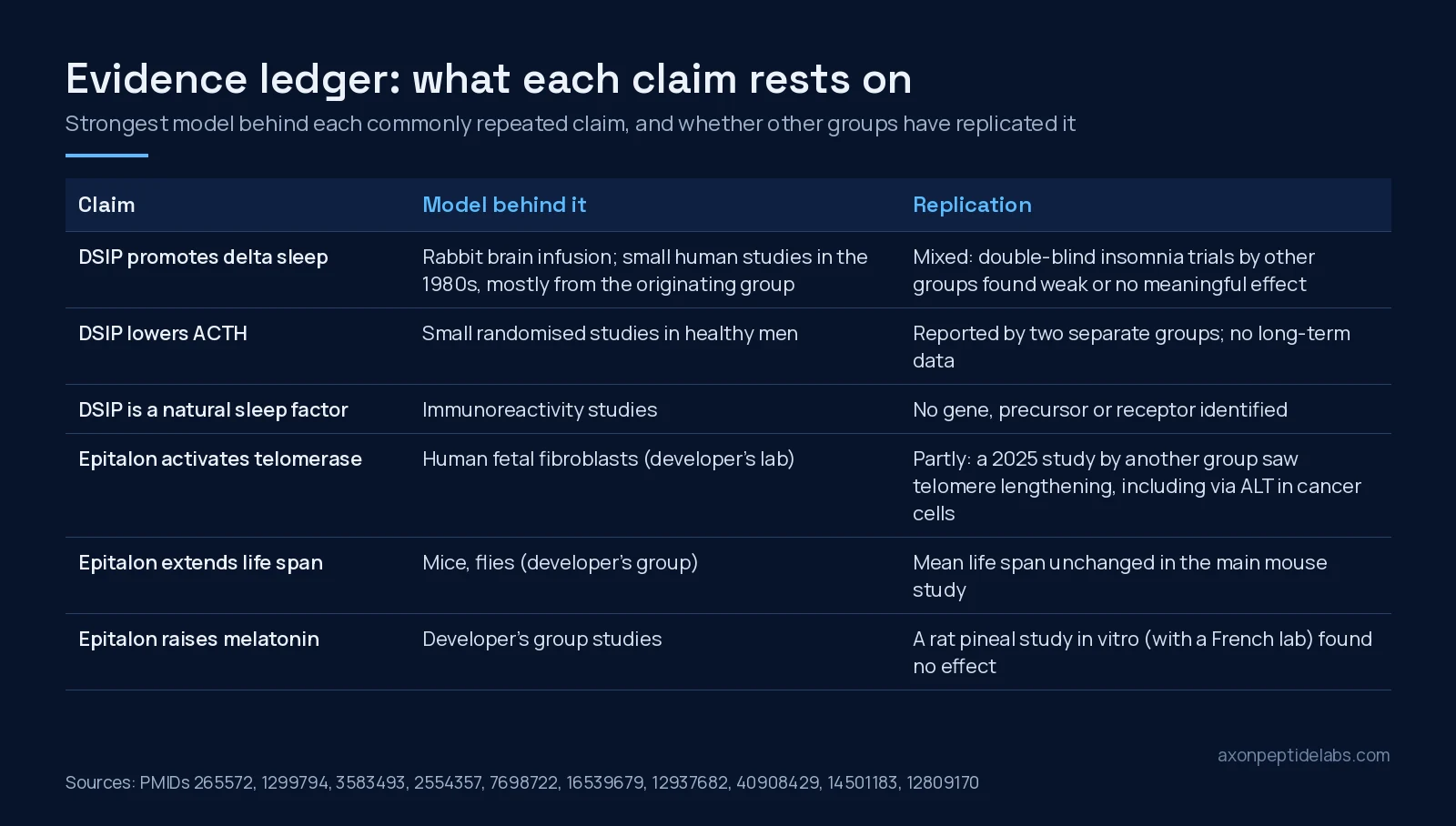
The first human studies were small and mostly came from the originating group. Six healthy volunteers reported sleep pressure and slept more after an intravenous infusion than after placebo [9], six chronic insomniacs slept longer with fewer interruptions [10], and a placebo-controlled study of 14 insomniacs reported better night sleep and daytime performance [11]. Independent groups then tested the idea more strictly. A double-blind crossover study in Uruguay found changes that were not significant against placebo nights and concluded the improvement was of little clinical significance [12]. A double-blind parallel-group trial in 16 chronic insomniacs in the Netherlands found weak effects, partly explained by a chance change in the placebo group, and no change in subjective sleep quality [13]. A later randomised study added a paradox: given to 12 women as an adjunct to isoflurane anaesthesia (12 controls received saline), DSIP increased heart rate, lightened anaesthetic depth on the bispectral index and, at the lowest dose tested, reduced delta rhythm [14].
A separate thread links DSIP to the stress axis. In two small randomised studies in healthy men, run by different groups, intravenous DSIP lowered plasma ACTH, while cortisol and vasopressin were unchanged [15][16]. The deeper problem is biological: a 2006 review calls DSIP “a still unresolved riddle”, because no DSIP gene, precursor protein or receptor has been isolated, and argues that the immunoreactivity measured over decades may come from DSIP-like peptides [2]. One proposed source is a sequence in the JMJD1B histone demethylase that differs from DSIP at two positions [17].
Epitalon: a designed tetrapeptide studied mostly in one programme
Epitalon was synthesised from the amino-acid composition of Epithalamin, a peptide extract of bovine pineal gland; a 2025 review counts 25 years of in vitro, in vivo and in silico work, while noting that its mechanisms remain uncertain and its physico-chemical characterisation limited [3]. The best-known result is from 2003: in telomerase-negative human fetal fibroblasts, Epitalon induced expression of the telomerase catalytic subunit, telomerase activity and telomere elongation [4], and treated fibroblasts went on dividing past the passage where controls stopped [18]. Both papers come from the developer’s laboratory.
The animal record is more mixed than summaries suggest. In female SHR mice treated from three months of age until natural death, Epitalon did not change mean life span, food intake or body weight; it was associated with longer survival of the longest-lived tenth, fewer bone-marrow chromosome aberrations and less leukaemia, while total tumour incidence was unchanged [19]. And on melatonin, a 2003 perifusion study of pineal glands from young and old rats, run with a French laboratory, found no effect of the tetrapeptide on melatonin secretion, basal or stimulated [20].
Work by groups outside the developer’s programme has appeared recently, all in cells. A 2025 study reported dose-dependent telomere lengthening in normal epithelial cells and fibroblasts through telomerase, and in two breast cancer lines through the alternative lengthening of telomeres (ALT) pathway [21]. Others reported reduced oxidative damage in ageing mouse oocytes in culture [22] and restored wound closure in a high-glucose retinal pigment epithelial cell model [23]. The ALT finding deserves attention: telomere extension in cancer cells is not a finding anyone should read as reassuring.
Side-by-side comparison
| Question | DSIP | Epitalon |
|---|---|---|
| Research theme | Sleep EEG, stress hormones [1][15] | Telomerase, chromatin, ageing markers [4][7] |
| Most rigorous human data | Small double-blind insomnia trials (14–16 patients) with weak or non-significant results [13][12] | No randomised placebo-controlled human trial found in PubMed (search October 1, 2026) |
| Main animal data | Rabbit EEG after brain infusion [1] | Mouse life span and tumour studies [19][24] |
| Notable null result | No meaningful benefit in a double-blind insomnia trial [13] | Mean mouse life span unchanged [19]; no effect on rat pineal melatonin in vitro [20] |
| Who produced most of the data | Originating Swiss group early; independent groups later, less positive [12][13] | Developer’s group for in vivo work; independent cell studies since 2022 [22][21] |
| Open biological question | Is there an endogenous DSIP at all? [2][17] | How does a tetrapeptide act; is the cancer-cell ALT effect relevant? [3][21] |
Why they get paired, and why that is weak
The two are grouped together because DSIP carries “sleep” in its name and Epitalon is described as a pineal peptide, and the pineal gland makes melatonin. But the sleep evidence for DSIP is old, small and inconsistent [13], and the melatonin link for Epitalon was not reproduced in the one in vitro rat study that tested it [20]. We found no study, animal or human, that tested the two together.
What the evidence does not show
- It does not show that DSIP is a physiological sleep factor. Without a gene, precursor or receptor, the “endogenous sleep peptide” description remains a hypothesis [2].
- It does not show durable sleep effects in humans. The most careful trials were small, short and largely null [13][12], and under anaesthesia DSIP reduced rather than increased delta activity [14].
- It does not show that Epitalon extends life span in mammals. The main mouse study found no change in mean life span [19].
- Cell telomere data are not organism data. Telomere lengthening in cultured fibroblasts [4] says nothing direct about whole animals, and lengthening in cancer cells [21] cuts the other way.
- Much of the Epitalon literature has not been independently replicated in vivo. Readers should weigh single-programme findings accordingly [3].
What a careful buyer can actually check
Since neither peptide has a pharmacopoeial standard, documentation does the work. For a nine-residue and a four-residue peptide, three things matter: an HPLC purity figure with the chromatogram, a mass-spectrometry result matching the expected mass (PubChem lists 848.8 for DSIP and 390.35 for Epitalon), and a batch number that matches the vial. The same four residues in a different order would have exactly the same mass, so a mass result alone cannot confirm Epitalon’s sequence; a fragmentation (MS/MS) result says more. None of this tells you anything about biological activity, which, as above, is poorly established for both.
Documentation at Axon
Axon lists DSIP 10mg and Epitalon 10mg in its sleep research range. No certificate is posted for either product on our COA library at the time of writing, so we quote no purity or batch data. With small peptides like these, an identity check by mass spectrometry matters as much as an HPLC purity figure: DSIP should read near 848.8 and Epitalon near 390.35. If you are comparing suppliers, you can buy lab-tested peptides in Canada; ask any supplier for batch documentation before ordering.
Frequently asked questions
What is the difference between DSIP and Epitalon?
DSIP is a nine-residue peptide (WAGGDASGE) isolated from rabbit blood in 1977 and studied for delta-sleep EEG and ACTH. Epitalon is a synthetic four-residue peptide (Ala-Glu-Asp-Gly) designed from a bovine pineal extract and studied for telomerase and ageing markers in cells and rodents.
Is DSIP a natural human sleep hormone?
That has never been established. No DSIP gene, precursor protein or receptor has been identified, and a 2006 review describes DSIP as a still unresolved riddle. A sequence in the JMJD1B protein that differs at two positions has been proposed as a possible source.
Did DSIP improve sleep in controlled trials?
Early small studies from the originating group reported improvements, but later double-blind trials by independent groups in 14 to 16 insomniac patients found weak or non-significant effects and judged them of little clinical significance.
Does Epitalon lengthen telomeres?
In cultured cells, yes: the developer’s lab reported telomerase induction in human fetal fibroblasts, and a 2025 independent study saw telomere lengthening in normal cells and, via the ALT pathway, in breast cancer cell lines. No whole-organism telomere data from controlled human trials exist.
Does Axon post a COA for DSIP or Epitalon?
No certificate is posted for DSIP 10mg or Epitalon 10mg on the Axon COA library at the time of writing, so this article quotes no purity or batch figures for either.
References
- Schoenenberger GA, Monnier M (1977). Characterization of a delta-electroencephalogram (-sleep)-inducing peptide. Proc Natl Acad Sci U S A. PMID: 265572. doi: 10.1073/pnas.74.3.1282.
- Kovalzon VM, Strekalova TV (2006). Delta sleep-inducing peptide (DSIP): a still unresolved riddle. J Neurochem. PMID: 16539679. doi: 10.1111/j.1471-4159.2006.03693.x.
- Araj SK, Brzezik J, Mądra-Gackowska K et al. (2025). Overview of Epitalon-Highly Bioactive Pineal Tetrapeptide with Promising Properties. Int J Mol Sci. PMID: 40141333. doi: 10.3390/ijms26062691.
- Khavinson VKh, Bondarev IE, Butyugov AA (2003). Epithalon peptide induces telomerase activity and telomere elongation in human somatic cells. Bull Exp Biol Med. PMID: 12937682. doi: 10.1023/a:1025493705728.
- Schoenenberger GA, Maier PF, Tobler HJ et al. (1978). The delta EEG (sleep)-inducing peptide (DSIP). XI. Amino-acid analysis, sequence, synthesis and activity of the nonapeptide. Pflugers Arch. PMID: 568769. doi: 10.1007/BF00581575.
- Khavinson V, Diomede F, Mironova E et al. (2020). AEDG Peptide (Epitalon) Stimulates Gene Expression and Protein Synthesis during Neurogenesis: Possible Epigenetic Mechanism. Molecules. PMID: 32019204. doi: 10.3390/molecules25030609.
- Khavinson VKh, Lezhava TA, Monaselidze JR et al. (2003). Peptide Epitalon activates chromatin at the old age. Neuro Endocrinol Lett. PMID: 14647006.
- Graf MV, Kastin AJ (1984). Delta-sleep-inducing peptide (DSIP): a review. Neurosci Biobehav Rev. PMID: 6145137. doi: 10.1016/0149-7634(84)90022-8.
- Schneider-Helmert D, Gnirss F, Monnier M et al. (1981). Acute and delayed effects of DSIP (delta sleep-inducing peptide) on human sleep behavior. Int J Clin Pharmacol Ther Toxicol. PMID: 6895513.
- Schneider-Helmert D, Schoenenberger GA (1981). The influence of synthetic DSIP (delta-sleep-inducing-peptide) on disturbed human sleep. Experientia. PMID: 7028502. doi: 10.1007/BF01971753.
- Schneider-Helmert D (1987). Effects of delta-sleep-inducing peptide on 24-hour sleep-wake behaviour in severe chronic insomnia. Eur Neurol. PMID: 3622582. doi: 10.1159/000116143.
- Monti JM, Debellis J, Alterwain P et al. (1987). Study of delta sleep-inducing peptide efficacy in improving sleep on short-term administration to chronic insomniacs. Int J Clin Pharmacol Res. PMID: 3583493.
- Bes F, Hofman W, Schuur J et al. (1992). Effects of delta sleep-inducing peptide on sleep of chronic insomniac patients. A double-blind study. Neuropsychobiology. PMID: 1299794. doi: 10.1159/000118919.
- Pomfrett CJ, Dolling S, Anders NR et al. (2009). Delta sleep-inducing peptide alters bispectral index, the electroencephalogram and heart rate variability when used as an adjunct to isoflurane anaesthesia. Eur J Anaesthesiol. PMID: 19142086. doi: 10.1097/EJA.0b013e32831c8644.
- Bjartell A, Ekman R, Bergquist S et al. (1989). Reduction of immunoreactive ACTH in plasma following intravenous injection of delta sleep-inducing peptide in man. Psychoneuroendocrinology. PMID: 2554357. doi: 10.1016/0306-4530(89)90004-8.
- Chiodera P, Volpi R, Capretti L et al. (1994). Different effects of delta-sleep-inducing peptide on arginine-vasopressin and ACTH secretion in normal men. Horm Res. PMID: 7698722. doi: 10.1159/000184207.
- Mikhaleva II, Prudchenko IA, Ivanov VT et al. (2011). JmjC-domain-containing histone demethylases of the JMJD1B type as putative precursors of endogenous DSIP. Peptides. PMID: 21262293. doi: 10.1016/j.peptides.2011.01.006.
- Khavinson VKh, Bondarev IE, Butyugov AA et al. (2004). Peptide promotes overcoming of the division limit in human somatic cell. Bull Exp Biol Med. PMID: 15455129. doi: 10.1023/b:bebm.0000038164.49947.8c.
- Anisimov VN, Khavinson VKh, Popovich IG et al. (2003). Effect of Epitalon on biomarkers of aging, life span and spontaneous tumor incidence in female Swiss-derived SHR mice. Biogerontology. PMID: 14501183. doi: 10.1023/a:1025114230714.
- Djeridane Y, Khavinson VKh, Anisimov VN et al. (2003). Effect of a synthetic pineal tetrapeptide (Ala-Glu-Asp-GLy) on melatonin secretion by the pineal gland of young and old rats. J Endocrinol Invest. PMID: 12809170. doi: 10.1007/BF03345159.
- Al-Dulaimi S, Thomas R, Matta S et al. (2025). Epitalon increases telomere length in human cell lines through telomerase upregulation or ALT activity. Biogerontology. PMID: 40908429. doi: 10.1007/s10522-025-10315-x.
- Yue X, Liu SL, Guo JN et al. (2022). Epitalon protects against post-ovulatory aging-related damage of mouse oocytes in vitro. Aging (Albany NY). PMID: 35413689. doi: 10.18632/aging.204007.
- Gatta M, Dovizio M, Milillo C et al. (2025). The Antioxidant Tetrapeptide Epitalon Enhances Delayed Wound Healing in an in Vitro Model of Diabetic Retinopathy. Stem Cell Rev Rep. PMID: 40493162. doi: 10.1007/s12015-025-10911-x.
- Kossoy G, Anisimov VN, Ben-Hur H et al. (2006). Effect of the synthetic pineal peptide epitalon on spontaneous carcinogenesis in female C3H/He mice. In Vivo. PMID: 16634527.