
Pinealon vs Epitalon: Two Khavinson Bioregulator Peptides Compared
For laboratory research only. Not for human or animal use. This article gives no dosing, administration or therapeutic advice.
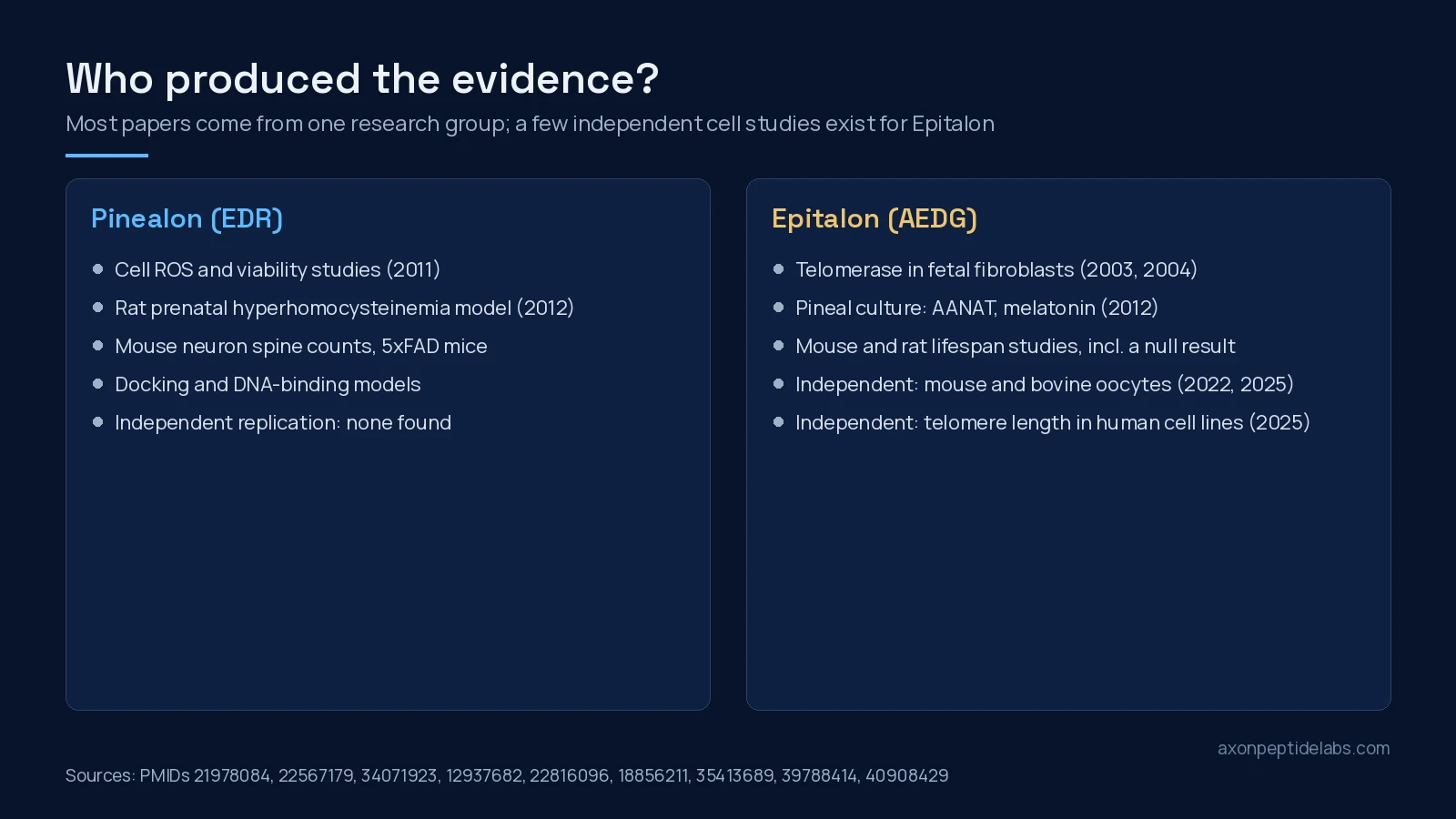
Short answer: Pinealon and Epitalon are two very short synthetic peptides from the same Russian bioregulator research programme, but they are different molecules studied for different things. Pinealon is the tripeptide Glu-Asp-Arg (EDR); most of its papers look at oxidative stress and survival in neurons and other cultured cells[1][3]. Epitalon is the tetrapeptide Ala-Glu-Asp-Gly (AEDG); its papers centre on telomerase, the pineal melatonin pathway and lifespan in rodents[10][12][15]. The two share no sequence motif beyond adjacent acidic residues (Glu-Asp), and the only direct comparison we found, in rat pineal tissue culture, gave them different results[8]. Nearly all of the literature on both comes from one research group, and almost all of it is cell, animal or computer-modelling work.
Identity: what each molecule actually is
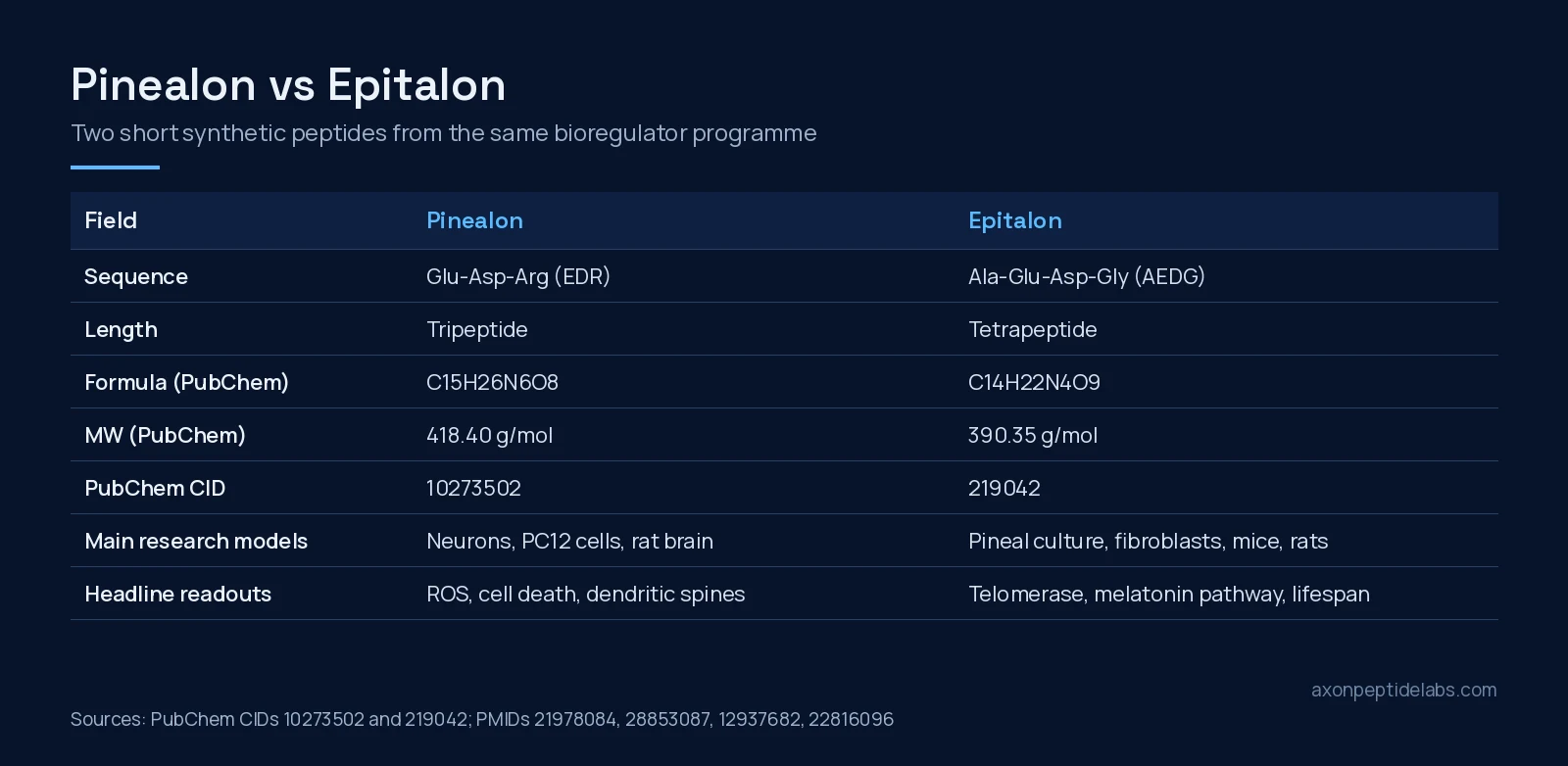
The values below come from PubChem records, not from certificates of analysis. Both are free, unmodified L-peptides with no protecting groups in their PubChem entries.
| Field | Pinealon | Epitalon |
|---|---|---|
| PubChem CID | 10273502 | 219042 |
| PubChem title | Glu-Asp-Arg | Epitalon |
| Synonyms (PubChem) | pinealon, EDR, H-Glu-Asp-Arg-OH, L-glutamyl-L-aspartyl-L-arginine | Epithalon, Epithalone, Ala-Glu-Asp-Gly, alanyl-glutamyl-aspartyl-glycine |
| CAS (PubChem synonym) | 175175-23-2 | 307297-39-8 |
| Molecular formula | C15H26N6O8 | C14H22N4O9 |
| Molecular weight | 418.40 g/mol | 390.35 g/mol |
| Length | 3 residues | 4 residues |
| Charge character | two acidic residues, one basic C-terminal Arg | two acidic residues flanked by neutral Ala and Gly |
The two are about 28 g/mol apart, so mass spectrometry separates them easily, and pinealon’s C-terminal arginine gives it a different net charge from glycine-ended epitalon. Neither feature says anything about biological activity.
Where the two peptides come from
Epitalon was designed from the amino-acid composition of Epithalamin, a polypeptide extract of bovine pineal gland, and has been studied for roughly 25 years with in vitro, in vivo and in silico methods[15]. A 2025 review from a Polish group, outside the original programme, summarised reported effects on melatonin synthesis, interleukin-2 mRNA, thymocyte activity and enzymes including telomerase, and noted that physico-chemical and structural studies of the peptide are still scarce[15].
Pinealon is named after the pineal gland too, but its research record is mostly about brain cells. The first widely cited paper described the synthetic tripeptide limiting reactive oxygen species (ROS) in rat cerebellar granule cells, neutrophils and PC12 pheochromocytoma cells exposed to oxidative stress[1].
Both belong to a family of “ultrashort” di-, tri- and tetrapeptides the programme describes as bioregulators. Related members such as Lys-Glu-Asp (KED) and Ala-Glu-Asp (AED) appear in the same papers, often tested side by side with AEDG[20][6].
Pinealon (EDR): what the studies looked at
Cell culture
In the 2011 cell study, pinealon reduced ROS accumulation in a dose-dependent way and lowered necrotic cell death measured by propidium iodide staining. The authors also saw a delayed ERK1/2 activation and changes in the cell cycle. Because the ROS effect saturated at lower concentrations while cell-cycle effects continued at higher ones, they proposed that the peptide does more than act as an antioxidant[1].
In primary mouse hippocampal neurons exposed to amyloid synaptotoxicity, an in vitro model of Alzheimer’s-type damage, EDR restored the number of mature “mushroom” dendritic spines to the control level; the related tripeptide KED had a smaller effect in the same setup[3]. In aging cultures of brain cortex cells, EDR and KED increased serotonin expression, and docking was used to suggest a complementary DNA sequence in the tryptophan hydroxylase gene[6].
Animal models
In rats, pinealon given to pregnant dams fed excess methionine (a model of prenatal hyperhomocysteinemia) was associated with better spatial orientation and learning in the offspring and with cerebellar neurons that accumulated less ROS when isolated and tested[2]. In 5xFAD mice, a transgenic Alzheimer’s model, KED and EDR prevented dendritic spine loss; the same paper used docking to map possible EDR binding sites in promoter regions of genes such as CASP3, SOD2 and PPARG[4].
Proposed mechanism
The programme’s model is that EDR enters cells, reaches the nucleus and binds histones or nucleic acids, shifting MAPK/ERK signalling and the expression of caspase-3, p53, SOD2, GPX1 and other proteins[5][4]. Much of this rests on molecular docking rather than direct binding measurements, which is a real limitation discussed below.
Epitalon (AEDG): what the studies looked at
Telomerase and cell lifespan
The best-known epitalon claim started with a 2003 report: adding the peptide to telomerase-negative human fetal fibroblasts induced expression of the catalytic subunit, telomerase activity and telomere elongation[10]. A follow-up in fetal lung fibroblasts reported that treated cells passed their usual division limit, making about ten extra passages[11]. Both papers came from the originating group.
In 2025 an independent group tested the question again in breast cancer lines (21NT, BT474) and normal epithelial and fibroblast cells. They reported dose-dependent telomere lengthening in normal cells through hTERT and telomerase upregulation, while in the cancer lines lengthening went through ALT (alternative lengthening of telomeres) activation instead[16].
Pineal and melatonin pathway
In rat pinealocyte culture, epitalon stimulated arylalkylamine-N-acetyltransferase (AANAT) and phosphorylated CREB and raised melatonin in the medium; adding norepinephrine with the peptide potentiated AANAT and pCREB expression[12]. The programme also published a small study of the night-time melatonin rhythm in elderly volunteers given Epithalamin, the pineal extract Epitalon was modelled on[21]. That is an extract, not the synthetic tetrapeptide, and we do not treat it as evidence of any effect in people.
Rodent lifespan, including a null result
In female HER-2/neu transgenic mice, a breast-tumour model, long-term epitalon was associated with longer mean and maximum lifespan and fewer breast adenocarcinomas[13]. The picture in rats is more mixed. In female rats kept under a standard day/night light regimen, epitalon did not change lifespan; effects on maximum lifespan were reported only in rats kept under natural northern or constant light, conditions that themselves shortened life[14]. That null result under standard conditions rarely appears in commercial summaries.
Other cell models
AEDG increased neurogenic markers (Nestin, GAP43, beta-III tubulin, doublecortin) in human gingival mesenchymal stem cells[19]. Outside the programme, a Chinese group found that epitalon in culture medium reduced ROS and spindle defects in post-ovulatory aging mouse oocytes[17], and a Korean group linked epitalon-activated telomerase to better bovine oocyte maturation and post-thaw embryo development in vitro[18].
Head to head: the few studies that tested both
Very few papers put EDR and AEDG in the same experiment, and those that do show the peptides behaving differently.
| Study | Model | Pinealon (EDR) | Epitalon (AEDG) |
|---|---|---|---|
| Organotypic pineal culture[8] | Pineal gland tissue from 3-month-old rats | No reported effect on Ki-67; no effect on apoptosis marker AIF | Stimulated Ki-67; only peptide that increased CGRP synthesis by pinealocytes; no effect on AIF |
| Fluorescent peptide uptake and DNA binding[7] | HeLa cells; labelled oligonucleotides in vitro | Entered cytoplasm, nucleus and nucleolus; preferred CNG- and CAG-containing sequences | Entered cytoplasm, nucleus and nucleolus; preferred CNG-containing sequences |
| Transporter docking[9] | Computer models of LAT1, LAT2, PEPT1 | EDR listed among the most effective predicted ligands | Included in the set of 26 short peptides modelled |
The pineal culture result is the most direct answer to the “which one is the pineal peptide” question: in that rat tissue model, AEDG, not EDR, was the one that changed pinealocyte proliferation and secretory markers[8]. The uptake study suggests both peptides can reach the nucleus of a cultured human cell line, and that their nucleic-acid binding preferences differ by sequence[7]. The transporter paper is docking only; it predicts that short peptides with an acidic N-terminus fit LAT1, LAT2 and PEPT1 binding sites but measures no transport[9].
Side-by-side summary
| Question | Pinealon (EDR) | Epitalon (AEDG) |
|---|---|---|
| Main research focus | Oxidative stress and neuron survival[1] | Telomerase, pineal melatonin pathway, lifespan[10][12] |
| Key animal models | Rat prenatal hyperhomocysteinemia; 5xFAD mice[2][4] | HER-2/neu mice; rats under different light regimens[13][14] |
| Independent replication | None found outside the programme | Telomere and oocyte cell studies (2022, 2025)[16][17][18] |
| Reported null or mixed results | None reported in the abstracts we read | No lifespan change in rats under standard light[14] |
| Mechanism evidence type | Mostly docking and expression markers[5] | Expression, enzyme activity and docking[15][19] |
What the evidence does not show
- It does not show independent confirmation for pinealon. Every EDR paper we read lists members of the originating programme as authors. That does not make the work wrong, but single-source literature has not yet been tested by others.
- It does not show a direct receptor or binding target. The gene-regulation model for both peptides relies heavily on molecular docking to DNA, histones and transporters[4][19][9]. Docking predicts fit; it does not measure binding in a cell.
- It does not show that the mouse lifespan results generalise. The HER-2/neu result comes from one transgenic tumour model[13], and in rats under standard lighting epitalon made no difference to lifespan[14].
- It does not show that telomere lengthening is purely desirable in every context. The 2025 independent study found ALT activation in cancer cell lines[16], which is exactly the kind of finding that needs more work before anyone draws conclusions.
- It does not show any human effect. Small human reports exist in Russian-language journals from the same group[21], but they are not controlled trials of the kind needed to support any claim, and this article makes none.
- It does not show the two peptides are interchangeable. In the one shared tissue experiment, they gave different results[8].
Because the existing work is so concentrated, a well-controlled study with a scrambled-sequence control and an identity check by mass spectrometry would add more than another repeat of the original designs. For a different pineal-associated pairing, see our DSIP vs Epitalon comparison.
Documentation at Axon
Axon lists Pinealon 10mg in its nootropic peptide category and also carries Epitalon 10mg. No certificate is posted for this product on our COA page at the time of writing, for either Pinealon or Epitalon; check the COA page for any report added later before you order. Identity values in this article come from PubChem, not from batch documents. When you are ready, you can buy lab-tested peptides in Canada.
Frequently asked questions
What is the difference between Pinealon and Epitalon?
Pinealon is the tripeptide Glu-Asp-Arg (EDR, C15H26N6O8 in PubChem) and Epitalon is the tetrapeptide Ala-Glu-Asp-Gly (AEDG, C14H22N4O9). Pinealon’s papers focus mostly on oxidative stress and survival in neurons and other cultured cells, while Epitalon’s focus on telomerase, the pineal melatonin pathway and rodent lifespan.
Is Pinealon a pineal gland peptide?
Despite the name, most Pinealon research is on neurons. In the one rat pineal tissue-culture study that tested both, Epitalon stimulated the proliferation marker Ki-67 and CGRP synthesis in pinealocytes, while EDR did not change Ki-67.
Has anyone outside the original research group studied these peptides?
For Epitalon, yes: independent groups have published cell studies on telomere length in human cell lines and on mouse and bovine oocytes. For Pinealon, we found no study without authors from the originating programme.
Does Epitalon lengthen telomeres?
Cell-culture studies report it. The original group found telomerase induction and telomere elongation in human fetal fibroblasts, and a 2025 independent study reported telomere lengthening in normal cells via telomerase and in breast cancer lines via the ALT pathway. These are in vitro findings only.
Did Epitalon extend lifespan in every animal study?
No. It was associated with longer lifespan in HER-2/neu transgenic mice, but in female rats kept under a standard light regimen it did not change lifespan; effects were reported only under natural or constant light.
Does Axon post a COA for Pinealon or Epitalon?
No certificate is posted for either product on the Axon COA page at the time of writing. Check the COA page for any report added later.
References
- Khavinson V, Ribakova Y, Kulebiakin K et al. (2011). Pinealon increases cell viability by suppression of free radical levels and activating proliferative processes. Rejuvenation Res. PMID: 21978084. doi: 10.1089/rej.2011.1172.
- Arutjunyan A, Kozina L, Stvolinskiy S et al. (2012). Pinealon protects the rat offspring from prenatal hyperhomocysteinemia. Int J Clin Exp Med. PMID: 22567179.
- Kraskovskaya NA, Kukanova EO, Lin’kova NS et al. (2017). Tripeptides Restore the Number of Neuronal Spines under Conditions of In Vitro Modeled Alzheimer’s Disease. Bull Exp Biol Med. PMID: 28853087. doi: 10.1007/s10517-017-3847-2.
- Khavinson V, Ilina A, Kraskovskaya N et al. (2021). Neuroprotective Effects of Tripeptides-Epigenetic Regulators in Mouse Model of Alzheimer’s Disease. Pharmaceuticals (Basel). PMID: 34071923. doi: 10.3390/ph14060515.
- Khavinson V, Linkova N, Kozhevnikova E et al. (2020). EDR Peptide: Possible Mechanism of Gene Expression and Protein Synthesis Regulation Involved in the Pathogenesis of Alzheimer’s Disease. Molecules. PMID: 33396470. doi: 10.3390/molecules26010159.
- Khavinson VKh, Lin’kova NS, Tarnovskaya SI et al. (2014). Short peptides stimulate serotonin expression in cells of brain cortex. Bull Exp Biol Med. PMID: 24909721. doi: 10.1007/s10517-014-2496-y.
- Fedoreyeva LI, Kireev II, Khavinson VKh et al. (2011). Penetration of short fluorescence-labeled peptides into the nucleus in HeLa cells and in vitro specific interaction of the peptides with deoxyribooligonucleotides and DNA. Biochemistry (Mosc). PMID: 22117547. doi: 10.1134/S0006297911110022.
- Khavinson VKh, Linkova NS, Chalisova NI et al. (2011). Effect of short peptides on expression of signaling molecules in organotypic pineal cell culture. Bull Exp Biol Med. PMID: 22803060. doi: 10.1007/s10517-011-1473-y.
- Khavinson VK, Linkova NS, Rudskoy AI et al. (2023). Feasibility of Transport of 26 Biologically Active Ultrashort Peptides via LAT and PEPT Family Transporters. Biomolecules. PMID: 36979488. doi: 10.3390/biom13030552.
- Khavinson VKh, Bondarev IE, Butyugov AA (2003). Epithalon peptide induces telomerase activity and telomere elongation in human somatic cells. Bull Exp Biol Med. PMID: 12937682. doi: 10.1023/a:1025493705728.
- Khavinson VKh, Bondarev IE, Butyugov AA et al. (2004). Peptide promotes overcoming of the division limit in human somatic cell. Bull Exp Biol Med. PMID: 15455129. doi: 10.1023/b:bebm.0000038164.49947.8c.
- Khavinson VKh, Linkova NS, Kvetnoy IM et al. (2012). Molecular cellular mechanisms of peptide regulation of melatonin synthesis in pinealocyte culture. Bull Exp Biol Med. PMID: 22816096. doi: 10.1007/s10517-012-1689-5.
- Anisimov VN, Khavinson VKh, Alimova IN et al. (2002). Epithalon decelerates aging and suppresses development of breast adenocarcinomas in transgenic her-2/neu mice. Bull Exp Biol Med. PMID: 12459848. doi: 10.1023/a:1021104819170.
- Vinogradova IA, Bukalev AV, Zabezhinski MA et al. (2007). Effect of Ala-Glu-Asp-Gly peptide on life span and development of spontaneous tumors in female rats exposed to different illumination regimes. Bull Exp Biol Med. PMID: 18856211. doi: 10.1007/s10517-007-0441-z.
- Araj SK, Brzezik J, Mądra-Gackowska K et al. (2025). Overview of Epitalon-Highly Bioactive Pineal Tetrapeptide with Promising Properties. Int J Mol Sci. PMID: 40141333. doi: 10.3390/ijms26062691.
- Al-Dulaimi S, Thomas R, Matta S et al. (2025). Epitalon increases telomere length in human cell lines through telomerase upregulation or ALT activity. Biogerontology. PMID: 40908429. doi: 10.1007/s10522-025-10315-x.
- Yue X, Liu SL, Guo JN et al. (2022). Epitalon protects against post-ovulatory aging-related damage of mouse oocytes in vitro. Aging (Albany NY). PMID: 35413689. doi: 10.18632/aging.204007.
- Ullah S, Haider Z, Perera CD et al. (2025). Epitalon-activated telomerase enhance bovine oocyte maturation rate and post-thawed embryo development. Life Sci. PMID: 39788414. doi: 10.1016/j.lfs.2025.123381.
- Khavinson V, Diomede F, Mironova E et al. (2020). AEDG Peptide (Epitalon) Stimulates Gene Expression and Protein Synthesis during Neurogenesis: Possible Epigenetic Mechanism. Molecules. PMID: 32019204. doi: 10.3390/molecules25030609.
- Lin’kova NS, Drobintseva AO, Orlova OA et al. (2016). Peptide Regulation of Skin Fibroblast Functions during Their Aging In Vitro. Bull Exp Biol Med. PMID: 27259496. doi: 10.1007/s10517-016-3370-x.
- Korkushko OV, Khavinson VKh, Shatilo VB et al. (2004). Effect of peptide preparation epithalamin on circadian rhythm of epiphyseal melatonin-producing function in elderly people. Bull Exp Biol Med. PMID: 15452611. doi: 10.1023/b:bebm.0000035139.31138.bf.