
IGF-1 LR3 vs HGH (Somatropin): Mechanism, Identity and Evidence
For laboratory research only. Not for human or animal use. This article gives no dosing, administration or therapeutic advice.
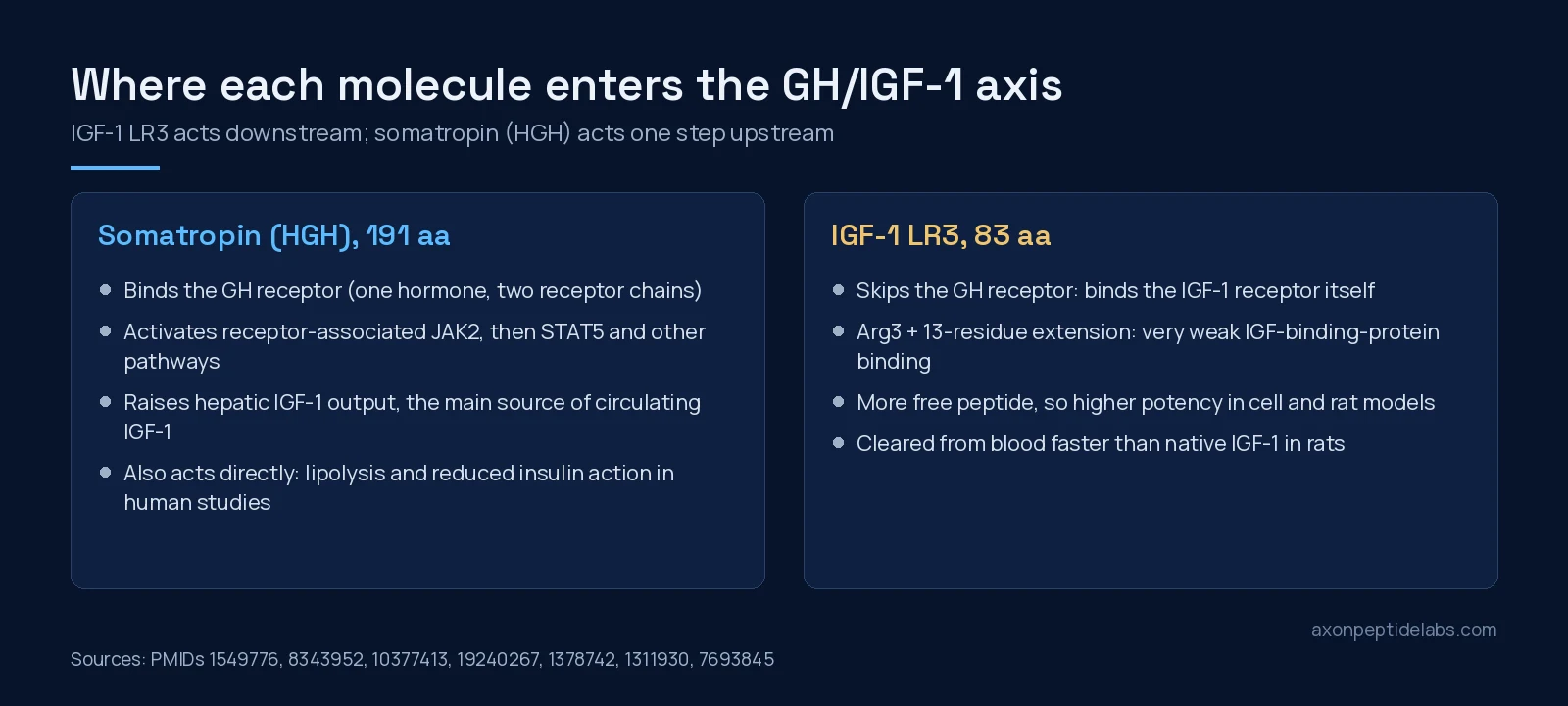
Short answer: HGH (somatropin) and IGF-1 LR3 act at different points of the same hormonal axis. Somatropin binds the growth hormone receptor and, among other effects, drives the liver to make IGF-1[3][4][6]. IGF-1 LR3 skips that step: it is an engineered IGF-1 analogue that binds the IGF-1 receptor directly and was designed to escape the IGF-binding proteins that normally hold IGF-1 in check[1][2]. Somatropin is an approved drug with decades of human data; IGF-1 LR3 has none. Its literature comes from cells, rats, pigs and calves.
This guide compares the two on identity, mechanism, what the animal and human studies found (null results included), and what is still unknown. If you are sourcing material, see the IGF-1 LR3 1mg and HGH 20iu listings and the COA notes near the end.
Two molecules, one axis
Growth hormone is secreted by the pituitary and works through a cell-surface receptor that a single hormone molecule pulls together as a pair. The 1992 crystal structure of human GH bound to its receptor’s extracellular domain showed one hormone engaging two receptor chains through two structurally different sites[3]. Binding activates JAK2, a tyrosine kinase attached to the receptor, which was identified as the GH receptor’s kinase in 1993[4]. From there the signal fans out to STAT transcription factors (including those that switch on the IGF-1 gene), the Ras/MAP kinase route, IRS proteins and PI3K/Akt[4][5].
The classic “somatomedin” idea held that GH works mainly by making the liver release IGF-1 into the blood. A 1999 mouse study tested that by deleting the IGF-1 gene in the liver only: circulating IGF-1 fell sharply, yet body weight, body length and femur length were normal[6]. The authors read this as evidence that locally made IGF-1 (autocrine and paracrine) matters more for growth than the circulating pool. GH also acts on its own, without IGF-1. In human studies its most prominent metabolic effect is a marked rise in lipolysis and free fatty acids, and it antagonises insulin’s effect on glucose metabolism[7].
IGF-1 itself is a 70-amino-acid protein with three disulfide bonds (UniProt P05019). In blood and tissue fluid almost all of it is bound to IGF-binding proteins (IGFBPs), which limit how much reaches the receptor at any moment. That is the lever IGF-1 LR3 was built to pull.
How IGF-1 LR3 was engineered
IGF-1 LR3 (“Long R3 IGF-I”) came out of an Australian programme producing IGF-1 in E. coli as fusion proteins. Two 1992 papers describe it. In the first, swapping glutamate-3 for arginine (or glycine) produced analogues that bound bovine IGFBP-2 very poorly and the type-1 IGF receptor slightly less well than native IGF-1, yet were more potent in rat L6 myoblasts; the authors concluded that reduced IGFBP binding, not stronger receptor binding, explained the potency[2]. The second added a hydrophobic extension made of the first 11 amino acids of methionyl porcine growth hormone plus Val-Asn. The resulting Long [Arg3]-IGF-I was the most potent analogue in cell lines that secrete IGFBPs, but less potent than IGF-1 in chicken embryo fibroblasts, which secrete no detectable IGFBPs[1].
That last detail is the key to the whole molecule. Where binding proteins are present, LR3 wins because more of it stays free. Where they are absent, its advantage disappears. A later receptor-signalling study found that IGFBP-3 still blunted LR3-induced receptor phosphorylation in a dose-dependent way, by sequestering the peptide outside the cell rather than acting on the receptor[9]. Weak binding is not zero binding.
Identity at a glance
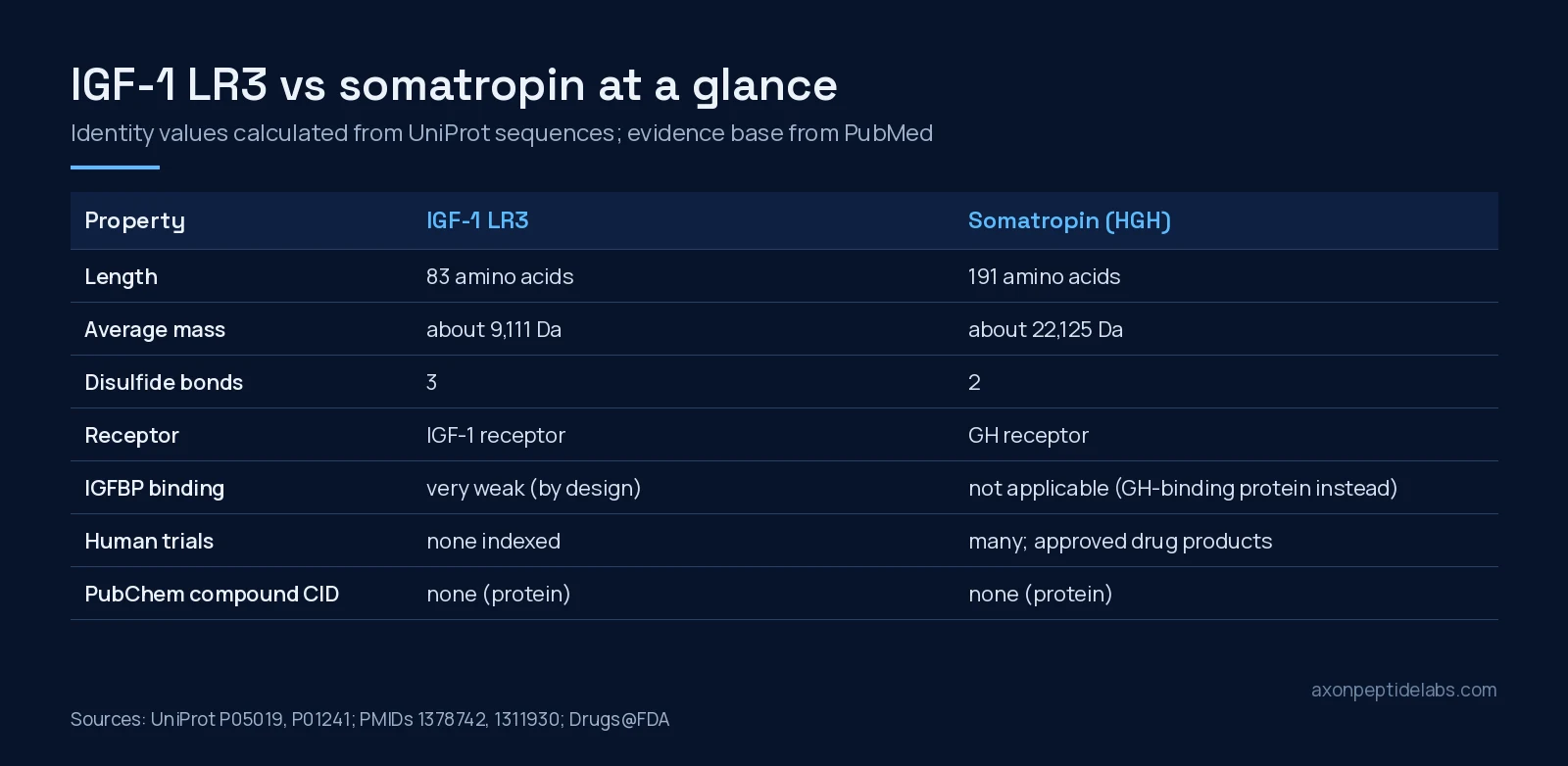
Neither molecule has a PubChem compound record (both are proteins), so the values below are calculated from the UniProt sequences: average masses with disulfides formed, and formulas summed residue by residue.
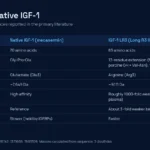
| Property | IGF-1 LR3 | Somatropin (HGH) |
|---|---|---|
| Also called | Long R3 IGF-I, LR3IGF-I, Long [Arg3]-IGF-I | Human growth hormone, somatotropin, recombinant hGH |
| Sequence basis | 13-residue N-terminal extension (Met plus porcine GH residues, then Val-Asn) + human IGF-1 with Glu3→Arg[1] | Mature human GH chain, residues 27–217 of the precursor (UniProt P01241) |
| Length | 83 amino acids | 191 amino acids |
| Formula (calculated) | C400H619N111O115S9 | C990H1528N262O300S7 |
| Average mass (calculated) | about 9,111 Da | about 22,125 Da |
| Disulfide bonds | 3 (from IGF-1) | 2 |
| PubChem CID | None (protein; no compound record) | None for somatropin (protein; PubChem holds substance records only) |
| Receptor | IGF-1 receptor[2] | GH receptor[3] |
For comparison, native IGF-1 calculates to about 7,649 Da (70 residues). The roughly 1,460 Da difference is the 13-residue extension.
What happens in the body: clearance and distribution
Because LR3 barely binds the circulating IGFBPs, it behaves differently in blood. Plasma binding was tested across rat, sheep, pig, human and chicken plasma: native IGF-1 bound most, des(1-3)IGF-I less, LR3 least, and the extent of variant binding differed between species[8]. In rats given radiolabelled tracers into a vein, LR3 was cleared faster than IGF-1; in pregnant rats, whose IGFBP-3 falls late in gestation, IGF-1 clearance sped up towards LR3’s rate[10]. A second tracer study found 37–50% more labelled LR3 than IGF-1 per gram of gut tissue, but the ratio was similar in young and adult rats, so selective gut delivery did not explain why LR3 had stronger gut effects in younger animals[11].
Animal findings for IGF-1 LR3
Almost all of the in vivo work is in rats, with a handful of livestock studies. Animal amounts are omitted here; the cited abstracts give them.
- Normal growing rats. Over 14 days, IGF-1 increased weight gain and nitrogen retention in a dose-dependent way, and LR3 matched the top IGF-1 effect at a much lower amount. In the same study, infused human GH did not stimulate body growth[12].
- Diabetic rats. In streptozotocin-diabetic rats, LR3 and des(1-3)IGF-I were 2.5–3 times more potent than IGF-1 at restoring growth, but none of the IGF peptides reduced glucosuria, unlike insulin[13].
- Dexamethasone-treated rats. IGF-1, and the variants more strongly, improved nitrogen balance and increased gut weight, yet fractional carcass weights stayed low[14]. When the peptides were given as one injection per day instead of continuous infusion, LR3 kept some of its potency advantage, but it was barely equal to IGF-1 at reversing carcass muscle loss[15].
- Gut. Over three days of infusion, LR3 but not IGF-1 increased intestinal weight and crypt proliferation in female rats[17].
- Livestock. In artificially reared piglets, LR3 increased growth and milk intake in freely fed animals but not in limit-fed ones[18]. In neonatal calves, LR3 given parenterally (not orally) lowered plasma glucose and insulin, while bovine GH transiently raised prolactin[19].
A null result worth knowing
The most direct test of the “lean tissue” idea came out negative. In young and adult rats on graded food restriction, a week of LR3 infusion kept body weight and nitrogen retention slightly higher, but muscle protein was not conserved. In adult rats LR3 made things worse, raising protein breakdown and lowering protein synthesis[16]. The authors concluded that LR3 did not reduce lean-tissue loss during short-term food restriction.
Human findings for somatropin (outside approved use)
Somatropin’s labelled uses are a matter for the drug labels and regulators, and this article gives no efficacy figures for them. What the research literature does settle is that claims made outside those uses have not held up. A systematic review of trials in healthy older adults found small changes in body composition and higher rates of soft-tissue oedema, joint pain, carpal tunnel syndrome and gynaecomastia, and concluded GH could not be recommended as an anti-ageing therapy[20]. A review of trials in healthy, athletic adults found lean body mass rose but strength and exercise capacity did not seem to improve, with more oedema and fatigue[21]. A 2017 meta-analysis of placebo-controlled trials in healthy young adults reached the same pattern: body composition changed, muscle strength and maximum oxygen uptake did not[22]. More lean mass on a scan is not the same as more functional muscle.
Side-by-side comparison
| Question | IGF-1 LR3 | Somatropin (HGH) |
|---|---|---|
| Where it acts | IGF-1 receptor, directly[2] | GH receptor, upstream of IGF-1[3][4] |
| Why it is studied | Low IGFBP binding gives more free peptide[1][9] | Native hormone with direct metabolic actions and IGF-1 induction[7][5] |
| Blood clearance | Faster than IGF-1 in rats[10][11] | Not compared head-to-head with LR3 |
| Main evidence models | Rat myoblasts, rats, piglets, calves[12][18][19] | Human trials and systematic reviews[20][22] |
| Notable null results | Did not spare muscle during food restriction; barely matched IGF-1 on muscle loss[16][15] | No strength or aerobic gains in healthy adults[21][22] |
| Glucose findings | Did not reduce glucosuria in diabetic rats[13] | Antagonises insulin action in human studies[7] |
| Regulatory status | Not an approved drug product; a different molecule from both somatropin and mecasermin | Approved prescription biologics listed on Drugs@FDA |
| Axon COA posted | No | No |
Regulatory status, stated plainly
Drugs@FDA lists several somatropin products as approved biologics, including Humatrope, Genotropin, Norditropin and Omnitrope. The approved form of native IGF-1 is a different molecule again: mecasermin (Increlex), which Drugs@FDA lists with an original approval dated August 30, 2005 (BLA 021839). IGF-1 LR3 is neither of these. It is a different molecule from both mecasermin and somatropin. These statements describe regulators’ listings; they say nothing about the status of any research material in any country.
What the evidence does not show
- No human data for IGF-1 LR3. We found no human trial in PubMed. Everything above is cell or animal work, mostly in rats.
- No transfer across species. LR3’s plasma binding varies by species[8], and its whole advantage depends on the binding-protein environment[1]. Rat potency ratios cannot be read as human ones.
- No head-to-head LR3 vs human GH study. The closest are a rat study with a human GH arm[12] and a calf study using bovine GH[19]. Neither compares the two as research tools in the same model on the same endpoints.
- No proof that “more lean mass” means more muscle function. LR3 did not spare muscle under food restriction[16], and GH in healthy adults raised lean mass without raising strength[21][22].
- No long-term safety data for LR3. The animal studies ran for days to a few weeks.
COA status at Axon
No certificate of analysis for IGF-1 LR3 1mg or HGH 20iu is posted on our COA page at the time of writing, so we cannot quote purity, mass confirmation or batch details for either listing. Reports that are posted (testides.com, for products such as ipamorelin and tesamorelin) are listed on that page by product and lot. Related growth-hormone-axis material is grouped under growth hormone peptides, and our tesamorelin GH-axis guide covers the releasing-hormone side of the same axis. To compare documentation across the catalogue before you buy lab-tested peptides in Canada, start with the COA page.
Frequently asked questions
Is IGF-1 LR3 the same thing as HGH?
No. HGH (somatropin) is the 191-amino-acid growth hormone that binds the GH receptor. IGF-1 LR3 is an 83-amino-acid engineered analogue of IGF-1, the hormone that sits downstream of GH, and it binds the IGF-1 receptor instead. They are different proteins with different receptors.
Why is IGF-1 LR3 more potent than native IGF-1 in experiments?
The arginine at position 3 and the 13-residue N-terminal extension make it bind IGF-binding proteins very weakly, so more of it stays free to reach the receptor. Its receptor binding is similar to or slightly lower than native IGF-1, according to the original characterisation papers.
Has IGF-1 LR3 been tested in human clinical trials?
We found no human trial of IGF-1 LR3 indexed in PubMed. The published work is in cell lines, rats, piglets and calves, and its binding to plasma proteins differs between species, so those results do not transfer to people.
Is somatropin an approved drug?
Yes. Drugs@FDA lists several somatropin products (for example Humatrope, Genotropin, Norditropin and Omnitrope) as approved prescription biologics. Approval covers those specific manufactured products for their labelled uses, not research-grade vials.
Does Axon post a COA for IGF-1 LR3 or HGH?
Not at the time of writing. No certificate of analysis for IGF-1 LR3 1mg or HGH 20iu is posted on the Axon COA page, so purity and identity for these two listings cannot be confirmed from a lab report there.
References
- Francis GL, Ross M, Ballard FJ et al. (1992). Novel recombinant fusion protein analogues of insulin-like growth factor (IGF)-I indicate the relative importance of IGF-binding protein and receptor binding for enhanced biological potency. J Mol Endocrinol. PMID: 1378742. doi: 10.1677/jme.0.0080213.
- King R, Wells JR, Krieg P et al. (1992). Production and characterization of recombinant insulin-like growth factor-I (IGF-I) and potent analogues of IGF-I, with Gly or Arg substituted for Glu3, following their expression in Escherichia coli as fusion proteins. J Mol Endocrinol. PMID: 1311930. doi: 10.1677/jme.0.0080029.
- de Vos AM, Ultsch M, Kossiakoff AA (1992). Human growth hormone and extracellular domain of its receptor: crystal structure of the complex. Science. PMID: 1549776. doi: 10.1126/science.1549776.
- Argetsinger LS, Campbell GS, Yang X et al. (1993). Identification of JAK2 as a growth hormone receptor-associated tyrosine kinase. Cell. PMID: 8343952. doi: 10.1016/0092-8674(93)90415-m.
- Carter-Su C, Schwartz J, Argetsinger LS (2016). Growth hormone signaling pathways. Growth Horm IGF Res. PMID: 26421979. doi: 10.1016/j.ghir.2015.09.002.
- Yakar S, Liu JL, Stannard B et al. (1999). Normal growth and development in the absence of hepatic insulin-like growth factor I. Proc Natl Acad Sci U S A. PMID: 10377413. doi: 10.1073/pnas.96.13.7324.
- Møller N, Jørgensen JO (2009). Effects of growth hormone on glucose, lipid, and protein metabolism in human subjects. Endocr Rev. PMID: 19240267. doi: 10.1210/er.2008-0027.
- Lord AP, Bastian SE, Read LC et al. (1994). Differences in the association of insulin-like growth factor-I (IGF-I) and IGF-I variants with rat, sheep, pig, human and chicken plasma-binding proteins. J Endocrinol. PMID: 7514204. doi: 10.1677/joe.0.1400475.
- Devi GR, Graham DL, Oh Y et al. (2001). Effect of IGFBP-3 on IGF- and IGF-analogue-induced insulin-like growth factor-I receptor (IGFIR) signalling. Growth Horm IGF Res. PMID: 11735239. doi: 10.1054/ghir.2001.0231.
- Bastian SE, Walton PE, Wallace JC et al. (1993). Plasma clearance and tissue distribution of labelled insulin-like growth factor-I (IGF-I) and an analogue LR3IGF-I in pregnant rats. J Endocrinol. PMID: 7693845. doi: 10.1677/joe.0.1380327.
- Shoubridge CA, Read LC (2003). Preferential intestinal delivery of long[Arg3] insulin-like growth factor (LR3IGF-I) over IGF-I in preweaning and adult rats. Endocrinology. PMID: 12697696. doi: 10.1210/en.2002-220643.
- Tomas FM, Knowles SE, Chandler CS et al. (1993). Anabolic effects of insulin-like growth factor-I (IGF-I) and an IGF-I variant in normal female rats. J Endocrinol. PMID: 8371075. doi: 10.1677/joe.0.1370413.
- Tomas FM, Knowles SE, Owens PC et al. (1993). Insulin-like growth factor-I and more potent variants restore growth of diabetic rats without inducing all characteristic insulin effects. Biochem J. PMID: 7683875. doi: 10.1042/bj2910781.
- Tomas FM, Knowles SE, Owens PC et al. (1992). Insulin-like growth factor-I (IGF-I) and especially IGF-I variants are anabolic in dexamethasone-treated rats. Biochem J. PMID: 1371669. doi: 10.1042/bj2820091.
- Tomas FM, Lemmey AB, Read LC et al. (1996). Superior potency of infused IGF-I analogues which bind poorly to IGF-binding proteins is maintained when administered by injection. J Endocrinol. PMID: 8708565. doi: 10.1677/joe.0.1500077.
- Tomas FM (2001). Insulin-like growth factor-I (IGF-I) analogue, LR(3)IGF-I, ameliorates the loss of body weight but not of skeletal muscle during food restriction. Growth Horm IGF Res. PMID: 11472075. doi: 10.1054/ghir.2000.0194.
- Steeb CB, Trahair JF, Read LC (1995). Administration of insulin-like growth factor-I (IGF-I) peptides for three days stimulates proliferation of the small intestinal epithelium in rats. Gut. PMID: 8549937. doi: 10.1136/gut.37.5.630.
- Dunshea FR, Chung CS, Owens PC et al. (2002). Insulin-like growth factor-I and analogues increase growth in artificially-reared neonatal pigs. Br J Nutr. PMID: 12067429. doi: 10.1079/BJNBJN2002574.
- Hammon H, Blum JW (1998). Endocrine and metabolic changes in neonatal calves in response to growth hormone and long-R3-insulin-like growth factor-I administration. Biol Neonate. PMID: 9483305. doi: 10.1159/000013968.
- Liu H, Bravata DM, Olkin I et al. (2007). Systematic review: the safety and efficacy of growth hormone in the healthy elderly. Ann Intern Med. PMID: 17227934. doi: 10.7326/0003-4819-146-2-200701160-00005.
- Liu H, Bravata DM, Olkin I et al. (2008). Systematic review: the effects of growth hormone on athletic performance. Ann Intern Med. PMID: 18347346. doi: 10.7326/0003-4819-148-10-200805200-00215.
- Hermansen K, Bengtsen M, Kjær M et al. (2017). Impact of GH administration on athletic performance in healthy young adults: A systematic review and meta-analysis of placebo-controlled trials. Growth Horm IGF Res. PMID: 28514721. doi: 10.1016/j.ghir.2017.05.005.