
Sermorelin vs CJC-1295: Native GHRH Fragment vs Albumin-Binding Analogue
For laboratory research only. Not for human or animal use. This article gives no dosing, administration or therapeutic advice.
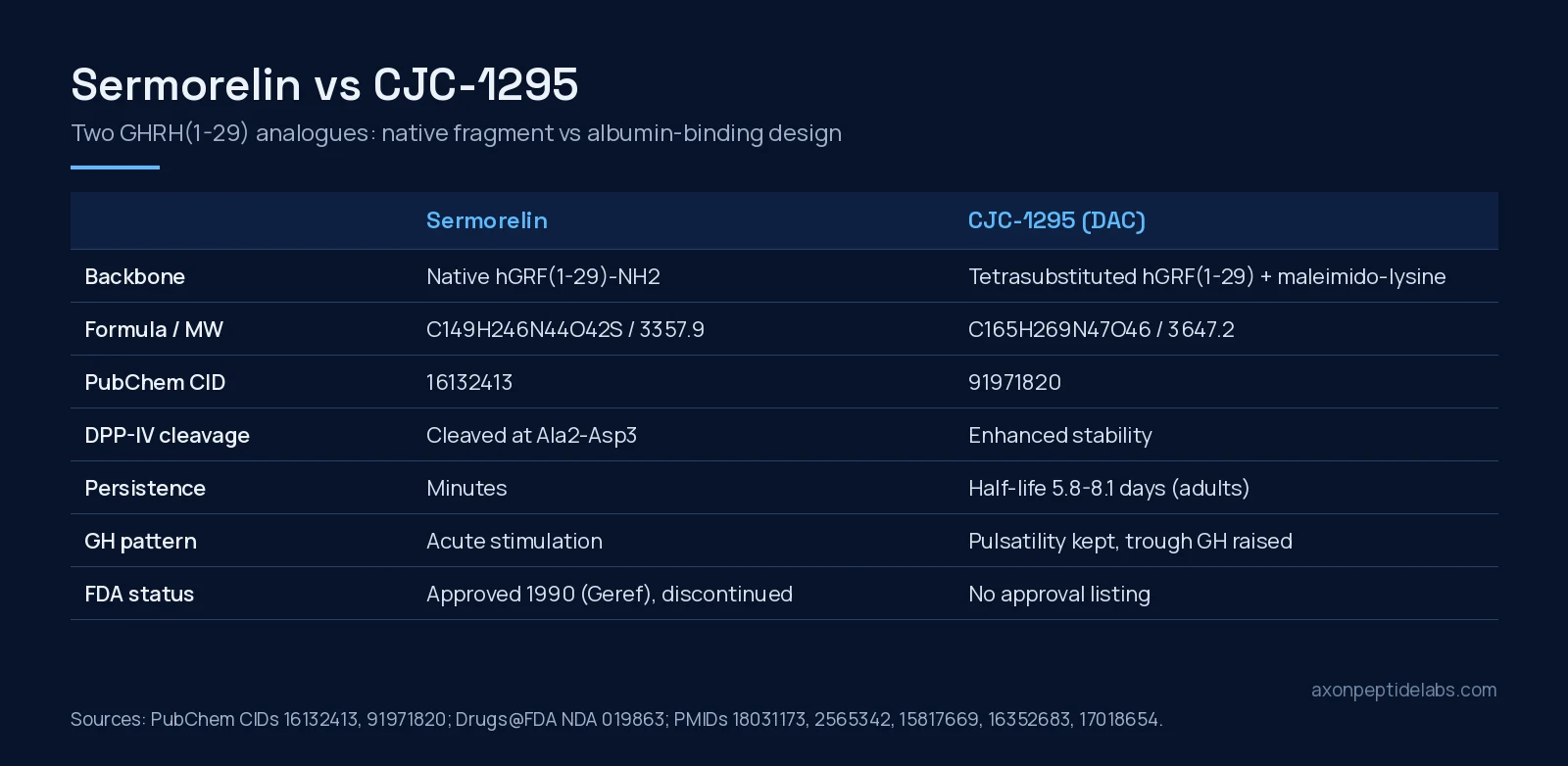
Short answer: sermorelin and CJC-1295 are built on the same 29-residue fragment of growth hormone-releasing hormone, but they solve different problems. Sermorelin is the unmodified fragment, hGRF(1-29)-NH2, described in a 1999 review as the shortest synthetic peptide with the full biological activity of GHRH[1]. Its weakness is speed: plasma dipeptidyl peptidase IV (DPP-IV) cuts GHRH between residues 2 and 3, producing a fragment with less than one-thousandth of the activity[2][3]. CJC-1295 is a tetrasubstituted hGRF(1-29) with a reactive maleimido-lysine added at the C-terminus so it binds serum albumin after injection; in rats it was still present in plasma beyond 72 hours[4], and in healthy adults its estimated half-life was 5.8 to 8.1 days[5]. Sermorelin was an FDA-approved drug (now discontinued); CJC-1295 never reached approval. One naming trap matters for buyers: “CJC-1295” in the literature means the albumin-binding (DAC) molecule, while some suppliers use the name for the non-DAC tetrasubstituted fragment.
From a pancreatic tumour to a 29-residue fragment
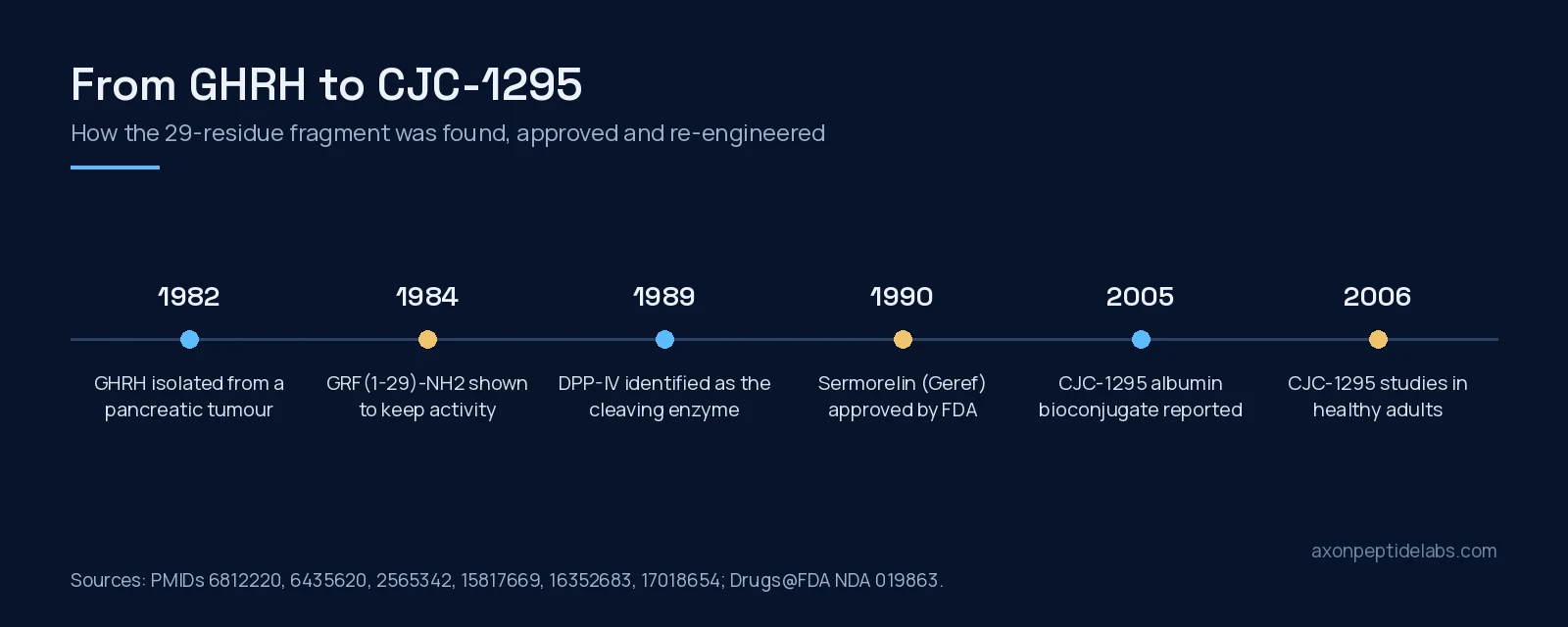
GHRH was first characterised in 1982 from a human pancreatic tumour that had caused acromegaly. The isolated 44-residue peptide was sequenced, and a synthetic copy had full biological activity in vitro and in vivo[6]. Two years later, deletion studies on rat pituitary cells showed that much of the C-terminus is dispensable: hGRF(1-31)-NH2, (1-30)-NH2 and (1-29)-NH2 kept about 50% of the potency of the full hormone, and even shorter fragments retained full intrinsic activity at much lower potency[7]. The (1-29)-NH2 fragment became sermorelin.
Structure-activity scans then mapped which positions could change. Single alanine replacements at positions 8, 9, 15, 22 and 28 (in a Nle27 background) gave analogues two to six times more potent than the full-length standard in vitro, while replacements at positions such as 1, 3, 5, 6, 10, 11, 13, 14 and 23 nearly abolished potency[8]. That map is the design space CJC-1295 was drawn from.
Identity at a glance
| Property | Sermorelin | CJC-1295 (DAC) |
|---|---|---|
| Synonyms | GRF(1-29)-NH2, hGHRH(1-29)-NH2, Groliberin, Geref (former brand) | CJC1295, GRF 1-29 (CJC1295), “with DAC” |
| Backbone | Native human GHRH residues 1-29, amidated | Tetrasubstituted hGRF(1-29) plus C-terminal lysine carrying a maleimidopropionamide group |
| Molecular formula | C149H246N44O42S | C165H269N47O46 |
| Molecular weight | 3357.9 g/mol | 3647.2 g/mol |
| CAS (PubChem synonym) | 86168-78-7 | 446262-90-4 |
| PubChem CID | 16132413 | 91971820 |
| How it lasts longer | It does not; native DPP-IV cleavage site intact | DPP-IV-resistant substitutions plus albumin binding |
| Regulatory history | Drugs@FDA: Geref, NDA 019863, approved December 28, 1990; listed as discontinued | No FDA approval listing found |
Formula, weight and CAS values are from the linked PubChem records. PubChem’s systematic name for CJC-1295 shows D-alanine at position 2, glutamine at position 8 and alanine at position 15 in place of the human residues, consistent with the development paper’s description of a tetrasubstituted hGRF(1-29)[4]. Regulatory details are from the FDA’s Drugs@FDA database.
Why sermorelin is short-lived
The main problem with native GHRH fragments is enzymatic. In human plasma, HPLC showed GHRH(1-44)-NH2 disappearing with a half-time of about 17 minutes, replaced by GHRH(3-44)-NH2, a stable metabolite with less than 10-3 of the parent’s biological activity[2]. The enzyme responsible was identified as DPP-IV: shortened fragments including GRH(1-29)-NH2 were cleaved just as rapidly, cleavage was blocked by the DPP-IV inhibitor diprotin A, and a D-amino acid at position 1 or 2 prevented hydrolysis[3]. Kinetic work with purified enzyme confirmed similar Ala2-Asp3 cleavage rates for the full hormone and for GRF(1-29)-NH2, and showed that peptides with D-configuration at the cleavage positions were not cut[9].
Human infusion data show the same thing. In ten men given constant intravenous infusions, the D-Ala2 analogue of GHRH(1-29)-NH2 had a lower metabolic clearance rate and a longer disappearance half-time (6.7 versus 4.3 minutes) than the native fragment[10]. The 1999 review notes that sermorelin’s hormone responses made it useful as a rapid, relatively specific diagnostic test for growth hormone deficiency[1], a role that suits a short-acting molecule.
How CJC-1295 was engineered to last
Step one: block the enzyme and stabilise the chain
Before CJC-1295, analogue work showed how to protect GRF. In one series, swapping in the mouse residues His1 and Val2 completely inhibited DPP-IV cleavage over 24 hours, and replacing Asn8 with Thr, Ser or Gln reduced the rate of isomerisation and improved aqueous stability in vitro[11]. The Ala15 substitution had already been identified as potency-enhancing in alanine scans[8].
Step two: borrow albumin’s half-life
The decisive change was drug affinity complex (DAC) chemistry. The CJC-1295 team attached reactive maleimido groups to hGRF(1-29) derivatives so they would bond covalently to the free thiol at Cys34 of serum albumin. All three conjugates tested were more stable against DPP-IV and bioactive in rat pituitary cells; the best, CJC-1295, was detected in rat plasma beyond 72 hours, and a CJC-1295 immunoreactive band appeared on serum albumin within 15 minutes and remained beyond 24 hours[4].
Human pharmacology studies
CJC-1295 was tested in two randomised, placebo-controlled, double-blind ascending-dose studies in healthy adults aged 21 to 61, lasting 28 and 49 days, with GH and IGF-I exposure as the main outcomes; the estimated half-life was 5.8 to 8.1 days[5]. A separate study examined the pattern of GH release: during continuous stimulation by CJC-1295, GH pulsatility was preserved, with unchanged pulse frequency and magnitude, while trough GH rose[12]. Serum protein profiling in 11 young men before and one week after CJC-1295 was used to search for new biomarkers of GH and IGF-1 action[13]. These were mechanism and pharmacology studies, not treatment trials, and CJC-1295 did not proceed to approval.
Side-by-side research comparison
| Question | Sermorelin | CJC-1295 (DAC) |
|---|---|---|
| Sequence basis | Native hGRF(1-29)-NH2[1] | Tetrasubstituted hGRF(1-29) plus maleimido-lysine[4] |
| DPP-IV susceptibility | Cleaved at Ala2-Asp3[3][9] | Enhanced stability against DPP-IV[4] |
| Persistence | Minutes (native GHRH fragments)[2][10] | Days; half-life 5.8-8.1 d in adults[5] |
| Effect on GH pattern | Acute stimulation; used as a diagnostic test[1] | Pulsatility preserved, trough GH raised[12] |
| Regulatory history | FDA-approved 1990 (Geref), discontinued | No FDA approval listing |
| Doping detection | Metabolite sermorelin(3-29)-NH2 used as a marker[14] | Covered by GHRH analogue screens[14] |
The naming problem: CJC-1295 with and without DAC
In the peer-reviewed literature, CJC-1295 is the albumin-binding molecule described above[4][5]. In the research-peptide market, the names “CJC-1295 without DAC” and “Mod GRF(1-29)” are commonly used for a tetrasubstituted hGRF(1-29) lacking the maleimido-lysine. That non-DAC fragment would be expected to sit between sermorelin and CJC-1295: more resistant to DPP-IV than sermorelin because of the position-2 substitution[3][10], but without albumin binding. We found no published pharmacokinetic study of the non-DAC fragment under that name, so treat claims about its half-life with caution. Our CJC-1295 DAC vs no-DAC explainer covers this in more depth.
Anti-doping laboratories have had to deal with the same family. A 2021 method synthesised reference materials for several GHRH analogues and used a sermorelin metabolite, sermorelin(3-29)-NH2, to detect GHRH administration in urine by LC-MS/MS[14]. That metabolite is the same Ala2-Asp3 cleavage product the 1980s plasma studies described.
What the evidence does not show
- No head-to-head study. We found no published study comparing sermorelin and CJC-1295 in the same model or population.
- No approval for CJC-1295. Its human data are small pharmacology studies in healthy adults[5][12], and we found no FDA approval listing for it.
- Sermorelin’s clinical history is not current guidance. Its approved product is listed as discontinued on Drugs@FDA, and the 1999 review describes its diagnostic and paediatric use at that time[1].
- Persistence is not the same as activity. Longer half-life changes the GH pattern; with CJC-1295, trough GH rose while pulse frequency and size were unchanged[12]. Whether that difference matters depends on the research question.
- Non-DAC “CJC-1295” lacks its own literature. See the naming section above.
Sourcing for research
Axon stocks Sermorelin 10 mg, CJC-1295 with DAC 2 mg and CJC-1295 10 mg. Check each label and the product page to confirm whether a vial contains the DAC molecule. At the time of writing, no certificate of analysis for sermorelin or either CJC-1295 vial is posted on our COA page (the page lists a CJC-1295 + Ipamorelin blend, which is a different product), so request batch documentation if needed. For more GHRH-axis background, see our sermorelin vs HGH comparison. When you buy lab-tested peptides in Canada for GHRH work, choose sermorelin for short, acute stimulation models and CJC-1295 with DAC for sustained-exposure designs.
Frequently asked questions
What is the difference between sermorelin and CJC-1295?
Sermorelin is native hGRF(1-29)-NH2, the shortest fully active GHRH fragment. CJC-1295 is a tetrasubstituted version of that fragment with a maleimido-lysine that binds serum albumin, which extends its persistence from minutes to days.
Why does sermorelin act so briefly?
Plasma dipeptidyl peptidase IV cleaves GHRH fragments between residues 2 and 3, producing a metabolite with less than one-thousandth of the parent’s activity.
What is the half-life of CJC-1295?
In two randomised, placebo-controlled studies in healthy adults, the estimated half-life of CJC-1295 was 5.8 to 8.1 days.
Was sermorelin ever approved?
Yes. Drugs@FDA lists Geref (sermorelin acetate), NDA 019863, approved December 28, 1990. The product is now listed as discontinued.
Is CJC-1295 without DAC the same molecule?
No. In the literature CJC-1295 is the albumin-binding DAC molecule. Products sold as CJC-1295 without DAC or Mod GRF(1-29) are a tetrasubstituted fragment without albumin binding, with little published pharmacokinetic data under that name.
References
- Prakash A, Goa KL (1999). Sermorelin: a review of its use in the diagnosis and treatment of children with idiopathic growth hormone deficiency. BioDrugs. PMID: 18031173. doi: 10.2165/00063030-199912020-00007.
- Frohman LA, Downs TR, Williams TC et al. (1986). Rapid enzymatic degradation of growth hormone-releasing hormone by plasma in vitro and in vivo to a biologically inactive product cleaved at the NH2 terminus. J Clin Invest. PMID: 3093533. doi: 10.1172/JCI112679.
- Frohman LA, Downs TR, Heimer EP et al. (1989). Dipeptidylpeptidase IV and trypsin-like enzymatic degradation of human growth hormone-releasing hormone in plasma. J Clin Invest. PMID: 2565342. doi: 10.1172/JCI114049.
- Jetté L, Léger R, Thibaudeau K et al. (2005). Human growth hormone-releasing factor (hGRF)1-29-albumin bioconjugates activate the GRF receptor on the anterior pituitary in rats: identification of CJC-1295 as a long-lasting GRF analog. Endocrinology. PMID: 15817669. doi: 10.1210/en.2004-1286.
- Teichman SL, Neale A, Lawrence B et al. (2006). Prolonged stimulation of growth hormone (GH) and insulin-like growth factor I secretion by CJC-1295, a long-acting analog of GH-releasing hormone, in healthy adults. J Clin Endocrinol Metab. PMID: 16352683. doi: 10.1210/jc.2005-1536.
- Guillemin R, Brazeau P, Böhlen P et al. (1982). Growth hormone-releasing factor from a human pancreatic tumor that caused acromegaly. Science. PMID: 6812220. doi: 10.1126/science.6812220.
- Ling N, Baird A, Wehrenberg WB et al. (1984). Synthesis and in vitro bioactivity of C-terminal deleted analogs of human growth hormone-releasing factor. Biochem Biophys Res Commun. PMID: 6435620. doi: 10.1016/0006-291x(84)90309-7.
- Cervini LA, Donaldson CJ, Koerber SC et al. (1998). Human growth hormone-releasing hormone hGHRH(1-29)-NH2: systematic structure-activity relationship studies. J Med Chem. PMID: 9513600. doi: 10.1021/jm970618s.
- Bongers J, Lambros T, Ahmad M et al. (1992). Kinetics of dipeptidyl peptidase IV proteolysis of growth hormone-releasing factor and analogs. Biochim Biophys Acta. PMID: 1353684. doi: 10.1016/0167-4838(92)90317-7.
- Soule S, King JA, Millar RP (1994). Incorporation of D-Ala2 in growth hormone-releasing hormone-(1-29)-NH2 increases the half-life and decreases metabolic clearance in normal men. J Clin Endocrinol Metab. PMID: 7962295. doi: 10.1210/jcem.79.4.7962295.
- Campbell RM, Stricker P, Miller R et al. (1994). Enhanced stability and potency of novel growth hormone-releasing factor (GRF) analogues derived from rodent and human GRF sequences. Peptides. PMID: 7937325. doi: 10.1016/0196-9781(94)90211-9.
- Ionescu M, Frohman LA (2006). Pulsatile secretion of growth hormone (GH) persists during continuous stimulation by CJC-1295, a long-acting GH-releasing hormone analog. J Clin Endocrinol Metab. PMID: 17018654. doi: 10.1210/jc.2006-1702.
- Sackmann-Sala L, Ding J, Frohman LA et al. (2009). Activation of the GH/IGF-1 axis by CJC-1295, a long-acting GHRH analog, results in serum protein profile changes in normal adult subjects. Growth Horm IGF Res. PMID: 19386527. doi: 10.1016/j.ghir.2009.03.001.
- Memdouh S, Gavrilović I, Ng K et al. (2021). Advances in the detection of growth hormone releasing hormone synthetic analogs. Drug Test Anal. PMID: 34665524. doi: 10.1002/dta.3183.