
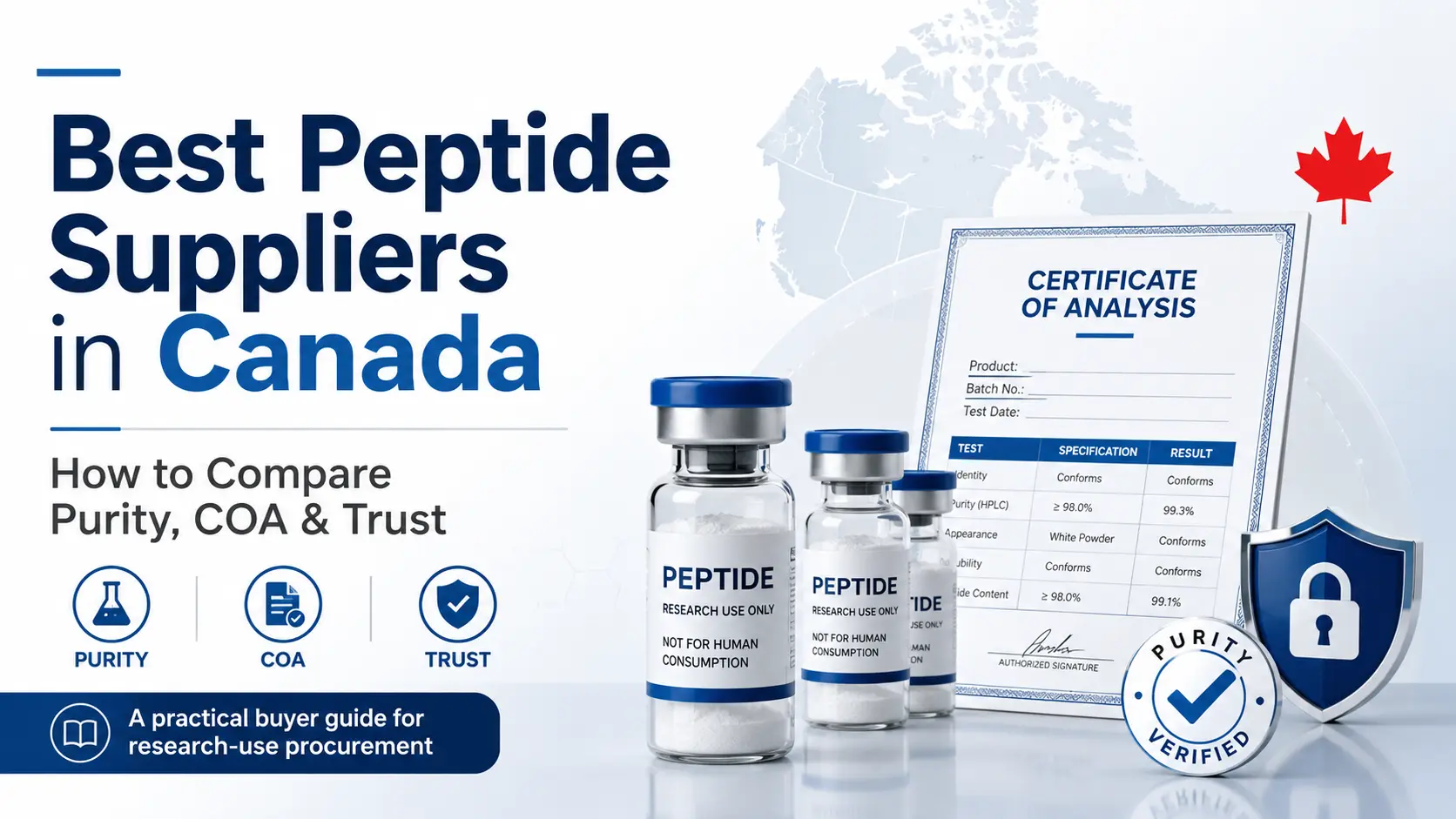
Best Peptide Suppliers in Canada: How to Compare Purity, COA & Trust
Quick answer: The “best” peptide supplier in Canada isn’t a single name — it’s whichever vendor scores highest on the criteria that actually predict quality: verifiable purity, batch-specific COAs, third-party testing, and transparent business practices. This guide gives you the framework to compare any of the best peptide suppliers Canada against those standards.
Search “best peptide supplier” and you’ll get a dozen lists that all disagree. The reason is simple: in a largely unregulated market, “best” is whoever paid for the placement, not whoever ships the cleanest product. A more useful question is how to tell good suppliers from bad ones yourself, so you’re not relying on someone else’s ranking. Here’s how to compare them on the things that matter.
When looking for the best peptide suppliers Canada, ensure they meet essential quality criteria to avoid inferior products.
Finding the Best Peptide Suppliers Canada
There’s no official registry of vetted peptide suppliers in Canada, so the filtering is on you. Start with vendors that ship domestically — that alone removes customs and seizure risk and cuts the field fast. Drop any that won’t show a batch-specific, third-party COA, then compare what’s left on purity proof (a real HPLC chromatogram and mass spec, not just a number) and transparency (real contact details and clear policies).
Skip ranked “top supplier” lists — they’re often paid placements — and treat any vendor making health or treatment claims as a reason to move on. Run each candidate through the same standards and the strongest one tends to surface on its own.
Start with purity — and how it’s proven
Every supplier claims high purity. The difference is whether they can prove it.
A serious vendor backs purity claims with an HPLC (high-performance liquid chromatography) chromatogram showing how much of the sample is the target peptide versus impurities, plus mass spectrometry (MS) confirming the molecule is what the label says. A number on its own — “99% pure!” — means nothing without the graph behind it. When comparing suppliers, rank the ones who show the data above the ones who only state it.
What to compare:
- Is a purity percentage listed (ideally 98%+)?
- Is there an actual chromatogram, not just a figure?
- Is identity confirmed by mass spec, not just purity measured?
Compare COA documentation
A Certificate of Analysis is the document that separates a credible supplier from a confident one. The strongest vendors make batch-specific COAs easy to find — you can review available COA records here as an example of what accessible documentation looks like.
When comparing suppliers, check whether each COA is:
- Batch- or lot-specific, matching the product you’d actually receive — not a generic PDF reused across the catalog
- Recent, with a test date in a reasonable window
- From a named third-party lab, not just the vendor’s own bench
- Accessible, ideally without having to ask
A supplier that publishes batch-matched, third-party COAs is making a verifiable commitment. One that offers vague or missing documentation is asking for trust it hasn’t earned.
Weigh in-house vs. third-party testing
In-house testing is better than no testing, but the vendor has an obvious incentive to pass its own product. Independent third-party verification is the stronger signal, because the lab has no stake in the result. The best suppliers name the lab and let you cross-reference the batch. When two vendors look equal on paper, the one using a named third-party lab wins the comparison.
Assess trust and transparency
Purity and paperwork tell you about the product. Trust signals tell you about the business behind it — and whether it’ll still be there if something goes wrong.
Compare suppliers on:
- Clear research-use labeling — products marked “for research use only,” with no human health or treatment claims. Vendors making therapeutic promises are a warning sign, not a premium option.
- Verifiable contact information — a real address, real support, not just a contact form. A thorough FAQ section is often a good sign a supplier has documented how it operates.
- Transparent policies — a clear shipping policy, returns, and a stated quality or replacement policy
- Consistent product detail — amount, SKU, category, and stock status on every listing
- Canadian shipping — domestic dispatch that avoids customs delays and border-seizure risk
Compare shipping and handling
How a supplier ships affects what actually arrives. Peptides are fragile, so compare:
- Lyophilized (freeze-dried) form, which travels and stores far better than pre-mixed solutions
- Proper, protective packaging that shields the vial from light and damage
- Clear storage and handling instructions included with the order
- Stated handling requirements for each product
A side-by-side comparison framework
Score each supplier you’re considering against the same checklist:
| Criterion | Strong supplier | Weak supplier |
|---|---|---|
| Purity proof | HPLC chromatogram + mass spec | A number, no data |
| COA | Batch-specific, third-party, accessible | Generic, in-house, or absent |
| Testing | Named independent lab | In-house only or unstated |
| Labeling | Clear research-use only | Health or treatment claims |
| Transparency | Real contact, clear policies | Form-only, vague terms |
| Shipping | Lyophilized, domestic, protective | Pre-mixed, international, minimal |
Whichever vendor checks the most boxes on the left is your “best” — and you reached that conclusion with evidence, not someone else’s ranking. When you’re ready to compare products directly, you can browse the full catalog in the shop.
Frequently asked questions
Who is the best peptide supplier in Canada? There’s no single answer — the best supplier for you is whichever one scores highest on verifiable criteria: proven purity, batch-specific third-party COAs, transparent business practices, and proper domestic shipping. Use a fixed checklist to compare them yourself rather than relying on ranked lists.
How do I verify a peptide supplier’s purity claims? Look for an HPLC chromatogram showing purity (ideally 98%+) and mass spectrometry confirming identity. A stated percentage without supporting data isn’t verification.
What makes a COA trustworthy? It should be batch- or lot-specific, recent, issued by a named third-party lab, and ideally accessible without having to request it.
Are research peptides in Canada for human use? No. Reputable suppliers provide them for research and laboratory use only — not for human or animal consumption or therapeutic use — and avoid making health claims.
Why does third-party testing matter more than in-house? An independent lab has no stake in the outcome, so its results are harder to fake or inflate than a vendor testing its own product.
To learn more about how we operate, see the Axon homepage or contact us through our FAQ.