
Selank vs DSIP: Mechanisms, Origins and Evidence Gaps
For laboratory research only. Not for human or animal use. This article gives no dosing, administration or therapeutic advice.
Short answer: Selank and DSIP are both short synthetic peptides studied in neuroscience labs, but they come from opposite ends of the evidence spectrum. Selank is a seven-residue analogue of the immune peptide tuftsin, designed in Russia and studied mainly in anxiety and stress models, where the best-supported mechanisms are allosteric modulation of GABA binding and inhibition of enkephalin-degrading enzymes[1][2]. DSIP (delta sleep-inducing peptide) is a nine-residue peptide isolated in 1977 from rabbit cerebral venous blood during electrically induced sleep[3]. Nearly fifty years later, no gene, precursor protein or receptor for it has been confirmed, and a 2006 review called the case for DSIP as a sleep factor “extremely poorly documented and still weak”[4]. If your research question is about GABAergic or enkephalinase biology, Selank has the more coherent literature. If it is about the history of sleep-factor research or HPA-axis signalling, DSIP is the classic, still unresolved, reference compound.
Two peptides, two origin stories
The comparison is often framed as “calm versus sleep”, which oversimplifies both. The more useful difference is how each peptide was found.
Selank was designed. Its sequence, Thr-Lys-Pro-Arg-Pro-Gly-Pro, is the tetrapeptide tuftsin (TKPR) extended at the C-terminus by Pro-Gly-Pro. Russian groups compared ten tuftsin-family peptides and Selank in rat and mouse stress models and described individual effects that depended on each molecule’s structure and its breakdown fragments[5]. The Pro-Gly-Pro tail is a deliberate stability choice, and the compound’s breakdown has been traced directly (see below).
DSIP was isolated. The Basel group of Schoenenberger and Monnier collected dialysate from the cerebral venous blood of rabbits whose intralaminar thalamus was being electrically stimulated to induce sleep. The active fraction was sequenced as Trp-Ala-Gly-Gly-Asp-Ala-Ser-Gly-Glu and named for the slow-wave (delta) EEG activity it produced after infusion into the brain of other rabbits[6][3]. In the 1977 characterisation, nine synthetic peptides, including five possible metabolic fragments and two analogues, were tested double-blind in 58 rabbits, and only intact synthetic DSIP gave significant, specific enhancement of delta and spindle EEG patterns[3].
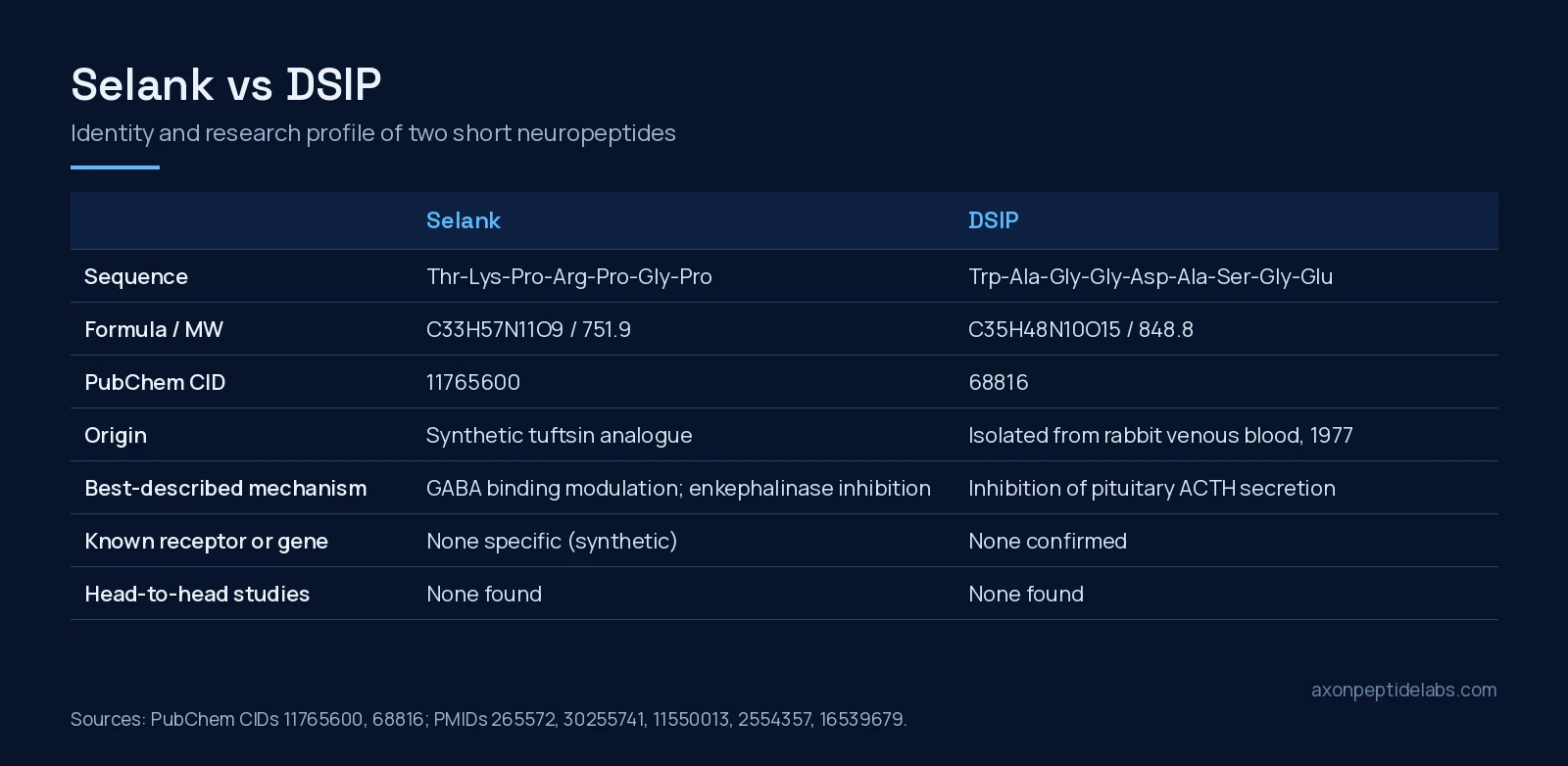
Identity at a glance
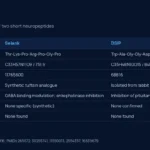
| Property | Selank | DSIP |
|---|---|---|
| Common synonyms | TP-7, Selanc | Emideltide (INN), DSIP nonapeptide |
| Sequence | Thr-Lys-Pro-Arg-Pro-Gly-Pro (TKPRPGP) | Trp-Ala-Gly-Gly-Asp-Ala-Ser-Gly-Glu (WAGGDASGE) |
| Length | 7 residues | 9 residues |
| Molecular formula | C33H57N11O9 | C35H48N10O15 |
| Molecular weight | 751.9 g/mol | 848.8 g/mol |
| CAS (PubChem synonym) | 129954-34-3 | 62568-57-4 |
| PubChem CID | 11765600 | 68816 |
| Origin | Synthetic tuftsin analogue | Isolated from rabbit cerebral venous blood (1977) |
Identity values are taken from the PubChem compound records linked above. Note how different the two sequences are: Selank is basic and proline-rich, while DSIP is acidic, glycine-rich and carries an N-terminal tryptophan. They share no sequence motif and no known receptor.
Selank: what the mechanism papers report
GABA receptor modulation
In radioligand binding work on isolated brain-cell membranes, Selank behaved as a positive allosteric modulator of [3H]GABA binding. Combined with benzodiazepines, its effect on binding was not additive and differed from either compound alone, and Selank blocked the modulatory activity of diazepam and olanzapine; the authors concluded the binding sites are not the same but may partly overlap[1]. Gene-expression work in rat frontal cortex pointed the same way: of 84 neurotransmission genes measured, 45 changed one hour after Selank or GABA administration and 22 after three hours, with positively correlated changes between the two compounds[7].
Enkephalinase inhibition
The older line of research concerns enkephalin breakdown. Selank inhibited enzymatic hydrolysis of plasma enkephalin in a concentration-dependent way (IC50 15 micromolar) and was more potent than the peptidase inhibitors bacitracin and puromycin[2]. In mice, the effect depended on strain: Selank increased plasma leu-enkephalin half-life and produced an anxiolytic-like open-field response in BALB/c mice but changed neither behaviour nor enkephalinase activity in C57Bl/6 mice[8]. That strain dependence is a useful reminder that animal model choice can decide the result.
Interaction with benzodiazepines in a stress model
In rats exposed to unpredictable chronic mild stress and tested in the elevated plus maze, Selank given alone was most effective at reducing anxiety indicators raised by a course of injections, while the diazepam plus Selank combination performed best under chronic stress[9].
Immune signalling
Because Selank is a tuftsin analogue, immune effects were also examined. A single injection of Selank or two of its fragments changed expression of 34 of 84 inflammation-related genes in mouse spleen at 6 and 24 hours, with Bcl6 responding to each peptide[10].
DSIP: what the literature reports
Sleep EEG, then doubt
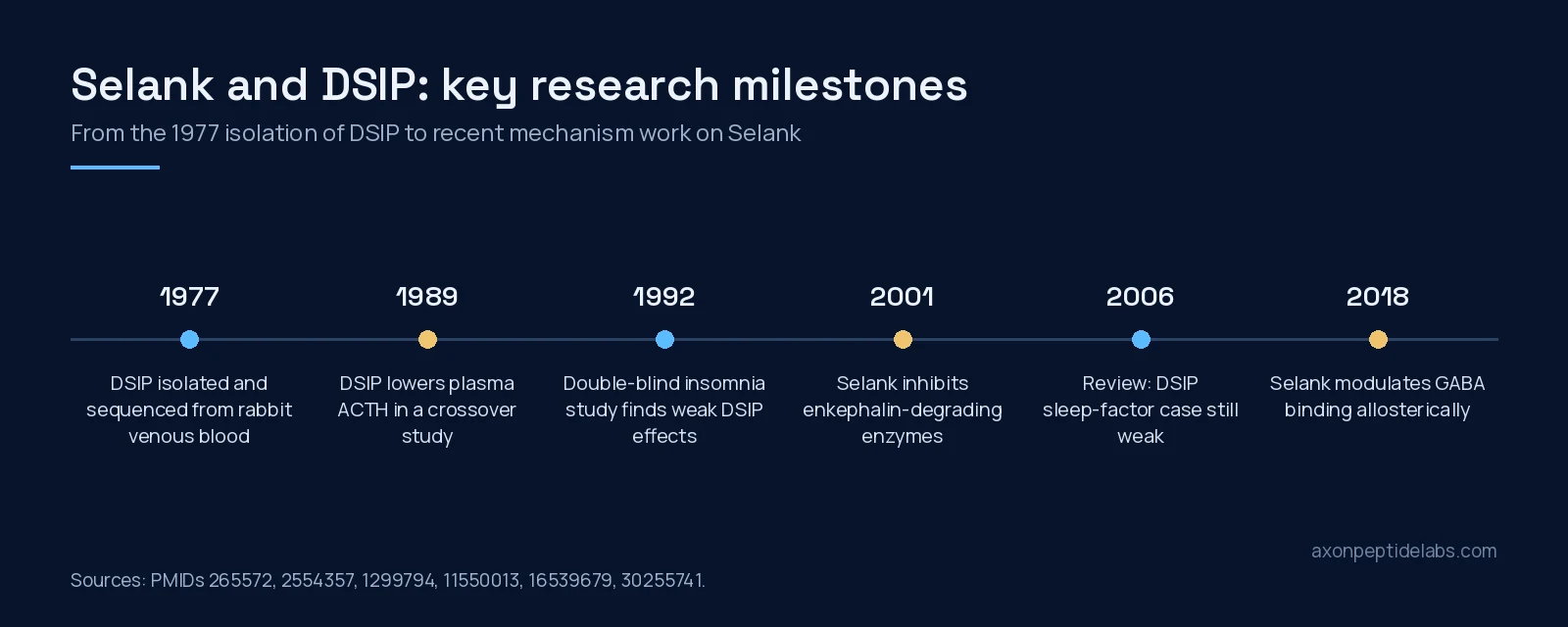
The founding rabbit experiments are clear about one thing: infused into the brain, synthetic DSIP enhanced delta and spindle EEG activity under double-blind conditions[3][6]. What followed was much less clear. The 2006 review in the Journal of Neurochemistry notes that the link between DSIP and sleep was never characterised further, partly because no DSIP gene, protein or receptor had been isolated. The reviewers also report that, in their own early rabbit and rat studies, certain artificial DSIP analogues showed significant slow-wave-sleep promoting activity but DSIP itself did not[4].
Small clinical studies that disagree
DSIP reached small human sleep-laboratory studies in the 1980s and early 1990s, and their conclusions conflict. A placebo-controlled study in 14 middle-aged people with chronic insomnia reported improved night sleep and daytime performance[11]. A later double-blind, matched-pairs study in 16 people with chronic insomnia found some statistically significant differences in sleep efficiency and latency, but the authors judged them weak, possibly due in part to an incidental change in the placebo group, and concluded that short-term DSIP was not likely to be of major therapeutic benefit[12]. Neither study is large enough to settle the question.
HPA-axis signalling
The most reproducible human-physiology finding concerns stress hormones. In a randomised, double-blind crossover study in 11 healthy men, plasma ACTH-like immunoreactivity fell for at least three hours after DSIP compared with saline, while plasma cortisol followed its normal decline[13]. A second study in 8 healthy men found that DSIP did not change circulating arginine-vasopressin, either at rest or in response to osmotic and orthostatic stimuli, and described DSIP as a known inhibitor of pituitary ACTH secretion[14].
Where does DSIP come from?
The missing-precursor problem has produced its own research line. A database analysis found that JMJD1B-type JmjC-domain histone demethylases contain the sequence WKGGNASGE, which differs from DSIP at only two positions, and proposed these proteins as putative precursors[15]. The 2006 review instead suggests that a structurally related DSIP-like peptide may account for DSIP-like immunoreactivity and activity[4]. Both remain hypotheses.
Side-by-side research comparison
| Question | Selank | DSIP |
|---|---|---|
| Best-described mechanism | Allosteric modulation of GABA binding; enkephalinase inhibition[1][2] | Inhibition of pituitary ACTH secretion[13][14] |
| Known receptor | None specific; acts on GABA binding allosterically[1] | None identified[4] |
| Known gene or precursor | Not applicable (synthetic) | None confirmed; JMJD1B-type proteins proposed[15] |
| Main animal models | Rat and mouse stress and anxiety models[5][9] | Rabbit intraventricular EEG studies[3] |
| Degradation data | Plasma breakdown products traced with tritium labelling[16] | Fragments tested in the 1977 study were inactive[3] |
| Main open question | Independent, non-Russian replication | Whether it is a physiological sleep factor at all[4] |
Stability and breakdown
For anyone handling these peptides in a lab, breakdown matters. Using evenly tritium-labelled Selank, researchers tracked its degradation in blood plasma and identified the pentapeptide TKPRP, the tripeptide TKP and the dipeptides RP and GP as the major products[16]. Because some of these fragments are themselves bioactive in the tuftsin family, Selank studies have to consider the fragments as well as the parent peptide[5]. For DSIP, the founding study synthesised five plausible metabolic fragments and found that none reproduced the EEG effect of the intact nonapeptide[3].
What the evidence does not show
- No head-to-head studies. We found no published study that tests Selank against DSIP in the same model. Any “better for” claim comparing them goes beyond the literature.
- No established DSIP biology. Without a confirmed gene, precursor or receptor, DSIP’s natural role remains, in the 2006 reviewers’ words, obscure[4].
- Limited independent replication for Selank. Most Selank papers come from a small number of Russian groups. A 2021 US review of GABAergic sedative-hypnotics described Selank as a poorly studied Russian drug sold to US consumers as a dietary supplement[17].
- Small, conflicting human data. The Selank clinical papers are small comparisons with benzodiazepines published in Russian[18][19], and the DSIP sleep studies enrolled 14 and 16 people with opposite conclusions[11][12]. None of this establishes safety or benefit, and we found no FDA approval listing for either peptide.
- Combination claims are untested. Selank and DSIP are often marketed together. We found no peer-reviewed study of the two in combination.
Sourcing either peptide for research
Axon stocks both as lyophilised research reagents: Selank 10 mg and DSIP 10 mg. At the time of writing, no certificate of analysis for Selank or DSIP is posted on our COA page, so ask for batch documentation before ordering if your protocol requires it. For related reading, our Semax and Selank overview covers Selank’s sister peptide, and the DSIP vs Epitalon comparison places DSIP beside another pineal-adjacent research peptide. When you are ready to buy lab-tested peptides in Canada, match the compound to the question: the GABA and enkephalinase literature for Selank, the HPA-axis and sleep-factor literature for DSIP.
Frequently asked questions
What is the main difference between Selank and DSIP?
Selank is a designed seven-residue tuftsin analogue studied mainly for GABA binding modulation and enkephalinase inhibition. DSIP is a nine-residue peptide isolated from rabbit blood in 1977 whose gene, precursor and receptor are still unknown.
Does DSIP have a known receptor?
No. A 2006 review noted that no DSIP gene, protein or receptor had been isolated, which is a main reason its role as a sleep factor remains poorly documented.
How does Selank act on the GABA system?
In radioligand binding studies on brain-cell membranes, Selank acted as a positive allosteric modulator of GABA binding, and it blocked the modulatory activity of diazepam and olanzapine.
What does Selank break down into?
Tritium-labelling studies identified the pentapeptide TKPRP, the tripeptide TKP and the dipeptides RP and GP as the major products of Selank breakdown in blood plasma.
Has Selank been compared with DSIP directly?
We found no published head-to-head study of Selank versus DSIP, and no peer-reviewed study of the two peptides used together.
References
- Vyunova TV, Andreeva L, Shevchenko K et al. (2018). Peptide-based Anxiolytics: The Molecular Aspects of Heptapeptide Selank Biological Activity. Protein Pept Lett. PMID: 30255741. doi: 10.2174/0929866525666180925144642.
- Zozulya AA, Kost NV, Yu Sokolov O et al. (2001). The inhibitory effect of Selank on enkephalin-degrading enzymes as a possible mechanism of its anxiolytic activity. Bull Exp Biol Med. PMID: 11550013. doi: 10.1023/a:1017979514274.
- Schoenenberger GA, Monnier M (1977). Characterization of a delta-electroencephalogram (-sleep)-inducing peptide. Proc Natl Acad Sci U S A. PMID: 265572. doi: 10.1073/pnas.74.3.1282.
- Kovalzon VM, Strekalova TV (2006). Delta sleep-inducing peptide (DSIP): a still unresolved riddle. J Neurochem. PMID: 16539679. doi: 10.1111/j.1471-4159.2006.03693.x.
- Kozlovskaya MM, Kozlovskii II, Val’dman EA et al. (2003). Selank and short peptides of the tuftsin family in the regulation of adaptive behavior in stress. Neurosci Behav Physiol. PMID: 14969422. doi: 10.1023/a:1025988519919.
- Schoenenberger GA, Maier PF, Tobler HJ et al. (1978). The delta EEG (sleep)-inducing peptide (DSIP). XI. Amino-acid analysis, sequence, synthesis and activity of the nonapeptide. Pflugers Arch. PMID: 568769. doi: 10.1007/BF00581575.
- Volkova A, Shadrina M, Kolomin T et al. (2016). Selank Administration Affects the Expression of Some Genes Involved in GABAergic Neurotransmission. Front Pharmacol. PMID: 26924987. doi: 10.3389/fphar.2016.00031.
- Sokolov OY, Meshavkin VK, Kost NV et al. (2002). Effects of Selank on behavioral reactions and activities of plasma enkephalin-degrading enzymes in mice with different phenotypes of emotional and stress reactions. Bull Exp Biol Med. PMID: 12432865. doi: 10.1023/a:1015582302311.
- Kasian A, Kolomin T, Andreeva L et al. (2017). Peptide Selank Enhances the Effect of Diazepam in Reducing Anxiety in Unpredictable Chronic Mild Stress Conditions in Rats. Behav Neurol. PMID: 28280289. doi: 10.1155/2017/5091027.
- Kolomin T, Shadrina M, Andreeva L et al. (2011). Expression of inflammation-related genes in mouse spleen under tuftsin analog Selank. Regul Pept. PMID: 21609736. doi: 10.1016/j.regpep.2011.05.001.
- Schneider-Helmert D (1987). Effects of delta-sleep-inducing peptide on 24-hour sleep-wake behaviour in severe chronic insomnia. Eur Neurol. PMID: 3622582. doi: 10.1159/000116143.
- Bes F, Hofman W, Schuur J et al. (1992). Effects of delta sleep-inducing peptide on sleep of chronic insomniac patients. A double-blind study. Neuropsychobiology. PMID: 1299794. doi: 10.1159/000118919.
- Bjartell A, Ekman R, Bergquist S et al. (1989). Reduction of immunoreactive ACTH in plasma following intravenous injection of delta sleep-inducing peptide in man. Psychoneuroendocrinology. PMID: 2554357. doi: 10.1016/0306-4530(89)90004-8.
- Chiodera P, Volpi R, Capretti L et al. (1994). Different effects of delta-sleep-inducing peptide on arginine-vasopressin and ACTH secretion in normal men. Horm Res. PMID: 7698722. doi: 10.1159/000184207.
- Mikhaleva II, Prudchenko IA, Ivanov VT et al. (2011). JmjC-domain-containing histone demethylases of the JMJD1B type as putative precursors of endogenous DSIP. Peptides. PMID: 21262293. doi: 10.1016/j.peptides.2011.01.006.
- Zolotarev IuA, Dadaian AK, Dolotov OV et al. (2006). [Evenly tritium-labeled peptides and their in vivo and in vitro biodegradation]. Bioorg Khim. PMID: 16637290.
- Doyno CR, White CM (2021). Sedative-Hypnotic Agents That Impact Gamma-Aminobutyric Acid Receptors: Focus on Flunitrazepam, Gamma-Hydroxybutyric Acid, Phenibut, and Selank. J Clin Pharmacol. PMID: 34396551. doi: 10.1002/jcph.1922.
- Zozulia AA, Neznamov GG, Siuniakov TS et al. (2008). [Efficacy and possible mechanisms of action of a new peptide anxiolytic selank in the therapy of generalized anxiety disorders and neurasthenia]. Zh Nevrol Psikhiatr Im S S Korsakova. PMID: 18454096.
- Medvedev VE, Tereshchenko ON, Israelian AIu et al. (2014). [A comparison of the anxiolytic effect and tolerability of selank and phenazepam in the treatment of anxiety disorders]. Zh Nevrol Psikhiatr Im S S Korsakova. PMID: 25176261.