
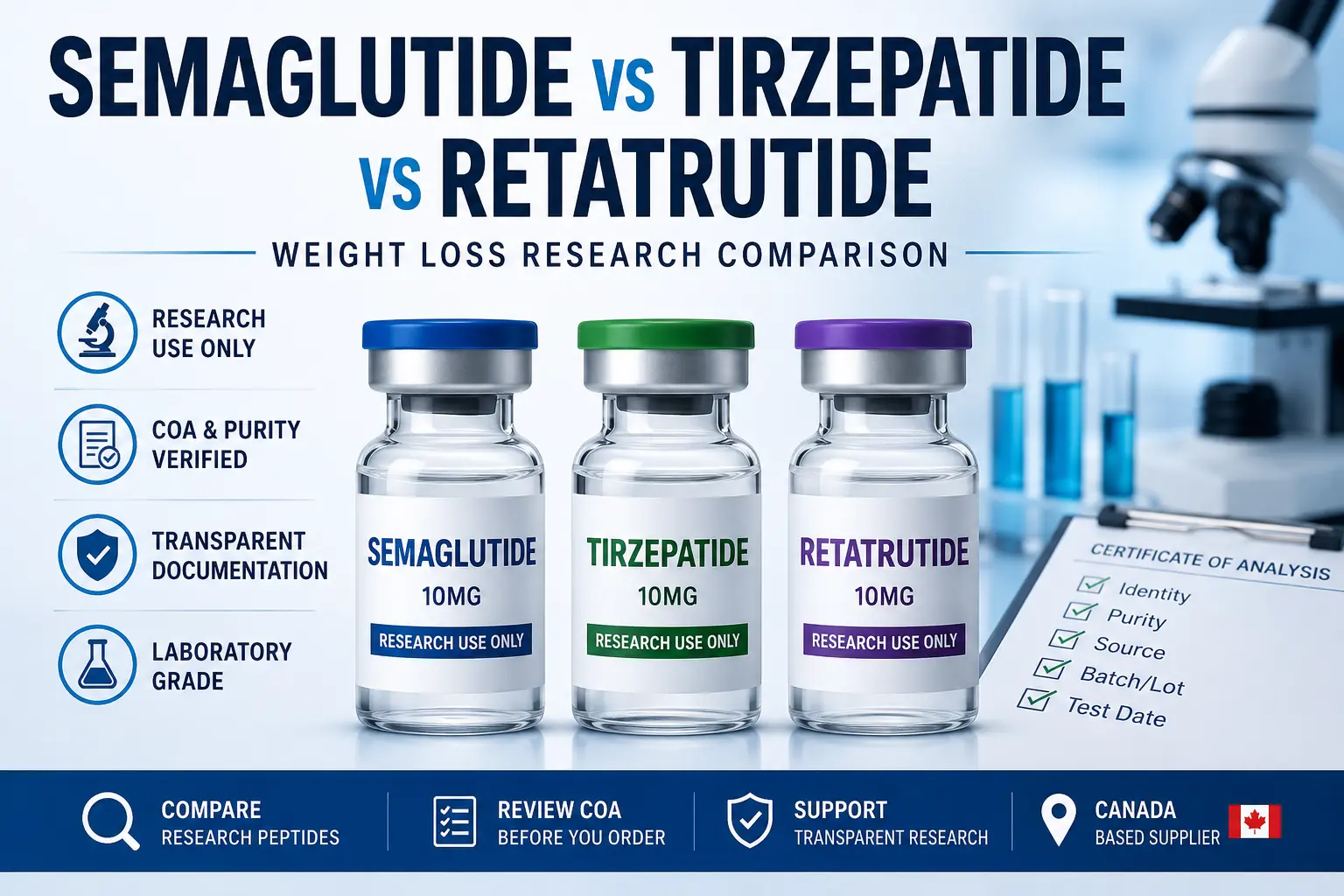
Semaglutide vs Tirzepatide vs Retatrutide: Metabolic Research Comparison
Semaglutide, Tirzepatide, and Retatrutide are often compared in metabolic research because all three are connected to incretin and metabolic pathway studies. Semaglutide is commonly discussed in GLP-1 receptor research, Tirzepatide is discussed in GIP and GLP-1 receptor research, and Retatrutide is described in published literature as involving GIP, GLP-1, and glucagon receptor activity. This article compares Semaglutide vs Tirzepatide vs Retatrutide as research materials.
Quick Comparison
| Product | Research Profile | Common Research context |
|---|---|---|
| Semaglutide | GLP-1 receptor pathway research | Metabolic research |
| Tirzepatide | GIP and GLP-1 receptor pathway research | Incretin and metabolic research |
| Retatrutide | GIP, GLP-1, and glucagon receptor pathway research | Triple-agonist metabolic research |
The main difference between Semaglutide, Tirzepatide, and Retatrutide is their receptor-pathway research profile. This is why they are often compared in articles about GLP-1 research, incretin research, and metabolic research peptides.
Why These Products Are Compared
Semaglutide, Tirzepatide, and Retatrutide appear in the same broad research conversation because they are all studied in relation to body-weight and metabolic outcomes. However, they are not the same compound, and they should not be described as interchangeable.
Semaglutide is generally discussed as a GLP-1 receptor agonist. Tirzepatide is discussed as a dual GIP and GLP-1 receptor agonist. Retatrutide is discussed as a triple hormone receptor agonist involving GIP, GLP-1, and glucagon receptor activity.
Semaglutide Research Overview
Semaglutide is one of the most recognized compounds in GLP-1 and metabolic research. It is commonly discussed in relation to GLP-1 receptor pathways and metabolic research.
When reviewing a Semaglutide product page, buyers should focus on Product identity, amount, SKU, COA availability, Purity details, and research-use labeling. Axon lists it for research use only.
Important details to review include:
| Buyer Check | What to Review |
|---|---|
| Product identity | Confirm the listed product is Semaglutide |
| Amount options | Check the available product size or variation |
| SKU | Review product tracking details where listed |
| COA | Look for available Certificate of Analysis information |
| Purity | Review purity details where published |
| Compliance | Confirm research-use only language is clear |
Semaglutide may be compared with Tirzepatide and Retatrutide because all three are discussed in metabolic research. Axon lists it for research use and laboratory procurement only.
Tirzepatide Research Overview
Tirzepatide is often compared with Semaglutide because it is discussed as a dual GIP and GLP-1 receptor agonist. This dual receptor-pathway research profile is one reason Tirzepatide is commonly included in incretin and metabolic research comparison articles.
For Canadian buyers reviewing Tirzepatide research products, the most important points are documentation and transparency. A useful product page should clearly show the product name, amount, SKU, COA access where available, purity details, and research-use positioning.
Axon lists Tirzepatide for research use only. This article covers its place in metabolic and incretin pathway research and does not give use instructions.
Retatrutide Research Overview
Retatrutide receives strong search interest because published research describes it as a triple hormone receptor agonist involving GIP, GLP-1, and glucagon receptor activity. This makes it different from Semaglutide and Tirzepatide in research comparison content.
Semaglutide is commonly associated with GLP-1 research. Tirzepatide is commonly associated with GIP and GLP-1 research. Retatrutide is discussed in relation to GIP, GLP-1, and glucagon receptor research.
Retatrutide is discussed in metabolic and triple-agonist research. Axon lists it for laboratory research use only, not for human use.
Buyers reviewing Retatrutide should check:
| Buyer Check | Retatrutide Page Detail |
|---|---|
| Research context | GIP, GLP-1, and glucagon receptor discussion |
| COA review | Available purity and batch details where published |
| Product identity | Clear product title, amount, and SKU |
| Related products | Semaglutide, Tirzepatide, Mazdutide, and Cagrilintide |
| Compliance | Research-use only, no dosing or personal-use framing |
Semaglutide vs Tirzepatide vs Retatrutide: Main Differences
The simplest way to compare Semaglutide, Tirzepatide, and Retatrutide is by their research pathway profile.
| Comparison Point | Semaglutide | Tirzepatide | Retatrutide |
|---|---|---|---|
| Main research pathway | GLP-1 | GIP + GLP-1 | GIP + GLP-1 + glucagon |
| Research category | GLP-1 research | Dual incretin research | Triple-agonist research |
| Common search intent | GLP-1 metabolic research | Semaglutide alternative research | Next-generation metabolic research |
| Documentation to review | COA, purity, batch details | COA, purity, batch details | COA, purity, batch details |
| Product-use language | Research-use only | Research-use only | Research-use only |
This comparison helps buyers understand why the three products appear together in search results. It should not be used as medical guidance or personal-use advice.
Which One Is Most Advanced in Research Context?
Retatrutide is often described as a next-generation research compound because it is discussed as a triple hormone receptor agonist. Tirzepatide is commonly positioned as a dual incretin research compound, while Semaglutide is widely recognized in GLP-1 research.
However, “advanced” does not automatically mean better for every research purpose. Buyers should compare each product based on the research topic, product identity, available documentation, COA access, purity details, and related category pages.
For research procurement, the most useful question is not simply which product is most popular. The better question is whether the product page provides clear, transparent, and verifiable information.
What Buyers Should Check Before Ordering
Before ordering Semaglutide, Tirzepatide, or Retatrutide for research procurement, buyers should review the product page carefully.
Important checks include:
| Buyer Check | Why It Matters |
|---|---|
| Product name | Confirms the correct compound |
| Amount options | Helps compare product variations |
| SKU | Supports product tracking |
| COA availability | Helps review documentation |
| Purity value | Provides a quality-review point where published |
| Batch or lot details | Supports batch-level review where available |
| Research-use language | Confirms the product is not positioned for personal use |
| Related products | Helps compare nearby research categories |
A transparent product page should make it easy to understand what the product is, what documentation is available, and what claims the page does not make.
How to Review COA and Purity Details
A COA, or Certificate of Analysis, is one of the most important documents to review when comparing research-use products. Where available, a COA may include product identity, batch or lot number, purity value, test date, testing method, lab/source information, and other quality-related details.
Buyers should look beyond general phrases such as “high quality” or “premium purity.” Instead, they should review the specific details behind those claims.
Useful COA fields may include:
Product name
Batch or lot number
Purity percentage
Test date
Testing method where listed
Lab or source information
Matching product details
If COA information is missing, unclear, or difficult to match with the product page, buyers should contact support before ordering.
Why Research-Use Language Matters
Semaglutide, Tirzepatide, and Retatrutide are sold by Axon for research use only. This article covers metabolic research and receptor-pathway context, not personal use.
Good research-use wording includes:
Metabolic research
Metabolic research
GLP-1 research
GIP and GLP-1 research
Triple-agonist research
Research-use only
Laboratory use only
COA review
Purity details
Batch information
Avoid wording that suggests the product is intended for human use, animal use, diagnosis, treatment, disease prevention, or personal results.
Related things to know
Buyers comparing Semaglutide, Tirzepatide, and Retatrutide may also review related incretin and metabolic research things.
Recommended related pages include:
FAQ
What is the difference between Semaglutide, Tirzepatide, and Retatrutide?
The main difference is their receptor-pathway research profile. Semaglutide is commonly discussed in GLP-1 receptor research, Tirzepatide is discussed in GIP and GLP-1 receptor research, and Retatrutide is discussed in GIP, GLP-1, and glucagon receptor research.
Is Retatrutide the same as Tirzepatide?
No. Tirzepatide is commonly discussed as a dual GIP and GLP-1 receptor agonist, while Retatrutide is described in published research as a triple hormone receptor agonist involving GIP, GLP-1, and glucagon receptor activity.
Why is Retatrutide compared with Semaglutide and Tirzepatide?
Retatrutide is compared with Semaglutide and Tirzepatide because all three appear in metabolic research discussions. Retatrutide receives additional attention because of its triple-receptor research profile.
Is this article about personal use?
No. It compares the three compounds as research materials in metabolic and receptor-pathway research. Axon sells them for laboratory research use only.
What should buyers compare before ordering?
Buyers should compare product identity, amount options, SKU, COA availability, purity details, batch information where available, research-use labeling, and related product pages.
Are Semaglutide, Tirzepatide, and Retatrutide for human use?
No. On a research-use product website, these products should be reviewed for laboratory and research use only. They are not intended for human or animal consumption, diagnosis, treatment, disease prevention, therapeutic use, or personal use.